 30°C
30°C

How Dominican Republic Microclimates Differ From Coast to Mountains
The Dominican Republic climate varies significantly across relatively short distances, with warm coastal areas giving way to cooler mountain environments and wetter or drier zones shaped by elevation, terrain and prevailing weather patterns. These microclimates help explain why conditions in one part of the country can differ noticeably from those in another, even on the same day.


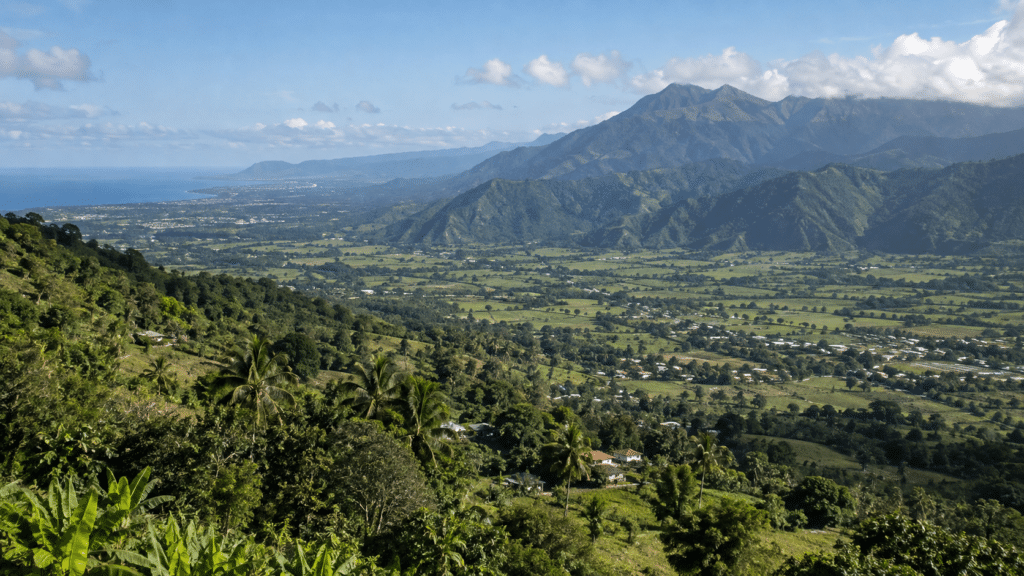
The Dominican Republic climate is shaped by more than its Caribbean location. Elevation, mountain ranges, exposure to winds and the distribution of rainfall create distinct local conditions across the country. As a result, temperatures and precipitation can change noticeably between coastal communities, inland valleys and high mountain areas.
Why the Dominican Republic Has So Many Microclimates
Microclimates develop when local geography modifies the broader regional climate. In the Dominican Republic, the most important influence is elevation. Temperatures generally become lower as altitude increases, while mountain terrain can also affect cloud formation, rainfall and wind patterns.
The country’s major mountain systems, including the Cordillera Central, help divide weather patterns across different parts of the island. Official meteorological reports regularly distinguish mountain areas from coastal and lowland regions when describing temperature and rainfall conditions.
Coastal Areas Tend to Stay Warmer
Much of the Dominican Republic’s population and tourism activity is concentrated near the coast, where elevations are relatively low and temperatures are generally warmer than in the interior mountains. Coastal conditions are also influenced by the surrounding Caribbean Sea and Atlantic Ocean, which moderate daily temperature changes.
This does not mean that all coastal areas have identical weather. The northern, eastern, southern and southwestern coasts can receive different amounts of rainfall depending on their exposure to prevailing winds and nearby terrain.
Mountain Areas Can Be Significantly Cooler
The contrast becomes clearer in elevated areas. The Cordillera Central contains some of the country’s highest terrain, and temperatures there can be substantially lower than in nearby lowlands. INDOMET has documented mountain conditions in which minimum temperatures fall to levels rarely experienced along the coast.
Highland locations such as Constanza can therefore feel very different from coastal destinations. In meteorological reports, temperatures recorded at Constanza and other elevated stations can be considerably lower than readings from warmer lowland locations during the same period.
Rainfall Also Changes From Region to Region
Temperature is only one part of the Dominican Republic climate. Rainfall varies considerably because mountains force moist air upward, encouraging cloud development and precipitation on exposed slopes. This creates wetter areas on some mountain-facing sides while other regions can remain comparatively dry.
INDOMET’s climatological reports show substantial differences in precipitation between regions and individual monitoring stations. The northern side of the Cordillera Central, for example, can experience periods of increased rainfall while parts of the south and southwest follow a markedly drier seasonal pattern.
Why Conditions Can Change Over Short Distances
A journey from the coast toward the interior can cross several climate zones without covering a particularly large geographic distance. The main reasons are changes in elevation, exposure to moisture-bearing winds and the presence of mountain barriers.
For travelers, this means that a weather forecast for a coastal destination should not automatically be applied to a mountain excursion. Conditions can become cooler and cloudier as elevation increases, while rainfall may also become more likely in areas exposed to moist air.
Seasonal Weather Patterns Add Another Layer
Seasonal atmospheric patterns can temporarily strengthen differences between regions. During the frontal season, which generally extends from November into March, cold fronts moving into the Caribbean can bring cooler temperatures and increased rainfall to northern and mountainous parts of the Dominican Republic.
INDOMET reports that these frontal systems particularly affect the northern, northeastern and northwestern regions as well as the Cordillera Central. Mountain areas can consequently experience cooler conditions at times when temperatures remain comparatively mild elsewhere in the country.
The result is a country where climate cannot be accurately described using a single temperature range or rainfall pattern. The coast, interior valleys and highlands each respond differently to the same broad weather system.