 24°C

Faro a Colón: History, Architecture and How to Visit
Rising above Santo Domingo Este, the Faro a Colón is one of the Dominican Republic's most distinctive monuments. Built in the shape of a monumental cross and inaugurated in 1992, it combines a memorial to Christopher Columbus, a mausoleum, and a museum with international exhibitions. Its location also makes it possible to combine the visit with Los Tres Ojos National Park, Parque Mirador del Este and other attractions on the eastern side of the capital.


What Is Faro a Colón?
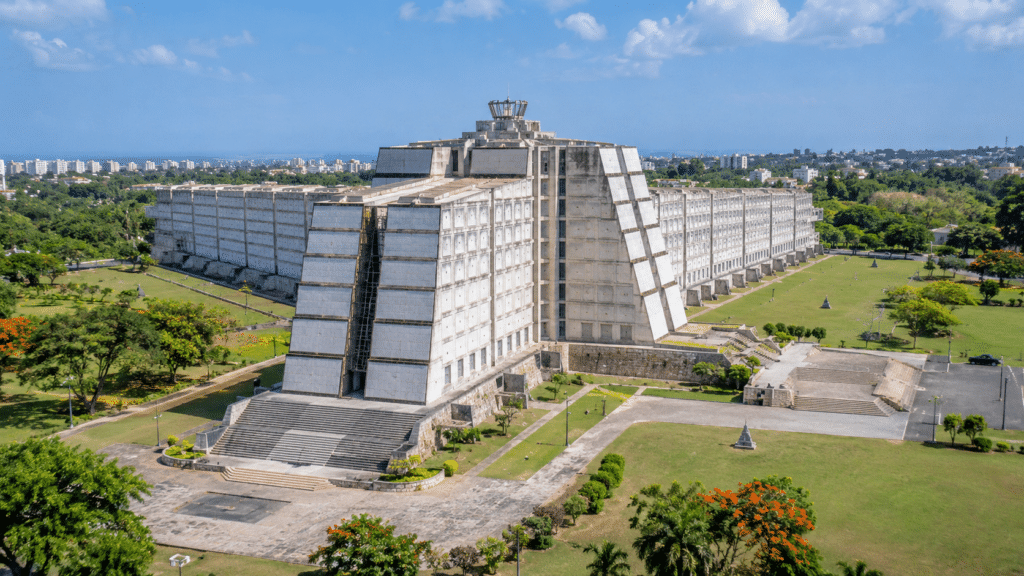
Faro a Colón, known in English as the Columbus Lighthouse, is a monumental museum and memorial dedicated to Christopher Columbus. It stands in Santo Domingo Este, on the eastern side of the Ozama River, within the wider Parque Mirador del Este area.
Unlike a conventional lighthouse, the building does not primarily serve as a maritime navigation facility. Its name comes from the lighting system incorporated into its design, which can project a large cross of light into the night sky. The monument was conceived as a tribute to Columbus and the European arrival in the Americas, while its museum spaces present historical and cultural exhibitions from different countries.
The building also contains an elaborate mausoleum traditionally identified by Dominican authorities as the resting place of Columbus. This combination of architecture, historical interpretation and memorial function makes the Faro a Colón one of the most unusual cultural attractions in the capital.
The History of Faro a Colón
An Idea That Took More Than a Century to Become Reality
The origins of the monument date back to 1852, when Dominican historian Antonio Delmonte y Tejada proposed building a memorial to Christopher Columbus in Santo Domingo. The idea gradually developed into an international project intended to recognize the historical connection between the Americas and Europe.
In 1923, the Fifth International Conference of American States, held in Santiago, Chile, supported the idea of constructing the monument through cooperation among the countries of the Americas. An international architectural competition followed. The process attracted 455 designs from 48 countries, and the winning proposal was submitted by British architect Joseph Lea Gleave.
Construction began in 1948, but the project was interrupted after its initial phase and remained unfinished for decades. Work resumed in 1986 under the government of President Joaquín Balaguer, with Dominican architect Teófilo Carbonell involved in adapting and completing the design.
The monument was completed in 1992, the year marking the 500th anniversary of Columbus’s first voyage to the Americas. It was inaugurated on October 6, 1992, during the commemorations associated with the quincentenary.
Why the Monument Was Built
The original concept was to create a monument that would honor Columbus and commemorate the arrival of Europeans in the Americas. Its religious symbolism reflects the historical interpretation of the event promoted by the project, particularly the spread of Christianity across the continent.
The monument also had an international dimension. The participation of architects from dozens of countries and the idea of cooperation among American nations were central to its original conception. The museum exhibitions inside the building continue that international theme by presenting cultural material from countries in the Americas and other regions.
Faro a Colón Architecture: A Monumental Cross
The most striking feature of Faro a Colón is its enormous cross-shaped design. Seen from above, the building forms a Latin cross laid horizontally across the ground. Its long east-west axis and shorter north-south arms create a distinctive geometric composition that is visible from the surrounding urban area.
According to the monument’s official museum description, the structure measures approximately 239 meters along its main axis, has arms extending around 60 meters from north to south, and reaches approximately 31 meters in height. It is built primarily from reinforced concrete, with marble incorporated into parts of the monument and its interior features.
The design combines modern monumental architecture with religious and historical symbolism. Its stepped massing and broad surfaces also evoke forms associated with pre-Columbian monumental architecture, including the stepped appearance of Mesoamerican pyramids. The result is a building that does not resemble a traditional lighthouse, church or conventional museum.
The Cross of Light
The lighting system is responsible for the monument’s name and one of its most recognizable features. A series of powerful lights installed along the structure can project a large cross-shaped beam into the night sky. The museum describes the projected light as visible from distances of up to 64 kilometers under suitable conditions.
The illumination is not something visitors should assume will operate every evening. It is associated with special occasions and depends on the operation of the lighting system. Travelers hoping to see the illuminated cross should check for an official announcement rather than plan their visit around an unconfirmed display.
The International Flags at the Entrance
The entrance area features the flags of countries from the Americas. They reinforce the international character of the original project and represent the cultural and national connections that the monument was intended to commemorate.
The large open setting around the building also makes it possible to appreciate its scale from outside before entering the museum. The exterior is an important part of the visit, particularly for travelers interested in architecture and monumental structures.
What to See Inside Faro a Colón
The interior is organized around a long central circulation area, with exhibition spaces and other rooms arranged along the building’s arms. The museum’s collections cover different aspects of history and culture, with contributions and exhibitions associated with countries in the Americas, Europe and Asia.
The Columbus Mausoleum
The mausoleum is the monument’s central memorial feature. It contains an elaborate funerary structure made of bronze and Carrara marble, originally created for the Cathedral of Santo Domingo in the 19th century. The mausoleum was transferred to Faro a Colón in the early 1990s, with its components moved and reassembled inside the new monument.
The Gothic-style structure is approximately nine meters high and consists of around 280 pieces. Its architectural details include columns, arches, sculptural elements and four bronze lions. A female figure representing the Dominican Republic forms part of the composition.
The mausoleum is traditionally presented by the Dominican institution as the resting place of Christopher Columbus. However, the location of the navigator’s remains has long been disputed between the Dominican Republic and Spain. The remains preserved in Seville Cathedral were authenticated by researchers from the University of Granada in 2024 through genetic analysis. Dominican authorities continue to maintain that Columbus’s remains are in Santo Domingo. Visitors should therefore understand the mausoleum’s significance as part of an unresolved historical dispute rather than assume that the identification is universally accepted.
International Cultural Exhibitions
One of the museum’s distinctive features is its collection of exhibitions associated with different countries. The official museum description refers to displays from more than 40 countries, presenting aspects of their cultural identity through objects, artwork, models and historical collections.
The range of material varies between exhibition spaces. Visitors may encounter traditional objects, artistic works, historical representations and items connected with the cultural relationships between Europe and the Americas. The displays give the building a broader international focus than a museum devoted exclusively to Columbus or Dominican history.
Underwater Archaeology and Maritime Heritage
The monument also houses a collection dedicated to underwater archaeological discoveries. The Museo de Rescate Arqueológico Submarino presents objects recovered from shipwrecks found along the Dominican coast, including material associated with Spanish, French and Dutch vessels from the 17th to the 20th centuries.
The official museum description identifies approximately 2,400 recovered objects in this collection. These finds provide a connection with the maritime history of the Caribbean, where shipping routes, colonial trade and naval activity left archaeological remains beneath the sea.
Religious and Cultural Spaces
Other spaces within the monument include the Santa María de la Rábida chapel, galleries displaying religious images associated with different countries in the Americas, and a room connected with the Vatican. These areas reflect the religious themes that shaped the original concept of the Faro a Colón.
The building also includes spaces intended for temporary exhibitions and conferences. The official museum description lists four temporary exhibition rooms and two conference rooms, although the exhibitions and rooms available to visitors may vary.
What Is the Cultural Significance of Faro a Colón?
Faro a Colón occupies a particular place in the Dominican Republic’s cultural landscape because it brings together architecture, national memory and an international interpretation of the colonial past.
For the Dominican Republic, the monument represents an official memorial to Columbus and the historical events that connected Hispaniola with Europe. Its museum collections also provide a setting for presenting the cultural identities of other countries and the wider history of the Americas.
At the same time, the monument’s symbolism reflects a specific historical perspective. The arrival of Europeans in 1492 initiated colonization, religious conversion, profound demographic changes and the destruction and transformation of Indigenous societies. Understanding the Faro a Colón therefore also means recognizing that the history it commemorates is viewed differently across the Americas and Europe.
Its location in Santo Domingo Este gives it an additional role in the cultural geography of the capital. While the Colonial City preserves many of the country’s earliest European-era buildings, Faro a Colón represents a much more recent effort to commemorate that broader historical period through monumental architecture.
How to Visit Faro a Colón
Location
Faro a Colón is located on Avenida Mirador del Este in Santo Domingo Este, east of the Ozama River. It is part of the wider Parque Mirador del Este area and is relatively close to Los Tres Ojos National Park.
The location is separate from the Colonial City, which lies on the opposite side of the river. Visitors staying in the historic center should therefore plan a short road journey rather than expect to reach the monument as part of an ordinary walking tour of the colonial streets.
Opening Hours
Published opening hours differ between official tourism and museum listings. The Dominican Republic’s official tourism website lists the museum as open Tuesday through Sunday from 9:00 a.m. to 5:00 p.m., while the MUSEOSRD institutional listing gives a schedule of 10:00 a.m. to 6:00 p.m. Both indicate that the museum is closed on Mondays.
Because these schedules are not consistent, visitors should confirm the opening time and last admission directly before traveling. The official tourism listing provides the contact number +1 809-591-4844.
Admission and Guided Visits
Admission prices can change, and the available official listings do not provide a consistently confirmed current tariff. It is advisable to check the price before arrival, particularly for international visitors, children and students.
The museum’s institutional information describes guided visits for Dominican and international visitors, including groups, with guides available in different languages. It identifies this service as free, although visitors should confirm its availability and whether advance arrangements are necessary.
How Long Should You Allow?
The time required depends on how much of the museum is open and how closely you want to examine the exhibitions. A visit focused on the main interior spaces and mausoleum can take around an hour, while visitors who want to explore the different displays and the exterior at a slower pace should allow additional time.
If you are combining the monument with Los Tres Ojos, it is sensible to reserve a substantial part of the morning or afternoon for both attractions rather than trying to fit them into a very short stop.
How to Get to Faro a Colón from Santo Domingo
By Taxi or Ride-Hailing Service
For most international visitors, taking a taxi or using a ride-hailing service is the most straightforward way to reach the monument. From the Colonial City, the journey involves crossing the Ozama River and continuing into Santo Domingo Este.
Travel time depends on traffic, the bridge used and the starting point. It is worth arranging the return journey in advance if you are visiting during a quieter period or plan to continue to another attraction in the eastern part of the city.
By Car
Visitors with a rental car can drive toward Avenida Mirador del Este and follow the signs for Faro a Colón. The monument is a prominent landmark, but it is useful to enter the museum’s name into a navigation app to reach the appropriate access point.
Allow extra time for traffic when crossing between the central districts and Santo Domingo Este. Check parking arrangements when you arrive and avoid leaving valuables visible inside the vehicle.
By Public Transportation
Public transportation serves Santo Domingo Este, but reaching the monument may involve more than one stage of a journey. Routes and service arrangements can change, and the final approach may require a walk or a separate local ride.
For travelers unfamiliar with the city, a taxi or ride-hailing service is generally easier than attempting to navigate several connections. Visitors who prefer public transportation should check current routes and stops before setting out.
Combining Faro a Colón with Los Tres Ojos and Other Attractions
One of the advantages of visiting Faro a Colón is its location in an area of Santo Domingo Este with several other attractions. The monument and nearby natural sites can be combined into a half-day itinerary, while the National Aquarium and the eastern waterfront offer additional options for a longer outing.
Los Tres Ojos National Park
Parque Nacional Los Tres Ojos is the most natural companion to a visit to Faro a Colón. Located nearby in Santo Domingo Este, the protected site features a limestone cave system containing freshwater lagoons surrounded by rock formations and vegetation.
The name means “The Three Eyes” and refers to the three main lagoons visible within the underground cave environment. A fourth lagoon, known as Los Zaramagullones, is reached by a small wooden boat or raft crossing and opens into a more exposed natural setting.
The park offers a very different experience from the Faro a Colón. The lighthouse is an enormous architectural and historical monument, while Los Tres Ojos is a natural attraction involving caves, water and walking paths. Visiting both provides a varied introduction to this part of the capital.
Visitors should be prepared for stairs, uneven surfaces and humid conditions inside the caves. Comfortable footwear is advisable, and people with limited mobility should consider the physical demands of the route before visiting.
Parque Mirador del Este
Parque Mirador del Este, also commonly called Parque del Este, is a large urban green and recreational area surrounding the monument. It includes outdoor spaces and sports facilities and provides a broader setting for understanding the eastern side of Santo Domingo.

It can be included as a short outdoor stop before or after visiting the Faro a Colón. However, the park is extensive, so visitors should identify the specific area they want to see rather than assume that every facility is immediately beside the monument’s entrance.
National Aquarium
The Acuario Nacional, or National Aquarium, is another attraction in Santo Domingo Este. Located along Avenida España near the Caribbean waterfront, it focuses on marine life and educational displays about aquatic environments.
It is particularly relevant for families and visitors interested in marine biodiversity. Its location is farther along the coastal side of Santo Domingo Este, so it is better treated as an additional stop in a longer itinerary rather than an attraction immediately next to the lighthouse.
Avenida España Waterfront
The waterfront along Avenida España offers a different way to experience Santo Domingo Este. The coastal road and nearby public spaces provide views toward the Caribbean and can be used for a short drive or walk after visiting the aquarium.
It is a useful addition for travelers who want to extend their visit beyond museums and natural attractions without returning immediately to the Colonial City.
A Suggested Half-Day Itinerary in Santo Domingo Este
A practical way to organize the area is to begin with the attraction that requires the most attention and then continue to the nearby sites.
Option 1: History and Nature
Start at Faro a Colón and allow time to see the architecture, mausoleum and museum exhibitions. Continue to Los Tres Ojos National Park to explore the caves and lagoons. If time allows, finish with a short visit to Parque Mirador del Este.
This combination is particularly suitable for visitors interested in history, architecture and natural landscapes. It also avoids trying to fit too many different attractions into one outing.
Option 2: A Longer Family Outing
Begin at Faro a Colón, continue to Los Tres Ojos and then travel toward the National Aquarium. The aquarium provides an educational activity that can be particularly appealing to families with children. Depending on the time available, finish with a stop along Avenida España.
Check the opening schedules of all three attractions before leaving, since their operating hours are not necessarily identical. If one site is closed, the order of the itinerary may need to change.
Frequently Asked Questions About Faro a Colón
Where is Faro a Colón located?
Faro a Colón is in Santo Domingo Este, on the eastern side of the Ozama River, along Avenida Mirador del Este. It is located in the Parque Mirador del Este area, relatively close to Los Tres Ojos National Park.
When was Faro a Colón inaugurated?
The monument was inaugurated on October 6, 1992, during the commemorations marking 500 years since Christopher Columbus’s first voyage to the Americas. Construction had begun decades earlier and resumed in 1986 after a long interruption.
Who designed Faro a Colón?
The winning design in the international architectural competition was submitted by British architect Joseph Lea Gleave. Dominican architect Teófilo Carbonell later participated in adapting and completing the project.
Are Christopher Columbus’s remains inside Faro a Colón?
The Dominican museum identifies the mausoleum inside Faro a Colón as the resting place of Christopher Columbus. However, Spain’s Seville Cathedral also holds remains identified as belonging to Columbus. Researchers from the University of Granada authenticated the remains in Seville through genetic analysis in 2024, while Dominican authorities continue to maintain their own historical position.
Can visitors see the illuminated cross at night?
The monument has a lighting system capable of projecting a large cross into the night sky, but visitors should not assume it will be illuminated every evening. Check for official announcements if seeing the light display is an important part of your plans.
Is Faro a Colón close to Los Tres Ojos?
Yes. Both attractions are in Santo Domingo Este and are close enough to combine in the same outing. Los Tres Ojos is a natural cave and lagoon system, while Faro a Colón is a historical monument and museum.
Is Faro a Colón worth visiting?
It is particularly relevant for travelers interested in monumental architecture, Dominican history, Columbus-related heritage and international cultural exhibitions. Its unusual design and mausoleum make it different from the museums and colonial buildings found in the historic center. Visitors mainly interested in interactive exhibitions or highly modern museum displays should keep in mind that the experience is centered on a large historic memorial and its collections.
Faro a Colón as Part of a Visit to Santo Domingo
Faro a Colón offers a different perspective on Santo Domingo from the one found in the Colonial City. Its monumental cross-shaped architecture, international exhibitions and mausoleum reflect a major effort to commemorate Columbus and the historical connections between the Americas and Europe.
The monument is also a useful starting point for exploring Santo Domingo Este. Combining it with Los Tres Ojos National Park creates a varied visit that brings together architecture, history and nature, while the National Aquarium and Avenida España provide additional options for travelers with more time.
For visitors who want to explore more of the Dominican capital, Faro a Colón is just one of many attractions worth discovering. From historic landmarks and museums to scenic waterfront areas and natural attractions, there are plenty of things to do in Santo Domingo that make the city an interesting destination to explore.