 24°C
24°C

Dominican Republic Shipwrecks: The Treasure Beneath the Sea
The waters around the Dominican Republic conceal a remarkable maritime archive: colonial galleons, cargoes of mercury and silver, religious objects, personal belongings, and possible remains connected to the earliest European settlements in the Americas. Some wrecks have been located and studied, while others remain uncertain or only partially identified. Among the most remarkable are the 1724 Nuestra Señora de Guadalupe and San José, the famous 1641 Nuestra Señora de la Concepción on the Silver Bank north of Hispaniola, and the still-investigated wreck sites around La Isabela. Recent UNESCO-supported research has shown that the story is far from finished.


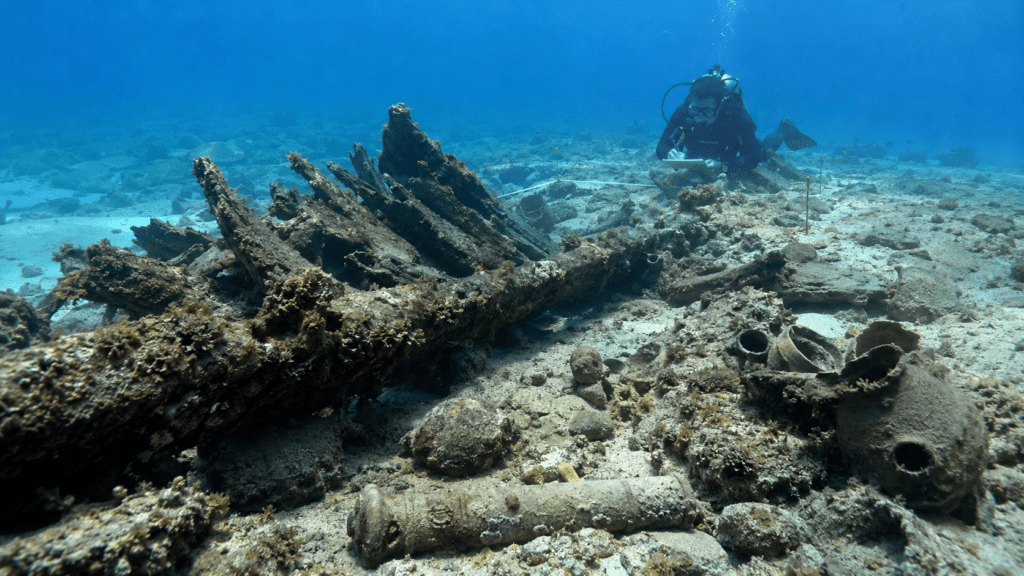
For centuries, ships approaching Hispaniola faced reefs, hurricanes, strong currents and unfamiliar coastal waters. Some survived the journey. Others disappeared beneath the Caribbean, taking with them cargoes, documents, weapons, personal possessions and human stories that would remain hidden for generations.
That history has created one of the least visible archaeological landscapes in the Dominican Republic. The country’s beaches and colonial cities are familiar to millions of visitors, but much of its maritime past lies underwater.
For treasure hunters, these sites have long represented the possibility of finding gold and silver. For archaeologists, however, the value is much broader. A wreck can preserve evidence about trade routes, navigation, technology, migration, warfare, religion, consumption and everyday life. UNESCO describes underwater cultural heritage as a historical archive whose cargoes can reveal the commodities people traded, the routes they followed and the ports they visited. UNESCO’s underwater cultural heritage program treats these remains as heritage rather than simply as sources of valuable objects.
Why Are There So Many Historic Shipwrecks Around the Dominican Republic?
The explanation begins with geography. Hispaniola occupies a strategic position in the Caribbean, between routes linking Spain, Cuba, Puerto Rico, Mexico, South America and other islands. During the Spanish colonial period, ships traveling between Europe and the Americas repeatedly passed near the island.
Those routes were also exposed to some of the Caribbean’s most dangerous maritime conditions. Hurricanes could rapidly transform relatively calm waters into violent seas. Reefs and shoals posed another danger, particularly to large sailing vessels whose navigation depended heavily on charts, astronomical observations, pilots and local knowledge.
The result was a combination that archaeologists find especially important: intensive maritime traffic passing through a complicated environment over several centuries.
The seabed therefore contains more than isolated wrecks. It can preserve evidence of a much larger commercial and political system. Spanish vessels carried mercury needed to process silver, food and drink, tools, weapons, religious objects, documents and private possessions. Other ships transported colonial products and precious metals toward Europe.
The Forgotten Ships of La Isabela
One of the most intriguing underwater archaeological areas is La Isabela on the northern coast of the Dominican Republic. Founded by Christopher Columbus in January 1493 during his second voyage, La Isabela is generally regarded as the first European settlement established in the Americas intended to be permanent.
The settlement itself is now an important archaeological site. But its nearby bay may contain an even more unusual record of the first years of European maritime activity in the Americas.
Historical records indicate that ships associated with Columbus’s second voyage and with other early expeditions were lost in the area. Indiana University’s Center for Underwater Science notes that the Marigalante, associated with Columbus, and other vessels were documented as having sunk while at anchor during hurricanes outside La Isabela.
That does not mean that every unidentified object on the seabed can be attributed to Columbus. The distinction is important. Archaeologists must establish an identification through evidence rather than through the historical appeal of a name.
For precisely that reason, La Isabela has become an important case study in modern underwater archaeology.
What Researchers Have Actually Found
UNESCO-supported investigations have used geophysical surveys, seafloor profiling and sediment sampling to examine the bay. A 2024 scientific mission identified and documented ten underwater cultural heritage sites in the area.
A second mission, conducted in April 2026 with support from UNESCO, the Dominican authorities, Spain and the Spanish Agency for International Development Cooperation, expanded the investigation. Researchers detected more than 40 underwater anomalies whose archaeological significance still requires verification.
This distinction matters because an anomaly is not automatically a shipwreck. It may represent natural geological material, modern debris or archaeological remains. The next stage is therefore direct archaeological verification.
The work demonstrates an important principle of underwater archaeology: finding a possible wreck is only the beginning. Researchers must establish its date, origin, function and relationship to the historical landscape.
UNESCO’s research on La Isabela provides a useful example of how modern scientific methods are being applied to the Dominican Republic’s submerged heritage.
The 1724 Disaster at Miches: Guadalupe and Tolosa
Among the best-documented shipwreck stories in the Dominican Republic is the disaster involving the Spanish vessels Nuestra Señora de Guadalupe and San José, better known as the Conde de Tolosa.
The two ships formed part of the Spanish fleet known as the Fleet of Quicksilver, or azogue. Their mission was not simply to transport treasure. They were carrying mercury, an essential material in the processing of silver in the mines of New Spain, in what is now Mexico.
Both vessels left Cádiz in July 1724. The Guadalupe, constructed in 1702, had been specially adapted to carry large quantities of mercury. The Tolosa was larger and carried a substantial mercury cargo as well.
On August 24, 1724, the vessels encountered a violent storm while navigating near Samaná Bay. The disaster occurred off the coast of what is now Miches, on the eastern side of the Dominican Republic.
The Tolosa sank, while the Guadalupe was driven ashore. Historical research indicates that more than 600 people died in the disaster, although the exact circumstances and numbers differ among historical accounts.
The story did not end with the sinking. Survivors from the Guadalupe reached the Dominican coast and had to travel in search of assistance. Their experiences became part of the documentary and archaeological record that later allowed researchers to reconstruct the disaster.
What Was Inside the Guadalupe?
The cargo illustrates why calling these wrecks simply “treasure ships” can be misleading.
The Guadalupe carried mercury from the Almadén mines, iron and nails, wine, spirits, oil and olives, along with personal possessions. Archaeologists have also documented navigational instruments, weapons, ammunition, clothing, coins, watches, religious objects and decorated European glass.
The glass collection is particularly remarkable. Research published by Spain’s National Archaeological Museum describes 364 complete glass pieces from the Guadalupe, in addition to hundreds of fragments. The collection provides unusually detailed evidence about European glass production and consumption in the early eighteenth century.
These objects tell a story that a pile of gold coins could never tell on its own. A wine bottle, a religious object, a navigational instrument or a piece of tableware can reveal how people lived, traveled and interacted with the wider Atlantic economy.
The National Archaeological Museum’s research on the Guadalupe glass collection shows how individual categories of artifacts can become valuable historical evidence.
The Treasure Hunters Who Came Before the Archaeologists
The story of the Guadalupe also reveals how attitudes toward shipwrecks have changed.
The wreck was rediscovered in the twentieth century after cannons were found in the waters off Miches. In 1976, an agreement with the Dominican authorities allowed the American treasure hunter Tracy Bowden to recover artifacts from the site. According to the historical research preserved by the University Pablo de Olavide, 7,499 objects were recovered without modern archaeological methodology.
Later research took a different approach.
Beginning in the 1990s, the Proyecto Galeones de Azogue brought together historians, archaeologists and naval specialists from Spain and the Dominican Republic. Instead of concentrating exclusively on valuable objects, researchers examined the ship, its cargo, archival records and testimony from survivors.
This shift from salvage to archaeology is one of the most important parts of the story. A coin separated from its exact location on a wreck can be interesting. A coin recorded together with its surrounding objects, position and archaeological context can become evidence.
The difference is similar to the difference between finding an old letter and finding the letter inside the desk, alongside the other documents, objects and records that explain who wrote it and why.
The Concepción: One of the Caribbean’s Great Treasure Wrecks
Few shipwreck stories associated with the Dominican Republic have acquired the fame of the Nuestra Señora de la Pura y Limpia Concepción.
The 600-ton Spanish vessel was built in Havana in 1620 and later refitted and armed as a galleon. In 1641, it was part of the New Spain Fleet returning across the Atlantic.
The ship was carrying valuable cargo when it was wrecked on coral reefs north of Hispaniola. The wreck site is generally identified with the Silver Bank, historically known as the Ambrosia Banks or Silver Shoals.
This geographical detail is important. The Concepción is often described in popular accounts as a Dominican Republic shipwreck because the site is north of Hispaniola and has a long historical connection with Dominican maritime heritage. It should not, however, be casually described as a wreck lying on the Dominican mainland coast.
The wreck became famous because it contained precious metals, coins and other valuable cargo. Contemporary salvage attempts and later expeditions transformed the site into one of the legendary treasure wrecks of the Caribbean.
William Phips and the First Great Salvage
The Concepción’s treasure did not remain untouched for centuries.
In the seventeenth century, the English adventurer William Phips organized a major salvage expedition to the wreck. Historical scholarship records the recovery of more than 25 tons of gold and silver, an extraordinary quantity that made the expedition one of the most famous salvage operations of its era.
The recovery also illustrates an often-overlooked part of maritime history: underwater salvage was already an international business long before modern diving equipment existed.
Divers working for Phips operated under extremely difficult conditions. Historical research indicates that enslaved divers from Bermuda, Jamaica and Barbados were among those involved in the salvage effort. Their contribution is an important reminder that the history of Caribbean treasure is also connected to the history of slavery and forced labor.
The Concepción Is Rediscovered
Centuries later, treasure hunters returned to the site. After numerous unsuccessful searches, the wreck was relocated in 1978 by a team led by Burt Webber and Jack Haskins.
The discovery generated a new wave of interest in the Dominican Republic’s maritime heritage and demonstrated how archival research could be combined with modern search technology.
The Nautical Archaeology Digital Library’s record of the Concepción documents the vessel’s history, wrecking and later searches.
The Concepción is therefore more than a story about lost silver. It is a case study in how shipwrecks can remain historically important long after their original cargo has been scattered, salvaged or removed.
What Does “Treasure” Actually Mean?
The word treasure creates a misleading picture of what archaeologists find underwater.
Precious metals are certainly part of the history. Spanish vessels could carry silver coins, gold objects, jewelry and other valuables. But archaeological treasure can also consist of much less glamorous objects.
- Mercury containers can reveal how the Spanish mining economy depended on transatlantic supply networks.
- Glassware can document manufacturing techniques, trade and social habits.
- Coins can provide evidence about monetary circulation and the geographical origins of cargo.
- Weapons can reveal military technology and the defensive requirements of merchant shipping.
- Navigational instruments can help reconstruct how sailors crossed the Atlantic.
- Food containers can reveal what passengers and crews consumed during long voyages.
- Religious objects can provide evidence about beliefs and practices carried across the ocean.
For historians, the greatest value often lies in the relationship between these objects. A shipwreck freezes a particular moment. Its cargo can preserve a snapshot of the society that created, purchased, transported and used those objects.

Why Shipwrecks Are Historical Time Capsules
A shipwreck can preserve information that is difficult to recover from written records.
Official documents might tell historians what a ship was supposed to carry. Archaeological evidence can reveal what was actually aboard.
This distinction can be particularly important in colonial history, when smuggling and undeclared trade were common problems for imperial authorities. Objects recovered from wrecks can sometimes reveal discrepancies between official cargo records and the material evidence.
The archaeological context also matters. If a group of objects remains together, researchers can study how they were distributed across the vessel and how the ship broke apart during the sinking.
That allows archaeologists to investigate questions that go beyond the identity of the ship: where people were located, how cargo was stored, how the vessel broke apart and which objects were carried away by currents after the sinking.
Why Not Simply Bring Everything to the Surface?
Modern underwater archaeology generally favors documentation and preservation over indiscriminate recovery.
Underwater cultural heritage can be destroyed even when valuable objects are successfully removed. Once an artifact is separated from its archaeological context, much of the information surrounding it may be lost.
The 2001 UNESCO Convention on the Protection of the Underwater Cultural Heritage establishes preservation in situ as the preferred option, meaning that cultural heritage should normally remain where it was found when circumstances permit. The Convention also establishes standards for scientific investigation and rejects commercial exploitation of underwater cultural heritage.
The Dominican Republic ratified the convention in 2021.
This represents a significant change from the treasure-hunting model that dominated many earlier shipwreck discoveries. The objective is no longer simply to recover the most valuable objects. It is to understand, document and preserve the historical site.
The UNESCO Convention on the Protection of the Underwater Cultural Heritage explains the principles governing the identification, research and preservation of sites more than 100 years old.
The Dominican Republic’s Underwater Archaeological Heritage
The country has increasingly treated its shipwrecks as part of a national archaeological heritage rather than as isolated sources of artifacts.
The Museo de las Atarazanas Reales in Santo Domingo plays an important role in presenting this history. The museum’s collections include material associated with shipwrecks around the island between the fifteenth and nineteenth centuries.
Research on the Guadalupe demonstrates how artifacts recovered from underwater sites can be preserved, studied and displayed rather than simply disappearing into private collections.
The Dominican Republic’s approach is also increasingly connected to international scientific cooperation. UNESCO missions at La Isabela have brought together Dominican researchers and specialists from international institutions to survey and document the seabed.
This cooperation is especially important because underwater archaeology requires specialized equipment and expertise. Researchers may use geophysical instruments, remote sensing, photogrammetry, sediment sampling and other techniques before entering a site physically.
The result is a form of archaeology in which the absence of a visible shipwreck does not necessarily mean that nothing is there. A buried or scattered site can leave detectable signatures in the seabed.
The Mystery of Columbus’s Lost Ships
Perhaps the most tempting stories involve the ships associated with Christopher Columbus.
La Isabela’s historical importance makes the possibility of locating one of these vessels particularly attractive. Yet archaeology demands restraint.
Researchers have identified underwater anomalies and documented shipwreck remains in the bay, but an anomaly cannot automatically be identified as a vessel belonging to Columbus. The connection must be demonstrated through archaeological, historical and material evidence.
That is why recent research at La Isabela is significant even if it does not produce a spectacular treasure discovery. Establishing what is on the seabed, dating it and understanding its relationship to the settlement can provide information about the earliest phase of European colonial expansion in the Americas.
In April 2026, UNESCO reported that a new geophysical survey identified more than 40 underwater anomalies. Researchers planned subsequent archaeological verification to determine which, if any, correspond to cultural remains from the period under investigation.
The search therefore remains open. The most important discovery may ultimately be a wreck, but it could also be a collection of objects, structural remains or environmental evidence that changes what historians understand about La Isabela.
Other Wrecks and Maritime Sites
The Guadalupe, Tolosa, Concepción and the possible Columbus-era wrecks are only part of a much wider underwater landscape.
The Dominican Republic’s maritime archaeological record extends across different periods and types of vessels. Some sites are associated with military activity, others with commercial shipping, colonial transportation or local maritime traffic.
There are also sites whose identities remain uncertain. This is normal in underwater archaeology. A wreck may survive only as scattered anchors, cannon, ceramics, fasteners, ballast or other objects after its wooden structure disappears.
That uncertainty is not a weakness. It is part of the archaeological problem researchers are trying to solve.
What Happens When a New Shipwreck Is Found?
A responsible archaeological investigation does not begin by removing everything that looks valuable.
Researchers first document the location and assess the site. They may use non-invasive techniques to establish its extent and identify concentrations of material. Historical research can then be compared with the physical evidence.
If excavation or recovery is justified, objects are carefully recorded so that their position and relationship to other materials are preserved in the archaeological record.
Conservation is another major challenge. An artifact that has spent centuries underwater can deteriorate rapidly once exposed to air. Metals, ceramics, glass and especially waterlogged organic materials require different conservation strategies.
This is why underwater archaeology is considerably more complex than simply sending divers to the seabed.
Why the Story Is About More Than Gold
Treasure has made Dominican shipwrecks famous, but gold and silver are only one part of their historical significance.
The wrecks reveal how the Caribbean functioned as a crossroads of the early modern world. Ships carried European manufactured goods, American precious metals, Asian commodities, food, religious objects and industrial materials across enormous distances.
The Guadalupe demonstrates the connection between Caribbean shipping and the silver economy of New Spain. The Concepción illustrates the scale of transatlantic wealth moving through Spanish imperial routes. La Isabela offers a window into the earliest European maritime presence in the Americas.
Together, these sites show that the sea surrounding the Dominican Republic was not a peripheral space. It was part of the infrastructure of an emerging Atlantic world.
Frequently Asked Questions About Dominican Republic Shipwrecks
What is the most famous shipwreck associated with the Dominican Republic?
The Nuestra Señora de la Pura y Limpia Concepción, wrecked in 1641 on the Silver Bank north of Hispaniola, is one of the most famous treasure wrecks associated with the country. The 1724 Nuestra Señora de Guadalupe and Conde de Tolosa are among the best-documented wrecks actually located off the Dominican coast.
Was Columbus’s Santa María found in the Dominican Republic?
No confirmed discovery of the Santa María has been established in the Dominican Republic. UNESCO experts previously rejected a claimed wreck near northern Haiti as Columbus’s flagship, and the identity of the Santa María remains unresolved. The distinction is important because Hispaniola’s waters contain many later wrecks that cannot automatically be linked to Columbus.
Can tourists visit shipwrecks in the Dominican Republic?
Some underwater archaeological sites have been developed for educational or diving purposes, but access to archaeological sites is not equivalent to permission to recover artifacts. Historic wrecks are protected cultural resources, and activities involving archaeological remains may be subject to authorization and conservation rules.
Where did the Guadalupe and Tolosa sink?
The two Spanish vessels were lost during a severe storm in 1724 near Samaná Bay and the coast of present-day Miches. The Tolosa sank, while the Guadalupe was driven ashore.
What was the Guadalupe carrying?
Its cargo included mercury, iron and nails, wine, spirits, oil, olives and personal possessions. Archaeological research has also documented coins, weapons, navigational equipment, religious objects and a significant collection of decorated European glass.
Why was mercury so important?
Mercury, or quicksilver, was essential to the amalgamation process used to extract silver from ore. The cargo of the 1724 Fleet of Quicksilver therefore illustrates how maritime transportation connected European supply centers with the mining economy of Spanish America.
Are there still undiscovered shipwrecks around the Dominican Republic?
Almost certainly. Recent scientific work at La Isabela alone has identified numerous underwater anomalies requiring further investigation. Many historic wrecks have never been located, while others may survive only as scattered or buried archaeological remains.
Can someone legally take coins or artifacts from a historic wreck?
Historic shipwreck material should not be treated as a finders-keepers situation. The Dominican Republic has committed itself to international standards for protecting underwater cultural heritage, and archaeological recovery requires appropriate authorization and scientific management. UNESCO’s framework emphasizes preservation and rejects commercial exploitation of underwater cultural heritage.
What Makes the Dominican Republic’s Shipwrecks So Important?
The most interesting thing about these wrecks is not that they contain objects that can be sold. It is that they preserve evidence that can no longer be recovered from ordinary historical documents.
A cannon can reveal military technology. A glass cup can illuminate trade and consumption. A coin can identify an economic network. A navigational instrument can show how sailors crossed the Atlantic. Even an apparently ordinary piece of cargo can help reconstruct the lives of people who traveled across the ocean centuries ago.
The wrecks also remind us that the history of the Dominican Republic did not happen only on land. Long before modern ports and tourism transformed the coastline, ships were arriving, departing, trading, fighting and sometimes disappearing in the same waters.
That is why the seabed around Hispaniola should be understood as an extension of the country’s historical landscape. Some of its most revealing chapters are not preserved in churches, forts or archives, but beneath the waves.
The Treasure That Still Remains
The Dominican Republic’s underwater heritage contains genuine stories of treasure, but the greatest discoveries may not glitter. The 1641 Concepción became famous because of its silver and gold. The 1724 Guadalupe has produced thousands of artifacts and an extraordinary collection of glass. La Isabela continues to raise questions about the ships involved in the first European settlement of the Americas.
What connects these stories is the information contained in the wrecks themselves.
Modern underwater archaeology is gradually replacing the old image of the treasure hunter searching for a chest of gold with a more demanding vision: mapping the site, preserving its context, studying its cargo, comparing it with historical records and protecting what remains for future generations.
For the Dominican Republic, that change matters. Its maritime heritage is not simply a collection of lost fortunes. It is a record of the people, economies, technologies and voyages that helped shape the Caribbean.
And much of that record is still waiting beneath the sea.