 25°C
25°C

Dominican Republic Ports: How Many Ships Arrive and What They Carry
The Dominican Republic received 5,781 vessel calls in 2024, according to data compiled by the Autoridad Portuaria Dominicana (APORDOM) and published by the National Statistics Office (ONE). Almost half of those calls were concentrated at the two main commercial gateways, Caucedo and Río Haina, while other ports specialize in petroleum products, coal, agricultural exports, containers, general cargo or cruise tourism.


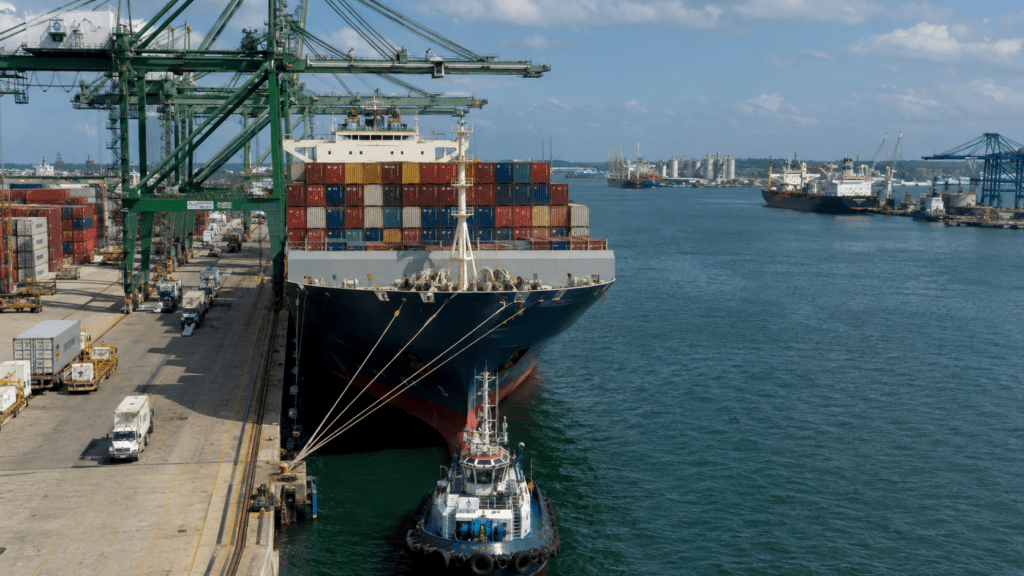
The Dominican Republic’s ports are far more than entry points for imported goods. They form a network in which individual terminals have very different roles: some handle large container ships and regional transshipment, others receive tankers carrying petroleum products, bulk carriers transporting coal or construction materials, refrigerated containers loaded with agricultural exports, and cruise ships carrying thousands of international visitors. Understanding how many vessels arrive at each port therefore requires looking not only at the number of ships, but also at the type of vessel and the cargo associated with each terminal.
The most complete official annual benchmark is 2024. APORDOM recorded 5,781 vessel arrivals at Dominican ports during that year, compared with 5,755 in 2023. The same statistics recorded 36.46 million metric tons of cargo, including imports, exports and international transit. ONE’s economic statistics, based on APORDOM administrative records, provide the port-by-port vessel totals and confirm the concentration of maritime activity in the country’s principal commercial gateways.
How Many Ships Arrive at Dominican Republic Ports?
There is no single “typical” Dominican ship. APORDOM classifies vessel traffic into categories including container ships, general-cargo vessels, bulk carriers, tankers, cruise ships, fishing vessels, tugs, barges, yachts and ferries. Consequently, a port that receives hundreds of vessel calls may be serving a completely different economic function from another port with fewer but much larger ships.
For 2024, the official port statistics show particularly heavy activity at Río Haina and Caucedo. The two Haina terminals recorded 1,740 vessel arrivals combined: 1,291 at Haina Oriental and 449 at Haina Occidental. Multimodal Caucedo recorded another 1,057. Together, these gateways accounted for roughly 48% of the 5,781 vessel arrivals recorded nationwide.
| Port or terminal | 2024 vessel arrivals | Main role |
|---|---|---|
| Río Haina – Oriental | 1,291 | Containers, general cargo, bulk cargo and liquid cargo |
| Caucedo | 1,057 | Container shipping, transshipment, vehicles and specialized cargo |
| Río Haina – Occidental | 449 | General cargo, bulk and liquid cargo |
| Puerto Plata | 533 | Cargo and cruise operations |
| Santo Domingo | 444 | General cargo, containers, cruise and ferry traffic |
| La Cana | 269 | Petroleum products |
| San Pedro de Macorís | 175 | Dry bulk, sugar, molasses and general cargo |
| Manzanillo | 137 | Refrigerated agricultural exports and dry bulk imports |
| Boca Chica | 117 | Containers, general cargo and liquid products |
| La Romana | 146 | Cargo and cruise operations |
| Punta Catalina | 32 | Coal for electricity generation |
The figures come from ONE’s 2024 economic statistics, which identify APORDOM as the source of the vessel records. They should be understood as vessel arrivals or calls, not as the number of individual ships in the national fleet. The same vessel can call at a Dominican port more than once during the year.
Río Haina: The Country’s Largest Multipurpose Gateway
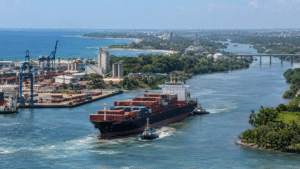
Río Haina is one of the most important commercial ports in the Dominican Republic and operates through Oriental and Occidental facilities. Combined, the two terminals handled 1,740 vessel arrivals in 2024 and more than 13.2 million metric tons of cargo. APORDOM describes Puerto Río Haina as a multipurpose port capable of handling different types of cargo, while its operator, Haina International Terminals, maintains container facilities as well as areas for general and project cargo.
Haina’s cargo mix is therefore broad. Container vessels bring manufactured goods, consumer products, machinery, food products and other merchandise packed in standardized containers. General-cargo vessels can carry products such as wood, wire rod, reinforcing steel, billets and heavy equipment. The terminal also handles project cargo and refrigerated containers, which are important for temperature-sensitive goods.
The port’s infrastructure illustrates why it can accommodate such a diverse traffic mix. Haina International Terminals reports 2,800 linear meters of berths and 15 berthing positions across both sides of the Haina River. Its principal container berth can handle Panamax-class vessels of up to 4,500 TEUs, while the terminal also operates mobile cranes for container and general-cargo vessels.
Caucedo: The Dominican Republic’s Main Container Hub
Caucedo, operated by DP World Dominican Republic, is the country’s other major commercial gateway and the principal center for containerized maritime trade. ONE recorded 1,057 vessel arrivals at Multimodal Caucedo in 2024. APORDOM’s annual statistics show that Caucedo handled about 11.48 million metric tons of cargo that year, making it one of the two largest cargo ports in the country.
Container shipping dominates Caucedo’s vessel traffic. APORDOM’s 2024 statistics recorded approximately 1.47 million TEUs at Caucedo. TEU, or twenty-foot equivalent unit, is a standard measure used to describe containerized cargo capacity; it does not represent the physical number of ships.
Caucedo also handles more than conventional containers. DP World lists services for imported vehicles under the RoRo model, general cargo, refrigerated cargo and project cargo, including oversized and heavy-lift shipments. Its network connects the Dominican Republic with North America, Central America, the Caribbean, South America, Europe and Asia.
The scale of the terminal has continued to grow. DP World reported that Caucedo handled about 1.71 million TEUs in 2024 under its own terminal throughput measurement, while APORDOM’s national statistics record approximately 1.47 million TEUs for Caucedo. The difference reflects the fact that port and terminal operators can use different statistical scopes or reporting methodologies. For national comparisons, APORDOM’s figures are the appropriate reference.
La Cana: A Specialized Port for Petroleum Products
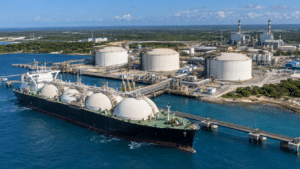
La Cana, in San Pedro de Macorís province, is an example of how a port can have a very different function from a container hub. APORDOM identifies the facility as specialized in receiving petroleum tankers carrying hydrocarbon derivatives for importation and subsequent domestic commercialization, as well as exports to regional markets.
The port recorded 269 vessel arrivals in 2024. Its cargo volume was approximately 2.89 million metric tons, placing it among the country’s largest cargo terminals despite handling a much smaller number of vessel calls than Haina or Caucedo.
This is an important distinction when interpreting port statistics. A tanker carrying a very large volume of liquid bulk can move many thousands of tons in a single call. Consequently, vessel counts alone do not measure a port’s economic importance.
Punta Catalina: Ships Carrying Coal for Power Generation
Punta Catalina, in Peravia province, is one of the country’s most specialized port facilities. APORDOM states that it is dedicated to receiving bulk carriers for the unloading of mineral coal used by the Punta Catalina power plant. The port’s security certification specifically identifies its operation as bulk vessels carrying coal in bulk.
Only 32 vessel arrivals were recorded at Punta Catalina in 2024, but the port handled approximately 1.91 million metric tons of cargo. This is a clear example of why the number of ships and the quantity of cargo can tell very different stories. A relatively small number of bulk carriers can transport enormous volumes compared with a much larger number of smaller commercial vessel calls.
San Pedro de Macorís: Bulk Materials, Sugar and Molasses
The port of San Pedro de Macorís handled 175 vessel arrivals in 2024 and approximately 908,000 metric tons of cargo. APORDOM describes its commercial role as including dry bulk imports such as clinker, coal and fertilizers, as well as exports of sugar, molasses and bagged cement. It also receives tourist vessels.
Its cargo profile reflects the economic activity of the eastern and southeastern parts of the country, where construction materials, agricultural commodities and industrial products generate maritime demand. The port’s relatively moderate vessel count therefore masks a diverse cargo function.
Manzanillo: Agricultural Exports and Dry Bulk Imports
Manzanillo, in Monte Cristi province, recorded 137 vessel arrivals in 2024 and handled approximately 615,700 metric tons of cargo. APORDOM identifies refrigerated containers carrying bananas and other fruits as an important export operation, while imports include general cargo and loose dry bulk such as clinker and mineral coal.
This makes Manzanillo particularly relevant to agricultural supply chains. Refrigerated containers, often called reefers, allow perishable products to remain within controlled temperature ranges during maritime transport. The port’s cargo profile therefore connects the northwest of the Dominican Republic with international markets while also supplying imported industrial materials.
Puerto Plata: Cargo and One of the Country’s Main Cruise Gateways
Puerto Plata is unusual because its maritime activity combines commercial cargo with cruise tourism. APORDOM identifies it as the principal port on the north coast and says it specializes in receiving both cargo ships and cruise vessels. It ranked third among Dominican ports by cargo volume in the official 2024 statistics, with approximately 1.48 million metric tons.
ONE recorded 533 vessel arrivals at Puerto Plata in 2024. APORDOM’s vessel classifications show a mixture of general-cargo vessels, container ships and bulk carriers, alongside the separate cruise terminals serving Amber Cove and Taíno Bay.
The tourism side is substantial. In 2024, Amber Cove recorded 265 cruise calls and Taíno Bay recorded 293. Together, the two Puerto Plata cruise terminals therefore accounted for 558 cruise calls during the year. The terminals are part of a broader maritime tourism system that also includes La Romana, Santo Domingo and other destinations.
La Romana: A Mixed Cargo and Cruise Port
La Romana recorded 146 vessel arrivals in 2024. Its activity combines commercial cargo with cruise operations, making it another example of a Dominican port serving two very different maritime markets. APORDOM’s infrastructure description distinguishes the western side of the port for cargo handling and the eastern side for passengers.
In the 2024 maritime passenger statistics, La Romana recorded 105 cruise vessel calls and more than 320,000 cruise passengers and crew movements under the categories reported by APORDOM. The figures demonstrate the importance of cruise ships alongside the port’s smaller commercial cargo operation.
Boca Chica: Containers, General Cargo and Liquid Products
Boca Chica recorded 117 vessel arrivals in 2024 and handled approximately 1.89 million metric tons of cargo. APORDOM identifies the port’s activities as including imports and exports, containerized cargo, general cargo, liquids, paper by-products and fuel, as well as tourist vessels.
The port therefore occupies a different niche from Caucedo, even though both are located in the wider Santo Domingo area. Caucedo is heavily centered on container shipping and transshipment, while Boca Chica has a broader mixture of general and liquid cargo operations.
Santo Domingo: Cargo, Cruise Ships and Ferry Traffic
The Port of Santo Domingo recorded 444 vessel arrivals in 2024. Its operations include general cargo and containerized merchandise, while its Don Diego and Sans Souci terminals also serve cruise vessels. The port has an additional passenger role through ferry operations.
APORDOM’s 2024 statistics show approximately 875,000 metric tons of cargo moving through Santo Domingo. The port is therefore commercially important, but its role is broader than that of a dedicated container terminal because its facilities combine cargo, cruise and ferry activity.
What Types of Ships Enter Dominican Ports?
Looking across the national system, the vessels arriving in the Dominican Republic can be grouped into several major categories. APORDOM’s quarterly statistics illustrate the diversity of this traffic: container ships, general-cargo vessels, bulk carriers, tankers and cruise ships are all significant categories, with additional traffic from fishing vessels, tugs, barges, yachts and ferries.
- Container ships: transport standardized containers carrying manufactured goods, food products, machinery, consumer merchandise and other internationally traded goods.
- General-cargo vessels: carry goods that may not be transported in standard containers, including steel products, wood, heavy equipment and project cargo.
- Bulk carriers: transport unpackaged dry commodities such as coal, clinker, fertilizers and other mineral or agricultural materials.
- Tankers: carry liquid bulk, particularly petroleum products and other hydrocarbon derivatives.
- RoRo vessels: transport wheeled cargo, including imported vehicles, which can be driven or rolled on and off the ship.
- Cruise ships: transport passengers and crew rather than commercial freight and are concentrated at dedicated tourism terminals.
- Ferries: carry passengers and, depending on the service, vehicles or other rolling cargo.
The distinction matters because one container ship may make multiple calls as part of a scheduled liner service, while a bulk carrier may arrive less frequently but unload tens of thousands of tons in a single operation. Vessel counts should therefore always be read alongside cargo tonnage and container throughput.
How Much Cargo Moves Through Dominican Ports?
Across the national port system, APORDOM recorded 36.46 million metric tons of cargo in 2024. Imports accounted for about 25.57 million tons, exports for about 5.33 million tons and international transit for about 5.56 million tons. Compared with 2023, total cargo increased by approximately 3.7%.
| Port | 2024 cargo volume | Share of national cargo |
|---|---|---|
| Río Haina | 13.24 million metric tons | About 36% |
| Caucedo | 11.48 million metric tons | About 31% |
| La Cana | 2.89 million metric tons | About 8% |
| Punta Catalina | 1.91 million metric tons | About 5% |
| Boca Chica | 1.89 million metric tons | About 5% |
| Puerto Plata | 1.48 million metric tons | About 4% |
| San Pedro de Macorís | 908,361 metric tons | About 2.5% |
| Santo Domingo | 875,024 metric tons | About 2.4% |
| Manzanillo | 615,727 metric tons | About 1.7% |
| La Romana | 192,720 metric tons | About 0.5% |
The concentration is striking: Río Haina and Caucedo together handled nearly 24 million metric tons in 2024, or roughly two-thirds of the country’s total port cargo. The two ports also accounted for almost half of vessel arrivals. This combination makes the Santo Domingo area the central maritime logistics zone of the Dominican Republic.
Containers Are Concentrated in a Small Number of Ports
Containerized trade is even more concentrated than overall cargo. APORDOM recorded approximately 2.11 million TEUs nationwide in 2024, including imports, exports and transit. Caucedo accounted for about 1.47 million TEUs, while Haina Oriental handled a substantial additional volume. Manzanillo, Puerto Plata and Santo Domingo also participated in container traffic but on a much smaller scale.
This concentration reflects the infrastructure required for modern container shipping. Large container terminals need deep water, ship-to-shore cranes, extensive storage yards, customs and inspection facilities, refrigerated-container connections and efficient links to roads and logistics centers. Caucedo and Haina have developed precisely these capabilities.
Why the Number of Ships Can Be Misleading
A common mistake is to rank ports simply by the number of vessels they receive. The 2024 figures show why that approach can be misleading. Punta Catalina received only 32 vessel calls but handled about 1.9 million tons, because its ships are bulk carriers delivering coal. La Cana received 269 calls and handled nearly 2.9 million tons, largely reflecting liquid bulk operations. By contrast, container hubs can receive far more individual vessel calls because scheduled liner services require frequent arrivals and departures.
There is another complication: a “vessel arrival” is not necessarily a unique ship. A single vessel can enter Dominican waters several times during a year as part of a regular service. For this reason, APORDOM’s vessel statistics should be interpreted as port calls rather than a count of unique ships visiting the country.
How Dominican Ports Divide the Country’s Maritime Trade
The geography of the port system reflects the geography of the economy. Haina and Caucedo serve the country’s largest population and consumption center around Santo Domingo and provide international container connectivity. La Cana serves petroleum logistics. Punta Catalina has a specialized energy role. San Pedro de Macorís connects bulk materials and agricultural products with maritime markets. Manzanillo serves the northwest, particularly agricultural exports. Puerto Plata and La Romana combine commercial activity with major cruise operations.
This specialization also provides resilience. The Dominican Republic does not depend on one port for every type of maritime trade. Different terminals have different depths, equipment, storage systems and access to regional markets. A disruption at a specialized terminal cannot always be replaced immediately by another port, but the overall system has multiple gateways for containers, bulk commodities, petroleum products and tourism.
What Has Changed Since 2024?
The 2024 figures remain the most useful full-year baseline for comparing all Dominican ports on the same basis, but later APORDOM reports show that activity continues to evolve. In the fourth quarter of 2025, the country recorded 1,506 vessel arrivals, compared with 1,377 in the same quarter of 2024. Caucedo recorded 277 arrivals, while Haina Oriental and Haina Occidental recorded 328 and 118 respectively. Puerto Plata recorded 174.
The fourth-quarter 2025 cargo figures also confirm the continued dominance of the main commercial gateways. Caucedo handled about 2.82 million metric tons during the quarter, while Haina Oriental and Haina Occidental handled about 1.57 million and 1.50 million respectively. Puerto Plata handled about 423,000 tons.
Container traffic remained concentrated as well. During the fourth quarter of 2025, APORDOM recorded 274,923 TEUs at Caucedo, 83,701 at Río Haina, 14,911 at Santo Domingo, 6,196 at Puerto Plata and 2,320 at Manzanillo.
Frequently Asked Questions
How many ships arrive in the Dominican Republic each year?
APORDOM recorded 5,781 vessel arrivals in 2024. The figure includes different vessel categories, not only commercial cargo ships. It also represents vessel calls, so the same ship can appear more than once during the year.
Which Dominican port receives the most ships?
Among individual commercial terminals, Haina Oriental recorded the highest 2024 total with 1,291 vessel arrivals, followed by Caucedo with 1,057 and Haina Occidental with 449. If both Haina terminals are treated as one port complex, Río Haina received 1,740 vessel arrivals.
Which port handles the most cargo?
Río Haina handled approximately 13.24 million metric tons in 2024, ahead of Caucedo with about 11.48 million. Together, they accounted for roughly two-thirds of all cargo recorded by APORDOM.
Which port handles the most containers?
Caucedo is the country’s principal container hub. APORDOM recorded approximately 1.47 million TEUs there in 2024, out of about 2.11 million TEUs recorded nationally.
What does the Dominican Republic import through its ports?
The answer varies by terminal. Container ports handle a wide range of manufactured goods, consumer merchandise, food products, machinery and other cargo. Specialized terminals handle petroleum derivatives, coal, clinker, fertilizers and other bulk materials. Haina also handles steel products, wood, heavy equipment and project cargo.
What does the Dominican Republic export by sea?
Exports vary by port and commodity. Manzanillo is specifically associated with refrigerated containers carrying bananas and other fruits. San Pedro de Macorís handles exports including sugar, molasses and bagged cement. Container terminals such as Caucedo and Haina also handle a wide variety of manufactured and agricultural exports.
Are all ships arriving in the Dominican Republic cargo ships?
No. APORDOM’s statistics include container ships, general-cargo vessels, bulk carriers, tankers, cruise ships and other vessel categories. Cruise traffic is particularly important at Amber Cove, Taíno Bay, La Romana, Santo Domingo and other tourism facilities.

Which Dominican ports are most important for cruise ships?
Puerto Plata is one of the country’s leading cruise destinations, with Amber Cove and Taíno Bay. La Romana is another major cruise gateway, while Santo Domingo and other ports also receive cruise calls. In 2024, APORDOM recorded 265 cruise calls at Amber Cove, 293 at Taíno Bay and 105 at La Romana.