 25°C
25°C

How the Energy Industry Works in the Dominican Republic
The Dominican Republic’s energy industry is a hybrid system in which privately and publicly owned generators produce electricity, the state-owned transmission company moves it across the national grid, distribution companies deliver and sell it to most consumers, and regulators oversee prices, market rules, concessions, and technical standards. Understanding how these pieces fit together is essential to understanding one of the country’s most economically important infrastructure sectors.


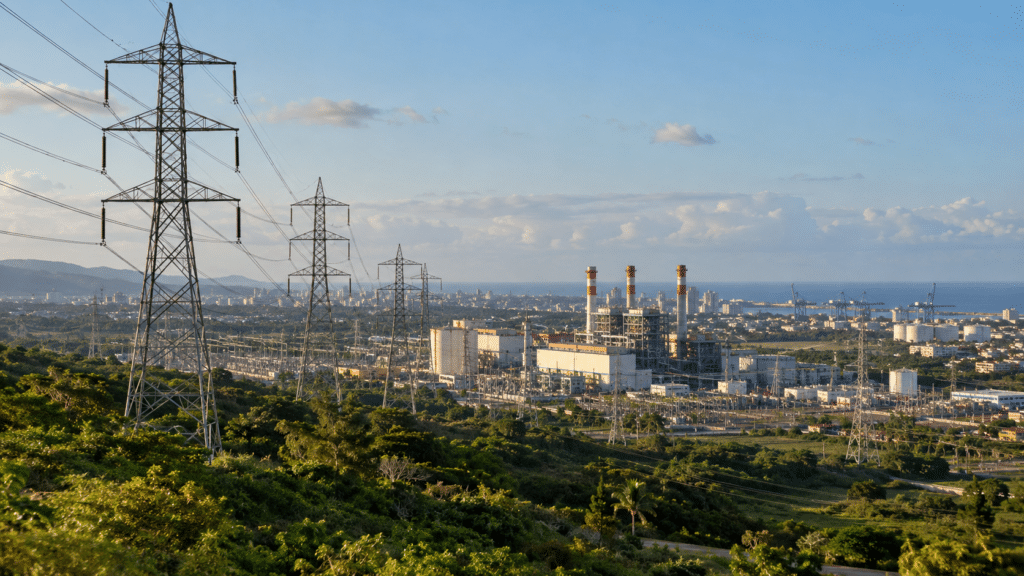
The Dominican Republic’s energy industry is best understood as a chain of interconnected businesses and public institutions rather than as a single state-controlled utility. Electricity is generated by a mixture of private, public and mixed-ownership companies; transported through a state-owned high-voltage network; and distributed primarily through three state-owned distribution companies. Around that physical system sits a regulatory and market framework designed to coordinate investment, dispatch, electricity trading, consumer tariffs and system reliability.
The Basic Structure of the Dominican Energy Industry
The electricity sector is organized around four core commercial activities: generation, transmission, distribution and commercialization. Generation is the most competitive part of the system, with numerous companies operating thermal, hydroelectric, solar, wind and other facilities. Transmission is effectively a state infrastructure business, while distribution to regulated customers is concentrated in three principal electricity distribution companies. The wholesale market connects these activities and provides the mechanism through which electricity and related services are traded.
| Activity | Main Function | Principal Actors |
|---|---|---|
| Generation | Produces electricity from thermal and renewable sources | Private, public and mixed-ownership generators |
| Transmission | Moves electricity through the high-voltage national grid | ETED, the state-owned transmission company |
| Distribution | Delivers electricity through local networks to customers | EDESUR, EDENORTE and EDEESTE, among other concessionaires in specific areas |
| Commercialization | Contracts, sells and bills electricity to customers under the applicable market regime | Distribution companies, market agents and suppliers serving eligible non-regulated users |
| System coordination | Coordinates dispatch and economic transactions in the interconnected system | Organismo Coordinador and the transmission system’s control center |
| Regulation and policy | Sets rules, supervises the market and develops energy policy | MEM, SIE and CNE |
The framework is principally based on the General Electricity Law No. 125-01, later modified by Law No. 186-07, together with implementing regulations and decisions issued by the competent authorities. The Ministry of Energy and Mines, the Superintendency of Electricity and the National Energy Commission have different responsibilities within this framework rather than performing interchangeable functions.
Who Controls the Energy Sector?
The state remains central to the Dominican electricity industry, but its role has changed substantially from the vertically integrated model that existed before the sector was restructured. The modern system separates generation, transmission and distribution and allows private capital to participate in electricity production and other energy businesses.
Ministry of Energy and Mines
The Ministry of Energy and Mines (MEM) is the government’s principal institution for energy policy. Created by Law No. 100-13, it is responsible for formulating and administering national energy policy and coordinating the government’s strategic approach to the sector. Its role is therefore broader than electricity alone and includes areas such as hydrocarbons, energy security and the country’s energy transition.
Superintendency of Electricity
The Superintendency of Electricity (SIE) is the main electricity regulator. It supervises compliance with the legal, regulatory and technical framework covering generation, transmission, distribution and commercialization. It also establishes regulated tariffs and regulated network charges where the law requires prices to be subject to regulation.
For businesses, this distinction matters. A power plant may be privately owned and operate commercially, but its participation in the electricity system remains subject to concessions, technical requirements, market rules and regulatory oversight.
National Energy Commission
The National Energy Commission (CNE) has an important planning and investment-development role. Among other responsibilities, it processes and evaluates energy concessions and administers the incentives established under the renewable-energy framework. For investors, the CNE is therefore one of the key institutions involved in developing a new generation project.
The Wholesale Electricity Market
The Wholesale Electricity Market is where the commercial relationships among generators, transmission and distribution participants and eligible non-regulated users are coordinated. The legal framework distinguishes between the contract market and the spot market.
In the contract market, electricity is traded through supply agreements, including power purchase agreements commonly known as PPAs. These contracts can provide generators with greater revenue visibility and distributors or large consumers with greater predictability over supply arrangements.
The spot market handles short-term transactions that are not covered by term contracts. The legal framework establishes economic transactions based on the system’s marginal costs. This creates an important distinction between the physical operation of the electricity system and the commercial contracts through which market participants manage their financial exposure.
The Organismo Coordinador
The Organismo Coordinador del Sistema Eléctrico Nacional Interconectado (OC-SENI) coordinates the operation of the interconnected electricity system and the economic transactions associated with the wholesale market. Its functions include coordinating economic dispatch, facilitating electricity exchanges among market agents and calculating the economic results generated by those transactions.
This coordination is essential because electricity cannot simply be produced, stored and delivered according to an individual buyer’s preference. Generation and demand must remain balanced continuously. The market therefore needs a central mechanism for determining which generating units operate and how their output interacts with the rest of the system.
Generation: Where Private Investment Plays Its Largest Role
Generation is the part of the Dominican electricity industry in which competition and private investment are most visible. The country has developed a diversified fleet of generating plants using natural gas, coal, fuel oil, diesel, hydroelectricity, wind, solar power and biomass.
The business model varies according to the plant. A generator may sell electricity through bilateral or long-term contracts, participate in the wholesale spot market, supply an eligible non-regulated customer or combine different arrangements. Renewable-energy projects can also operate under the special framework established by Law No. 57-07.
The result is a market in which investors are exposed not only to construction and operating costs but also to fuel prices, dispatch conditions, contractual terms, grid constraints, regulatory requirements and the ability of counterparties to meet their payment obligations.
Public Generation
Public ownership remains important in generation. Empresa de Generación Hidroeléctrica Dominicana (EGEHID) operates the country’s state-owned hydroelectric generation assets. Hydroelectric plants provide renewable electricity while also giving the system a generation resource whose operating economics differ from those of fuel-fired plants.
Empresa de Generación Eléctrica Punta Catalina (EGEPC) is another major state-owned generation company. It was created as a state-owned corporation to own and administer the Punta Catalina thermal generation assets. The plant’s ownership structure is therefore different from that of mixed public-private generators.
Mixed and Private Generation
The private sector has a substantial presence in generation. One prominent example is EGE Haina, a mixed public-private company created during the restructuring of the electricity industry. Its portfolio illustrates the diversification taking place in the sector, with renewable generation alongside natural gas, fuel oil and other technologies.
AES Dominicana is another important private-sector participant, with generation assets and infrastructure connected to the national electricity system. Other market participants include companies operating natural-gas, coal, hydroelectric, wind, solar and other generating facilities.
The CNE’s concession records demonstrate the breadth of the investment pipeline. They include solar photovoltaic, wind, hydroelectric, biomass and conventional thermal projects, illustrating that the generation business is not limited to a small group of traditional utilities.
How Electricity Generation Is Chosen
The economic logic of generation can be simplified into one principle: the system seeks to meet electricity demand while using the available generating resources according to the operating and market rules. Plants differ significantly in fuel cost, efficiency, technical characteristics, availability and operating constraints.
A solar plant, for example, has no fuel cost once its equipment is operating but depends on sunlight. A natural-gas plant can generally provide more controllable output but has fuel and transportation costs. Hydroelectric generation depends on water availability. Thermal plants using oil or coal have different fuel, environmental and operating-cost profiles.
The system operator and market mechanisms therefore have to balance the economics of each technology with reliability requirements. The cheapest theoretical source is not necessarily capable of supplying electricity whenever demand requires it.
Transmission: The State-Owned Electricity Highway
Once electricity is generated, it must travel over the high-voltage network before reaching distribution systems and large consumers. This is the role of the Empresa de Transmisión Eléctrica Dominicana (ETED), the state-owned transmission company.
ETED operates, maintains and administers the country’s high-voltage transmission infrastructure, including transmission lines and substations. Its network provides the physical connection between generating plants, distribution systems and other large points of electricity consumption.
The distinction between transmission and generation is commercially important. A private generator can build and operate a power plant, but connecting that plant to the national system requires compliance with technical requirements and coordination with the transmission infrastructure. ETED therefore becomes a critical counterpart for new generation projects, particularly as renewable development expands into locations where the existing grid may need reinforcement.
The Control Center
ETED also houses the Centro de Control de Energía (CCE), which operates the SENI in real time under the applicable system-coordination framework. The control center translates the planned operating schedule into real-time instructions and continuously monitors the system.
This is one of the most important distinctions for understanding the industry: the company that owns the transmission infrastructure is not simply a passive carrier. Its operational functions are integrated into the real-time management of a system in which supply and demand must remain balanced every second.
The SENI: The Physical Backbone of the Market
The Sistema Eléctrico Nacional Interconectado (SENI) is the interconnected network of generating facilities, transmission infrastructure and distribution systems that allows electricity to move across the country. It is the physical platform on which much of the wholesale electricity market operates.
The SENI also explains why an electricity project cannot be evaluated solely by looking at its generating capacity. A new 100-megawatt plant is economically useful only if the system can receive its output and transport it to where demand exists. Grid congestion, substation capacity and transmission investments can therefore influence the commercial value and timing of new generation projects.
Distribution: The Link With Most Electricity Consumers
Distribution is the final major infrastructure stage before electricity reaches most households and businesses. Distribution companies operate lower-voltage networks, connect customers, install and maintain meters, bill consumers and collect electricity payments.
The three principal state-owned distribution companies are EDENORTE, EDESUR and EDEESTE. Each has a defined geographic concession area. For regulated customers inside those areas, the distribution company is the principal commercial interface with the electricity consumer.
| Distributor | General Geographic Role | Main Commercial Function |
|---|---|---|
| EDENORTE | Northern and northwestern areas of the country | Distribution and commercialization for regulated customers within its concession area |
| EDESUR | Southern and southwestern areas, including much of the western side of Greater Santo Domingo | Distribution and commercialization for regulated customers within its concession area |
| EDEESTE | Eastern areas, including much of eastern Greater Santo Domingo and the country’s eastern provinces | Distribution and commercialization for regulated customers within its concession area |
The economics of distribution are particularly important because a distributor purchases electricity and then has to recover its costs through customer billing while managing technical and non-technical losses. This makes metering, collection, network maintenance, theft prevention, customer management and tariff design central business issues.
Why Distribution Losses Matter Economically
Electricity losses are one of the defining economic challenges of the Dominican distribution business. Not every kilowatt-hour purchased by a distribution company is ultimately billed and collected from customers. Some losses occur because of technical characteristics of the network, while others can result from inaccurate metering, unauthorized connections or electricity that is delivered but not successfully collected as revenue.
This creates a direct financial problem. A distributor can purchase electricity from generators, but if a significant portion of the energy does not produce corresponding revenue, the gap affects the company’s financial position and, ultimately, the public finances when the state must support the distribution system.
For this reason, investment in meters, network modernization, automated billing, commercial management and loss reduction can be economically as important as building additional generation capacity.
Commercialization and the Difference Between Regulated and Non-Regulated Customers
Electricity commercialization does not operate identically for every customer. The system distinguishes between regulated users and non-regulated users.
Regulated users receive electricity under a regulated tariff framework. The SIE establishes or approves the applicable tariff mechanisms and the distribution company supplies the customer within its concession area.
Non-regulated users, by contrast, are eligible to participate directly in the wholesale market under the applicable rules. They can obtain authorization from the SIE and may purchase electricity through supply contracts with market agents or participate in the spot market.
This distinction is particularly relevant to large industrial companies, free-zone operators and other businesses whose electricity consumption can justify a different commercial structure. A non-regulated customer is not simply a household with a larger electricity bill; it is a participant with a different legal and commercial position in the market.
How an Electricity Contract Works
A simplified electricity transaction can involve several separate relationships. A generator produces electricity and may enter into a PPA with a distributor or another eligible market participant. The physical electricity is injected into the SENI, where the system is operated collectively rather than routed exclusively to the buyer named in the contract.
The contract creates a commercial obligation between the parties, while the system operator manages the physical flow of electricity. The wholesale market and its settlement mechanisms then account for the differences between contractual positions and actual system operations.
This separation between physical electricity flows and financial contracts is fundamental to understanding the business. Electricity cannot normally be traced from a particular generating unit to a particular household in the same way that a shipment of goods can be traced from a factory to a customer.
Fuel: The Business Behind Thermal Generation
Fuel is one of the most important economic variables in the electricity industry because a large portion of the country’s generation fleet remains thermal. The principal fuels used in the electricity system include natural gas, coal and petroleum-derived products such as fuel oil and diesel.
The country’s energy system is therefore connected to international commodity markets. Changes in global oil and gas prices can affect generation costs, electricity-market economics and the financial exposure of companies that depend on imported fuels.
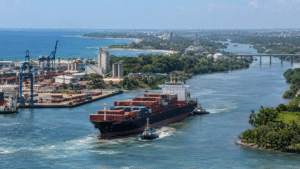
The Dominican Republic also has an important petroleum-products infrastructure. Refinería Dominicana de Petróleo (Refidomsa) refines crude oil and imports finished petroleum products. Its portfolio includes products such as LPG, gasoline, jet fuel, diesel and fuel oil, making petroleum logistics relevant not only to transportation but also to the broader energy economy.
Natural Gas and LNG
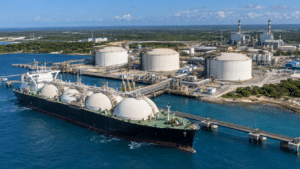
Natural gas has become increasingly important in electricity generation because it can support large-scale, dispatchable generation while generally producing fewer direct carbon emissions than coal or fuel oil for the same amount of electricity generated.
The country’s reliance on imported energy means that fuel security also depends on ports, storage, regasification or other import infrastructure, contracts and international supply chains. For electricity investors, the availability and cost of fuel can therefore be as important as the technical performance of the generating equipment.
Renewable Energy Is Changing the Investment Model
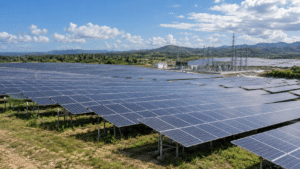
Renewable generation has become an increasingly important part of the Dominican electricity business. Solar and wind projects can be developed by multiple private investors, allowing capacity to be distributed among a larger number of companies and locations.

The renewable framework is strongly associated with Law No. 57-07, which established incentives and special regimes for renewable-energy development. The CNE plays an important role in processing concessions and administering elements of that framework.
The economics of renewable generation are different from those of conventional thermal plants. Solar and wind projects generally have high upfront capital requirements but low operating fuel costs. Their output is variable, however, creating additional requirements for forecasting, system flexibility, transmission capacity and, increasingly, energy storage.
Distributed generation adds another layer. Under the country’s net-metering framework, households, businesses and other customers can install renewable generation and interact with the distribution network under the applicable rules. This changes the traditional relationship between utility and customer because some consumers can become partial producers of electricity.
Why Energy Storage Is Becoming More Important
The expansion of solar and wind generation increases the value of technologies that can shift electricity availability across time. Battery energy storage systems can absorb electricity when it is abundant and release it when demand or system conditions make additional power valuable.
Storage can also provide system services that help manage fluctuations and improve grid stability. This is why transmission and system-planning institutions are increasingly considering battery storage alongside conventional investments in lines, substations and generating capacity.
For investors, storage creates a new business category between generation and grid infrastructure. Its commercial value can depend on several revenue streams, including energy arbitrage, capacity-related services and system-support functions, depending on the regulatory and market framework.
Public and Private Companies Work Together
The Dominican model is neither a fully state-owned electricity system nor a completely liberalized private utility market. It is a hybrid structure in which the state controls important strategic infrastructure and institutions while private companies play a major role in generation and investment.
The relationship can be summarized as follows: the government establishes policy and owns key infrastructure; regulators establish and enforce market rules; public and private generators compete or contract to supply electricity; ETED operates the high-voltage transmission system; distributors serve regulated customers; eligible large users can participate directly in the wholesale market; and the Organismo Coordinador manages the economic and operational coordination required by the interconnected system.
Where the Main Business Risks Lie
Energy companies operating in the Dominican Republic face a combination of commercial, regulatory, operational and infrastructure risks. These risks vary significantly depending on the segment of the industry.
- Generation: fuel prices, plant availability, dispatch, contractual terms, financing costs and regulatory changes.
- Renewables: resource variability, interconnection capacity, permitting, financing, curtailment risk and long-term contractual arrangements.
- Transmission: capital-intensive infrastructure, system reliability, expansion requirements and the need to connect new generation to demand centers.
- Distribution: electricity losses, collection rates, network condition, customer management, tariffs and financial sustainability.
- Large electricity consumers: energy prices, supply reliability, contract structure, demand patterns and eligibility for non-regulated status.
- Fuel businesses: international commodity prices, shipping, storage, inventory management, taxes and domestic demand.
These risks are interconnected. For example, a renewable project may have competitive generation costs but still face delays if transmission infrastructure is not available. A distributor may have adequate physical electricity supply but remain financially stressed if its losses and collection problems are high. A thermal generator may have a technically efficient plant but face higher costs when international fuel prices rise.
What the Energy Industry Means for the Dominican Economy
Electricity is a foundational input for almost every part of the Dominican economy. Hotels, factories, free zones, supermarkets, telecommunications networks, hospitals, offices and households all depend on reliable electricity. The cost and quality of power therefore influence the competitiveness of businesses well beyond the energy sector itself.
The industry also generates substantial demand for investment in power plants, transmission lines, substations, distribution networks, meters, storage systems, fuel infrastructure and engineering services. As the economy expands, the energy sector must add capacity while improving the efficiency of the infrastructure that already exists.
For international investors, this makes the electricity industry relevant not only as an infrastructure opportunity but also as a determinant of operating conditions in other sectors. A manufacturing investment, for example, may evaluate electricity reliability and cost as carefully as labor, logistics, taxation and access to markets.
The Strategic Direction of the Sector
The long-term direction of the Dominican electricity system is shaped by three simultaneous objectives: meeting rising demand, maintaining reliable supply and diversifying the energy mix. Renewable generation is expanding, while natural gas remains important for dispatchable generation. At the same time, the transmission and distribution networks must expand and modernize to accommodate new sources of electricity.
Official data reported for 2025 indicate that renewable sources accounted for approximately one-quarter of electricity production, while the system recorded a maximum instantaneous demand of 3,923 MW. These figures illustrate both sides of the sector’s challenge: the country is adding cleaner generation, but it is also dealing with a rapidly growing electricity system that requires continued investment in conventional capacity, networks and system flexibility.
The result is likely to be a more diversified industry rather than a simple replacement of one technology by another. Natural gas, hydroelectricity, solar, wind, storage and other technologies can perform different functions within the same system.
A Simple Way to Understand the Entire System
For a business reader, the Dominican energy industry can be visualized as a chain with several connected layers:
- Fuel and natural resources provide the inputs for electricity production.
- Generators convert those resources into electricity.
- The wholesale market provides the commercial framework for buying and selling electricity.
- ETED and the transmission network move electricity across the high-voltage system.
- Distribution companies deliver electricity through local networks and bill most regulated consumers.
- Large non-regulated users can participate more directly in wholesale electricity transactions.
- The OC-SENI and control center coordinate the physical and economic operation of the interconnected system.
- MEM, SIE and CNE provide policy, regulatory, planning and concession functions.
The most important point is that these layers cannot be analyzed independently. Generation investment affects transmission requirements; transmission constraints affect the value of generation projects; distribution losses affect the financial position of utilities; tariffs affect consumers; fuel prices influence generation economics; and regulation shapes the commercial relationships among virtually all of the participants.
Frequently Asked Questions
Is the Dominican electricity sector publicly or privately owned?
It is a hybrid system. The state owns important companies and infrastructure, including the national transmission company and major generation and distribution assets, while private companies have a substantial role in electricity generation and investment.
Who generates electricity in the Dominican Republic?
Electricity is generated by a large group of public, private and mixed-ownership companies. The generation fleet includes natural gas, coal, fuel oil, hydroelectric, solar, wind and biomass facilities.
Who owns the electricity transmission network?
The high-voltage transmission system is operated by ETED, the state-owned Empresa de Transmisión Eléctrica Dominicana. Its responsibilities include operating, maintaining and administering the national transmission infrastructure.
Who distributes electricity to households?
The principal distribution companies are EDENORTE, EDESUR and EDEESTE. They operate in different geographic concession areas and serve regulated customers through their local electricity networks.
Can a large company buy electricity directly from a generator?
Eligible companies can obtain non-regulated-user status and participate in the wholesale market under the applicable rules. A non-regulated user can purchase electricity through supply contracts with market participants or participate in the spot market.
Why are fuel prices important to electricity prices?
Thermal generation remains an important part of the electricity system. Changes in the cost of natural gas, coal, fuel oil or diesel can therefore affect the cost of producing electricity and the economics of electricity-market transactions.
Why is renewable energy expanding in the Dominican Republic?
Renewables can diversify the electricity supply, reduce exposure to imported fossil fuels and support national energy and environmental objectives. The country also has a legal framework that provides incentives for renewable-energy investment.
What is the difference between the SENI and the wholesale electricity market?
The SENI is the physical interconnected electricity system: generating plants, transmission facilities, substations and distribution networks. The wholesale electricity market is the commercial framework through which market participants buy, sell and settle electricity and related transactions.
Conclusion
The Dominican Republic’s energy industry is a complex public-private system built around a clear division of functions. Generators provide competing sources of electricity; the state-owned transmission network provides the physical backbone; distribution companies connect most consumers to the system; eligible large users can participate more directly in wholesale transactions; and public institutions establish the policy, regulatory and planning framework.
From an economic perspective, the sector’s central challenge is not simply building more power plants. It is coordinating generation, fuel supply, transmission, distribution, investment, regulation and consumer demand so that the electricity system can expand without undermining financial sustainability or reliability. The continued growth of renewable generation, combined with investment in natural-gas capacity, transmission, distribution modernization and storage, is gradually changing the structure of the industry while preserving the central role of the state in infrastructure and regulation.
For companies and investors, that interconnected structure is the key to understanding the market. Opportunities do not exist only in electricity generation. They also arise in grid infrastructure, energy storage, fuel logistics, renewable development, distributed generation, efficiency, metering and the technologies required to operate a larger and more diversified electricity system.