 27°C
27°C

States Sue Trump Administration Over New Global Tariffs
A coalition led by New York has asked a federal trade court to block a new round of tariffs imposed by the Trump administration, arguing the measures violate U.S. trade law and could raise costs for businesses and consumers across the country.


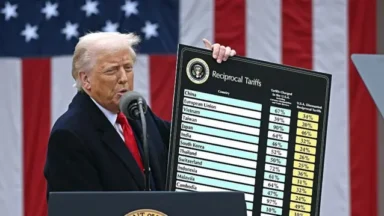
NEW YORK — New York Attorney General Letitia James and Governor Kathy Hochul, joined by officials from 24 other states, have filed a lawsuit challenging a new set of tariffs introduced by the administration of President Donald Trump. The legal action seeks to prevent the measures from taking effect, arguing they were imposed without following the procedures required under U.S. trade law.
The coalition contends that the tariffs, which target dozens of trading partners, would increase costs for American businesses and consumers while exceeding the executive branch’s legal authority. The lawsuit was filed before the U.S. Court of International Trade, the federal court that handles disputes involving customs and international trade.
Challenge Centers on Section 301 Authority
The states argue that the administration improperly relied on Section 301 of the Trade Act, a law that allows the U.S. government to respond to unfair foreign trade practices after completing specific investigative procedures. According to the complaint, those legal requirements were not fully met before the new tariffs were announced.
James and Hochul maintain that the administration turned to Section 301 after previous tariff measures adopted under other legal provisions failed to withstand judicial scrutiny. They also argue that citing concerns over forced labor served as a justification for restoring broad tariffs that had previously been struck down by the courts.
Questions Over the Investigation Process
The lawsuit points to the administration’s decision in March 2026 to launch investigations into 59 countries and the European Union under Section 301. When tariffs imposed under Section 122 of the Trade Act expired on July 23, the administration replaced them with a new set of duties affecting those trading partners.
According to the plaintiffs, the investigations were completed unusually quickly. They note that previous Section 301 investigations involving Brazil and China took between eight months and nearly a year, while the government reported reviewing approximately 60 trading partners in less than three months.
States Argue Tariffs Lack Legal Justification
The complaint also questions whether the new tariffs are genuinely linked to combating forced labor. It notes that the government’s own report identified only three products associated with forced labor concerns, while one of those products—frozen beef from Brazil—was ultimately exempted from the new duties.
The coalition further argues that the tariffs were applied broadly to both raw materials and finished products without distinguishing whether individual goods were likely connected to forced labor. It also alleges that the Office of the United States Trade Representative (USTR) failed to adequately consider comments submitted by foreign governments and affected industries during the consultation process.
Coalition Seeks to Block Tariffs
The lawsuit claims the administration violated the Administrative Procedure Act by failing to conduct a sufficiently thorough investigation and by not providing an adequate legal basis for the new tariffs. The plaintiffs also argue that Congress granted only limited authority to the executive branch to impose trade restrictions of this scope.
In addition to New York, the legal challenge is supported by the attorneys general of 22 states as well as the governors of Kentucky and Pennsylvania. Together, they are asking the court to halt the implementation of the tariffs and declare them inconsistent with existing U.S. law.