 30°C
30°C

Dominican Republic Cruise Tourism Reaches 2.8 Million Passengers
Cruise tourism has become a major economic activity in the Dominican Republic, with the country receiving about 2.8 million cruise passengers in 2025, up sharply from roughly 1.1 million in 2019. The expansion has been accompanied by new terminals, private and public investment, a growing network of cruise lines and a wider group of local businesses supplying transportation, excursions, food, retail, port services and other activities.


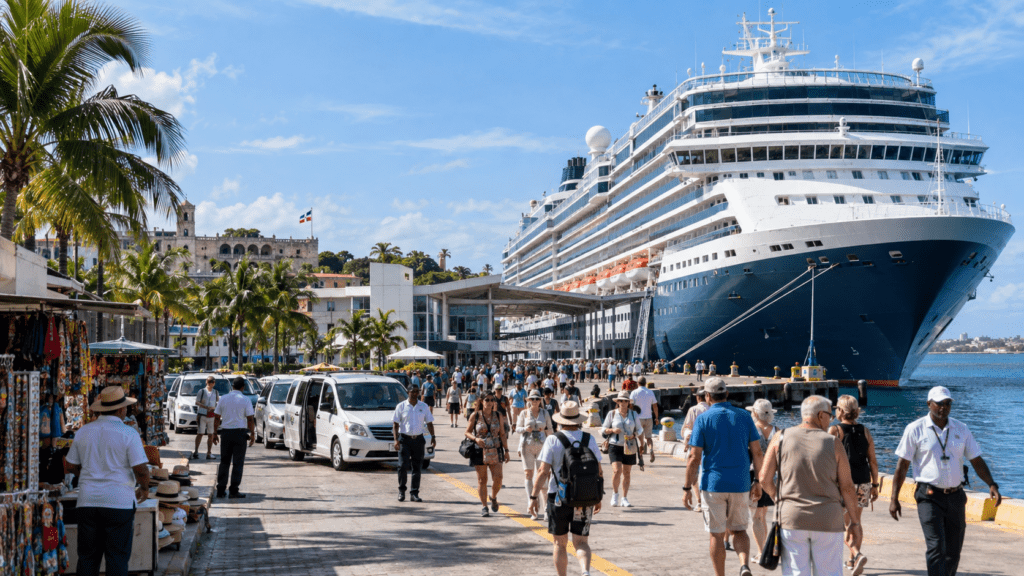
Cruise tourism in the Dominican Republic has evolved from a complementary part of the country’s tourism industry into a significant port-based economic activity. The scale of the change is visible in passenger numbers: the Dominican Republic received approximately 2.8 million cruise visitors in 2025, compared with about 1.1 million in 2019, according to the Dominican Port Authority (APORDOM). The growth has been supported by new terminals, expanded infrastructure and increased participation by international cruise operators.
How Large Is Cruise Tourism in the Dominican Republic?
The growth of cruise tourism has been particularly pronounced since the pandemic. APORDOM reports that the country received about 1.2 million cruise passengers in 2022, rising to approximately 2.7 million in 2025 and about 2.8 million for the full year according to figures subsequently reported by the authority. The 2025 result was more than double the country’s 2019 level.
This expansion matters because cruise passengers generate economic activity beyond the port itself. A cruise call creates demand for port operations, security, transportation, shore excursions, restaurants, retail businesses, guides, taxis, maintenance services and other suppliers. The economic effect therefore depends not only on how many ships arrive, but also on how much passenger and crew spending reaches businesses in the surrounding communities.
The Dominican Republic has also become more geographically diversified as a cruise destination. Puerto Plata, La Romana, Samaná, Santo Domingo and Pedernales are among the locations involved in the cruise economy, although their roles and passenger volumes differ substantially.
The Dominican Republic’s Main Cruise Ports
The country’s cruise network combines established terminals with newer facilities designed to bring cruise traffic to destinations that previously had little or no exposure to the sector.
| Port or cruise destination | Location | Role in the cruise sector |
|---|---|---|
| Amber Cove | Puerto Plata | One of the country’s largest cruise terminals and a major gateway for northern Dominican Republic cruise traffic. |
| Taíno Bay | Puerto Plata | Major modern terminal that has substantially expanded Puerto Plata’s cruise capacity. |
| La Romana | La Romana | Long-established cruise destination serving the southeastern tourism corridor. |
| Santo Domingo | Greater Santo Domingo | Urban cruise gateway associated with the capital and the Colonial City area. |
| Port Cabo Rojo | Pedernales | Newer cruise development intended to connect cruise traffic with the economy of the southwest. |
| Samaná | Samaná | Emerging cruise market with investment aimed at increasing the port’s capacity and local economic integration. |
The distribution of traffic has historically been concentrated in a few terminals. Ministry of Tourism data for 2023, for example, recorded 1,046,596 passengers at Amber Cove and 737,913 at Taíno Bay, while La Romana received 347,031. Samaná recorded 45,016, with additional traffic reported through Santo Domingo, Isla Catalina and other facilities.
That concentration has economic implications. Large terminals can generate substantial passenger volumes for an established tourism market, while newer ports such as Cabo Rojo are being developed partly as instruments of regional economic diversification.
Puerto Plata and the Concentration of Cruise Traffic
Puerto Plata has become the country’s principal cruise cluster because it hosts both Amber Cove and Taíno Bay. The two terminals give cruise operators access to the same broader destination while providing substantial berthing and passenger-handling capacity.
APORDOM’s first-quarter 2024 figures illustrate the scale of the two facilities. From January through March, Taíno Bay received 101 cruise ships carrying approximately 332,334 passengers, while Amber Cove received 71 ships with about 317,694 passengers. Together, the two terminals accounted for the majority of the passenger traffic reported during that period.
The concentration creates economies of scale. Cruise lines can schedule multiple calls in the same destination, while local companies can develop services around a relatively predictable flow of visitors. Transportation operators, tour companies, restaurants, retailers and other businesses can therefore build capacity around cruise demand rather than relying exclusively on occasional ship calls.
La Romana: An Established Cruise Economy
La Romana represents a different model because the cruise industry has been established there for decades. The destination is closely connected with the southeastern tourism economy and with the wider tourism infrastructure of La Romana and the surrounding area.
An expansion of the La Romana Cruise Terminal involved an investment of more than US$15 million and was designed to increase the port’s operational capacity and ability to receive larger ships. APORDOM has used the economic activity generated by individual cruise calls as an example of the potential value to local workers and businesses.
The economic model in La Romana illustrates an important feature of cruise tourism: the port is only one part of the value chain. Once passengers leave a ship, spending can flow to guides, transportation providers, restaurants, retailers, artisans and other businesses. The size of that flow depends on passenger numbers, the proportion going ashore and the services they purchase.
Port Cabo Rojo and the Development of Pedernales
Port Cabo Rojo represents the expansion of cruise tourism into a region with a much smaller established tourism economy than Puerto Plata or La Romana.
The port was developed with private-sector participation from ITM Group and an investment reported by APORDOM at nearly US$100 million. The project was conceived not simply as a cruise terminal but as part of a broader development strategy for Pedernales and the Enriquillo region.
By 2025, APORDOM reported that the operation had generated more than 300 direct jobs and nearly 1,000 indirect jobs. These figures illustrate why the economic impact of cruise tourism is not limited to passenger spending. New terminals require employees, security services, transportation, maintenance, food services and other supporting activities.
The development also demonstrates the limits of using passenger totals alone to measure regional impact. A port can receive large ships without automatically producing equivalent benefits for nearby communities. The strength of the local supply chain, the percentage of passengers who leave the terminal, the availability of locally owned businesses and the extent to which services are purchased locally all influence the economic result.
How Much Do Cruise Passengers Spend?
Passenger spending is one of the most closely watched economic indicators in cruise tourism. APORDOM has cited an average expenditure of around US$100 per cruise passenger in the Dominican Republic, while officials have also cited measurements ranging from roughly US$90 to US$120 in the wider Caribbean and a Dominican average of about US$108 in connection with Port Cabo Rojo.
These figures should be treated as estimates rather than as a fixed amount spent by every passenger. Spending varies according to the passenger, the port, the duration of the call, the excursions offered, local prices and the share of passengers who actually go ashore.
At a simple US$100 average, 2.8 million cruise passengers would correspond to approximately US$280 million in potential passenger spending. That is an illustrative calculation, not an independently measured national economic-impact figure. It should not be interpreted as money retained entirely by local businesses or as the total contribution of cruise tourism to the Dominican economy.
The distinction matters because cruise tourism involves several layers of expenditure. Some spending occurs inside terminals or through companies connected to cruise operators, while other spending reaches independent businesses in the destination. The economic benefit to a community depends heavily on how much of the total expenditure remains within the local economy.
Where Cruise Passenger Spending Goes
Cruise passengers can generate demand across a broad group of local activities. The most visible beneficiaries are often businesses that interact directly with passengers, but the economic chain can extend considerably further.
- Tour operators: Shore excursions create demand for guides, transportation and destination-specific services.
- Restaurants and food businesses: Passengers who spend time outside the terminal can purchase meals, drinks and other food products.
- Transportation providers: Taxis, buses, vans and other transport services connect passengers with attractions and commercial areas.
- Retail and artisans: Souvenirs, crafts, clothing and other retail purchases provide direct sales opportunities.
- Port service providers: Cruise calls require security, logistics, waste management, maintenance and other operational services.
- Local suppliers: Businesses can participate indirectly by supplying food, materials, equipment or professional services to companies operating in the cruise ecosystem.
The distinction between direct and indirect activity is important. A restaurant serving cruise passengers receives direct demand, while a local supplier selling products to that restaurant benefits indirectly. Both are part of the economic footprint, although they should not be treated as identical forms of employment or income.
The Role of Local Suppliers
The development of a stronger local supply chain is one of the central economic questions surrounding cruise tourism. Passenger arrivals alone do not guarantee that a large proportion of the economic value will remain in the Dominican Republic.
Local participation can occur at several levels. Small businesses can sell directly to passengers, while larger companies can supply transportation, food, maintenance, security, logistics and other services to terminals and tourism operators. The more locally sourced these inputs are, the greater the potential for cruise activity to circulate through the domestic economy.
There is also a geographic dimension. A business located close to a cruise terminal is more likely to capture passenger spending than one located far from the port unless it participates in an organized excursion or supply chain. This makes connectivity between terminals, commercial areas and surrounding communities an important part of the economic model.
Cruise Lines Operating in the Dominican Republic
The Dominican Republic is served by a wide range of international cruise companies. ProDominicana’s investment documentation identifies operators including Royal Caribbean, Norwegian Cruise Line, AIDA, Holland America Line, Costa Cruises, Carnival Cruise Line, Azamara, MSC Cruises, Seabourn, The World, Silversea, Regent, Oceania and Club Med, among others.
The presence of multiple operators reduces the country’s dependence on a single cruise company and allows different ports to target different itineraries and passenger segments. Large mainstream cruise brands generate high passenger volumes, while luxury and premium operators can produce different spending patterns and destination requirements.
Cruise itineraries are also not permanently fixed. Port calls can change because of weather, operational considerations and decisions by cruise lines. As a result, projected ship calls should not be treated as guaranteed passenger arrivals.
Why Cruise Lines Invest in Dominican Ports
For cruise operators, port infrastructure affects whether a destination can accommodate larger ships, multiple vessels and increasingly demanding passenger-handling requirements.
Investment therefore focuses on more than the berth itself. A competitive cruise terminal requires passenger facilities, access roads, security, utilities, transportation connections and the ability to process large numbers of people efficiently.
The Dominican Republic has expanded this infrastructure considerably. APORDOM has reported that the country moved from three cruise terminals to five during the recent expansion period, while additional projects have been planned or developed in locations including Samaná and Santo Domingo.
ProDominicana also identifies cruise tourism as a specialized tourism segment within the country’s investment strategy and highlights the country’s port and transport connectivity as factors supporting tourism investment.
Public and Private Investment in Cruise Infrastructure
The Dominican cruise industry combines public infrastructure and private investment. Government agencies are responsible for port administration, regulation and public infrastructure, while private companies can finance and operate terminals and associated commercial facilities.
APORDOM reported more than RD$800 million in investment from 2020 onward in its own port-related activities. Separately, major private or mixed projects have involved substantially larger amounts. The Port Cabo Rojo project, for example, was announced with an investment of nearly US$100 million, while the expansion of the La Romana Cruise Terminal involved more than US$15 million.
These investments illustrate the capital intensity of cruise tourism. The economic activity generated by a terminal depends on infrastructure that must be built and maintained before passenger spending can occur. For governments and investors, the relevant calculation therefore includes both the expected tourism revenue and the long-term costs of developing and operating the infrastructure.
Samaná and the Next Phase of Cruise Development
Samaná is becoming another important example of how cruise infrastructure can be linked more directly with a local economy.
The first stage of Samaná Bayport opened after receiving 22 cruise calls and about 50,000 passengers from December 2025. The terminal’s next-season projection was approximately 45 cruise ships and 90,000 passengers.
The economic objective is different from simply maximizing passenger throughput. The project has been presented as a way to connect passengers more directly with businesses in Santa Bárbara de Samaná and surrounding communities. That approach seeks to increase the proportion of passenger spending captured by restaurants, retailers, guides, transportation providers and other local businesses.
Samaná therefore illustrates an important principle of cruise economics: the design of a port can influence how passengers interact with the destination. A terminal that connects visitors efficiently with a town’s commercial areas can create different local effects from a facility designed primarily as a self-contained destination.
Employment Effects of Cruise Tourism
Cruise tourism creates employment through both port operations and visitor spending. Jobs can be directly connected to terminals, or indirectly generated by businesses that serve passengers and cruise-related companies.
Direct employment can include port operations, security, maintenance, passenger processing and administrative functions. Indirect employment can involve guides, drivers, restaurant workers, retail employees, artisans, suppliers and other service providers.
Port Cabo Rojo provides a documented example of this effect. APORDOM reported more than 300 direct jobs and close to 1,000 indirect jobs associated with the operation by 2025. These figures are specific to that project and should not be extrapolated mechanically to the entire national cruise industry.
The distribution of employment also matters. A cruise industry that creates jobs mainly within terminals produces a different local economic effect from one that generates extensive employment among independent businesses, suppliers and community-based tourism companies.
How Cruise Tourism Affects Local Economies
The economic impact of cruise tourism is particularly visible in port communities. A cruise ship can bring thousands of potential customers to a destination within a few hours, creating a concentrated demand for services.
For established destinations such as Puerto Plata and La Romana, cruise activity adds another source of tourism demand to an already developed visitor economy. For newer destinations such as Pedernales, the potential effect is more structural because cruise traffic can contribute to the creation of tourism businesses and infrastructure where the sector was previously smaller.
There can also be wider infrastructure effects. Roads, public spaces, utilities, security systems and tourism facilities may be upgraded to support growing visitor numbers. Some investments serve cruise passengers directly, while others can benefit residents and other types of visitors.
The Limits of Cruise Tourism’s Economic Impact
Passenger arrivals should not automatically be equated with economic development. Cruise passengers generally spend less time in a destination than overnight visitors, and they do not necessarily use hotels or make the same range of purchases as tourists who stay for several days.
The economic contribution also depends on the structure of the cruise call. A passenger who remains aboard the ship generates a different local economic effect from one who spends several hours in the destination. Likewise, a passenger who books a locally operated excursion and eats at a local restaurant can generate a different value chain from one whose spending remains largely within the terminal or cruise company’s ecosystem.
For that reason, passenger totals are best understood as an indicator of market scale rather than a complete measure of economic impact.

Cruise Tourism and the Dominican Republic’s Tourism Strategy
Cruise tourism fits into a broader strategy to diversify the Dominican Republic’s tourism offer beyond traditional resort-based travel.
The country’s investment promotion agency identifies cruise tourism alongside other specialized segments and emphasizes the Dominican Republic’s combination of air and maritime connectivity, infrastructure and tourism investment conditions.
The cruise sector also provides a mechanism for distributing tourism activity geographically. Puerto Plata and La Romana already have mature tourism economies, while projects in Pedernales and Samaná seek to connect cruise demand with regions where tourism development is at a different stage.
This geographic diversification can be economically significant if new cruise traffic encourages the development of locally owned enterprises and supporting infrastructure rather than functioning primarily as an isolated port operation.
What Determines the Economic Value of a Cruise Call?
The number of passengers is only one variable. Several factors determine how much economic activity a cruise call can generate for the Dominican Republic and the specific destination.
- Passenger volume: More passengers create a larger potential customer base.
- Passenger disembarkation: Spending opportunities increase when passengers leave the ship and enter the destination.
- Average expenditure: The value of purchases, excursions, food and transportation determines direct local revenue.
- Local ownership: Spending at Dominican-owned businesses can create a different domestic economic effect from spending captured by external companies.
- Local sourcing: Businesses that purchase goods and services from domestic suppliers create wider economic linkages.
- Length of stay: The amount of time available on shore affects the number of services passengers can consume.
- Infrastructure: Efficient ports and transport connections allow more passengers to reach businesses and attractions.
- Destination integration: The easier it is for passengers to access local commercial areas, the greater the potential for wider community participation.
These factors explain why two ports receiving similar numbers of passengers can produce different economic outcomes.
The Direction of Future Cruise Investment
The Dominican Republic is continuing to expand its cruise infrastructure rather than treating existing terminals as the final stage of development. APORDOM has reported projects involving new or expanded facilities in Samaná, Santo Domingo and other destinations, while Port Cabo Rojo continues to develop as a newer cruise gateway.
One of the more ambitious objectives is to strengthen Santo Domingo’s role in cruise tourism. Proposed infrastructure has included a new terminal near the Malecón and the Colonial City, with the possibility of developing a home-port operation. A home port differs from a conventional port of call because passengers can begin or end their cruise there, potentially creating additional demand for hotels, transportation, restaurants and other services.
That model could broaden the economic footprint of cruise tourism, although its success would depend on cruise-line itineraries, airport connectivity, passenger demand and the ability of the city to handle embarkation and disembarkation efficiently.
Why the Cruise Sector Matters to the Dominican Economy
The significance of cruise tourism is not simply the number of ships entering Dominican waters. Its importance lies in the combination of infrastructure investment, international tourism demand, employment and spending that can connect ports with surrounding economies.
The country’s growth from approximately 1.1 million cruise passengers in 2019 to around 2.8 million in 2025 represents a substantial expansion of the market. At the same time, the development of terminals in destinations such as Pedernales and Samaná shows that cruise tourism is increasingly being used as an instrument for regional tourism development.
The central economic question is therefore shifting from how many cruise passengers the Dominican Republic can receive to how effectively those passengers can generate lasting value for Dominican businesses, workers and communities.
Frequently Asked Questions About Cruise Tourism in the Dominican Republic
How many cruise passengers visit the Dominican Republic?
The Dominican Republic received approximately 2.8 million cruise passengers in 2025, according to figures reported by APORDOM. That compares with approximately 1.1 million in 2019.
Which Dominican port receives the most cruise passengers?
Puerto Plata is the country’s principal cruise cluster because it has both Amber Cove and Taíno Bay. Ministry of Tourism data for 2023 showed Amber Cove and Taíno Bay together receiving the majority of the country’s cruise passengers.
How much does a cruise passenger spend in the Dominican Republic?
APORDOM has cited an average of around US$100 per cruise passenger, with other statements placing the Dominican average at approximately US$108. Actual expenditure varies considerably between passengers and destinations.
Does cruise tourism create jobs in the Dominican Republic?
Yes. Employment can be generated directly by terminals and port operations and indirectly through transportation, excursions, restaurants, retail, security, maintenance and other suppliers. APORDOM reported more than 300 direct and nearly 1,000 indirect jobs associated with Port Cabo Rojo by 2025.
Which cruise lines operate in the Dominican Republic?
The country receives ships from numerous international operators, including Royal Caribbean, Norwegian Cruise Line, Carnival Cruise Line, MSC Cruises, Costa Cruises, Holland America Line, AIDA, Silversea, Regent and Oceania, among others.
Is cruise tourism important for communities outside the traditional resort areas?
It can be. New cruise infrastructure in destinations such as Pedernales and Samaná is intended to connect cruise traffic with local businesses and employment. The size of the benefit depends on how much passenger spending and procurement is captured by businesses in the surrounding community.
Conclusion
Cruise tourism has become a substantial component of the Dominican Republic’s tourism and port economy. The increase from roughly 1.1 million cruise passengers in 2019 to about 2.8 million in 2025 has been accompanied by major investments in terminals and the emergence of new cruise destinations.
The sector’s longer-term economic value, however, depends on more than passenger numbers. Ports, cruise operators, local suppliers, transportation companies, restaurants, retailers, guides and other businesses form an interconnected economic system. The extent to which that system creates local employment, uses Dominican suppliers and keeps passenger spending within surrounding communities will determine how deeply cruise tourism contributes to regional development.