 24°C
24°C

African, Indigenous, And Foreign Words In Dominican Spanish
Dominican Spanish is the product of centuries of linguistic contact, and its vocabulary preserves evidence of the societies that shaped the island. Taíno and other Indigenous languages supplied names for plants, foods, animals and objects that had no equivalent in European Spanish; African languages contributed words associated with food, beliefs, social life and culture; and later contact with English and French introduced additional vocabulary. The result is not a collection of isolated foreign words, but a layered lexicon that reflects the history of the Dominican Republic.


A Vocabulary Shaped by Centuries of Contact
The vocabulary of Dominican Spanish cannot be explained solely by looking at Spain. From the first encounters between Europeans and the Indigenous peoples of Hispaniola to the arrival of enslaved Africans and later contact with English- and French-speaking societies, the language has continually absorbed, adapted and reshaped words from other linguistic traditions.
The Academia Dominicana de la Lengua describes several mechanisms through which this vocabulary developed: adaptation of existing Spanish words, Indigenous terms, maritime vocabulary, words of African origin and loans from other languages. These processes did not occur at the same time or under identical circumstances. Each reflects a different historical layer of Dominican society.
This distinction is important. A word used in the Dominican Republic is not necessarily a Dominican invention, and a word with a foreign etymology is not necessarily perceived as foreign by modern speakers. Once a loanword becomes established, it can behave like any other Spanish word, taking Spanish endings, forming derivatives and acquiring meanings specific to the Dominican context.
Indigenous Words: The Oldest American Layer
The Indigenous contribution is among the earliest non-European layers in Dominican Spanish. When Spanish speakers arrived in Hispaniola, they encountered plants, animals, foods, agricultural techniques and objects for which their European vocabulary often had no precise equivalent. Indigenous words provided an immediate solution.
The languages of the Caribbean were not a single uniform language. The Academia Dominicana de la Lengua notes that the pre-Columbian Antilles were linguistically diverse and that the Taíno language represented a Caribbean form within the broader Arawakan linguistic family. For this reason, it is more accurate to distinguish documented Taíno or Arawakan forms from terms whose precise Indigenous origin remains uncertain.
Some Indigenous words became so widespread that they are no longer perceived as foreign at all. They entered Spanish in the Caribbean and subsequently spread throughout the Americas and, in some cases, into other languages.
Food and Agriculture
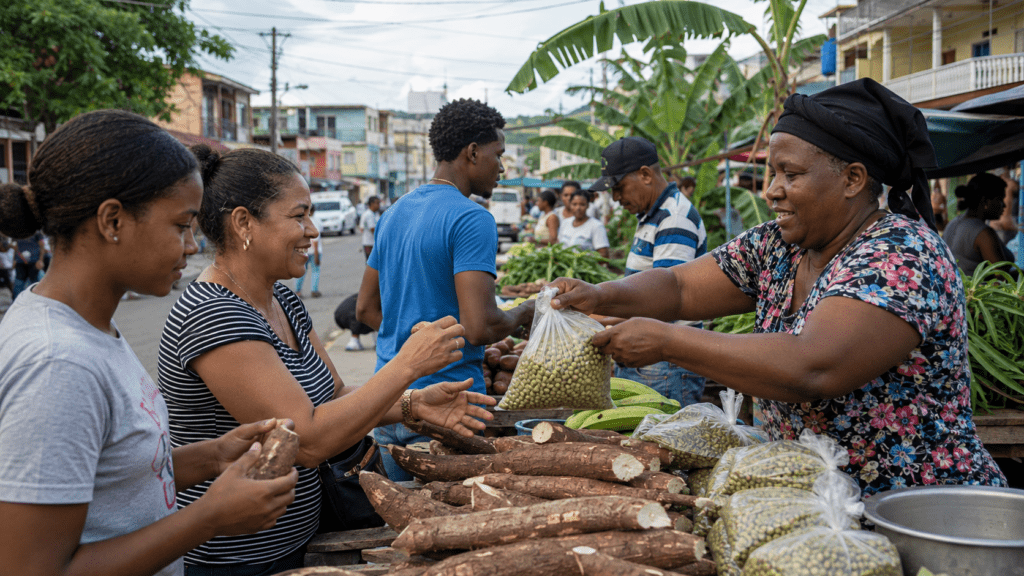
Food provides some of the clearest examples. Words such as yuca, batata, ají, yautía, casabe and maní are associated with Indigenous American vocabulary and became part of the Spanish spoken in the Caribbean.
The influence went beyond the names of individual foods. The Indigenous vocabulary also described the tools and techniques used to process them. The Academia Dominicana de la Lengua identifies terms connected with yuca production, including burén, sibucán and guayo. These words survive because the objects and practices they described remained relevant after Spanish became the dominant language.
Plants and the Natural Environment
The natural environment generated another large group of Indigenous terms. European settlers encountered vegetation and animals that were unfamiliar to them, making Indigenous terminology particularly useful.
Among the examples documented by Dominican lexicographic sources are caoba, ceiba, guayacán, mangle, bejuco, caimito, jagua and guanábana. Other well-known terms include hamaca, canoa, barbacoa, bohío and cacique.
Some of these words eventually became international Spanish. That means their historical origin is Indigenous American even though a speaker in Spain or another Spanish-speaking country may use them without any awareness of their etymology.
Place Names and Historical Memory
Indigenous influence is also preserved in Dominican place names. Toponyms can survive even when the language from which they originated has disappeared. They therefore provide a linguistic record of earlier populations and their relationship with the landscape.
The survival of Indigenous terminology in Dominican Spanish is consequently more than a vocabulary issue. It is also evidence of how the Spanish language adapted to an American environment and incorporated concepts that were already embedded in the island’s Indigenous societies.
African Words in Dominican Spanish
The African contribution emerged under very different historical circumstances. Africans were brought to Hispaniola through the Atlantic slave trade from the early colonial period onward. They arrived from different regions and linguistic communities, meaning that there was never a single “African language” responsible for all African-derived vocabulary in the Dominican Republic.
The Academia Dominicana de la Lengua uses the term Afro-Dominicanisms for words of African origin found in Dominican Spanish and gives examples including fucú, mandinga, guandul, baquiní and quimbamba.
These examples also demonstrate why African influence cannot be reduced to a simple list of words. The vocabulary is connected to beliefs, food, funerary customs, social life and concepts that became part of Dominican culture through interaction between African-descended populations and the wider society.
Guandul and the African Food Vocabulary
Guandul, also commonly heard in the plural guandules, is a particularly useful example. The Academia Dominicana de la Lengua cites sources that connect the term with kikongo wandu, referring to a type of pea, while also noting historical discussion about the route through which the word entered Dominican usage.
This illustrates an important principle of etymology: identifying a word as African in origin does not always tell us exactly when or by which route it reached the Dominican Republic. A word can travel through several Caribbean societies before becoming established in Dominican Spanish.
Fucú and Belief
Fucú is another word documented by Dominican linguistic sources as an Afro-Dominicanism. In Dominican usage it refers to bad luck or a harmful influence. Its cultural importance is greater than its dictionary definition because it belongs to a wider vocabulary of popular beliefs and expressions that developed within Dominican society.
Words such as these demonstrate how African linguistic influence could survive even when the original African languages spoken by enslaved people were not maintained as community languages. Vocabulary can outlive the language from which it came, particularly when the borrowed term becomes associated with a locally established belief or practice.
Bachata and the Importance of Etymological Caution
Bachata provides an especially interesting example because the word and the musical genre have different historical questions attached to them. UNESCO describes the term as presumed to be of African origin and notes that it originally referred to a lively gathering or party rather than specifically to the Dominican musical genre.
That qualification matters. The modern Dominican bachata developed through a complex interaction of musical traditions, including bolero and Afro-Antillean genres. The fact that the word has a proposed African etymology does not mean that the entire musical genre can simply be described as an African import.
The UNESCO description of Dominican bachata makes this distinction particularly clear by describing the music as a fusion of rhythmic bolero with other Afro-Antillean genres while separately discussing the presumed African origin of the word bachata.
Not Every Dominican Word With an African Connection Has a Certain Etymology
African etymology can be difficult to establish because the historical record of the languages spoken by enslaved Africans in the Caribbean is incomplete. People from different African linguistic communities were brought into the region, while colonial records often categorized them according to broad geographic or ethnic labels that do not correspond neatly to individual languages.
For that reason, serious linguistic research distinguishes between documented Africanisms, words whose African origin is probable and words for which the proposed etymology remains uncertain. This is particularly important for popular explanations that attribute a Dominican word to a specific African language without documentary evidence.
The same caution applies to words that exist elsewhere in the Caribbean. A shared word does not necessarily prove that it was borrowed directly from Africa into the Dominican Republic. It may have traveled through another Caribbean society, developed independently or acquired its Dominican meaning after entering Spanish.
Foreign Influences After the Colonial Period
Dominican Spanish continued to change after the earliest Indigenous and African influences. Geographic proximity to other Caribbean societies, political relationships and international economic connections introduced vocabulary from European and North American languages.
The Academia Dominicana de la Lengua specifically identifies French and English as important sources of later lexical influence. These borrowings belong to a different historical process from the Indigenous and African layers because they generally entered Spanish through sustained international contact rather than through the first colonial encounters.
French Influence
French has influenced Spanish throughout the Hispanic world, but the Caribbean’s geographical and historical connections with French-speaking societies created additional opportunities for contact.
Dominican linguistic sources cite examples such as flamboyán, fuete and reportarse among French-related influences in Dominican Spanish. Some foreign terms become so thoroughly integrated into Spanish that speakers no longer perceive them as loans.
This process is not unique to the Dominican Republic. Languages routinely borrow vocabulary when speakers encounter new cultural practices, institutions, technologies or objects. Over time, the borrowed word can be adapted to the receiving language’s pronunciation, spelling and grammar.
English and the Modern Dominican Lexicon
English became an increasingly visible source of vocabulary through the Dominican Republic’s economic, political and cultural connections with the English-speaking Caribbean and, especially, the United States.
The Academia Dominicana de la Lengua gives examples including bómper, chance, guachimán and plomero, the latter connected with English plumber. These forms demonstrate that borrowing does not always preserve the original pronunciation or spelling. Dominican speakers adapt foreign words to the sound system and grammatical patterns of Spanish.
Guachimán is particularly revealing. It derives from the English expression watchman, but its Spanish form and pronunciation make it immediately recognizable as a word that has been domesticated within Dominican Spanish.
Loanwords Become Dominican Through Use
Once a borrowed word becomes established, speakers may stop treating it as foreign. It can take Spanish plural endings, produce derivatives or develop meanings that differ from those found in the source language.
The Academia Dominicana de la Lengua explains this process using older loans such as yuca and casabe. These words entered Spanish because they named realities unfamiliar to the Europeans arriving in the Americas, and they subsequently became fully integrated into Spanish. The same source notes that they can even serve as bases for new Dominican formations such as yuquita and casabero.
This is one of the clearest signs that vocabulary borrowing is not simply a matter of replacing one word with another. The receiving language can make the borrowed term its own.
Foreign Words and Dominican Meanings
Another important feature of Dominican Spanish is semantic adaptation. A word may already exist in Spanish but acquire a distinctive meaning in the Dominican Republic. This is different from borrowing a completely foreign word.
The Academia Dominicana de la Lengua distinguishes between lexical Dominicanisms and semantic Dominicanisms. The first category includes words created within Dominican Spanish, while the second includes Spanish words that acquired a particular Dominican meaning.
Examples include cuero, which in Dominican usage can refer to a prostitute; lámina, which can refer to an attractive woman; gancho, meaning a trap; and chepa, meaning a coincidence or stroke of luck. These are not foreign words in the strict sense, but they demonstrate another way in which contact, creativity and local usage produce a distinctive vocabulary.
Three Major Layers of Dominican Vocabulary
Looking at these influences together reveals three particularly important historical layers. The Indigenous layer reflects the need to name the American environment and the knowledge of the island’s original peoples. The African layer reflects the presence and cultural contribution of African-descended communities. Later foreign loans reflect continuing connections with neighboring Caribbean societies, Europe and the English-speaking world.
| Source | Examples | Historical contribution |
|---|---|---|
| Taíno and Arawakan | yuca, ají, batata, casabe, hamaca, canoa, bohío, caoba | Names for foods, plants, objects, places and aspects of the Indigenous environment. |
| African languages | fucú, guandul, baquiní, quimbamba, bachata* | Vocabulary connected with food, beliefs, social practices and cultural life. |
| French and French-related contact | flamboyán, fuete, reportarse | Later Caribbean and international linguistic contact. |
| English | bómper, chance, guachimán, plomero | Economic, political and cultural contact with English-speaking societies. |
*Bachata is included with an important qualification: UNESCO describes the word’s African origin as presumed rather than certain.
Why the Indigenous Contribution Is Larger Than It First Appears
Many Indigenous words are so deeply established in international Spanish that their origin is easy to overlook. Hamaca, canoa, huracán and barbacoa are not perceived by most modern speakers as foreign vocabulary. Yet their histories are connected with Indigenous languages of the Americas.
This creates an apparent paradox. The most successful Indigenous loans can become the least noticeable ones. A word becomes linguistically ordinary precisely because generations of speakers have used it without needing to think about where it came from.
The Dominican case is particularly significant because the island was one of the first places in the Americas where Spanish came into sustained contact with Indigenous American languages. Some of the vocabulary adopted there subsequently traveled throughout the Spanish-speaking world.
Why African Vocabulary Is Less Easy to Identify
African influence can be less visible to modern speakers because the languages that contributed the words did not survive as dominant community languages in the Dominican Republic. The vocabulary therefore remained embedded within Spanish and Dominican cultural practices rather than forming a separate linguistic system.
There is also a methodological problem. African populations brought to the Caribbean came from multiple linguistic areas, and historical documentation is uneven. Consequently, the safest approach is to rely on words whose proposed African etymologies are supported by recognized linguistic sources rather than creating long lists based on resemblance alone.
This approach also prevents an important misunderstanding: African influence on Dominican Spanish is not measured only by the number of words that can be traced to Africa. Cultural practices, music, foodways and social traditions can influence the meaning and use of Spanish even when the vocabulary itself has a different origin.
Foreign Influence Is an Ongoing Process
Unlike the Indigenous and early African layers, which are primarily historical, foreign lexical influence continues whenever Dominican speakers interact with other linguistic communities. English is particularly significant because of migration, tourism, commerce, media and the large Dominican population living in the United States.
But borrowing does not mean that Dominican Spanish is losing its identity. Languages have always changed through contact. The distinctive feature of Dominican Spanish is not that it has remained untouched by other languages, but that its speakers have repeatedly adapted external vocabulary to local usage.

The same principle explains why a borrowed word can coexist with a Spanish equivalent, replace it in particular contexts or develop a specifically Dominican meaning. Language change is not a one-directional process.
A Vocabulary That Records Dominican History
Dominican vocabulary can be read almost like a historical record. Indigenous words preserve evidence of the societies that inhabited Hispaniola before European colonization. African-derived terms reflect the presence of Africans and their descendants and the cultural systems they helped create. French and English loans reveal later geopolitical, economic and cultural connections.
These layers should not be treated as competing explanations for Dominican Spanish. They are successive and overlapping parts of its development. The Haitian influence on Dominican Spanish vocabulary is another important part of this broader history of linguistic contact on Hispaniola. A single conversation can contain words whose histories stretch across different continents and centuries.
The Diccionario del español dominicano, published by the Academia Dominicana de la Lengua in 2013, documents more than 11,000 entries and more than 14,000 meanings, illustrating the scale of the lexicographic work required to describe Dominican Spanish as a distinct variety.
Frequently Asked Questions
What Indigenous languages influenced Dominican Spanish?
The strongest documented Indigenous layer comes from Taíno, a Caribbean form associated with the broader Arawakan linguistic family. Some words are also identified more broadly as Caribbean or as having uncertain Indigenous affiliation. It is therefore not accurate to attribute every Indigenous American word to Taíno specifically.
Which Dominican words have African origins?
Recognized Dominican linguistic sources identify examples such as fucú, mandinga, guandul, baquiní and quimbamba. The etymology of individual words should be checked separately because the historical routes of African vocabulary into Caribbean Spanish are not always fully documented.
Is bachata an African word?
UNESCO describes the word bachata as presumed to be of African origin and notes that it originally referred to a lively gathering or party. The modern musical genre developed later in the Dominican Republic through a combination of musical influences, so the etymology of the word should not be confused with the complete history of the genre.
What are some Indigenous words still used in Dominican Spanish?
Examples include yuca, ají, batata, casabe, hamaca, canoa, bohío, cacique, caoba, guanábana, maní and guayacán. Many have spread beyond the Dominican Republic and are now part of general Spanish vocabulary.
What foreign languages have influenced Dominican Spanish?
French and English are among the most clearly documented later sources of lexical influence. Dominican linguistic sources also identify a historical maritime vocabulary and contact with other varieties of Spanish as important components of the language’s development.
Why do some foreign words look completely Spanish?
Because borrowed words are normally adapted to the receiving language. Their spelling, pronunciation, plural forms and meanings can change over time. After generations of use, speakers may no longer recognize them as loans.