 24°C
24°C

Dominican Republic World Records
The Dominican Republic has been associated with world records across culture, sports, food, history and mass participation events. Verified examples include the largest merengue dance, the largest bachata dance, major Guinness World Records achieved in Santo Domingo and other Dominican cities, and Marileidy Paulino’s Olympic record in the women’s 400 meters.


The Dominican Republic is known internationally for baseball, merengue, bachata and a distinctive culinary tradition, but the country has also produced or hosted a surprising range of record-breaking achievements. Some are sporting milestones, while others celebrate Dominican music, food, popular traditions and large public events.
Not every record associated with the Dominican Republic is a sporting world record. Guinness World Records, for example, recognizes achievements involving large-scale dances, dominoes, food and historical milestones. In athletics, Dominican athletes have also established important national and international marks, including an Olympic record set by Marileidy Paulino in Paris in 2024.
What World Records Is the Dominican Republic Known For?
Among the best-documented records connected directly with the country are the largest merengue dance, the largest bachata dance, the most people playing dominoes simultaneously, the largest corn pudding and the largest green plantain ball. The country is also associated with a Guinness World Records historical distinction concerning the first permanent European settlement in the New World.
| Record | Achievement | Location | Year |
|---|---|---|---|
| Largest merengue dance | 844 participants | Santo Domingo | 2019 |
| Largest bachata dance | 489 pairs | Santo Domingo | 2021 |
| Most people playing dominoes simultaneously | 3,344 people | Santo Domingo | 2012 |
| Longest relay reading marathon across multiple venues | 1,000 hours, 5 seconds | 155 municipalities | 2012 |
| Largest corn pudding | 858.95 kg | Cotuí | 2024 |
| Largest green plantain ball | 560 kg | Santiago de los Caballeros | 2025 |
The Largest Merengue Dance
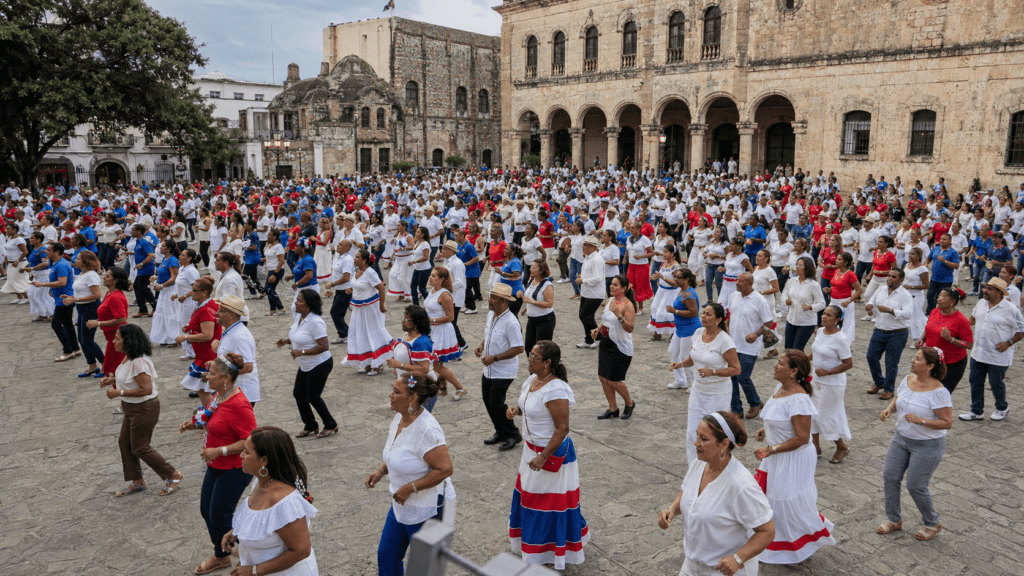
One of the most culturally significant Dominican records is the largest merengue dance. Guinness World Records records 844 participants dancing together at Plaza España in Santo Domingo on 3 November 2019.
The event was organized by AZ Films Producciones and used the song El Merengón. Beyond the number itself, the achievement is notable because merengue is one of the defining musical and dance traditions of the Dominican Republic.
The record demonstrates how a traditional Dominican cultural form can become the basis for a formally measured international record. Santo Domingo provided the setting for a mass event that transformed a familiar national tradition into a Guinness-recognized achievement.
The Largest Bachata Dance
Dominican musical culture produced another major Guinness World Records achievement two years later. On 11 December 2021, AZ Films Producciones organized the largest bachata dance at the Malecón in Santo Domingo, with 489 pairs taking part.
Bachata originated in the Dominican Republic before becoming an international musical and dance genre. The Guinness record therefore has significance beyond the numerical achievement: it connects a globalized form of Dominican culture with the country where the tradition originated.
Participants rehearsed the official choreography for three months before the event, which was organized as part of a celebration of bachata in the Dominican Republic and included a tribute to bachata singer Luis Segura.
Dominoes: A Record Reflecting Dominican Popular Culture
Dominoes are deeply embedded in Dominican social life, and the country has also produced a Guinness record connected with the game. On 22 January 2012, 3,344 people played dominoes simultaneously at an event organized by Luis Alberto Ramirez Feliz in Santo Domingo.
This record is different from the dance achievements because it is based on participation in a recreational activity rather than a performance. Nevertheless, it illustrates how everyday Dominican social traditions can become the basis for internationally recognized records when organized on a sufficiently large scale.
A Reading Marathon Across the Dominican Republic
Another unusual record involved reading rather than sport or entertainment. Guinness World Records lists the longest relay reading marathon across multiple venues as 1,000 hours, 5 seconds.
The achievement involved 931 participants and extended across 155 municipalities in the Dominican Republic. The event was organized by the Ministry of Youth and ran from 20 February to 2 April 2012.
Because the record was conducted across multiple locations, it represented a nationwide participation effort rather than an event confined to a single venue in Santo Domingo.
Dominican Food Records
Food has also provided a recurring theme for Dominican record attempts. Several Guinness World Records achievements have involved traditional ingredients or dishes associated with the country’s cuisine.
Largest Corn Pudding
On 2 November 2024, the Consejo Ecoturístico de la provincia Sánchez Ramírez and SMA Group achieved the Guinness World Records title for the largest corn pudding. The finished creation weighed 858.95 kilograms, or about 1,893.66 pounds, and was prepared in Cotuí, Sánchez Ramírez.
The preparation reportedly required approximately eight hours, followed by around six hours of cooking. The achievement illustrates how local culinary traditions can be transformed into large-scale public events while retaining a clear connection to a particular Dominican province.
Largest Green Plantain Ball
The Dominican Republic also holds a Guinness record for the largest green plantain ball. On 26 July 2025, SMA Group and Amigos Seafood Steakhouse created a green plantain ball weighing 560 kilograms in Santiago de los Caballeros.
Fifty chefs and culinary students participated in the preparation, which took more than five hours. The record is particularly recognizable in the Dominican context because plantains are a fundamental ingredient in many traditional dishes.
Marileidy Paulino and the Olympic Record
Dominican sporting records are particularly prominent in athletics. The most important recent international example is Marileidy Paulino, who won the women’s 400 meters at the Paris 2024 Olympic Games in 48.17 seconds.
That performance was officially recorded by World Athletics as an Olympic record. Paulino surpassed the previous Olympic mark of 48.25 seconds, set by France’s Marie-José Pérec at the 1996 Atlanta Games.
Paulino’s achievement was historic for the Dominican Republic for another reason: World Athletics reported that she became the first woman from the country to win an Olympic gold medal in any sport. Her victory therefore combined an individual sporting record with a major milestone in Dominican Olympic history.
Dominican Athletes and National Records
The country’s athletics record book extends well beyond Olympic records. Dominican athletes have established national records in sprinting, middle-distance running, hurdles, relays and other events.
Among the best-known names is Félix Sánchez, a two-time Olympic champion in the 400-meter hurdles. Luguelín Santos also became one of the country’s leading quarter-milers, while Paulino has established herself among the world’s elite 400-meter runners.
These national records should not be confused with world records. A Dominican national record means the best officially recognized performance by a Dominican athlete in a particular event; a world record is the best performance recognized globally under the governing rules of that sport.
A Historical World Record Connected With the Dominican Republic
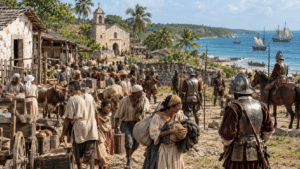
Some records connected with the Dominican Republic are historical rather than athletic or cultural. Guinness World Records lists Isabella, on the island of Hispaniola in what is now the Dominican Republic, as the site of the first permanent European settlement in the New World.
The settlement was established in 1493 during Christopher Columbus’s second voyage. Santo Domingo was founded several years later and eventually became the capital of the Spanish colony on the island.
This distinction requires historical context. The term “first permanent European settlement” refers to European colonial settlement and does not mean that the area was previously uninhabited. Hispaniola was home to Indigenous Taíno societies long before the arrival of Europeans.
Why So Many Dominican Records Involve Culture
A striking feature of the country’s record history is the number of achievements involving collective participation. Merengue, bachata, dominoes and food are all activities that can bring large groups of people together, making them particularly suitable for record attempts.
This also reflects the international appeal of Dominican cultural traditions. A Guinness record can turn a familiar local practice into an event with a clearly measurable achievement, while simultaneously drawing attention to the tradition behind it.
The dance records are especially significant because both merengue and bachata are closely associated with Dominican identity. Their records are therefore not simply numerical curiosities; they document the ability of Dominican cultural traditions to generate large-scale public participation.
Are These Records Still Current?
World records are not permanent. Guinness World Records explicitly notes that records can change and that newly achieved records may not immediately appear online. For that reason, a record listed on a Guinness page should be understood as the verified record associated with that title at the time the source was checked, rather than as a guarantee that no subsequent attempt has surpassed it.
The distinction is particularly important for an evergreen article. A record can be broken without the older achievement disappearing from historical records. When researching a specific record for publication or an official claim, the current Guinness World Records database or the relevant sporting federation should be consulted.
World Records vs. Dominican National Records
The phrase “Dominican record” can refer to two very different things. A Dominican national record is a country’s best performance in a particular discipline, while a world record is the best recognized performance internationally.
For example, a Dominican athlete may hold the national record in an athletics event without holding the world record. Conversely, a Dominican athlete can set an Olympic record without setting a world record, as happened with Marileidy Paulino’s 48.17-second 400 meters in Paris.
This distinction is important when comparing achievements. Olympic records apply specifically to the Olympic Games, whereas world records cover performances recognized under the broader rules of the relevant international federation.