 25°C
25°C

Dominican Republic National Parks Face Forest Loss Warning
Agronomist Gabriel Valdez Sierra has urged stronger environmental protection in the Dominican Republic, warning that continued ecosystem degradation could threaten forests, biodiversity, water resources and agricultural production.


Gabriel Valdez Sierra, a Dominican agronomist and author, is calling for stronger action to protect natural resources and biodiversity as environmental degradation continues to put pressure on forests, soils and water systems.
Speaking during the presentation of his book “Natural Resources and Ecology,” Valdez Sierra warned that the loss of productive land, deforestation and the decline of plant and animal species are creating growing challenges for ecosystems in the Dominican Republic and around the world.
Among the figures cited by the agronomist was an estimate that nearly 61,000 square kilometers of new desert areas emerge each year as productive land becomes degraded. He also pointed to soil erosion, which he said is occurring faster than natural soil formation, as a major threat to long-term agricultural productivity.
Pressure on Forests, Soil and Water
The environmental concerns outlined by Valdez Sierra extend beyond the loss of vegetation. Soil degradation can reduce the productive capacity of agricultural land, while the destruction of tropical forests can weaken ecosystems that support biodiversity and contribute to water regulation.
Rising concentrations of carbon dioxide and other greenhouse gases were also identified as factors that could increase pressure on temperatures, water availability, agriculture and coastal areas. For the Dominican Republic, where forests, watersheds and protected areas are closely linked to water resources and rural production, the condition of natural ecosystems has implications well beyond conservation.
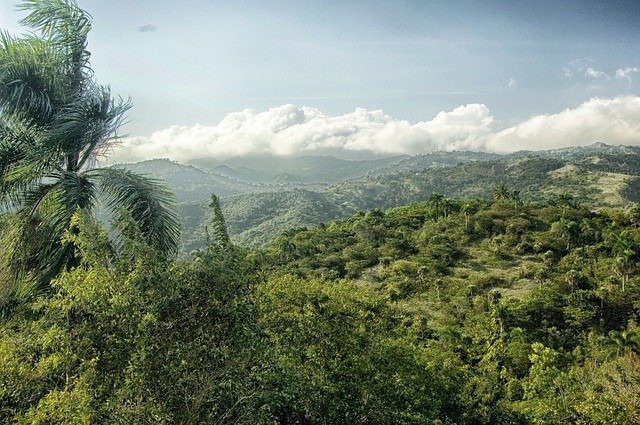
The country’s mountain forests are particularly important because several protected areas safeguard highland ecosystems and the headwaters of major rivers. The José Armando Bermúdez National Park, established in 1956, protects part of the Central Mountain Range and is adjacent to the José del Carmen Ramírez National Park. The protected areas are also associated with Pico Duarte, the highest peak in the Caribbean.
Protected Areas Remain Central to Conservation
Valdez Sierra’s book examines the development of the Dominican Republic’s protected-area system, including the creation of some of the country’s earliest national parks during the 1950s and the subsequent expansion and evolution of conservation efforts through 2020.
These protected landscapes preserve forests, watersheds and habitats for native species while also supporting activities such as scientific research and nature-based tourism. Their condition therefore has environmental and practical consequences for communities and visitors who depend on healthy ecosystems.
The conservation challenge is not limited to national parks. The Dominican Republic and Haiti share ecosystems and watersheds along the island’s border, making cooperation particularly important for biodiversity and climate adaptation.
Binational Conservation Efforts
One example is CAReBIOS, a binational initiative focused on strengthening ecosystem adaptation in the border biosphere reserves shared by the Dominican Republic and Haiti. The project has supported protection, sustainable use, research and environmental education around the La Selle and Jaragua-Bahoruco-Enriquillo biosphere reserves.
Dominican environmental authorities have also reported work under CAReBIOS involving ecosystem restoration, biodiversity research, environmental education and the strengthening of governance structures in protected areas.
For Valdez Sierra, greater public awareness is an essential part of addressing the depletion of natural resources. His call for collective action places the protection of forests and biodiversity alongside soil conservation and climate resilience as interconnected environmental priorities for the Dominican Republic.