 27°C
27°C

Urban Trees Can Help Reduce Heat in Santo Domingo
Research by Universidad Nacional Pedro Henríquez Ureña (UNPHU) shows that tree canopy density, crown size and proper maintenance can significantly improve thermal comfort for pedestrians in Santo Domingo’s public spaces.


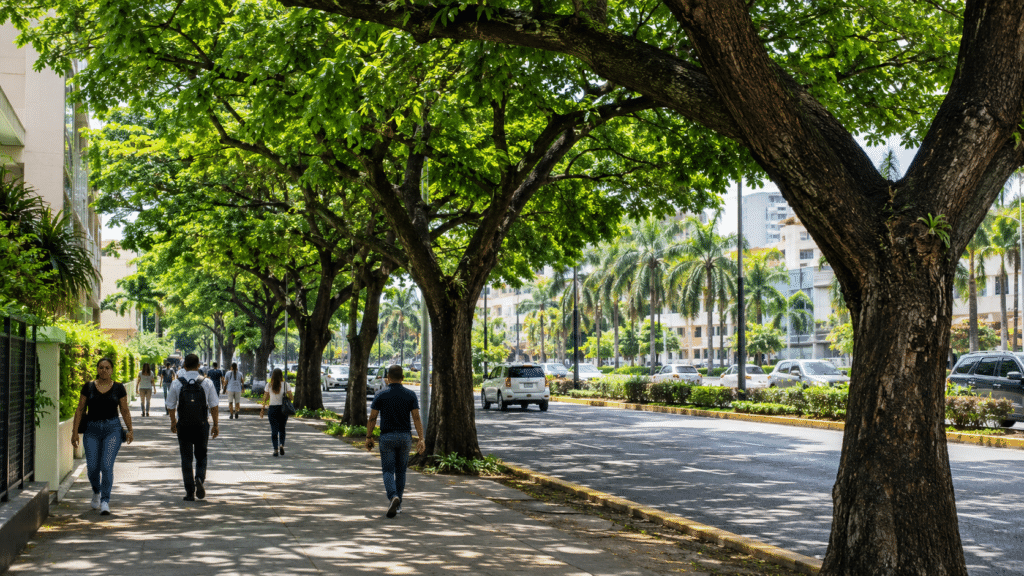
Tree selection and management could play a significant role in reducing heat exposure in Santo Domingo, according to research by the Universidad Nacional Pedro Henríquez Ureña (UNPHU). The study found that the size and density of tree canopies influence radiant temperature and the thermal comfort experienced by pedestrians in urban public spaces.
The research, conducted by Gilkauris Rojas-Cortorreal and Julio Peña of UNPHU’s School of Architecture and Urban Planning, together with Jaume Roset of the Universitat Politècnica de Catalunya in Spain, examined two species found along Winston Churchill Avenue: mahogany and royal palm.
Mahogany Provided Greater Thermal Protection
Both species were found to provide shade and reduce solar exposure, but mahogany performed better in the study because of its greater canopy density and wider crown. Those characteristics allow it to cover a larger portion of the urban environment and limit the amount of heat reaching exposed surfaces.
The study recorded canopy density of approximately 70% for mahogany, compared with 53% for royal palm. During winter conditions, mahogany reduced radiant temperature by as much as 5.5 degrees Celsius, while royal palm produced a reduction of about 1.5 degrees Celsius.
Under summer conditions, the reduction associated with mahogany ranged from 2 to 6 degrees Celsius, compared with approximately 2 to 3 degrees Celsius beneath royal palms. The research also found that both species reduced the amount of solar radiation reaching urban surfaces.
Tree Canopy Size Matters in Urban Planning
The findings indicate that simply increasing the number of trees may not provide the same thermal benefits as selecting species suited to each location. Crown diameter and canopy density are important factors in determining how much shade a tree can provide and how effectively it can limit radiant heat in pedestrian areas.
Proper maintenance is also part of that equation. The researchers warn that inappropriate pruning can substantially reduce foliage density, limiting the tree’s ability to provide shade and deliver environmental benefits. They recommend an urban tree management plan that considers species selection, placement, maintenance and pruning from the earliest stages of tree growth.
“Urban tree planting should be understood as part of the city’s climate infrastructure,” Rojas-Cortorreal said. “The species selected, the size of its crown and the way it is maintained determine how much protection it can provide to pedestrians and how effectively it can reduce surface heating.”
Urban Design Also Influences Heat Exposure
The research places the role of trees within a broader urban environment. Expanding areas of asphalt and concrete, limited soil permeability and planning focused primarily on automobiles can contribute to the urban heat island effect and reduce the habitability of spaces used by pedestrians.
The study evaluated urban morphology, vegetation, microclimate and thermal comfort using a selected road model in Santo Domingo. Field measurements were taken under and outside tree canopies, allowing researchers to compare the thermal conditions associated with each species.
The findings were published in Entrópico: Architecture and Urbanism, a scientific journal published by UNPHU. The research was supported by the Dominican Ministry of Higher Education, Science and Technology (MESCyT) through its master’s and doctoral scholarship program.
For a city where pedestrians experience heat in streets and other exposed public areas, the research points to tree canopy as one component of urban design that can influence thermal conditions. The study’s findings support a more deliberate approach to selecting, placing and maintaining trees as Santo Domingo develops its public spaces.