 23°C
23°C

46 Professionals Certified to Fight Child Labor in Dominican Republic
Forty-six professionals in the Dominican Republic have completed a specialized 100-hour diploma program focused on children's rights and the prevention and eradication of child labor, strengthening the country's network of trained personnel working on child protection.


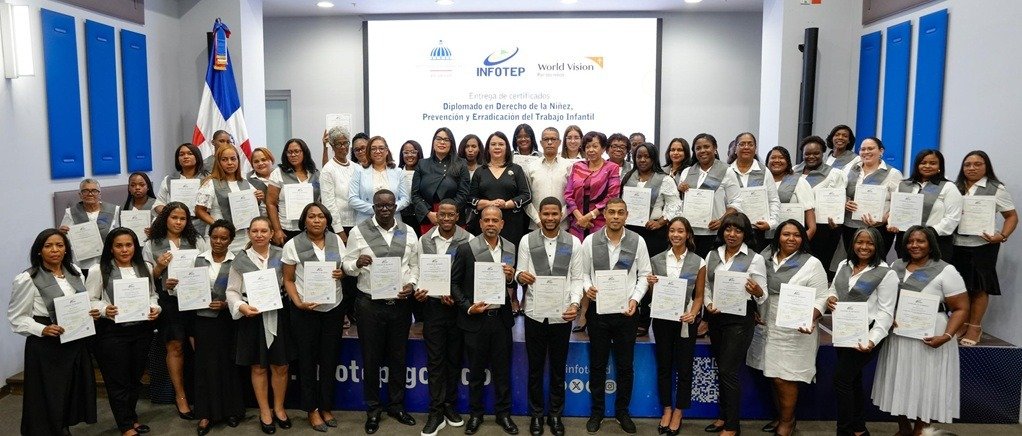
INFOTEP, the Dominican Republic’s National Institute for Technical and Professional Training, has certified 46 professionals who completed a specialized diploma on children’s rights, prevention and the eradication of child labor.
The program was organized in coordination with the Ministry of Labor and World Vision Dominican Republic as part of a broader effort to strengthen the country’s institutional response to child labor through specialized training for professionals involved in protecting children and adolescents.
Training Focuses on Child Protection
The 100-hour diploma program was designed to expand participants’ legal, technical and methodological knowledge related to preventing and eliminating child labor and protecting the rights of children and adolescents.
The curriculum included nine modules covering children’s rights, the national protection and restitution system, child labor and its worst forms in the Dominican Republic, the country’s legal framework, juvenile criminal justice, domestic violence, abuse and exploitation, neglect and violence against children, and positive parenting.
The newly certified professionals belong to INFOTEP’s Valdesia and Oriental regional offices. The organizers said the training is intended to help participants apply their knowledge within their communities, organizations and institutions.
Nearly 200 Professionals Trained Since 2022
The latest graduating group is part of a longer-running collaboration through the Interinstitutional Technical Roundtable for the Eradication of Child Labor. Since 2022, the initiative has delivered nine diploma programs nationwide, benefiting nearly 200 professionals.
The partnership brings together training, government and child-protection organizations around a common objective: improving the capacity of professionals who work directly or indirectly with children and adolescents affected by or vulnerable to child labor.
Labor Vice Minister for Child Labor and Vulnerable Groups Dulce Mercedes Quiñones said eliminating child labor requires trained professionals, coordinated public policies and sustained institutional action.
Institutions Seek Stronger Response to Child Labor
World Vision representative Daniela Romero encouraged the graduates to turn their training into concrete action in their communities and organizations. She said expanding the number of trained professionals increases the collective capacity to protect children and challenge attitudes that can normalize child labor.
INFOTEP Director General Maira Morla Pineda similarly emphasized the broader responsibility associated with the training, describing child protection as a measure of a society’s development and civic commitment.
The initiative reflects an approach that combines professional training with coordination among public institutions and organizations working on children’s rights. For the Dominican Republic, strengthening that network is intended to improve prevention efforts and the identification and response to situations involving child labor.
The institutions involved said they plan to continue promoting specialized training and interagency coordination as tools to prevent and eradicate child labor and strengthen comprehensive protection for children and adolescents.