 22°C
22°C

PLD Economist Warns Rising Costs Are Squeezing Dominican Households
Dominican economist Richard Medina has warned that sustained increases in food and other household expenses are eroding purchasing power among low-income and middle-class families, while also raising operating costs for small businesses.



Richard Medina, an economist and member of the Political Committee of the Dominican Liberation Party (PLD), has raised concerns about the sustained increase in the cost of living in the Dominican Republic, pointing particularly to food prices and their effect on household purchasing power.
Medina said inflation has remained above the upper end of the Central Bank’s target range in recent months. The Dominican central bank reported annual inflation of 5.67% in June 2026, above its 4.0% target with a tolerance range of plus or minus 1 percentage point.
The Central Bank also reported that June’s monthly inflation was driven largely by transportation, food and non-alcoholic beverages, diverse goods and services, and restaurants and hotels. The institution said those groups together accounted for about 90% of the monthly increase in the consumer price index.
Food Prices At The Center Of The Concern
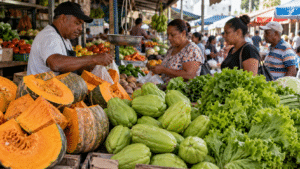
Medina argued that food prices have risen faster than the overall inflation rate, citing increases over the previous year in several commonly consumed products. He said yuca rose 42%, yautía 25%, peppers 22%, beef 14%, green plantains 12%, potatoes 12% and chicken nearly 6%.
“Every day, Dominicans buy less with the same amount of money,” Medina said in a video, arguing that the impact is particularly significant for lower-income households whose budgets leave less room to absorb higher food costs.
The latest official data provide broader context for the concern. While headline inflation stood above the Central Bank’s target range in June, core inflation was 4.96%, remaining within the target range. The Central Bank has attributed recent inflationary pressure in part to higher energy costs and increases in selected food prices.
Middle-Class Budgets Face Multiple Pressures
Medina said the pressure extends beyond groceries and fuel for middle-class households. He pointed to higher school fees, residential maintenance costs and monthly mortgage payments as additional expenses affecting family budgets.
According to his estimate, some middle-class families are spending between 25,000 and 60,000 pesos more each month when increases in food, gasoline, education, residential maintenance and mortgage payments are combined. Medina argued that these additional expenses have become harder to absorb because household salaries have not increased at a comparable pace.
The figures cited by Medina are his assessment of household costs rather than an official estimate of the average increase in family spending. His broader argument centers on the gap between the price of essential goods and services and the pace of wage growth.
Higher Costs Also Put Pressure On Small Businesses
Medina also linked rising household expenses to challenges facing micro, small and medium-sized enterprises, known in the Dominican Republic as MIPYMES. He said businesses are being squeezed by higher input costs at the same time that consumers have less purchasing power.
“When the cost of living rises, operating costs also rise,” Medina said, warning that small merchants and entrepreneurs can become trapped between more expensive supplies and customers with reduced ability to spend.
He argued that the combination can leave some small businesses with limited room to absorb higher costs without raising prices, reducing activity or taking on additional debt.
Inflation Expected To Remain A Key Economic Issue
The inflation debate comes as the Dominican economy continues to expand. The Central Bank reported that economic activity grew 6.4% year over year in June, while average growth for the first half of 2026 reached 4.5%.
At the same time, the Central Bank has indicated that inflation is expected to return to its target range during the fourth quarter of 2026 as the effects of higher international oil prices diminish. That outlook means the evolution of food prices and household purchasing power will remain closely tied to how quickly inflationary pressures ease during the second half of the year.
For Dominican households and small businesses, the issue is not limited to the headline inflation rate. The composition of price increases matters as well, particularly when they affect food, transportation, housing-related expenses and other recurring costs that take up a significant share of monthly budgets.