 22°C
22°C

Dominican Republic Residency Permits Increase 76.6% Between 2018 and 2025
The Dominican Republic has significantly expanded the number of residency permits issued over the past eight years, reflecting sustained growth in long-term migration as more foreign nationals choose the Caribbean nation as a regional destination.


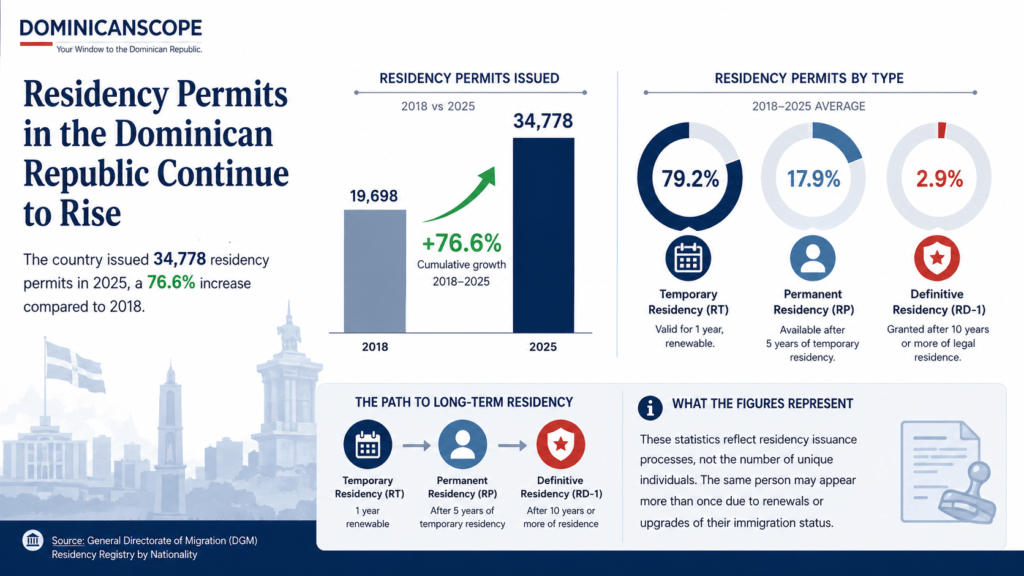
The Dominican Republic issued 34,778 residency permits in 2025, up from 19,698 in 2018, according to data from the General Directorate of Migration (DGM). The increase represents cumulative growth of 76.6% over the period, highlighting a steady rise in the number of foreigners obtaining legal residency in the country.
The figures come from the DGM’s Residency Registry by Nationality and suggest that the Dominican Republic continues to attract migrants seeking to establish a long-term presence in the country rather than pursuing only temporary stays.
Temporary Residency Remains the Main Entry Route
The Dominican immigration system issues three principal categories of residency permits. Temporary Residency (RT) is valid for one year and can be renewed. Permanent Residency (RP) is available to foreign nationals who have maintained temporary residency for at least five years. The final category, Definitive Residency (RD-1), grants a 10-year residence permit to individuals who have lived in the country for 10 years or longer.
Between 2018 and 2025, temporary permits consistently accounted for the largest share of approvals. On average, 79.2% of all residency permits issued each year were temporary, while 17.9% were permanent and 2.9% were definitive residency permits.
A Gradual Path Toward Long-Term Residency
The distribution of permits reflects the structure of the Dominican Republic’s immigration framework, in which most foreign residents initially enter under temporary status before becoming eligible for permanent residency and, eventually, definitive residency after meeting the required years of legal residence.
The data also indicate that the country’s residency system supports a gradual process of legal integration, with relatively few applicants reaching the final stage compared with those entering the system through temporary permits.
Residency Figures Represent Administrative Processes
The DGM notes that the statistics measure residency issuance processes rather than individual migrants. As a result, the same person may appear more than once in the data after renewing or upgrading their immigration status over time.
This distinction means the figures should not be interpreted as the total number of unique foreign residents living in the Dominican Republic, but rather as the volume of residency permits processed across different stages of the country’s immigration system.