 23°C
23°C

Dominican Republic Scams Targeting Expats: A Complete Guide to Staying Safe
Moving to the Dominican Republic can be an exciting opportunity, but adapting to a different legal system, business culture and social environment also creates opportunities for fraudsters. While the vast majority of Dominicans are honest people, expatriates are often perceived as having greater financial resources or less familiarity with local practices. Understanding how common scams work—and learning to recognize their warning signs—can help newcomers avoid costly mistakes and settle into the country with greater confidence.



Every country has scams, and the Dominican Republic is no exception. However, the risks facing expatriates are often different from those affecting local residents. Foreigners frequently arrive without an established network of trusted professionals, may not fully understand local regulations, and sometimes face language barriers. These factors can make them attractive targets for dishonest individuals looking for quick financial gain.
It is important to distinguish between isolated criminal behavior and everyday life in the Dominican Republic. Millions of residents, tourists and expatriates live, work and invest in the country without becoming victims of fraud. Nevertheless, understanding the most common schemes can significantly reduce the chances of becoming one of the exceptions.
Why expatriates are frequently targeted
Most scams directed at foreigners do not rely on sophisticated technology. Instead, they exploit uncertainty, unfamiliarity with local customs and the natural desire to solve problems quickly after arriving in a new country.
Several factors increase vulnerability:
- Limited knowledge of Dominican laws and administrative procedures.
- Difficulty identifying trustworthy lawyers, real estate agents or contractors.
- Language barriers that make contracts or verbal agreements harder to understand.
- The assumption that foreigners have greater purchasing power.
- Pressure to make quick decisions before opportunities supposedly disappear.
These vulnerabilities are not unique to the Dominican Republic. Consumer protection agencies around the world warn that immigrants and expatriates are frequently targeted because they may be unfamiliar with local systems and official procedures. The U.S. Federal Trade Commission, for example, highlights immigration fraud and fake advisory services as recurring risks affecting newcomers.
A common misconception: “Everything is a scam”
Online discussions about life in the Dominican Republic often contain sweeping statements suggesting that fraud is unavoidable. One forum contributor summarized his experience by saying that “you can kick a stone and twenty scammers will come out,” describing situations involving fake land sales, invented family emergencies, inflated beach prices and repeated requests for loans.
Although this reflects one individual’s personal perception rather than objective evidence, it illustrates an important point: many expatriates initially struggle to distinguish between genuine commercial practices, aggressive sales tactics and outright fraud.
A more accurate conclusion is that foreigners should approach unfamiliar transactions with the same level of caution they would use in any country where they lack local knowledge.
The most common scams targeting expatriates
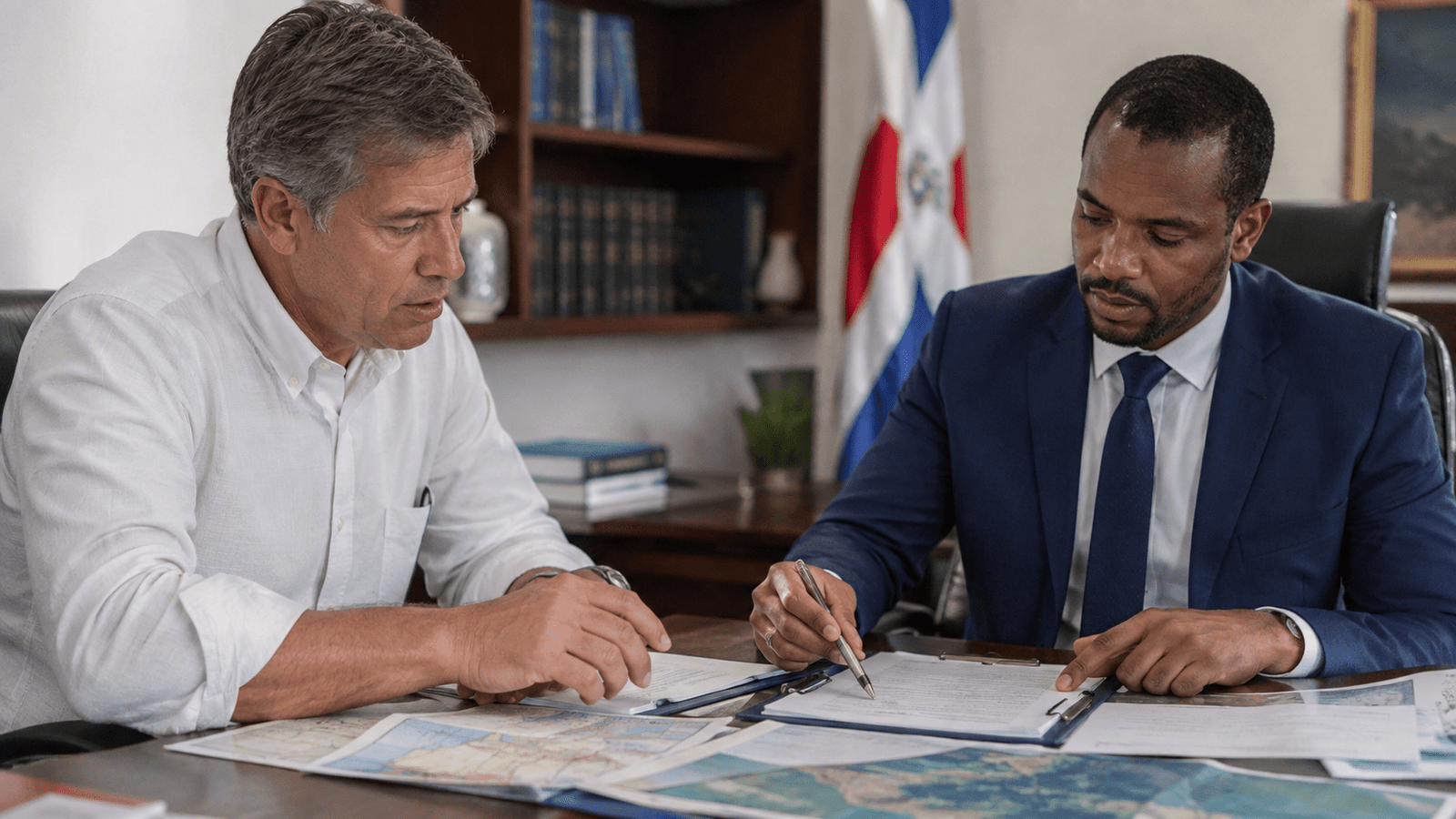
1. Real estate fraud
Property transactions represent some of the largest financial decisions expatriates make. Unfortunately, they are also among the areas where mistakes can be most expensive.
Real estate scams can take many forms, including:
- People attempting to sell land they do not legally own.
- Properties advertised with incomplete or defective ownership documentation.
- Developments promoted before obtaining the necessary permits.
- Fake reservation deposits.
- Pressure to transfer money before proper legal due diligence has been completed.
Dominican authorities have investigated several large-scale real estate fraud cases involving domestic and international buyers, demonstrating that these schemes can affect both locals and foreigners.
For expatriates, one of the biggest mistakes is assuming that a property advertisement or a friendly intermediary guarantees legitimacy. Independent legal verification of title records, ownership history and contractual documentation remains essential before transferring funds.
Warning signs
- Requests for large deposits before legal review.
- Refusal to provide original ownership documentation.
- Pressure to “act today” because another buyer is supposedly waiting.
- Unusually low prices compared with similar nearby properties.
- Reluctance to involve an independent attorney chosen by the buyer.
2. Rental scams
Many expatriates arrange accommodation before arriving in the Dominican Republic. This creates opportunities for fraudsters using copied photographs, fake listings or properties they do not control.
Common tactics include:
- Advertising attractive homes at below-market prices.
- Demanding deposits before viewings.
- Using messaging apps while avoiding video calls or property visits.
- Claiming that immediate payment is necessary because multiple tenants are interested.
International research shows that rental scams commonly rely on urgency, emotional pressure and fabricated reasons why a property cannot be viewed before payment. These techniques are not unique to the Dominican Republic but are particularly risky for people relocating from abroad.
3. Inflated prices for tourists and newcomers
Not every overcharge constitutes fraud, but price discrimination is a frequent complaint among first-time visitors and newly arrived expatriates.
Examples include:
- Unpriced goods or services.
- Restaurants or beach vendors quoting different prices depending on the customer.
- Informal transportation without agreed fares.
- Tourist services where prices are negotiated rather than fixed.
One experienced expatriate participating in an online discussion described receiving unexpectedly high bills at beaches unless prices were confirmed before ordering. While such experiences vary considerably depending on the location and business involved, they illustrate why asking for prices in advance is good practice.
Whenever possible, request prices before accepting any product or service, particularly in informal settings where menus or official price lists are not displayed.
4. Immigration and residency scams
Obtaining residency in the Dominican Republic involves several administrative procedures, official documentation and, in many cases, legal assistance. This complexity creates opportunities for individuals who falsely claim to have special influence within government agencies or promise to accelerate applications in exchange for additional payments.
Common immigration-related scams include:
- Individuals posing as immigration consultants without legal qualifications.
- False promises of “guaranteed” residency approvals.
- Requests for unofficial fees supposedly needed to speed up processing.
- Fake government websites or fraudulent online payment portals.
- Forged residency cards or immigration documents.
The Dominican Republic’s General Directorate of Migration (Dirección General de Migración) clearly establishes official procedures and authorized requirements. Legitimate residency applications follow standardized administrative processes and cannot be guaranteed through unofficial intermediaries.
Any person claiming to have special access to immigration officials or offering unusually fast approvals in exchange for additional payments should be treated with caution.
Warning signs
- Requests for cash payments without official receipts.
- Promises that “connections” inside government agencies will guarantee approval.
- Pressure to avoid using official procedures.
- Refusal to provide written contracts or invoices.
- Websites that imitate official government pages.
Financial scams and investment fraud
Foreign retirees and investors are frequent targets of financial fraud because they are often perceived as having retirement savings, investment capital or regular foreign income.
Common schemes include:
- Guaranteed high-return investments.
- Real estate developments promising unrealistic returns.
- Foreign exchange or cryptocurrency schemes.
- Ponzi or pyramid investment programs.
- Business opportunities requiring large upfront investments.
One of the most reliable warning signs is the promise of exceptionally high returns with little or no risk. Legitimate investments always involve some level of uncertainty, and no reputable financial advisor can guarantee unusually high profits.
Before investing significant amounts of money, expatriates should verify whether financial institutions are regulated by the appropriate Dominican authorities and seek independent professional advice.
Requests for personal loans and financial assistance
Long-term expatriates often report repeated requests for loans or financial help from people they have recently met. These requests may begin with genuine friendship before gradually becoming financial.
Common stories include:
- A relative who urgently needs medical treatment.
- School tuition that must supposedly be paid immediately.
- A temporary emergency that requires a short-term loan.
- Promises to repay money after receiving an expected payment.
Many requests are undoubtedly genuine, particularly among close friends and family members. However, expatriates should remember that emotional stories are also widely used by scammers because they create pressure to act quickly without verifying the facts.
Several experienced foreign residents recommend establishing personal boundaries early and avoiding lending money to people they have only recently met.
Online scams affecting expatriates
Like residents in virtually every country, expatriates in the Dominican Republic are increasingly targeted through digital fraud rather than face-to-face encounters.
These include:
- Phishing emails impersonating banks.
- Fake delivery notifications.
- Romance scams.
- Investment scams promoted through social media.
- Fraudulent online marketplaces.
- Identity theft.
Cybercriminals frequently combine publicly available personal information with convincing messages designed to create urgency.
For example, an email may claim that your Dominican bank account has been temporarily suspended and ask you to click a link to verify your identity. In reality, the link directs users to a fake website designed to steal login credentials.
Contractor and home repair scams
Foreign homeowners sometimes experience problems when hiring builders, contractors or maintenance workers without adequate references.
Common issues include:
- Large advance payments followed by abandoned projects.
- Poor-quality materials substituted for those originally agreed.
- Constant requests for additional payments.
- Projects left unfinished after receiving deposits.
These situations are not unique to expatriates, but newcomers unfamiliar with local business practices may find it more difficult to identify reliable contractors.
Obtaining multiple quotations, requesting written contracts and verifying previous work can significantly reduce these risks.
Taxi and transportation scams
Transportation-related disputes generally involve price inflation rather than sophisticated fraud.
Examples include:
- Charging tourists significantly higher fares.
- Claiming that meters are unavailable.
- Changing agreed prices after arriving.
- Taking unnecessarily long routes.
Ride-hailing applications and authorized transportation services have reduced many of these problems in major cities, although travelers should still verify fares before beginning journeys whenever fixed prices have not already been established.
Counterfeit products and fake branded goods
Street markets, informal vendors and some tourist areas may offer products advertised as authentic international brands at unusually low prices.
These products frequently include:
- Luxury watches.
- Designer clothing.
- Perfumes.
- Electronics.
- Sports merchandise.
In many cases, buyers understand they are purchasing replicas. Problems arise when counterfeit goods are deliberately presented as genuine products at prices intended to mislead foreign buyers.
If authenticity matters, purchasing from authorized retailers remains the safest option.
Who is most vulnerable?
While anyone can become the victim of fraud, experience shared by expatriate communities and consumer protection organizations suggests that certain groups face greater risks.
New arrivals
People who have recently relocated often need housing, transportation, banking services, legal assistance and immigration advice simultaneously. This creates multiple opportunities for dishonest individuals to exploit unfamiliarity with local procedures.
Retirees
Retirees may have accumulated savings, pension income or proceeds from property sales abroad, making them attractive targets for financial scams and investment fraud.

Non-Spanish speakers
Language barriers can make contracts, legal documents and verbal agreements more difficult to evaluate independently.
Remote workers and digital nomads
Although generally comfortable with online services, digital nomads remain vulnerable to phishing attacks, fake rental listings and fraudulent online marketplaces when relocating between countries.
Warning signs that should never be ignored
Although scams vary widely, many share the same behavioral patterns. Learning to recognize these warning signs is often more effective than memorizing individual fraud schemes.
Be especially cautious if you encounter any of the following:
- Pressure to make an immediate decision.
- Requests for large cash payments or bank transfers before receiving documentation.
- Promises of guaranteed results or unusually high financial returns.
- Refusal to provide written agreements, contracts or official receipts.
- Excuses for why independent lawyers, notaries or translators are unnecessary.
- Prices that seem dramatically lower than comparable offers.
- Requests to keep a transaction confidential.
- Reluctance to answer reasonable questions or provide supporting documentation.
- Attempts to exploit sympathy through dramatic personal stories that require immediate financial assistance.
None of these warning signs automatically indicate fraud. However, when several appear together, the safest approach is to pause the transaction and seek independent advice before proceeding.
How to protect yourself as an expatriate
Avoiding scams is rarely about being suspicious of everyone. Instead, it involves developing habits that reduce unnecessary risk while allowing you to enjoy life in the Dominican Republic.
Take your time
Fraudsters often rely on urgency. Whether buying property, signing a lease or investing money, avoid making important decisions under pressure.
Verify independently
Do not rely solely on recommendations from the person selling a product or service. Whenever possible, verify documentation independently and seek advice from professionals who have no financial interest in the transaction.
Use reputable professionals
Lawyers, accountants, immigration specialists and real estate agents should have established reputations and verifiable professional credentials.
Keep written records
Save contracts, invoices, payment confirmations and written communications. Proper documentation can be invaluable if a dispute arises later.
Avoid carrying large amounts of cash
Electronic payments through established financial institutions generally provide better records than cash transactions.
Learn basic Spanish
Even a modest understanding of Spanish can significantly reduce misunderstandings and make it easier to identify inconsistencies during conversations or negotiations.
Build a trusted local network
One of the best protections against fraud is developing relationships with trustworthy residents and long-term expatriates who can recommend reliable professionals and explain local business practices.
What to do if you believe you have been scammed
If you suspect you have become the victim of fraud, acting quickly may improve the chances of recovering losses or preventing further damage.
Recommended steps include:
- Stop making additional payments until the situation has been clarified.
- Collect contracts, receipts, emails, screenshots and other evidence.
- Contact your bank immediately if financial accounts may have been compromised.
- Report identity theft or cybercrime to the appropriate financial institutions.
- Seek legal advice if significant amounts of money are involved.
- Report suspected criminal activity to the Dominican authorities when appropriate.
Even when financial recovery is not possible, reporting fraud may help prevent others from becoming victims.
Common myths about scams in the Dominican Republic
Myth: Every foreigner will eventually be scammed.
Reality: Many expatriates live in the Dominican Republic for years without experiencing significant fraud. Good preparation, realistic expectations and careful decision-making greatly reduce risk.
Myth: Only tourists are targeted.
Reality: Tourists may face certain scams more frequently, but long-term residents can also become targets, particularly in areas such as real estate, construction and investments.
Myth: Speaking Spanish completely eliminates the risk.
Reality: Language skills certainly help, but even fluent Spanish speakers can become victims if they fail to verify documents or rush important decisions.
Myth: Every price difference is a scam.
Reality: Prices can legitimately vary depending on location, season, quality and negotiation. A higher price does not necessarily indicate fraudulent intent, although transparency should always be expected.
Frequently Asked Questions
Is the Dominican Republic safe for expatriates?
Yes. Thousands of foreigners successfully retire, work, invest and raise families in the Dominican Republic. As in any country, exercising reasonable caution and understanding local conditions significantly improves personal safety.
Are property scams common?
Real estate fraud does occur, particularly when buyers skip legal due diligence or rely exclusively on informal recommendations. Independent legal verification remains one of the best protections.
Should I hire a lawyer when buying property?
Yes. Independent legal representation is strongly recommended for any significant real estate transaction, especially for foreign buyers unfamiliar with Dominican property law.
Are tourists charged higher prices?
In some informal markets and tourist areas, foreigners may be quoted higher prices than local residents. Asking for prices in advance and using businesses with transparent pricing helps reduce misunderstandings.
What is the best defense against scams?
The most effective protection combines patience, independent verification, written documentation and advice from trusted professionals. Fraudsters typically succeed when they convince people to act quickly without verifying the facts.
Final thoughts
Living in the Dominican Republic can be an enriching experience, and millions of visitors and expatriates enjoy the country every year without encountering serious problems. However, relocating to a new country inevitably involves a learning curve, particularly when navigating unfamiliar legal systems, business practices and social norms.
Rather than approaching every interaction with suspicion, expatriates are better served by developing informed habits: verify important transactions, seek independent professional advice, understand local procedures and resist pressure to make hurried decisions.
Most scams rely less on sophisticated deception than on exploiting trust, urgency or unfamiliarity. By recognizing these tactics and preparing accordingly, newcomers can greatly reduce their exposure to fraud while focusing on what brought them to the Dominican Republic in the first place: building a successful and rewarding life in one of the Caribbean’s most dynamic countries.