 25°C

WHO Advisers Urge Broader HPV Vaccine Access as Dominican Republic Expands Its Program
The World Health Organization's vaccine advisers say countries may consider vaccinating girls as young as four against human papillomavirus (HPV) if doing so improves immunization coverage. The recommendation comes as the Dominican Republic expands its national program, which already includes girls and boys ages 9 to 14, and works to prevent cervical cancer.


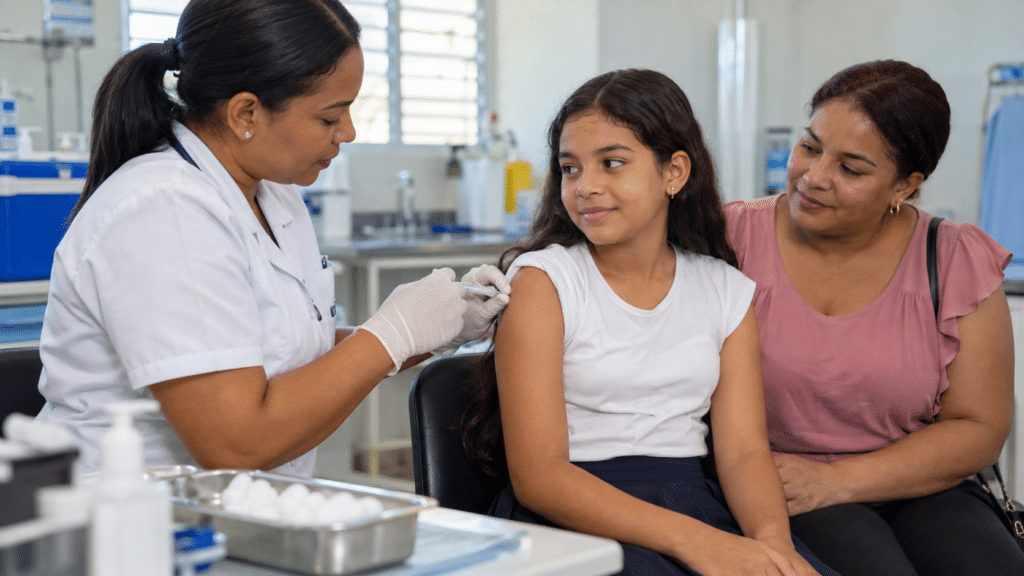
The World Health Organization (WHO) is urging countries to consider additional strategies to increase HPV vaccination, including routine immunization for girls ages 4 to 8 when starting at a younger age could help raise coverage. For the Dominican Republic, the guidance adds to an ongoing public health effort to prevent cervical cancer and protect children before they are exposed to the virus.
The recommendation was presented on October 13 by Anthony Scott, chair of the WHO’s Strategic Advisory Group of Experts on Immunization (SAGE). Although 165 countries have introduced HPV vaccines, global coverage remains at 33%, well below the international target of 90%.
The proposal does not replace the priority recommendation to vaccinate girls ages 9 to 14. Instead, it gives countries another potential option if offering the vaccine to younger children helps more eligible girls receive protection.
What the WHO guidance means for the Dominican Republic
The Dominican Republic introduced HPV vaccination for girls ages 9 to 14 in 2017. In April 2025, the Pan American Health Organization (PAHO) reported that the country had expanded its program to include boys in the same age group.
That expansion is significant because HPV can cause several types of cancer and genital warts in both women and men. It also highlights the importance of vaccines in the Dominican Republic as a public health measure to prevent disease and protect people of different ages. Vaccinating boys as well as girls can broaden protection against HPV and support prevention efforts across the population.
According to PAHO, the country has also maintained a National Plan for the Elimination of Cervical Cancer since 2020. In August 2026, the organization reported that the Ministry of Public Health and the National Health Service were advancing a pilot project to introduce HPV testing as a primary screening method in first-level health care facilities in the provinces of Elías Piña and Dajabón.
The WHO’s latest advice does not, by itself, change the Dominican Republic’s national vaccination schedule. Any decision to extend routine vaccination to girls ages 4 to 8 would need to be made by the country’s health authorities, taking into account local needs, evidence and program capacity.
Why HPV vaccination is important
Human papillomavirus is a common infection that can spread through sexual contact. Most infections clear naturally, often without symptoms. However, persistent infection with certain high-risk types can cause cellular changes that may eventually develop into cancer.
HPV is the leading cause of cervical cancer. The disease remains a major global public health concern because it can often be prevented through vaccination and detected early through screening.
PAHO reported that the Dominican Republic recorded 967 new cervical cancer cases and 622 deaths in 2022, citing figures from the International Agency for Research on Cancer’s Global Cancer Observatory. Those figures underline the importance of prevention, timely screening and access to treatment.
Why experts are considering vaccination at younger ages
The WHO’s primary target remains girls ages 9 to 14, when vaccination can provide protection before exposure to HPV. However, experts say countries may consider offering the vaccine to girls ages 4 to 8 if this approach helps improve participation and overall coverage.
According to SAGE, updated evidence also supports a single-dose schedule as an efficient approach for girls ages 9 to 14 to help countries reach the global coverage target. The WHO had already endorsed a one-dose option in 2022 for this age group.
The objective is to simplify vaccination programs and reach more children, particularly where logistical barriers, missed appointments or limited access to health services prevent families from completing recommended immunization.
Nevertheless, the proposed younger age range should not be interpreted as an instruction for parents to arrange vaccination independently or as confirmation that the Dominican Republic has already adopted a new schedule. Families should follow the guidance issued by the Ministry of Public Health and consult authorized vaccination services about eligibility.
Vaccination and screening work together
HPV vaccination is a central tool for preventing cervical cancer, but it does not eliminate the need for screening. Vaccines protect against important cancer-causing HPV types, while screening can identify infections or precancerous changes that require medical follow-up.
PAHO recommends that countries work toward vaccinating 90% of girls against HPV by age 15, screening 70% of women with a high-performance test by ages 35 and 45, and ensuring that 90% of women with precancerous lesions or invasive cervical cancer receive appropriate treatment.
In the Dominican Republic, expanding access to vaccination for both girls and boys, strengthening screening services and improving public awareness are complementary measures. The WHO’s latest guidance opens the door to considering an earlier vaccination age, but the immediate priority remains ensuring that children in the currently recommended groups receive their vaccines.
Parents and caregivers can consult the Pan American Health Organization’s HPV vaccine guidance for information about eligibility, recommended vaccination ages and the role of immunization in preventing HPV-related cancers.