 27°C
27°C

Dominican Republic Advances High-Grade Scoliosis Surgery
A medical team led by spine surgeon Carlos Rodríguez has performed the Dominican Republic’s first navigated high-grade scoliosis surgery using O-arm technology, bringing advanced intraoperative imaging and navigation to a complex spinal procedure at Clínica Abreu.


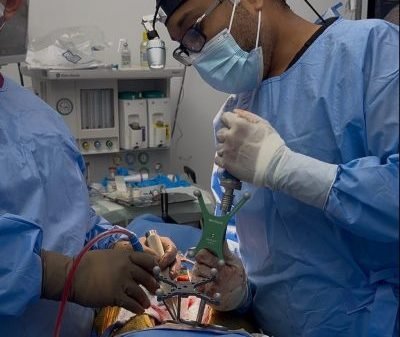
A team of specialists led by spine surgeon Carlos Rodríguez has performed what was described as the first high-grade scoliosis surgery in the Dominican Republic navigated with O-arm technology. The procedure took place at Clínica Abreu and incorporated real-time intraoperative imaging with the StealthStation S8 navigation platform.
The combination of three-dimensional imaging and surgical navigation is designed to give the medical team updated anatomical information during the operation. In complex spinal deformity procedures, that information can help guide the placement of surgical instruments with greater precision.
Real-Time Imaging During Complex Spine Surgery
The O-arm system allows surgeons to obtain three-dimensional images during an operation rather than relying exclusively on images acquired before the procedure. Those images can then be integrated with the StealthStation S8 platform, connecting the intraoperative anatomy with specialized navigated instruments.
Rodríguez said the technology expands the options available for treating patients with complex spinal deformities by providing current anatomical references throughout the procedure. The approach is particularly relevant in high-grade scoliosis surgery, where significant spinal deformity can make orientation during the operation more challenging.
Navigation Applied to Severe Spinal Deformities
High-grade scoliosis involves substantial curvature and deformation of the spine, making accurate identification of vertebral structures an important part of surgical planning and execution. Navigation systems can provide the surgeon with updated references while instruments are being positioned, helping guide different stages of the procedure.
For patients undergoing surgery for severe vertebral deformities, the integration of intraoperative imaging with navigation represents an additional technological tool for complex cases. Its use does not replace the surgical expertise required for these procedures, but provides the medical team with additional information while the operation is underway.
A New Capability for Spine Surgery in the Dominican Republic
The procedure at Clínica Abreu marks the introduction of this combination of advanced imaging and navigation into a high-grade scoliosis operation in the Dominican Republic. It reflects the growing availability of precision technologies for specialized spinal surgery in the country.
The development is also relevant to patients seeking complex spine care in the Dominican Republic, where access to advanced intraoperative technologies can broaden the range of procedures that specialized medical teams can perform locally. The significance of the intervention lies in the application of these tools to a severe spinal deformity rather than in the technology alone.