 28°C
28°C

Youth Migration in the Dominican Republic: What Rural Students Want
A 2026 study of 124 high school students in El Cercado, a rural municipality in San Juan province, offers a detailed look at why young Dominicans consider leaving their hometowns, what they hope to find elsewhere and why many still expect to return. The research found that 62% said they planned to move away after high school, while 84% said they expected to return at some point; education was particularly important to female students, while male students placed greater emphasis on jobs and business opportunities. The findings describe migration intentions, not completed migration, but they provide a useful window into the pressures shaping the future of rural communities.


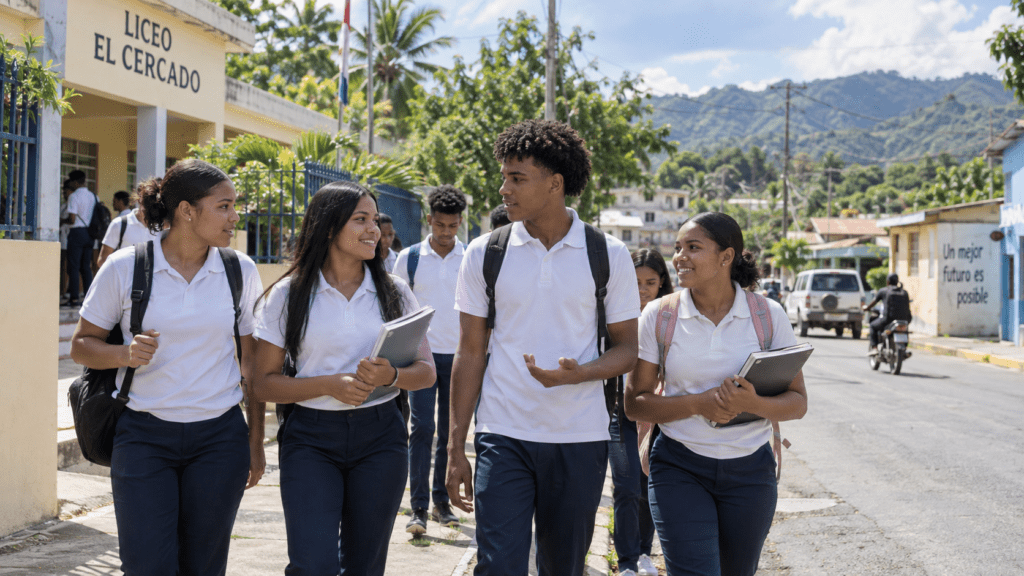
A new study of young people in rural Dominican Republic suggests that migration is not necessarily a rejection of home. For many students in the municipality of El Cercado, in the southwestern province of San Juan, leaving appears to be viewed as a way to obtain education, employment and better living conditions before potentially returning with new skills, resources or opportunities.
The study, published in Heliyon in 2026 by researcher Truc T. Ngo, examined the aspirations and migration perspectives of high school students in El Cercado. Its findings are particularly relevant because they distinguish an important but often overlooked issue: wanting to leave is not the same as actually migrating. The survey measured students’ plans and intentions after secondary school; it did not track whether those students subsequently moved, where they went or whether they eventually returned.
What the Study Investigated
The research focused on youth in El Cercado, a rural municipality in San Juan province. According to the Dominican Republic’s National Statistics Office, known by its Spanish acronym ONE, the municipality had 17,987 residents in the 2022 census. The municipality is part of the El Valle region and includes the municipal districts of Derrumbadero and Batista.
Ngo’s research sought to understand how students viewed their future careers, whether they expected to remain in El Cercado after finishing high school, why they might leave, what could persuade them to stay and whether they envisioned returning after an initial departure.
The research team administered a 20-question survey to 124 students at three high schools in El Cercado. The questionnaire covered demographic and household characteristics, educational and career aspirations, intentions to stay or leave, reasons for those choices and perceptions of the role of local government, community leaders and outside organizations.
The study was therefore relatively small and geographically specific. Its results should not be interpreted as a statistical portrait of all Dominican youth, nor as evidence that the same percentages apply throughout the country. Instead, the research provides a detailed case study of aspirations among high school students in one rural Dominican municipality.
A Rural Economy Where Agriculture Still Matters
El Cercado’s economic setting is important for understanding the students’ answers. The study describes agriculture as a primary source of employment in the area and notes that many families are connected to farming. At the same time, the researchers found that students’ own career ambitions generally extended well beyond traditional agricultural occupations.
This tension reflects a broader challenge identified by the Economic Commission for Latin America and the Caribbean, or CEPAL. A 2024 CEPAL study on rural youth in the Dominican Republic found that structural gaps continue to affect rural territories even as the country’s economy and food system have undergone major changes. The organization identified employment, rural well-being and access to opportunities as central issues for young people’s transition into adult life.
The Dominican Ministry of Agriculture has also documented the economic importance of agricultural activity in San Juan. In one official account, the ministry described irrigation infrastructure serving agricultural producers in communities including El Cercado and neighboring areas, illustrating the continuing role of farming in the province’s rural economy.
For the students surveyed by Ngo, however, agriculture was rarely the career they imagined for themselves. The study reports that students commonly aspired to become engineers, teachers, lawyers, business owners and medical professionals. Only one respondent identified farming as a desired career.
That does not mean the students rejected agriculture or their communities. Rather, the findings suggest a gap between the economic structure they inherited and the professional opportunities they associate with their own futures.
Most Students Wanted More Education After High School
One of the clearest findings was the strength of educational aspirations. Ninety-one percent of the surveyed students said they hoped to attend college or vocational school after completing high school.
The result is significant because students in El Cercado face a practical geographic constraint: the study describes primary and secondary education as available locally but says students seeking further education generally have to leave the municipality.
For young people who want to continue studying, therefore, education itself can become a reason to move. Migration in this context is not necessarily driven by an immediate desire to establish a permanent life elsewhere. It can be part of a longer strategy in which a student leaves temporarily to acquire qualifications that are difficult to obtain locally.
The distinction matters for policymakers. If a young person leaves because a desired degree or technical program is unavailable locally, simply encouraging that person to remain may not address the underlying reason for departure. The study instead points toward the importance of expanding educational access and creating credible employment pathways within rural communities.
Gender Differences Were Especially Visible in Education and Work
The study found notable differences between male and female students in the reasons associated with their aspirations and migration intentions.
All of the female students surveyed said they planned to pursue higher education. Female respondents also showed a stronger tendency to consider leaving El Cercado after high school in order to obtain educational opportunities elsewhere.
Male students, by comparison, placed greater emphasis on employment and business opportunities. The study reports that male respondents were substantially more likely than female respondents to identify job opportunities in El Cercado as a reason to stay and employment or business opportunities elsewhere as reasons to leave.
More than 70% of female students said they planned to move away, compared with 55% of male students. The researchers also found that female students were more likely to cite educational opportunities elsewhere as a reason for leaving.
These differences should not be interpreted as proof that gender itself causes migration. The study identified patterns and associations within a relatively small sample. It did not establish a causal relationship between gender and migration behavior.
The researchers also identified a second gender-related issue: the surveyed student body itself contained more males than females. Of the 124 respondents, 58% identified as male, 38% as female and 4% did not provide a gender identity. The authors noted that this distribution differed from the gender composition of the municipality and said the study did not investigate the specific causes of the disparity in school attendance.
The study discusses household responsibilities and other social factors as possible explanations, but these are presented as issues requiring further investigation rather than as conclusions established by the survey.
Leaving Does Not Necessarily Mean Abandoning Home
Perhaps the study’s most important finding is the relationship between migration intentions and attachment to the community.
When students were asked whether they planned to stay in El Cercado after high school, 72% said no. When asked separately whether they planned to move away, however, 62% said yes.
The difference between those figures is important. It indicates that the students’ responses did not translate into a single, perfectly consistent measure of intended movement. Some students may have been uncertain, may have interpreted the questions differently or may have wanted to leave without having the resources to do so.
For that reason, the 62% figure should be understood as a measure of stated migration intention, not a prediction that 62% of the students will actually migrate.
The distinction is central to migration research. An aspiration expresses a desired future. An intention generally indicates a stronger expectation or plan, but neither guarantees that movement will occur. Financial constraints, family responsibilities, education costs, employment opportunities, immigration requirements and other circumstances can prevent people from acting on their plans.
Most Students Who Wanted to Leave Also Expected to Return
The study found that 84% of the surveyed students said they planned to return to El Cercado after an initial departure.
The main reason for returning was the desire to help the community grow and develop. Other motivations included family obligations, establishing businesses and making shorter visits.
This finding changes the way the migration question can be understood. The students were not simply describing a choice between staying forever and leaving forever. Many appeared to imagine a sequence: leave to improve their prospects, acquire education or work experience, and then return with greater capacity to contribute at home.
The study found some gender differences in those return aspirations as well. A somewhat larger share of female students than male students said they wanted to return to help the community grow and develop or to establish new businesses. Male students were more likely to describe returning only for short-term visits. These differences should again be treated as observations from the study rather than general rules about Dominican men and women.
Why Better Living Conditions Matter
For students who considered staying in El Cercado, the most prominent motivation was not simply employment. The study identified better living conditions as the leading factor that students believed could encourage young people to remain, followed by more job opportunities and access to higher education.
This is consistent with the broader picture described by CEPAL, which has emphasized the structural barriers facing rural youth in the Dominican Republic. The issue is not simply whether young people have a job; it also concerns whether their communities offer enough educational, economic and social opportunities to make staying a realistic choice.
The implication is that rural retention cannot be reduced to a single policy intervention. A student may have access to secondary school but not a university program. Another may have a family farm but lack access to markets, technology or financing. A third may find employment but still leave because the available jobs do not match long-term professional ambitions.
The students’ responses point toward a combination of opportunities rather than a single solution.
The Study’s Findings on Household Circumstances
Household conditions were also part of the research. Fifty-two percent of students described their household socioeconomic status as average relative to other households in El Cercado, while 33% described it as below average.
Most respondents, 85%, said they were financially supported by their parents at the time of the survey, and 62% expected to continue receiving financial and living support after completing high school.
The researchers found a statistically significant association between household socioeconomic status and some career ambitions, although the study did not find a statistically significant overall relationship between gender and socioeconomic status. Students aspiring to teaching or who were undecided about their careers tended to come from lower socioeconomic households, while medical-career aspirations appeared more common among students from higher-income households. The latter group was small, however, so the result should be interpreted cautiously.
These findings reinforce the importance of treating migration decisions as part of a broader household and economic context. Young people’s aspirations do not exist independently of the resources available to their families.
What the Findings Mean for Rural Development
The research raises a broader question for the Dominican Republic: what happens to rural communities when ambitious young people believe that their best path to education or professional advancement requires leaving?
If those young people leave permanently, rural communities can lose part of the future workforce needed to operate businesses, schools, farms, health services and local institutions. If they leave temporarily and return with qualifications, savings or business experience, migration can instead become part of a development cycle.
The study’s 84% return intention is therefore especially relevant. It suggests that the challenge may not simply be to prevent young people from leaving. In some cases, a more realistic objective could be to create conditions that make education-related or employment-related mobility compatible with eventual return.
That interpretation is consistent with wider research on migration and development in the Dominican Republic. An OECD study carried out with Dominican institutions found that migration affects multiple areas of national development, including labor markets, agriculture, education, investment, financial services, social protection and health. It also concluded that the country’s development policies could make better use of the links between migration and development.
Migration Is Already Part of the Dominican Economy
The significance of youth migration extends beyond individual decisions. The Dominican Republic has a large diaspora whose economic relationship with the country is visible through remittances.
The World Bank reports that the Dominican Republic recorded net migration of -35,306 in 2025, while remittances received represented 9.7% of gross domestic product. These figures describe national migration and economic patterns, not the students in El Cercado, and they should not be used as evidence that the students will follow the same trajectories.
The country’s central bank maintains official series covering remittances by month, source country and receiving province, underscoring the importance of migration-related financial flows in the national economy.
The International Monetary Fund reported that remittances to the Dominican Republic reached 8.6% of GDP in 2024 and that the United States accounted for close to 85% of remittance inflows that year.
These national figures provide context, but they do not establish a direct connection between the El Cercado students and remittance flows. The study did not investigate whether respondents had relatives abroad, whether they expected to receive or send remittances, or whether remittances influenced their decisions.
Why Agriculture Still Matters to the Migration Question
The students’ limited interest in farming is notable because agriculture remains important to the rural economy of San Juan. The Ministry of Agriculture has documented agricultural production and irrigation infrastructure serving communities in and around El Cercado, while the study itself describes farming as a major source of employment for local households.
At the same time, CEPAL’s research on rural youth identifies a changing food system and persistent structural gaps between rural territories and major urban centers. That combination helps explain why a young person can recognize agriculture as economically important while still aspiring to a career outside farming.

For rural development, the issue is therefore not simply whether young people should become farmers. A more diversified rural economy could create opportunities in agricultural technology, processing, logistics, commerce, professional services and entrepreneurship alongside traditional production.
Such diversification could also allow young people who acquire education elsewhere to find relevant work when they return, reducing the gap between their professional aspirations and the opportunities available locally.
What the Study Does Not Tell Us
The research is valuable precisely because it examines a specific group closely, but its limitations must be kept in view.
First, the sample consisted of 124 students from three high schools in one municipality. The results cannot automatically be generalized to all rural youth in the Dominican Republic, much less to the country’s entire young population.
Second, the study measured stated aspirations and intentions. It did not follow the participants over time to determine who actually migrated, who remained, who moved elsewhere within the Dominican Republic or who went abroad.
Third, the study cannot establish that a particular factor caused a migration decision. For example, the stronger educational aspirations reported among female students are an observed pattern; they are not proof that lack of educational access caused female migration.
Finally, the study itself identifies several questions that require additional research, including the role of family responsibilities, parental education, school attendance and the way young people balance personal ambitions with obligations to their communities.
Why the Distinction Between Intention and Migration Matters
Migration statistics and aspiration surveys answer different questions.
| Measure | What It Tells Us | What It Does Not Tell Us |
|---|---|---|
| Migration aspiration | Whether a person would like to move or sees migration as desirable | Whether the person will actually move |
| Migration intention | Whether a person reports plans or an expectation to move | Whether those plans will be completed |
| Actual migration | Whether a person moved from one place to another | Whether the move was originally planned or whether the person will return |
| Return migration | Whether someone who migrated subsequently returned | Whether future migrants will follow the same pattern |
The El Cercado study belongs primarily in the second category. Its findings show what students say they intend to do, not what ultimately happened to them.
That distinction is especially important when interpreting figures such as 62% planning to move away and 84% planning to return. They describe expectations at the time of the survey. They should not be converted into forecasts of actual migration or return rates.
A Potential Policy Lesson: Make Staying More Compatible With Opportunity
The study does not provide a national policy blueprint, but its findings identify several areas that appear particularly relevant to rural youth: access to higher education, employment, business opportunities and living conditions.
The strongest message is that retaining young people may depend less on persuading them to stay and more on making staying compatible with their ambitions. If students believe that professional advancement requires leaving, migration becomes a logical response to limited local options.
That is particularly visible among female students in the study, for whom higher education was a prominent motivation. Improving access to postsecondary education could therefore affect migration decisions, although the study does not establish how much such an intervention would change actual migration behavior.
The research also found that students placed considerable importance on external organizations, including nonprofits, volunteers and universities from outside the community, in supporting local development. They rated outside groups at an average importance of 4.18 on a five-point scale, compared with 4.07 for local residents and community leaders and 3.60 for local government.
Those ratings reflect the students’ perceptions, not an independent assessment of the effectiveness of these institutions. Nevertheless, they indicate that the young people surveyed saw collaboration beyond the municipality as potentially important to improving local opportunities.
What Rural Youth Aspiration Reveals About the Dominican Republic
The El Cercado study offers a more complicated picture of youth migration than the idea of a simple rural exodus.
Many students want to leave, but they also want to study. Many want better jobs, but they also want to build businesses. Many expect to move away, but most of those surveyed also expect to return. And while their career ambitions often differ sharply from the agricultural work that dominates their local economy, their answers show a continuing attachment to their community.
For the Dominican Republic, that combination matters. Rural migration can represent a loss of young talent when departures become permanent, but mobility can also provide education, experience and financial resources that later benefit communities of origin.
The central question raised by the study is therefore not simply how to stop young people from leaving El Cercado. It is whether rural communities can offer enough education, decent work, entrepreneurship and living conditions to make staying a credible option—and enough opportunities for those who do leave to return and put what they have learned to use.
Frequently Asked Questions
Where was the youth migration study conducted?
The study was conducted in El Cercado, a rural municipality in San Juan province in southwestern Dominican Republic. The research surveyed students at three local high schools.
How many young people participated?
The survey included 124 high school students. Because the sample came from one municipality, the findings should not be treated as representative of all Dominican youth.
Did most students want to migrate?
Most students expressed an intention to leave El Cercado after high school, but the exact measure depends on the question asked. Seventy-two percent said they did not plan to stay, while 62% said they planned to move away. The study therefore indicates substantial migration intention but does not establish that the same percentage actually migrated.
Did female and male students have different aspirations?
Yes. Female students showed particularly strong interest in higher education and were more likely to identify education elsewhere as a reason to leave. Male students placed greater emphasis on jobs and business opportunities. These are patterns within the study sample, not universal differences between Dominican men and women.
Did students plan to return?
Yes. Eighty-four percent of respondents said they planned to return to El Cercado after initially leaving. Helping the community grow and develop was the leading reason for return.
What would encourage young people to stay?
The study identified better living conditions, more employment opportunities and greater access to higher education as the leading factors that students believed could encourage young people to remain in El Cercado.
Does the study prove that migration is caused by poor economic conditions?
No. The study identifies associations between students’ circumstances, aspirations and migration intentions, but it does not establish causal relationships. It also did not track actual migration over time.
Conclusion
The young people surveyed in El Cercado are not simply choosing between their hometown and the outside world. Their responses suggest that many see mobility as a route toward education, work and improved living conditions, while maintaining a strong connection to the community where they grew up.
That distinction is important for understanding youth migration in the Dominican Republic. A rural student who leaves for university or employment is not necessarily a permanent loss to the community. The study’s finding that 84% expected to return shows that migration and local development can be connected in ways that a simple stay-or-leave framework misses.
The challenge is whether rural communities can convert that willingness to return into realistic opportunities. Access to higher education, diversified employment, entrepreneurship and better living conditions emerge from the study as central parts of that question. For policymakers and community leaders, the findings provide a reminder that young people’s decisions are shaped not only by where they come from, but by whether they can imagine a viable future there.