 28°C
28°C

US Presses Dominican Republic To Repeal Rice Tariff Decree
The United States is pressing the Dominican Republic to repeal a decree governing rice imports, arguing that the measure affects market-access commitments under the Dominican Republic-Central America-United States Free Trade Agreement, or DR-CAFTA, as both countries open a broader dialogue on trade.


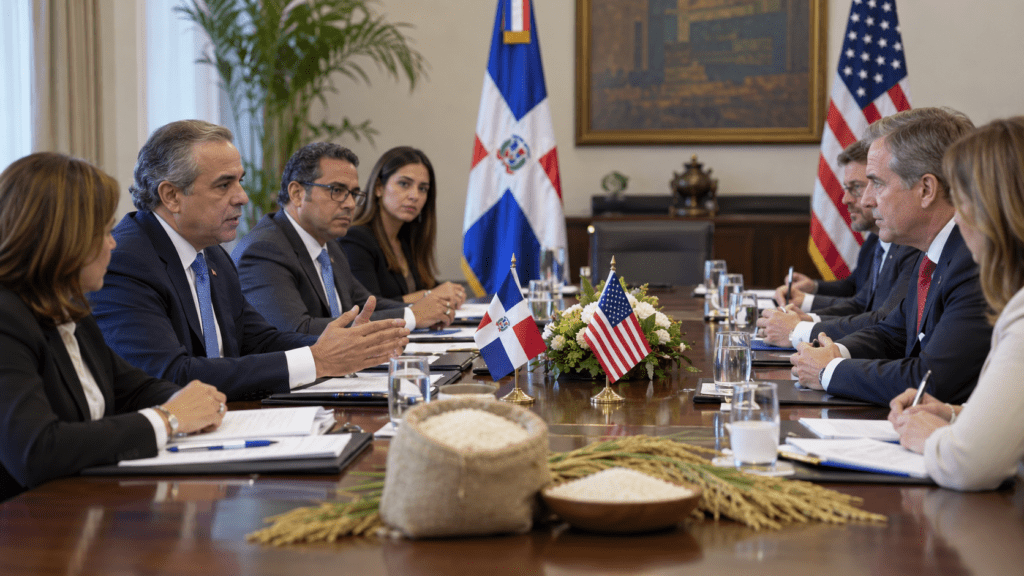
The United States has called for the Dominican Republic to repeal Decree 693-24, which establishes tariff treatment for rice imports, putting agricultural market access at the center of a new round of bilateral trade discussions.
The issue was raised during a virtual meeting between U.S. and Dominican officials as the two countries began discussions on their bilateral tariff agenda. The meeting was led by Jeffrey Goettman, Deputy United States Trade Representative, and Dominican Foreign Minister Víctor “Ito” Bisonó. U.S. officials also included Julie Callahan, the country’s chief agricultural negotiator.
The U.S. Trade Representative’s Office said the repeal of the decree is important for the Dominican Republic to meet its market-access obligations under DR-CAFTA regarding U.S. rice. The agreement entered into force for the Dominican Republic in 2007 and established a timetable for reducing and eliminating tariffs on agricultural products.
What Decree 693-24 Does
Issued in December 2024, Decree 693-24 applies the Dominican Republic’s tariff schedule notified to the World Trade Organization to several rice tariff classifications. The measure establishes a 20% ad valorem tariff within the applicable quota and 99% outside the quota. It also provides duty-free access for 23,300 metric tons of rice from the United States.
The decree took effect on December 31, 2024. In its trade-barriers reporting, the U.S. Trade Representative has said the measure preserves, indefinitely, a 23,300-metric-ton duty-free quota for U.S. rice and applies a 99% tariff to shipments above that amount. Washington has argued that maintaining this structure raises concerns about compliance with the Dominican Republic’s DR-CAFTA commitments.
The dispute centers on the transition established by the trade agreement. U.S. trade officials have stated that the Dominican Republic agreed under DR-CAFTA to eliminate tariffs on rice and certain other agricultural products by January 1, 2025, following the agreement’s tariff phaseout schedule.
Rice Becomes Part Of A Wider Trade Negotiation
The discussion over rice is taking place alongside a broader effort to strengthen the economic relationship between Washington and Santo Domingo. The Dominican Foreign Ministry said the September 9 meeting with Goettman marked the beginning of bilateral talks on the tariff agenda and that the two governments discussed priority commercial issues and the next steps in the process.
The USTR has also expressed interest in negotiating a Reciprocal Trade Agreement with the Dominican Republic. That places the rice dispute within a wider conversation over the conditions governing trade between the two countries rather than treating it as an isolated agricultural issue.
The Dominican Republic has a particularly important commercial relationship with the United States. DR-CAFTA provides the framework for substantial trade in goods and services between the two markets, while the U.S. remains a major destination for Dominican exports.
Why Rice Is Politically Sensitive In The Dominican Republic
For Santo Domingo, the rice issue involves more than tariff policy. Rice is a strategic agricultural product tied to domestic production and food security. When Decree 693-24 was issued, the Dominican government cited national food sovereignty and the protection of domestic agricultural production among the considerations behind the measure.
President Luis Abinader has also described domestic rice production as an important component of national food security. The government reported that Dominican rice production reached 14.2 million quintals in 2024, reflecting the scale of the local industry.
That creates a policy balance for the Dominican government: complying with its international trade commitments while considering the interests of local producers and the country’s food-security objectives.
No Dominican Commitment Announced
The U.S. position was made public as the bilateral trade dialogue gets underway, but neither the USTR nor the Dominican Foreign Ministry has announced that Santo Domingo has agreed to repeal the decree.
The Dominican Foreign Ministry has characterized the new channel as a dialogue intended to strengthen economic and commercial relations and address issues of mutual interest. The two sides are expected to continue discussions as they consider the broader framework for their trade relationship.
For now, the treatment of U.S. rice remains one of the clearest points of tension in the emerging negotiations. Any change to Decree 693-24 would have implications for U.S. agricultural exporters, Dominican rice producers and the way Santo Domingo balances its DR-CAFTA obligations with domestic food-security policy.
For more Dominican political news, follow developments involving government policy, international relations, trade and the decisions shaping the country’s political landscape.