 29°C
29°C

Dominican Republic Housing Market Includes 205,646 Low-Cost Homes
Real estate trusts are managing the development of 205,646 low-cost homes in the Dominican Republic, with RD$122.2 billion in assets tied to these projects as housing affordability remains a challenge for lower-income households.


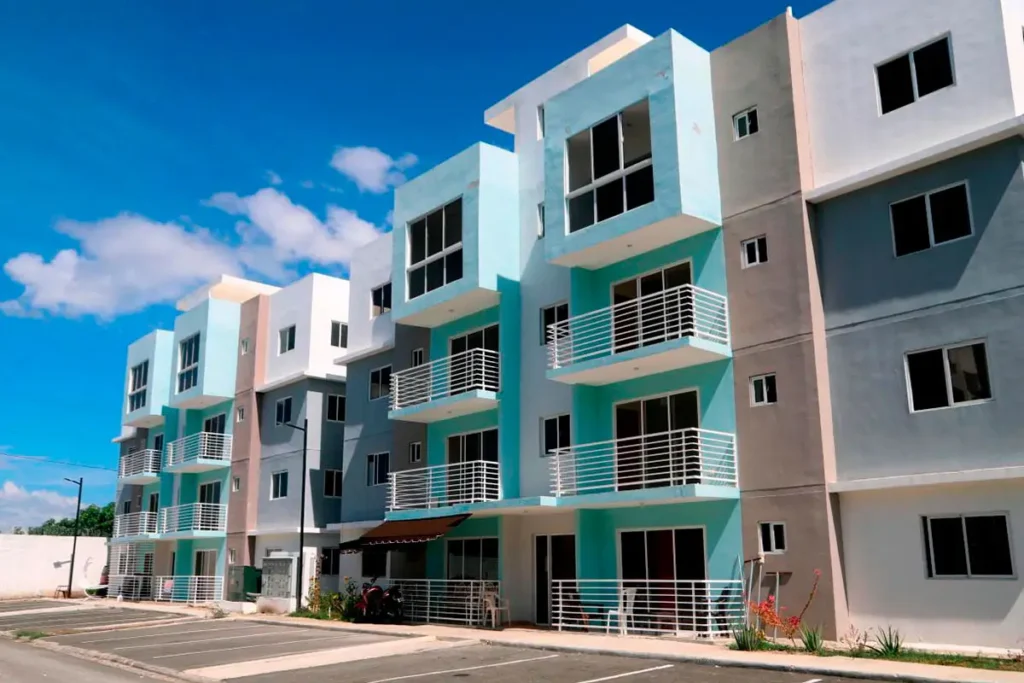
Real estate trusts are playing an increasingly important role in the Dominican Republic housing market, managing the development of more than 205,000 low-cost homes amid a national housing deficit estimated at more than 1.4 million units.
Data from the Association of Dominican Fiduciary Companies (Asofidom) show that, as of March 2026, its nine affiliated fiduciary companies were managing 205,646 low-cost housing units through 621 real estate trusts. The projects represented RD$122.2184 billion in administered assets.
Of that amount, RD$118.482 billion, or 96.9%, was associated with active trusts. The remainder was distributed among projects in liquidation, inactive trusts and other categories.
Real Estate Trusts Manage Nearly 300,000 Homes
Low-cost housing is only part of the activity managed by the fiduciary sector. Other real estate trusts administered RD$169.1558 billion through 694 trusts during the first half of 2026, including resources connected to 88,818 homes priced above the low-cost housing threshold cited in the data.
Christian Molina, executive president of Asofidom, said the figures demonstrate the scale of the fiduciary model within the country’s real estate sector. When the higher-priced units are included, the nine affiliated fiduciaries were managing close to 300,000 housing units nationwide through these structures.
The broader fiduciary sector administered RD$679.8 billion in assets through 1,683 trusts of different types at the end of the first quarter of 2026, according to Asofidom.
Five Fiduciaries Hold More Than 90% Of Low-Cost Housing Assets
Assets linked to low-cost housing projects are concentrated among the country’s largest fiduciary companies. Fiduciaria La Nacional leads with RD$29.819 billion in administered assets, representing 24.4% of the total.
Fiduciaria Reservas follows with RD$24.542 billion and a 20.1% share. FIDUCORP administers RD$21.497 billion, equivalent to 17.6%, while Fiduciaria Popular manages RD$21.313 billion, or 17.4%. Fiduciaria BHD accounts for another RD$14.331 billion, representing 11.7%.
Together, those five institutions account for more than 90% of the assets allocated to low-cost housing. The remaining 8.7% is distributed among Trust & Partners, Fiduciaria Universal, APAP and HTS Fiduciaria.
Affordability Remains A Key Constraint
The expansion of housing projects through fiduciary structures has not eliminated the affordability gap facing lower-income households. A worker earning the private-sector commercial minimum wage of RD$29,988, effective February 2026, has limited room to build savings while taking on a mortgage.
That pressure is compounded by household expenses. The monthly cost of the family consumption basket for the lowest-income quintile stood at approximately RD$29,311.98, leaving little financial margin for a household at that income level to save toward a home or absorb a mortgage payment.
The supply of the least expensive properties has also narrowed. Data from the National Statistics Office (ONE) indicate that homes priced at up to RD$3 million accounted for only 7% of housing supply during the second half of 2025.
Homes priced between RD$3.1 million and RD$5 million represented 33.9% of the market during the same period, down from 46.2% in the first half of 2025. The figures point to a gap between the number of housing units being developed and the purchasing capacity of some of the households most affected by the country’s housing shortage.
Fiduciary Financing Expands Housing Development
Real estate trusts provide a structure for organizing and administering the financial and legal components of housing developments, allowing large numbers of units to be managed under dedicated projects. Their growing role has made the fiduciary sector an important participant in the expansion of the country’s housing supply.
For the Dominican Republic, however, the scale of projects alone does not determine whether new homes are accessible to the households facing the greatest affordability constraints. Prices, household income, mortgage capacity and the availability of lower-cost units remain central factors in determining how effectively new housing supply addresses the deficit.
The data from Asofidom therefore illustrate both sides of the housing market: fiduciary structures are supporting the development of hundreds of thousands of homes, while the limited supply of properties at the lowest price levels continues to present a challenge for many potential buyers.
Follow Dominican Republic news for more coverage of housing, real estate, investment, infrastructure and the economic developments affecting residents and businesses.