 28°C
28°C

Dominican Innovation Gains Attention With First University Chip
A microchip developed by students, professors and graduates at the Pontificia Universidad Católica Madre y Maestra is putting Dominican innovation into an international semiconductor network, with the project involving U.S. universities, technology companies and the U.S. Department of State.


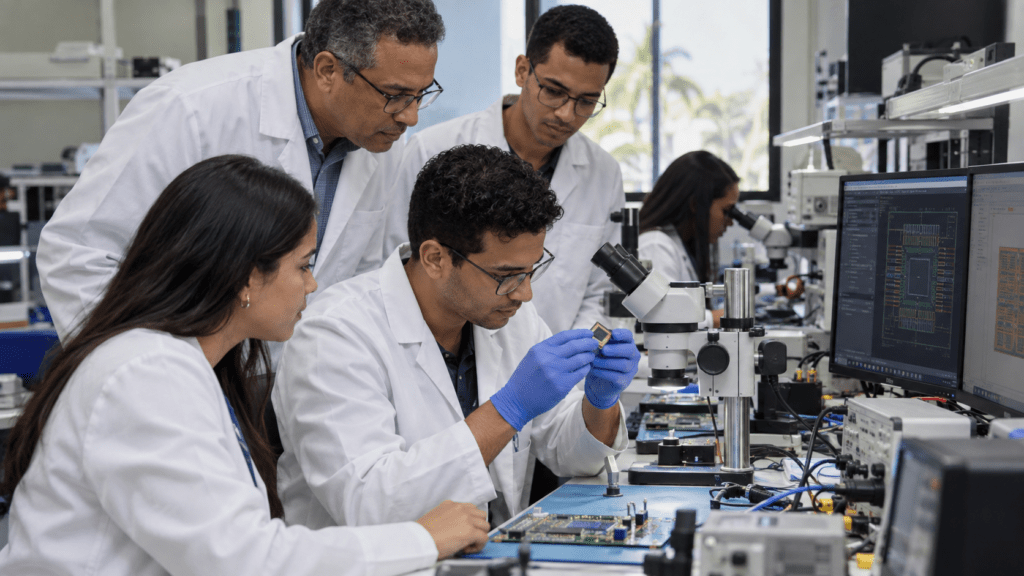
Dominican innovation is drawing new international attention after the Pontificia Universidad Católica Madre y Maestra (PUCMM) unveiled what it identifies as the first university-developed microchip in the Dominican Republic. The device was designed and verified locally before being manufactured in silicon through an international industrial process.
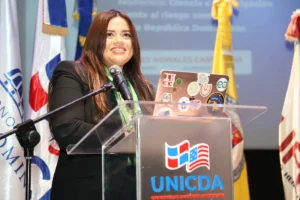
The milestone was presented in Santo Domingo on September 10, 2026, during the university’s “STEM Transforma RD: Innovación para construir el futuro” event. The project involved 27 students, professors and graduates and required roughly a year of work to move from electronic architecture and simulation to physical design, manufacturing and validation.
From a Dominican University to the Global Semiconductor Industry
The significance of the project extends beyond the chip itself. PUCMM worked with international companies and academic institutions involved in different stages of semiconductor development. GlobalFoundries manufactured the physical circuits through a Multi-Project Wafer process, while Synopsys provided design tools and training and Keysight contributed technology for design, simulation, measurement and testing.
The university also participated in the international Chip Design to Tapeout initiative through Synopsys Academic & Research Alliances. Technical training was supported by Purdue University, the University at Albany–SUNY and the University of California, Santa Cruz. The project also received support from the U.S. Department of State through the U.S. Embassy in the Dominican Republic.
The result is a prototype measuring 2.935 by 2.935 millimeters and built using GF180MCU technology at 180 nanometers. Fifty individual units were produced and subsequently moved through packaging and validation stages.
A First Step Toward Local Chip Design
The chip contains an arithmetic logic unit, registers and control logic that allow it to perform operations and process instructions. More importantly for the university, the project exposed Dominican students and researchers to the full development cycle required to turn a digital circuit design into physical hardware.
One of the technology’s potential applications is connected to biomedical research. PUCMM is developing a smart mattress system designed to identify positions in which patients could be at risk of developing pressure ulcers or remaining in one position for extended periods. The microchip is intended to serve as the control unit for systems that process information generated by the mattress.
The university is already working on a second generation of chips with neural-processing capabilities. The objective is to explore artificial intelligence operations directly at the hardware level, extending the project from basic chip design toward more specialized computing applications.
Semiconductors Become a National Technology Priority
The development comes as the Dominican Republic seeks a larger role in the global semiconductor value chain. Presidential Decree 324-24 declared the development of a domestic semiconductor industry a high national priority, while the country’s semiconductor strategy focuses on building the talent and institutional capabilities needed to participate in the sector.
An OECD review published in March 2026 found that the Dominican Republic was seeking to capitalize on changes in global semiconductor supply chains, although the country did not yet have semiconductor firms operating domestically. The report identified opportunities as well as infrastructure, skills and ecosystem challenges that will influence the development of the sector.
That broader strategy has also encouraged cooperation between Dominican universities, industry and international institutions. The Instituto Tecnológico de Santo Domingo (INTEC), for example, has been developing research, training and international partnerships around semiconductors and advanced manufacturing, including work with Purdue University, IEEE and the U.S. Department of State.
International Links Extend Beyond the Microchip
The semiconductor project is part of a wider expansion of the Dominican Republic’s innovation infrastructure in 2026. In June, the country’s National Office of Industrial Property, known as ONAPI, joined the European Union Intellectual Property Office’s DesignView platform, making more than 650 Dominican industrial designs accessible through an international database.
The World Intellectual Property Organization also reported in June that the Dominican Republic had launched a National Intellectual Property Strategy toward 2030. The strategy is intended to help researchers, universities, entrepreneurs and businesses protect, commercialize and transfer innovations into the market.
Together, these developments point to a shift from technology consumption toward greater emphasis on research, intellectual property, design and commercialization. The PUCMM chip does not mean the Dominican Republic has established a semiconductor manufacturing industry, but it demonstrates that a Dominican university has completed a full chip-design pathway with international partners and produced physical silicon.
The next stage will depend on whether these academic capabilities can be expanded into sustained research, specialized talent, technology transfer and industrial applications. For now, the microchip provides a concrete example of how Dominican universities are beginning to connect local engineering talent with one of the world’s most strategically important technology industries.