 25°C
25°C

Dominican Republic Exports: The Products Selling Most Abroad
The Dominican Republic has expanded and diversified its export base, with gold, medical devices, tobacco products and cocoa among the products generating the largest overseas sales. Official data show that the country recorded more than US$14.6 billion in merchandise exports in 2025, while the first months of 2026 continued to show strong demand for several of its leading products.


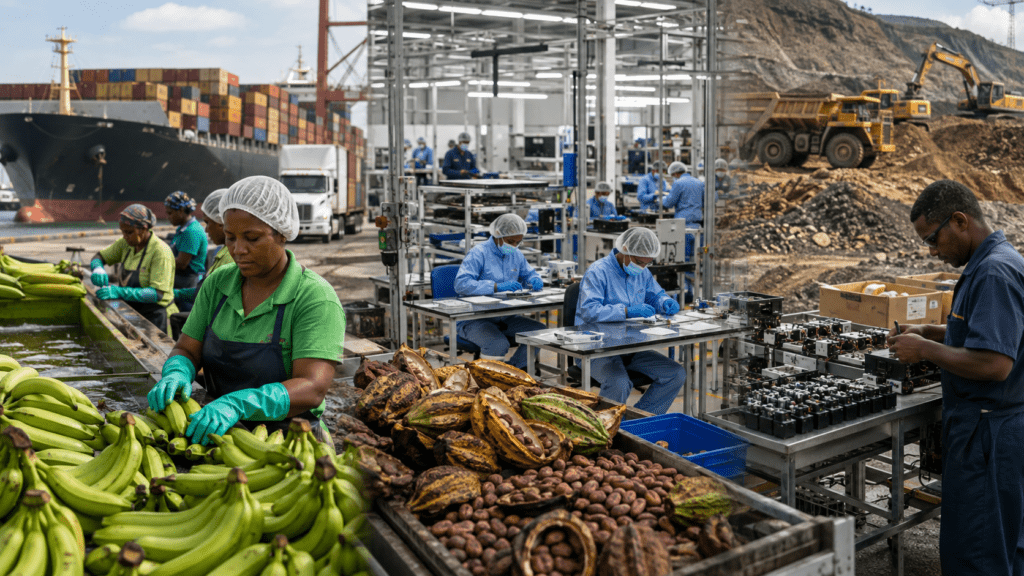
The Dominican Republic is better known internationally for tourism, beaches and Caribbean culture, but its presence in global trade extends far beyond services. The country exports thousands of different products to markets across the world, ranging from minerals and agricultural commodities to medical devices, tobacco, electrical equipment and processed foods.
Official figures show that merchandise exports reached a record US$14.65 billion in 2025, according to ProDominicana, the Dominican Republic’s export and investment promotion agency. The increase was driven by more than 1,467 tariff lines that recorded higher exports, with raw gold making the largest contribution to the annual increase. ProDominicana
Which Dominican Products Sell the Most Abroad?
The answer depends on whether products are measured individually, by broad industrial category, or by export regime. However, official trade data consistently place several products and sectors among the country’s most important sources of export revenue.
| Product or sector | Key export data | Why it matters |
|---|---|---|
| Raw gold | US$2.38 billion in 2025 | Largest individual export product and a major source of foreign exchange |
| Tobacco and tobacco products | About US$1.36 billion in 2025 | Major industrial export and global leader in premium cigars |
| Cocoa | US$668.9 million in cocoa beans in 2025 | Fast-growing agricultural export with strong international demand |
| Medical devices | US$721.5 million in the first quarter of 2026 from the free-zone medical-device sector | High-value manufacturing sector closely integrated with global supply chains |
| Rum | About US$116.3 million in 2025 | Established branded food-and-beverage export |
1. Gold Has Become the Largest Export Product

Raw gold is the Dominican Republic’s leading individual merchandise export. ProDominicana reported that gold exports reached US$2.383 billion in 2025, adding US$911.4 million to the country’s year-over-year export growth. The mining sector as a whole generated more than US$2.59 billion in exports during the year, representing more than 18% of total merchandise exports.
The importance of gold has also continued into 2026. In March, raw gold accounted for US$247.1 million, or 17.1% of that month’s total exports. The Banco Central de la República Dominicana subsequently reported that gold exports reached US$1.592 billion during January-June 2026, an increase of 68.8% from the same period of 2025.
Gold is therefore different from products such as cocoa or tobacco in one important respect: its export value is strongly influenced by international commodity prices as well as production levels. That makes mining an important source of foreign exchange, but also means its contribution can fluctuate significantly from one period to another.
2. Medical Devices Are a Major Export Success
One of the less obvious features of Dominican trade is the importance of medical devices and medical instruments. These products are manufactured primarily within the country’s free-zone system and connect Dominican factories with international healthcare supply chains.
During the first quarter of 2026, medical devices led exports from the free-zone sector with US$721.5 million, according to the National Council of Export Free Zones. The sector increased 9.3% compared with the same quarter of 2025.
The figures illustrate an important structural change in the Dominican export economy. The country is not dependent only on agricultural commodities or traditional Caribbean products. Its free zones have developed significant manufacturing capacity for sophisticated products that are sold to demanding international markets.
3. Dominican Tobacco Remains a Global Export Powerhouse
Tobacco and tobacco products are among the Dominican Republic’s best-known exports. ProDominicana identifies the country as the world’s leading exporter of premium cigars, while official Dominican data show that tobacco and its derivatives generated approximately US$1.359 billion in exports in 2025.
The tobacco industry is also highly diversified geographically. According to the Dominican Tobacco Institute, Dominican tobacco products were exported to 142 countries in 2025, with the United States by far the largest market. U.S. purchases were valued at about US$1.066 billion, followed by Germany, China, Puerto Rico and Spain.
The sector’s strength extends beyond cigar manufacturing. It includes tobacco cultivation, processing, cigar production and related manufacturing activities. This creates a broader economic chain than the value of finished cigar exports alone might suggest.
4. Cocoa Is One of the Fastest-Growing Agricultural Exports
Cocoa has become one of the Dominican Republic’s most important agricultural exports. Cocoa-bean exports reached US$668.9 million in 2025, an increase of US$237.2 million from the previous year, according to ProDominicana.
The growth was particularly notable during 2025. Between January and September, cocoa-bean exports increased 64.1% year over year. Earlier in the year, the Directorate General of Customs also identified cocoa as one of the products contributing strongly to export growth.
The Dominican agricultural sector has a distinctive position in cocoa because the country is also known for producing organic cocoa. ProDominicana lists cocoa among the country’s leading agricultural export products alongside bananas, coffee, avocados, mangoes and other crops.
Cocoa therefore illustrates how the Dominican Republic can compete internationally not only through volume but also through differentiated agricultural production and access to specialized markets.
5. Rum Continues to Build an International Market
Rum does not generate export values comparable with gold, tobacco or medical devices, but it remains one of the country’s most recognizable processed products.
Exports of Dominican rum reached approximately US$116.3 million in 2025, according to ProDominicana. Spain, the United States, Cyprus, Haiti, the Netherlands and Germany were among the principal markets.
The product is part of a broader group of Dominican processed foods and beverages that give the country an opportunity to export more than raw agricultural commodities. Processing, aging, packaging and branding can increase the value captured within the domestic economy.
6. Bananas, Avocados and Other Agricultural Products
The Dominican Republic also maintains a broad agricultural export portfolio. ProDominicana identifies bananas, coffee, organic cocoa, pineapples, avocados, mangoes, plantains, coconuts, dragon fruit, greenhouse vegetables and aromatic herbs among the country’s exportable agricultural products.
Bananas are particularly relevant. During January-September 2025, banana exports increased 5.4% year over year, while the country’s broader agricultural export category also recorded strong growth.
Avocados, peppers and other fresh agricultural products contribute smaller amounts than minerals or industrial exports but play an important role in diversifying the export base. Their importance is also different because agricultural products connect exporters to food distribution chains, supermarkets and specialized buyers in foreign markets.
7. Electrical Products, Iron Bars and Plastics Add Industrial Diversity
The country’s export basket also includes a wide range of industrial products. Among the products that recorded notable growth during 2025 were iron bars, plastic articles, Portland cement and electrical circuit breakers.
Iron bars, for example, recorded a 69.3% increase during January-September 2025. Plastic articles increased 10.1%, while Portland cement rose 21.2%. Electrical circuit breakers also recorded significant growth.
These products demonstrate that Dominican exports are not limited to commodities with a traditional Caribbean identity. Manufacturing and industrial production account for a substantial part of the country’s international trade, particularly through free zones.
Why Are Medical Devices and Tobacco So Important?
The answer is closely connected to the Dominican Republic’s free-zone system. Free zones are industrial areas where companies receive specific customs and fiscal conditions designed to facilitate production for export. They have become a major platform for manufacturing goods destined for international markets.
In the first four months of 2026, free-zone exports exceeded US$2.8 billion. Medical and pharmaceutical products accounted for US$966 million, while tobacco and its derivatives generated US$461.2 million during the same period.
This model has helped the country develop manufacturing capabilities that are significantly different from its traditional agricultural export base. Medical devices, electrical products, pharmaceuticals, footwear, textiles and tobacco products are all part of this broader industrial ecosystem.
Who Buys Dominican Products?
The United States is the Dominican Republic’s dominant export market. During January-September 2025, exports to the United States reached US$5.3836 billion, representing 50.3% of total exports for the period.
Other important markets included India, Haiti, Canada, the Netherlands, Belgium, Puerto Rico, China and Jamaica. The mix varies considerably by product. Gold, for example, has been an important driver of exports to India and Canada, while the United States remains the principal destination for many manufactured and agricultural products.
The geographic distribution is significant because it reduces the risk of relying on a single type of buyer, even though the United States remains by far the largest market.
How Much Does the Dominican Republic Export?
According to ProDominicana, Dominican merchandise exports reached US$14.6452 billion in 2025, an increase of 13.4% compared with 2024. The organization reported that more than 1,467 tariff lines contributed to the increase, indicating that export growth extended beyond a handful of products.
The Directorate General of Customs reported a slightly different total of US$14.374 billion for 2025 because the institutions use different statistical frameworks. For readers comparing official figures, it is important to use the same methodology and source throughout an analysis rather than treating every published total as directly interchangeable.
ProDominicana’s broader export dashboard reports more than 160 export destinations and more than 3,000 exported products, underscoring the breadth of the Dominican export economy.
What the Export Data Reveal About the Dominican Economy
The most important development is not simply that one product sells more than another. The export data show a Dominican economy with three distinct export pillars: natural resources, agricultural and food products, and manufactured goods.
Gold provides a large concentration of export value and foreign exchange. Agricultural products such as cocoa and bananas connect Dominican producers with international food markets. Meanwhile, medical devices, tobacco, electrical products and other manufactured goods demonstrate the country’s integration into global industrial supply chains.
This diversification matters because the performance of these sectors is influenced by different factors. Commodity exports are sensitive to international prices, agriculture is exposed to weather and production conditions, and manufacturing depends heavily on international demand, logistics, investment and trade policy.
The Products to Watch in the Dominican Export Economy
Based on official export figures, several products stand out for both their current importance and their potential to influence future export performance:
- Gold: the largest individual export product and a major source of foreign exchange.
- Medical devices: one of the country’s most important high-value manufacturing activities.
- Tobacco and premium cigars: a globally recognized Dominican export with a broad international market.
- Cocoa: a fast-growing agricultural export, particularly important in the country’s organic and specialty production.
- Rum: a major branded food-and-beverage export with established markets in Europe and the Americas.
- Bananas and other agricultural products: part of a diversified fresh-produce export sector.
- Industrial products: including electrical equipment, iron products, plastics, cement and other manufactured goods.
Frequently Asked Questions
What is the Dominican Republic’s biggest export?
Raw gold is the country’s largest individual merchandise export. It generated approximately US$2.383 billion in exports in 2025.
Are cigars the Dominican Republic’s largest export?
No. Cigars are one of the country’s most internationally recognized exports and the Dominican Republic is a global leader in premium cigar exports, but raw gold generates substantially more export value. Tobacco and its derivatives generated approximately US$1.359 billion in 2025.
What agricultural product does the Dominican Republic export the most?
Cocoa is among the country’s most valuable agricultural exports and recorded particularly strong growth in 2025. Bananas, avocados, coffee, mangoes, plantains and other crops also form part of the agricultural export portfolio.
What is the main destination for Dominican exports?
The United States is the Dominican Republic’s largest export market. It accounted for 50.3% of total exports during January-September 2025.
Does the Dominican Republic export manufactured goods?
Yes. Manufactured products are a major part of the country’s export economy. Medical devices, tobacco products, electrical equipment, pharmaceuticals, footwear, textiles, plastics and other industrial goods are produced for international markets, particularly through the free-zone system.