 24°C
24°C

Dominican Republic Tobacco Exports: Where The World’s Cigars Go
The Dominican Republic has become one of the world’s most important tobacco-exporting economies, particularly in cigars. In 2024, exports of cigars, cheroots and cigarillos containing tobacco reached approximately $1.055 billion, with the United States absorbing about 85% of that value. Raw tobacco adds another substantial export stream: unstemmed tobacco exports were worth about $186.5 million, led by China, while stemmed or stripped tobacco added $53.9 million. Taken together, these major tobacco categories show an industry whose international reach extends well beyond premium cigars, with North America, Europe, Asia and Latin America playing different roles in the supply chain.


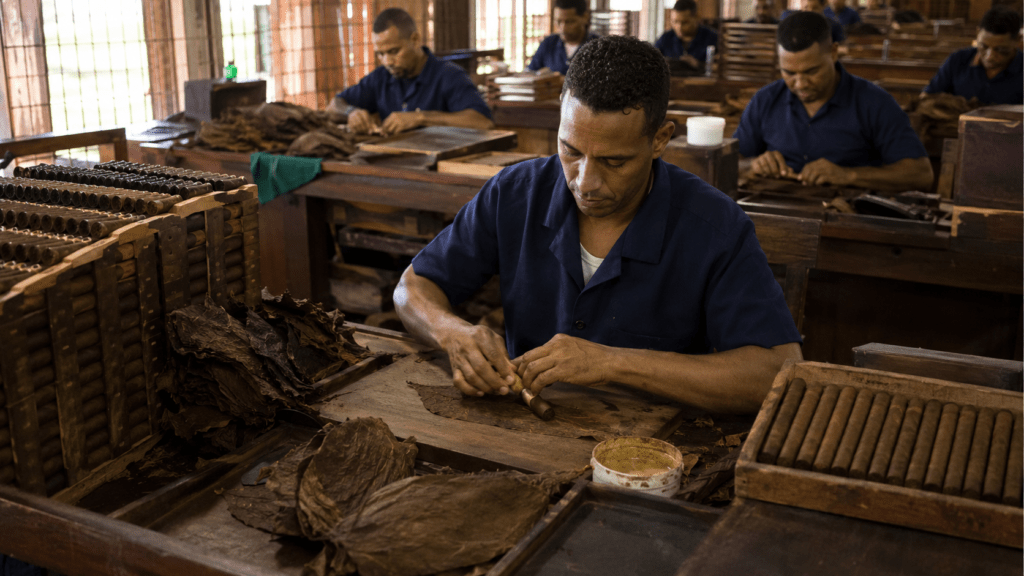
The Dominican Republic is internationally associated with premium cigars, but its tobacco industry is considerably broader than the finished products sold in cigar shops. The country exports manufactured cigars, raw tobacco leaves and other tobacco products, while also importing substantial quantities of tobacco used by domestic manufacturers. Understanding the industry therefore requires looking beyond a single export number and following the product through the international supply chain.
The clearest picture comes from international merchandise-trade data classified under the Harmonized System (HS). For 2024, the most important category was HS 2402.10, covering cigars, cheroots and cigarillos containing tobacco. Dominican exports in this category were valued at $1.055 billion and weighed about 45.5 million kilograms. The United States alone accounted for $897.4 million, or roughly 85% of the reported export value. Germany, Belgium, Canada and Spain followed at much smaller levels.
How Much Tobacco Does the Dominican Republic Export?
There is no single figure that perfectly captures the Dominican Republic’s tobacco exports because international customs statistics divide the industry into several product categories. A premium cigar and a bale of unprocessed tobacco leaf are both tobacco products, but they occupy very different places in the value chain and have different destinations.
Using 2024 trade data for the principal identifiable categories provides a useful picture of the industry’s scale. Cigars, cheroots and cigarillos represented by far the largest finished-product stream, while unstemmed tobacco was the second-largest category by export value among the major lines examined.
| Product category | 2024 exports | Quantity | Leading destination |
|---|---|---|---|
| Cigars, cheroots and cigarillos | $1.055 billion | 45.48 million kg | United States |
| Unstemmed tobacco | $186.49 million | 8.08 million kg | China |
| Stemmed or stripped tobacco | $53.93 million | 2.47 million kg | United States |
| Cigarettes containing tobacco | $6.92 million | 612,022 kg | United States |
| Homogenized or reconstituted tobacco | $17.54 million | 12.52 million kg | United States |
These five categories alone add up to approximately $1.32 billion in 2024 exports. The figure should be treated as a practical measure of the major tobacco trade streams rather than as a universal “total tobacco exports” number, because customs classifications contain additional products and because different statistical systems can produce differences in how individual tobacco products are recorded.
The importance of cigars is nevertheless unmistakable. The $1.055 billion exported under HS 2402.10 was several times the value of the country’s exports of raw, unstemmed tobacco. This reflects the value created by processing, manufacturing, branding and finishing tobacco in the Dominican Republic before it reaches international buyers.
The Dominican Republic’s Position in the Global Cigar Market
The Dominican Republic is not simply a significant cigar producer; it is a major global exporter. In 2024, it was the leading national exporter of cigars, cheroots and cigarillos containing tobacco to the United States, with shipments valued at $897.4 million. Nicaragua ranked second in U.S. imports from the same product category at $368.4 million, followed by Honduras at $88.3 million.
This comparison is important because the United States is the world’s largest commercial destination for Dominican cigars. The Dominican Republic’s advantage is therefore not based solely on the volume of tobacco grown domestically. It is also based on its manufacturing ecosystem, established international distribution networks and long-standing position in the premium cigar trade.
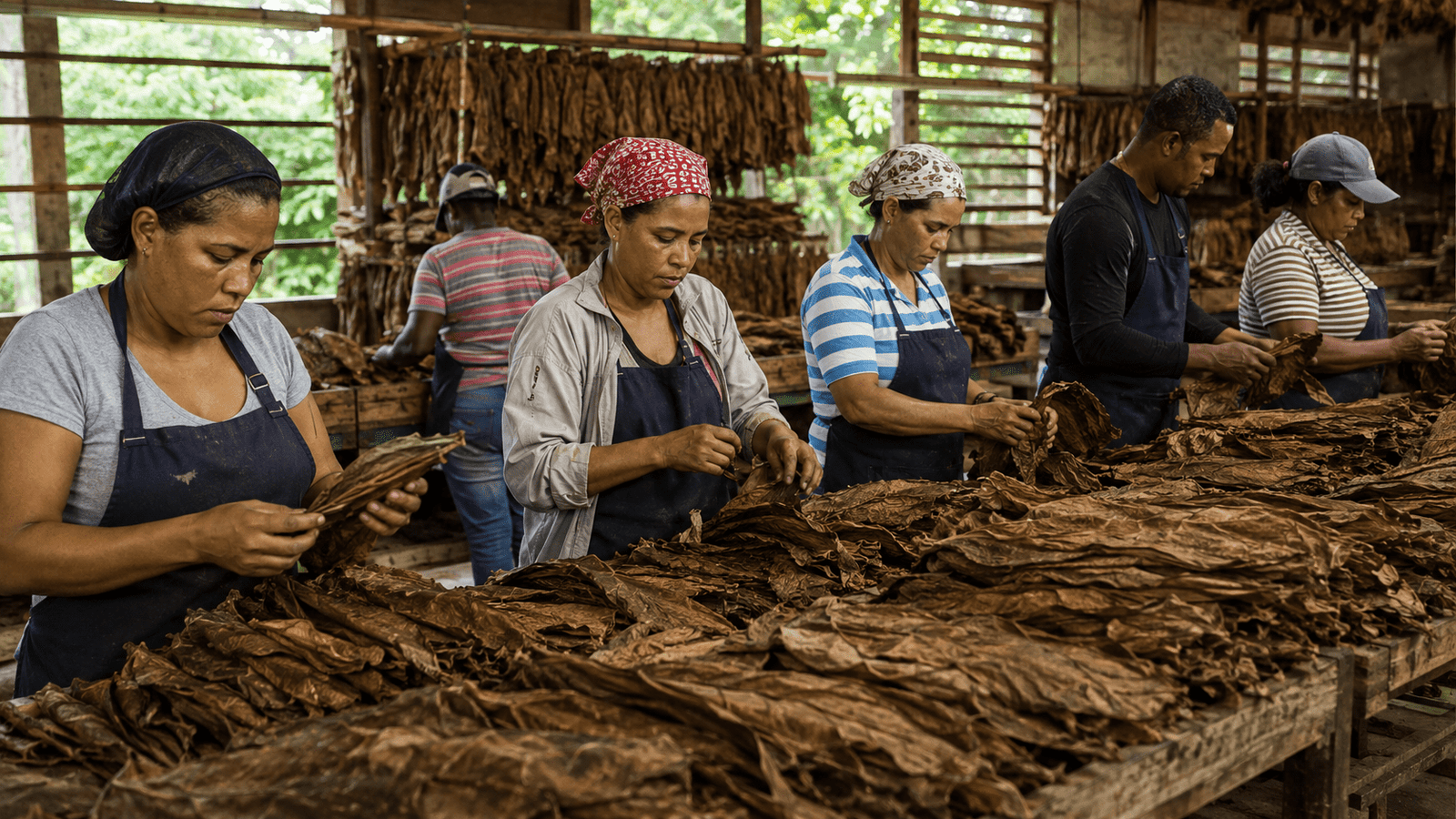
The country’s export-promotion agency, ProDominicana, identifies the Dominican Republic as the world’s leading exporter of premium cigars. The country’s tobacco sector is concentrated around a manufacturing and agricultural network that connects tobacco-growing areas with processing facilities, cigar factories and export channels.
Where Do Dominican Cigars Go?
The United States is overwhelmingly the main destination for Dominican cigars. In 2024, Dominican exports of cigars, cheroots and cigarillos containing tobacco to the United States were worth $897.4 million, compared with $47.0 million to Germany, $23.3 million to Belgium, $13.6 million to Canada and $9.0 million to Spain.
| Destination | 2024 Dominican cigar exports | Share of category |
|---|---|---|
| United States | $897.4 million | About 85% |
| Germany | $47.0 million | About 4.4% |
| Belgium | $23.3 million | About 2.2% |
| Canada | $13.6 million | About 1.3% |
| Spain | $9.0 million | About 0.8% |
| Other markets | About $65.1 million | About 6.2% |
The remaining markets include Italy, France, Japan, China, Bulgaria, the Czech Republic, Austria, Ukraine, the Netherlands and Singapore, among others. The geographical pattern shows that Dominican cigars are exported to a genuinely global market, but that the trade is highly concentrated in North America.
That concentration matters. A country can have a diversified list of destinations while still depending heavily on one market economically. The Dominican cigar industry is an example of this distinction: its products reach Europe, Asia, the Caribbean and other parts of the Americas, but the United States remains the dominant commercial outlet.
Why the United States Dominates Dominican Cigar Exports
The strength of the U.S. market has several dimensions. First, the United States has a large and established premium cigar market. Second, Dominican manufacturers have built long-standing commercial relationships with U.S. importers, distributors and retailers. Third, the two countries are connected through the Dominican Republic-Central America Free Trade Agreement, known as CAFTA-DR, which provides a formal framework for trade and market access.
U.S. tariff classifications also specifically recognize Dominican-origin products under the Dominican Republic-Central America special tariff treatment for qualifying goods. The U.S. International Trade Commission’s tariff schedule includes Dominican Republic-Central America treatment for relevant cigar classifications, subject to the applicable rules.
Access to the U.S. market does not mean that tobacco products can enter without regulation. The U.S. Food and Drug Administration regulates tobacco products imported into the country, and imported tobacco products must comply with applicable federal requirements. The FDA’s tobacco jurisdiction includes cigars and other tobacco products.
This regulatory environment is an important part of understanding where Dominican cigars “end up.” The export statistic records the first commercial destination, but the product then enters a regulated U.S. distribution chain that may include importers, wholesalers, retailers, cigar lounges, specialty stores and other points of sale.
Germany and Belgium: Europe’s Role in the Trade
Europe is the Dominican cigar industry’s second major geographic market, although its individual national markets are much smaller than the United States. Germany was the second-largest destination for Dominican cigars in 2024, with exports of about $47 million. Belgium followed with approximately $23.3 million.
Belgium deserves particular attention because trade statistics record the country as a significant European destination even though the value of shipments there does not necessarily represent final consumption by Belgian consumers. International trade frequently passes through distribution and logistics hubs before reaching its ultimate retail market.
The same principle applies to European trade more generally. A shipment recorded as an export to one European country identifies the importing partner in the customs transaction; it does not necessarily tell us where every cigar is eventually smoked. For that reason, export statistics are best interpreted as evidence of first destination markets, not as a perfect map of final consumer demand.
China Is More Important for Dominican Raw Tobacco Than for Cigars
The geography changes significantly when the product is raw tobacco rather than a finished cigar.
In 2024, the Dominican Republic exported about $186.5 million of unstemmed or unstripped tobacco. China was the largest destination, receiving approximately $73.7 million, followed by the United States at $49.6 million. Honduras, Germany and Nicaragua were the next largest destinations.
China therefore occupies a very different position in the Dominican tobacco trade from the United States. For finished cigars, the U.S. market is overwhelmingly dominant. For unprocessed tobacco, China was the largest individual destination by export value in 2024.
This distinction reveals an important feature of the global tobacco supply chain. Tobacco leaves do not necessarily remain in the country where they are grown or where they are first exported. Raw tobacco can cross borders for processing, blending, manufacturing or re-export. The country importing the Dominican leaf is therefore not necessarily the country where the final tobacco product is consumed.
What Happens to Dominican Tobacco After It Leaves the Country?
There are at least three broad pathways.
- Finished cigars go directly into foreign consumer markets. This is the clearest case. A Dominican cigar exported to the United States can enter an importer or distributor and ultimately reach retailers and consumers.
- Raw tobacco becomes an input for manufacturing elsewhere. Unstemmed or processed tobacco can be purchased by manufacturers or processors that use the leaf in blends or other tobacco products.
- Intermediate products move through international supply chains. Tobacco can be processed in one country and then incorporated into products sold in another market. Customs statistics do not always follow the product through every subsequent transaction.
This is why the phrase “where Dominican tobacco ends up” needs to be handled carefully. Trade data can identify the destination reported by the Dominican exporter, but they do not automatically identify the final consumer, final retail outlet or final country of consumption.
The Dominican Republic Also Imports Tobacco
The country’s role in the international tobacco industry is not limited to exporting locally grown tobacco. Dominican manufacturers also import significant quantities of tobacco from abroad.
In 2024, for example, the Dominican Republic imported approximately $374.9 million of unstemmed tobacco. The United States supplied about $179.5 million, followed by Ecuador at $63.9 million, Honduras at $25.9 million, Mexico at $19.8 million and the Philippines at $18.8 million.
The country also imported about $65.95 million of smoking tobacco under the relevant classification, with the United States accounting for almost all of that reported trade. This demonstrates that the Dominican tobacco industry operates as part of an international production network rather than as a closed domestic system.
A cigar made in the Dominican Republic can therefore contain a combination of domestically grown and imported tobacco, depending on the manufacturer, product and formulation. The fact that the finished cigar is exported as a Dominican product does not necessarily mean that every component originated in the Dominican Republic.
Why the Raw-Tobacco and Cigar Markets Look So Different
The difference between raw tobacco and finished cigars is fundamentally a difference in value creation.
Raw tobacco is an agricultural commodity. Its international price is influenced by leaf quality, variety, crop conditions, processing and global supply and demand. Finished premium cigars incorporate additional stages: curing, fermentation, aging, sorting, blending, rolling, quality control, packaging, branding and distribution.
That additional processing helps explain why the Dominican Republic can simultaneously be a major exporter of raw tobacco and an even larger exporter of finished cigars by value. The country is participating in multiple stages of the value chain rather than depending exclusively on the cultivation of tobacco leaf.
The Importance of Santiago and the Dominican Tobacco Belt
The tobacco industry is geographically associated with northern and central parts of the Dominican Republic. Santiago is particularly important. The Ministry of Agriculture has identified Santiago as the country’s largest tobacco-producing area, accounting for approximately 51% of cultivation according to government information.
The agricultural base extends beyond a single province. Tobacco is cultivated in several parts of the country, while manufacturing and processing facilities connect agricultural production with international markets.
This geographic structure matters economically because tobacco exports are not generated solely at the factory gate. The value chain includes farmers, agricultural suppliers, processors, manufacturers, packaging operations, logistics providers and export businesses.
How Important Is Tobacco to Dominican Merchandise Exports?
Tobacco is one of the Dominican Republic’s major manufactured-export sectors. The country’s total merchandise exports reached about $13.85 billion in 2024, according to Dominican government fiscal reporting. Tobacco products were among the sectors contributing to the growth of free-zone manufacturing exports during the year.
The broader significance of tobacco therefore extends beyond the value of agricultural production. Much of the industry’s economic importance comes from transforming tobacco into higher-value manufactured products before exporting them.
This is particularly visible in premium cigars. The country is not competing only on the basis of agricultural output. It is competing through manufacturing capabilities, product quality, skilled labor, established brands and access to major consumer markets.
Is the United States Too Important to the Dominican Tobacco Industry?
The concentration of cigar exports in the United States creates both strength and vulnerability.
The strength is obvious: the Dominican industry has access to a deep, sophisticated and high-value market with established demand for Dominican cigars. A strong U.S. market can support investment, production and employment in the Dominican Republic.
The vulnerability is equally clear. When approximately 85% of a product category’s export value goes to one country, changes in that market can have an outsized effect on exporters. Regulatory changes, consumer preferences, taxation, economic conditions, distribution trends or trade-policy changes in the United States can therefore matter greatly to Dominican cigar manufacturers.
The industry’s European and Asian markets provide some diversification, but they are not yet comparable to the scale of the U.S. destination for finished cigars.
What the 2024 Numbers Reveal About the Global Market
Several conclusions emerge from the trade data.
- Dominican cigars are a billion-dollar export business. The 2024 value of cigar, cheroot and cigarillo exports exceeded $1 billion.
- The United States is the dominant destination for finished cigars. It absorbed roughly 85% of the reported export value in this category.
- China is particularly important for raw tobacco. It was the largest destination for Dominican unstemmed tobacco in 2024.
- Europe is an important secondary market. Germany and Belgium were the leading European destinations for Dominican cigars in the 2024 data.
- The industry is integrated into global supply chains. The Dominican Republic both exports tobacco and imports substantial quantities of tobacco from other countries.
- Export destination is not the same as final consumption. Customs statistics normally identify the first importing partner, not every subsequent movement of the product.
What “Where It Ends” Really Means
For finished Dominican cigars, the answer is relatively straightforward: the overwhelming majority of export value is destined for the United States, with Europe, Canada, Asia and other markets accounting for the remainder.
For raw tobacco, the answer is more complex. China, the United States, Honduras, Germany and Nicaragua were important destinations for unstemmed Dominican tobacco in 2024. Those shipments can enter manufacturing chains in which the tobacco is processed or incorporated into other products before reaching consumers.
The most accurate way to describe the Dominican Republic’s position is therefore not simply as a country that “exports cigars.” It is a global tobacco-processing and manufacturing hub whose products move through several international channels. Its finished cigars are heavily oriented toward the U.S. consumer market, while its raw tobacco participates in a broader network involving manufacturers and processors in North America, Europe, Asia and Latin America.
Data Limitations and How to Read the Numbers
International trade statistics should be interpreted with care. Export figures are normally reported on a customs basis and can differ from the value reported by importing countries because of freight, insurance, valuation methods, timing, classification and other statistical differences.
The Harmonized System also separates tobacco into detailed categories. A figure for cigars cannot simply be added to every other tobacco statistic without checking the classification. For this reason, this study treats the major HS categories separately and uses 2024 as the principal reference year because it provides a complete annual basis for comparison.
The Dominican General Directorate of Customs maintains a trade-statistics system that allows users to examine exports by product classification and destination. International databases such as the World Bank’s WITS platform reproduce UN Comtrade data and make bilateral comparisons possible.

Official and Statistical Sources
Dominican General Directorate of Customs trade statistics provides official Dominican merchandise-export data by product and destination.
World Bank WITS provides UN Comtrade-based international trade data used for the 2024 product and destination analysis in this study.
ProDominicana provides information on the Dominican Republic’s export sectors and identifies the country as the leading global exporter of premium cigars.
U.S. Trade Representative information on CAFTA-DR provides the framework for understanding the trade relationship between the Dominican Republic and the United States.
U.S. Food and Drug Administration guidance on imported tobacco products explains the regulatory requirements applicable to tobacco products entering the U.S. market.