 22°C
22°C

How the Economy of the Dominican Republic Works
The economy of the Dominican Republic works through a continuous flow of money, goods, services, labor and investment between households, businesses, financial institutions, government and the rest of the world. People earn income and spend it, companies hire workers and invest to produce goods and services, banks move savings into credit, the Government collects taxes and provides public services, while imports, exports, tourism, remittances and foreign investment connect the domestic economy to international markets.


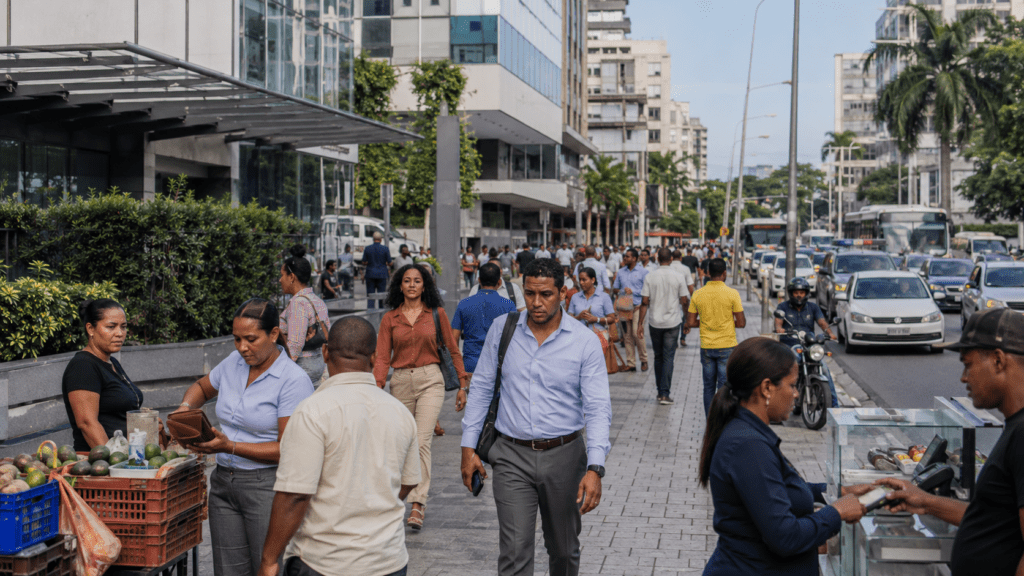
To understand how the economy of the Dominican Republic works, it is more useful to follow the flow of economic activity than to memorize a list of industries. A worker earns a salary, uses part of it to buy food or pay rent, and may save or borrow for a larger purchase. A business receives that spending as revenue, pays employees and suppliers, invests in equipment and pays taxes. A bank takes deposits and provides loans. The Government collects revenue and spends it on public services and infrastructure. At the same time, imports, exports, tourism, remittances and foreign investment connect these domestic transactions to the international economy.
The Economy as a Continuous Flow of Money and Resources
Every economy can be understood as a system of exchanges. Households provide labor and receive income. Businesses combine labor, capital, land, technology and other inputs to produce goods and services. Consumers purchase those goods and services, creating revenue for businesses. Governments collect taxes and use them to finance public activity. Financial institutions connect people and organizations that have money available with those that need financing.
The Dominican Republic adds an important international dimension to this process. Its economy is closely connected to other countries through merchandise trade, tourism, financial flows, remittances and foreign investment. Money therefore enters and leaves the country through several different channels rather than through exports alone.
The result is a circular process rather than a series of isolated transactions. Income creates spending, spending creates business revenue, business revenue supports employment and investment, and those activities generate more income. Taxes and financial transactions influence the flow, while international trade and capital provide additional channels into and out of the economy.
Households: Where Labor Becomes Income and Spending
Households are one of the central actors in the economic system because most people participate in the economy primarily by working, consuming, saving or borrowing. A person may work for a private company, a public institution, a small business or themselves. In return, they receive wages, salaries, professional income or profits.
That income is then allocated among different uses. A household may spend money on food, housing, transportation, electricity, telecommunications, education, health care, entertainment and other goods and services. Some income may be saved, while some households also use credit to finance purchases or investments.
When households spend money, the transaction becomes income for someone else. Money paid at a supermarket becomes revenue for the retailer and helps pay employees and suppliers. Rent becomes income for a property owner. A restaurant bill creates revenue for the restaurant and supports purchases from food distributors and other suppliers.
This is why consumer spending is not simply a measure of what households buy. It is one of the mechanisms through which economic activity is transmitted from one business and worker to another.
Employment: The Link Between People and Businesses
Employment connects households to the productive side of the economy. Businesses need workers to provide services, manufacture products, transport goods, operate hotels, build properties, manage offices and perform countless other tasks. Workers, in turn, depend on employers and customers for income.
The labor market determines how these two sides meet. Employers decide how many workers they need and what skills they require. Workers offer their time and skills in exchange for compensation. Wages are influenced by factors such as productivity, qualifications, labor demand, the supply of workers and the characteristics of individual industries.
Employment also affects government finances. Salaries and other forms of income can generate personal income-tax obligations, while employers and employees participate in social-security arrangements. Businesses also pay taxes associated with their activities.
The connection works in the other direction as well. When employment increases, more households have income to spend. Higher household spending can increase demand for businesses, which may encourage additional hiring and investment. When employment weakens, the process can reverse as households become more cautious about spending.
Businesses: Turning Inputs Into Goods and Services
Businesses are the productive engine of the economy. They combine workers, capital, technology, land, energy, materials and organizational knowledge to produce something that customers or other businesses are willing to pay for.
A Dominican business may sell almost entirely to local customers, export its products, serve international visitors or do several of these things at once. A supermarket depends mainly on domestic consumers. A hotel receives money from visitors and purchases supplies from other businesses. A factory may sell to both the domestic market and customers abroad.
Businesses have several financial responsibilities. They must pay employees, suppliers, lenders and taxes while maintaining enough cash to continue operating. If revenue exceeds costs over time, the business can generate profits. Those profits can be distributed to owners, retained within the company or reinvested in expansion.
Investment is especially important because it increases productive capacity. A company that purchases machinery, opens another location, develops software or builds a new facility is attempting to produce more efficiently or serve a larger market in the future.
Prices: How Buyers and Sellers Coordinate
Prices provide one of the basic coordination mechanisms of a market economy. When consumers want more of a product, businesses have an incentive to supply more if doing so is profitable. When demand falls, businesses may reduce production, lower prices, change their products or redirect resources elsewhere.
Prices also communicate information about scarcity and costs. If an imported fuel becomes more expensive internationally, the increase can affect transportation costs and eventually influence the prices of other goods and services. If demand for hotel rooms rises, higher prices can encourage hotel operators to expand capacity or investors to build additional accommodation.
Prices do not operate in isolation. Taxes, regulations, competition, exchange rates, wages, international prices and government policies can all affect what consumers pay and what businesses receive.
Banks: Moving Savings Into Credit
Banks perform a central function by connecting people and organizations that have funds available with those that need financing. A household may place money in a deposit account, while another household may seek a mortgage. A company may maintain deposits while borrowing to purchase equipment or expand its operations.
In simplified terms, banks transform part of the funds they receive into loans and other financial assets, subject to regulation, liquidity requirements, credit risk and other constraints. This allows financial resources to move toward consumption and productive investment rather than remaining unused.
Credit can therefore accelerate economic activity. A business that cannot finance a new factory from its existing cash may borrow to build it. A household may use a mortgage to purchase a home. A farmer may need financing before harvesting and selling a crop.
Credit also creates obligations. Borrowers must repay principal and interest, and banks must manage the possibility that loans will not be repaid. For this reason, the availability and cost of credit influence how quickly households and companies can expand their spending.
The Central Bank and the Price of Credit
The Central Bank of the Dominican Republic (BCRD) plays a central role in monetary policy and the financial system. One of its most important tools is the policy interest rate, which influences financial conditions throughout the economy.
When monetary policy becomes more restrictive, borrowing generally becomes more expensive or less readily available. That can discourage some household consumption and business investment and reduce pressure on prices. When monetary conditions become more accommodative, lower financing costs can support credit, spending and investment, although the effects depend on banks, borrowers and broader economic conditions.
The BCRD operates under an inflation-targeting framework, with a medium-term inflation target of 4% plus or minus 1 percentage point. Its monetary-policy decisions therefore consider inflation, economic activity, international conditions, exchange-rate developments and other factors.
This creates an important connection between a decision made at the central bank and everyday economic activity. A change in monetary conditions can eventually affect mortgage rates, business loans, consumer credit, investment decisions and household spending.
The Government: Taxes, Spending and Public Services
The Government participates in the economy both as a purchaser and as a provider of public services. It collects revenue and spends money on areas such as infrastructure, education, health, security, public administration and social programs.
Taxes are the principal mechanism through which much of this public activity is financed. The Dominican tax system includes taxes on income, consumption and particular goods and activities. The Dirección General de Impuestos Internos (DGII) administers and collects the country’s principal internal taxes.
One of the most important consumption taxes is ITBIS, a value-added tax applied to taxable transfers and imports of industrialized goods and to services. The DGII describes a general rate of 18%, with a reduced rate applying to certain products.
The Government also collects income taxes. Corporate income and individual income are taxed under different rules, and the tax system includes withholding mechanisms for certain payments.
The economic effect of taxation goes beyond government revenue. A tax changes the amount of money available to households and businesses, while government spending puts money back into the economy through salaries, procurement, infrastructure projects and public services.
How a Consumer Purchase Generates Multiple Economic Effects
Consider a simple hypothetical example: a family spends money at a Dominican restaurant. The restaurant records revenue from the sale. Part of that revenue pays employees, another part pays food suppliers, another covers rent, electricity and other operating costs, and part may become profit or be used for investment.
The food supplier then uses its revenue to pay farmers, importers, transport companies, employees and other suppliers. Employees receive wages and spend part of their income on their own households. The transaction can therefore create several additional rounds of economic activity.
Taxes may also be collected during the process. The Government can receive consumption taxes on taxable transactions and income-related taxes from businesses or workers, according to the applicable rules. This illustrates why a single purchase can connect households, businesses and government simultaneously.
Government Spending Completes Another Part of the Cycle
Public spending creates another channel through which money moves through the economy. Suppose the Government contracts a company to build or repair infrastructure. The company receives payment and uses it to purchase materials and pay workers. Those workers then spend part of their income on household needs.
The Government’s role is therefore not limited to collecting taxes. It also creates demand for goods and services, provides infrastructure that businesses use, employs people and supplies services that households consume without purchasing them directly from private companies.
At the same time, government spending has to be financed and managed within fiscal constraints. Borrowing can provide resources for public expenditure, but debt creates future obligations. The quality and productivity of public spending therefore matter as much as its size.
Imports: How Foreign Goods Enter the Domestic Economy
The Dominican economy is deeply connected to international suppliers. Businesses and households purchase imported fuel, machinery, vehicles, industrial inputs, food products, technology and consumer goods.
When an imported product enters the country, money ultimately flows to a foreign producer or supplier rather than remaining entirely within the domestic economy. But imports can also support domestic production. A factory may import machinery or components that allow it to manufacture products in the Dominican Republic. A transportation company may import vehicles that enable it to provide services locally.
Imports therefore should not automatically be interpreted as a negative economic phenomenon. An economy needs foreign goods and services when domestic producers cannot supply them at the required price, quality or scale. The important question is how imports fit into the country’s broader production, consumption and trade relationships.
Exports: Bringing Foreign Demand Into the Economy
Exports work in the opposite direction. A Dominican company sells a product or service to a customer abroad, bringing foreign demand into the domestic economy.
Manufactured goods, agricultural products and minerals are examples of merchandise exports. Tourism operates through a different mechanism but has a similar external effect: an international visitor brings foreign money into the country and spends it on accommodation, food, transportation and other services.
Export earnings can support domestic employment, business revenue and investment. A factory that receives more foreign orders may hire additional workers or purchase equipment. A hotel with strong international demand may expand its facilities or increase purchases from local suppliers.
The Exchange Rate: The Price of the Dominican Peso in Foreign Currency
International transactions require currencies to be exchanged. The Dominican peso is used for most domestic transactions, while international trade and financial activity frequently involve currencies such as the U.S. dollar.
The exchange rate affects the relationship between domestic prices and foreign prices. If the peso becomes weaker against the dollar, imports priced in dollars can become more expensive in pesos, all else being equal. This can increase costs for businesses that rely on imported fuel, equipment or materials and can eventually affect consumers.
The exchange rate can also influence exporters and tourism. Foreign visitors may find Dominican goods and services relatively more or less expensive depending on currency movements, while exporters convert foreign earnings into pesos when paying domestic costs.
Because the Dominican economy is highly connected to international markets, the exchange rate is an important transmission mechanism between global conditions and domestic economic activity.
Tourism: An Export That Happens Inside the Country
Tourism provides a useful example of why economic flows cannot always be understood simply by looking at physical exports. A hotel room does not cross a border, but when a foreign visitor pays for that room, money enters the Dominican economy from abroad.
The visitor’s spending then moves through several domestic businesses. A hotel may pay employees, purchase food from suppliers, contract transportation services and buy electricity and other inputs. Restaurants, tour operators, shops and transport providers similarly receive revenue from international visitors.

This makes tourism an important bridge between the domestic service economy and international demand. It also explains why changes in international travel can have effects far beyond hotels.
Remittances: Foreign Income That Reaches Households Directly
Remittances operate through a different channel. A Dominican living abroad sends money to relatives in the Dominican Republic. The recipient household receives income without having sold a product or service to the foreign sender.
The household can then use the funds for consumption, education, housing, health care, debt payments, savings or other purposes. Once spent, the money becomes revenue for domestic businesses and can circulate through the economy.
This means remittances influence domestic demand even though they originate outside the country’s production system. They are particularly important because they connect the international Dominican community directly with household finances inside the country.
Foreign Investment: Bringing Capital Into the Production System
Foreign direct investment introduces another external flow. A foreign company or investor may provide capital for a hotel, factory, energy project, mining operation, real estate development or other business activity.
The initial investment can create demand for construction, equipment, professional services and labor. Once the project begins operating, it can generate wages, purchases from suppliers, exports, tax payments and profits.
The effect depends on the type of investment and how strongly the project is connected to domestic suppliers and workers. An investment that develops local production capacity can have broader economic effects than one with limited domestic linkages.
What Happens When a Business Decides to Invest?
Business investment is essentially a decision about the future. A company invests when it expects that additional productive capacity will generate sufficient returns to justify the cost and risk.
Suppose a Dominican manufacturer expects demand for its products to increase. It may borrow money from a bank to purchase machinery. The bank provides financing, the machinery supplier receives payment, workers install the equipment, and the manufacturer begins producing more. If sales increase as expected, the company generates additional revenue and may eventually hire more workers.
The process demonstrates why investment has a multiplier-like effect on economic activity without requiring every investment to produce the same outcome. The initial expenditure creates demand for suppliers and workers, while the completed investment can increase future production.
Why Employment and Productivity Matter More Than Employment Alone
An economy can create jobs without necessarily producing large improvements in living standards. What matters over the long term is also productivity: how much value workers and businesses can produce with the resources available to them.
Higher productivity can allow businesses to pay better wages while remaining competitive, or enable them to offer more goods and services without proportionally increasing costs. Productivity can improve through better education and skills, technology, infrastructure, management, access to finance and more efficient institutions.
This is why economic development is not simply a matter of creating more employment. The quality of jobs, workers’ skills, investment in productive capacity and the efficiency of the economy all influence how much income can ultimately be generated.
How Inflation Moves Through the Economy
Inflation occurs when the general level of prices rises over time, reducing the purchasing power of money. Its effects move through the economy in several directions.
Higher costs for fuel, imported inputs or food can raise the operating expenses of businesses. Companies may absorb some of those costs, reduce margins, change suppliers or increase prices. Workers may then seek higher wages to maintain purchasing power. Consumers facing higher prices may reduce spending on some goods and services.
Monetary policy is one mechanism used to influence these dynamics. The BCRD’s policy decisions are designed in part to keep inflation near its target while considering economic activity and other conditions.
Inflation therefore affects much more than the price tag in a supermarket. It can influence household budgets, wage negotiations, business investment, interest rates, savings and the real value of debt.
How a Change in Interest Rates Reaches Households and Businesses
The transmission from monetary policy to the real economy takes time and occurs through several channels. A change in the central bank’s policy rate can affect banks’ funding conditions and market interest rates. Banks may then adjust the rates offered on loans and deposits.
For a household, more expensive credit can make a mortgage, vehicle loan or consumer loan less attractive. For a business, higher financing costs can cause an expansion project to be postponed or reduced. Conversely, easier financial conditions can support borrowing and investment when households and companies are willing and able to take on additional debt.
The exchange rate and expectations also matter. Businesses may change their pricing and investment decisions when they expect inflation, interest rates or currency conditions to change.
How the Different Parts Work Together
The Dominican economy can be viewed as a set of interconnected circuits rather than separate sectors.
| Actor or mechanism | What it provides | What it receives |
|---|---|---|
| Households | Labor, consumption and savings | Income, goods, services and financial returns |
| Businesses | Goods, services, jobs and investment | Consumer spending, investment and business revenue |
| Banks | Credit, payments and financial intermediation | Deposits, interest and financial fees |
| Government | Public services, infrastructure and regulation | Taxes and other public revenue |
| Foreign customers | Demand for Dominican exports and tourism | Goods and services from the Dominican Republic |
| Foreign investors | Capital, technology and business connections | Returns and ownership interests |
| Diaspora | Remittance income to Dominican households | Financial transfers to relatives and other recipients |
These relationships mean that the same economic event can affect several parts of the system. A new hotel, for example, is initially an investment project. During construction it creates demand for workers and materials. Once operating, it creates jobs and purchases from suppliers. International guests generate foreign revenue, while the hotel pays taxes and financial obligations. Employees then spend part of their income in other businesses.
What Happens When the Economy Slows Down?
An economic slowdown can move through the system in the opposite direction. If households become uncertain about their income, they may reduce discretionary spending. Businesses then experience weaker sales and may delay hiring or investment. Lower investment reduces demand for construction, equipment and professional services.
If the slowdown is caused by external conditions, the effects can arrive through different channels. A fall in international tourism can reduce hotel and restaurant revenue. Lower foreign demand can affect exporters. Higher international fuel prices can increase production and transportation costs. Weaker economic conditions abroad can also influence remittances and foreign investment.
The economy does not necessarily respond uniformly. Some sectors can expand while others contract, which is one reason that headline economic growth figures do not always describe the experience of every household or business.
Why the International Economy Matters So Much
The Dominican Republic is an open economy, meaning that a substantial part of its economic activity is connected to international trade and financial flows. This creates opportunities but also exposes the country to developments outside its control.
International demand can create jobs through tourism and exports. Foreign capital can finance new productive capacity. Remittances can support household income. Imported machinery can raise productivity. But global recessions, energy prices, interest rates, exchange-rate movements and disruptions in international supply chains can also affect domestic businesses and consumers.
This external exposure is not a weakness by itself. It is a consequence of participating in the international economy. The economic challenge is to make those connections productive while maintaining sufficient resilience to external shocks.
A Practical Example: One Dollar Moving Through the Economy
Imagine, purely as an illustration, that an international visitor spends the equivalent of one dollar at a Dominican business. The business receives revenue from a foreign customer. It may use part of that revenue to pay a worker, another part to buy supplies, another part for rent or financing, and another part for taxes or profit.
The employee who receives income may spend it at another local business. The supplier may use its revenue to pay farmers, importers, transport companies or other employees. The Government may use tax revenue to finance public spending. The business owner may reinvest part of the profit.
Not all of the original dollar remains in the domestic economy. Some may ultimately be used to pay for imported goods or services, while other portions can circulate through domestic transactions several times. The example illustrates the central principle: economic activity is created through networks of transactions, not through isolated payments.
The Most Important Mechanisms to Understand
For an international reader, six mechanisms explain much of how the Dominican economic system operates in practice.
- Household spending: income is converted into demand for goods and services, generating business revenue.
- Employment: businesses and public institutions exchange income for workers’ time and skills.
- Credit and investment: banks and financial markets help move funds toward consumption and productive activity.
- Taxation and public spending: the Government collects part of economic income and redistributes resources through public services, transfers and procurement.
- International trade and tourism: foreign demand brings money into the country while imports allow households and businesses to access goods, services and productive inputs from abroad.
- Remittances and foreign investment: international financial flows connect foreign income and capital directly with Dominican households and businesses.
None of these mechanisms operates independently. Their interaction determines how strongly economic activity expands, how quickly changes in prices and interest rates spread, and how external events affect domestic businesses and households.