 24°C
24°C

International Movies Filmed In The Dominican Republic
The Dominican Republic has been a filming destination for major international productions for decades, with Santo Domingo, Samaná, La Romana, Puerto Plata, Punta Cana and other locations standing in for Havana, tropical islands, wartime Southeast Asia and fictional Caribbean settings. From Francis Ford Coppola's The Godfather Part II and Apocalypse Now to modern productions such as The Lost City, Shotgun Wedding, NYAD and Road House, the country has combined distinctive landscapes with an increasingly sophisticated production infrastructure and a film incentive system designed to attract foreign projects.


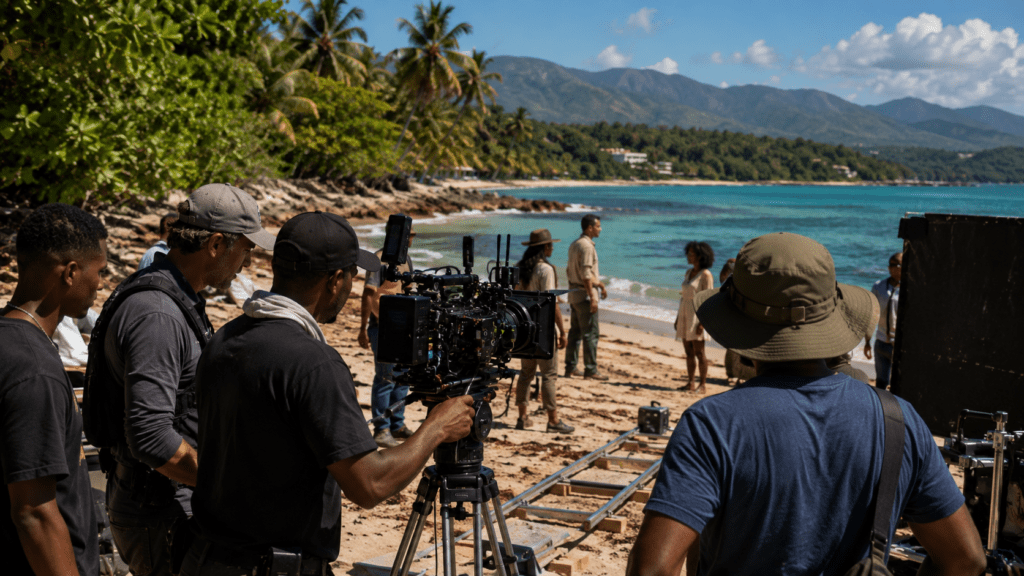
The Dominican Republic has a long history of attracting international filmmakers. Its combination of Caribbean beaches, tropical forests, mountains, rivers, colonial architecture and modern urban environments has allowed productions to recreate places ranging from 1950s Havana to fictional islands and remote tropical territories. What began with location shooting by major directors in the 1970s has developed into a professional production sector capable of hosting large international films, television projects and streaming productions.
The country’s importance as a filming destination increased substantially after the adoption of Law 108-10 on the Promotion of Cinematographic Activity in 2010. The legislation created the Dominican Republic’s film authority, DGCINE, and established incentives intended to attract both domestic and foreign productions. DGCINE says that by 2022 the country had hosted 373 foreign film productions, in addition to 437 Dominican productions.
Why International Productions Choose the Dominican Republic
Location variety is one of the country’s principal advantages. A single production can find beaches, dry landscapes, dense vegetation, mountains, rivers, historic streets and contemporary urban settings without leaving the island. DGCINE specifically highlights the country’s range of natural environments and notes that its colonial architecture has been used to represent other cities and historical periods.
The Dominican Republic also offers an established production infrastructure. Lantica Studios, formerly known as Pinewood Dominican Republic Studios, has soundstages and specialized facilities, including a large water tank designed for demanding aquatic productions. The studio opened in 2014 under a partnership between Lantica Media and Pinewood Group; the partnership ended in 2024, after which the complex continued under the Lantica Studios name.
The fiscal framework is another important factor. DGCINE states that qualifying foreign productions can receive a 25% transferable tax credit on qualifying expenditure incurred in the Dominican Republic, with a minimum qualifying spend of US$500,000. The program also establishes requirements concerning local participation and production permits.
This combination of locations, infrastructure, local crews and incentives helps explain why the Dominican Republic can function as more than a tropical backdrop. For international producers, it can serve as a practical production base capable of supporting substantial portions of a film.
The Godfather Part II: Santo Domingo as Havana
One of the most important chapters in the history of international filming in the Dominican Republic is Francis Ford Coppola’s The Godfather Part II, released in 1974.
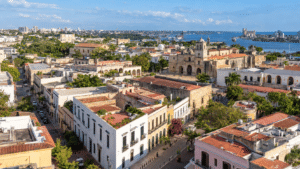
The film’s story moves between different periods and locations, including Cuba during the final days of the Batista regime. Because filming in Cuba was not feasible for the American production, Santo Domingo was used to recreate Havana. Scenes were shot in the Colonial City, whose architecture provided a convincing historical setting. Dominican cultural sources identify 1974 as the year in which scenes from the film were shot in Santo Domingo.
The production is significant because it demonstrated an enduring advantage of Santo Domingo: historic architecture that can convincingly represent other cities. The Colonial City, with its centuries-old streets, plazas and buildings, has subsequently attracted productions seeking locations that do not look unmistakably modern.
Apocalypse Now and the Chavón River
Coppola returned to the Dominican Republic for Apocalypse Now, the 1979 Vietnam War epic. Most of the production was filmed in the Philippines, but sequences were also shot around the Chavón River in La Romana. Dominican cultural sources identify the river as one of the country’s important locations for the film.
The Chavón landscape offered the dense vegetation and dramatic river scenery required for a film portraying the jungles of Southeast Asia. Its cinematic value is particularly clear because the same area has subsequently been associated with other major productions.
The Chavón River therefore represents an important early example of a Dominican location being used not to portray the Dominican Republic itself, but an entirely different part of the world. That practice remains common in international filmmaking.
Havana, The Good Shepherd and Other Historical Settings
The use of Santo Domingo as a stand-in for Havana continued decades later. Havana, directed by Sydney Pollack and released in 1990, was filmed largely in the Dominican Republic because production in Cuba was not practical for an American film at the time. Santo Domingo provided architectural similarities to Havana, while Dominican locations and extras helped recreate the atmosphere of Cuba during the Batista era.
The Good Shepherd also used Santo Domingo for scenes representing locations outside the Dominican Republic. Filming records identify Parque Duarte in Santo Domingo as a location for scenes set in Leopoldville, while the wider production also worked in the United States and United Kingdom.
These productions illustrate why the country has remained useful to filmmakers working with historical narratives. A location does not necessarily need to resemble the place where the story is officially set. What matters is whether its architecture, landscape, logistics and production design can be transformed convincingly on screen.
Pirates of the Caribbean: The Curse of the Black Pearl
The Dominican Republic also became part of the production landscape for Pirates of the Caribbean: The Curse of the Black Pearl, released in 2003 and starring Johnny Depp, Geoffrey Rush, Orlando Bloom and Keira Knightley.
Production took place across several Caribbean locations, including Samaná in the Dominican Republic, as well as locations in St. Vincent and the Grenadines and Dominica.
Samaná’s coastline was particularly well suited to a production built around ships, beaches, tropical vegetation and the visual language of Caribbean adventure. The Dominican Republic’s official tourism authority identifies Playa Rincón in Samaná among the country’s notable cinematic locations associated with the film.
The production helped reinforce an idea that has become central to Dominican film tourism: locations that appear fictional or remote on screen may correspond to real places that visitors can recognize and explore.
Miami Vice and the Use of Dominican Locations for International Stories
Michael Mann’s Miami Vice is another example of the Dominican Republic being incorporated into a major Hollywood production. DGCINE lists the film among international productions that have used Santo Domingo’s historic urban environment.
The film’s production also demonstrates an important characteristic of large location shoots: a movie may use several countries to construct a single cinematic world. The Dominican Republic does not have to represent itself to be valuable. Its architecture, streets, coastline and infrastructure can be adapted to the needs of a story set elsewhere.
47 Meters Down and the Rise of Specialized Film Infrastructure
The arrival of modern studio infrastructure gave the Dominican Republic a new advantage beyond its natural locations. In 2015, 47 Meters Down became the first feature film to use the large horizon water tank at Pinewood Dominican Republic Studios. The underwater thriller, starring Mandy Moore and Claire Holt, used the facility for its demanding underwater photography.
The importance of the production was not simply the film itself. It demonstrated that the country could support specialized filmmaking that would otherwise require a very different production environment. A Caribbean location could therefore provide both natural scenery and purpose-built facilities.
This evolution matters because major productions increasingly require controlled environments for water work, stunts, visual effects and complex technical sequences. Studio facilities complement the Dominican Republic’s natural locations rather than replacing them.
xXx: Return of Xander Cage and the Action-Film Economy
xXx: Return of Xander Cage, released in 2017, added another large international action production to the country’s filming history. The Dominican Republic’s official tourism authority identifies Puerto Plata, including Playa Grande and Playa El Encuentro, among the locations associated with the film.
Action films are particularly well suited to the Dominican Republic because they can combine beaches, roads, urban environments and rugged landscapes within a relatively compact geographic area. They also generate demand for local crews, transportation, construction, security, equipment rental, accommodation and other services.
Old: M. Night Shyamalan in the Dominican Republic
The country became an increasingly important destination for large international productions during the late 2010s and early 2020s. One example was M. Night Shyamalan’s Old, a thriller released in 2021.
The production was among the international projects that helped drive a sharp increase in local film spending. DGCINE reported that the Dominican Republic was on course for approximately US$80 million in local production spending in 2020, compared with a previous high of US$30 million in 2017. The organization attributed part of the increase to international productions including Old.
This period was particularly significant because international filming continued to generate activity despite the disruption caused by the COVID-19 pandemic. The Dominican Republic’s geographic proximity to the United States and its production infrastructure helped maintain its appeal to international producers.
Shotgun Wedding: Jennifer Lopez and a Modern Caribbean Production
Shotgun Wedding, starring Jennifer Lopez and Josh Duhamel, represents the type of contemporary studio production for which the Dominican Republic has become particularly visible. The action romantic comedy was filmed largely in the country and used its resort environments and tropical landscapes to create the setting for an extravagant destination wedding that descends into chaos.
The production also illustrates the economic scale that modern international shoots can bring. During the period when Shotgun Wedding, Arthur the King and other international projects were being developed or filmed, DGCINE highlighted the growing contribution of foreign productions to the local economy.
For the Dominican film industry, projects of this scale are valuable not only because of their international visibility but because they require large numbers of local services and workers.
The Lost City: A Major Hollywood Production in Samaná and Beyond
One of the clearest examples of the Dominican Republic’s emergence as a major international filming destination is The Lost City, released in 2022 and starring Sandra Bullock, Channing Tatum and Daniel Radcliffe, with Brad Pitt in a supporting role.
The adventure comedy was filmed in the Dominican Republic, including locations in Samaná and Casa de Campo. DGCINE reported that the cast and crew spent extended periods in the country and that production operated within a controlled environment during the COVID-19 pandemic.
The film is particularly useful as an example because its fictional world depends heavily on tropical landscapes. Rather than relying exclusively on computer-generated environments, the production could use real Dominican terrain to create the sense of an isolated and exotic lost world.
The official Dominican tourism authority also identifies Punta Cana among the locations associated with the film, reinforcing the country’s role as a multi-location production environment rather than a single resort backdrop.
NYAD and the Dominican Republic as a Stand-In for Open Water
NYAD, the 2023 biographical drama starring Annette Bening and Jodie Foster, provides a different example of international production in the Dominican Republic. The film dramatizes Diana Nyad’s long-distance swimming efforts, requiring extensive water-based imagery and production logistics.
DGCINE includes NYAD among the major foreign productions filmed in the country, while Dominican reporting documented the participation of local figures and the presence of Bening and Foster during production.
The production demonstrates how the country’s usefulness extends beyond conventional beach photography. Large-scale water productions can require controlled facilities, open-water environments, local maritime support and specialized crews. The Dominican Republic’s combination of these elements has helped broaden the types of international productions that can be carried out there.
Road House: The Dominican Republic as the Florida Keys
The 2024 remake of Road House, starring Jake Gyllenhaal and Conor McGregor, offers one of the clearest modern examples of the Dominican Republic standing in for another location.
The story is set around a fictional community in the Florida Keys, but much of the production was carried out in the Dominican Republic. Production records identify Santo Domingo and Punta Cana among the filming locations, while reporting on the shoot also identifies locations around Guayacanes.
The contrast is instructive. Viewers watching the finished film are expected to believe they are looking at the Florida Keys, while the production actually relied heavily on Dominican locations. This is one of the fundamental reasons international productions use the country: a well-selected location can reproduce the visual characteristics of another place without requiring the entire production to travel there.
Road House also demonstrates how contemporary productions combine Dominican locations with small amounts of filming elsewhere. Some scenes were shot in Las Vegas, including material connected to the film’s UFC storyline.
Fast X and the Continued Use of Santo Domingo
The Fast & Furious franchise has also maintained a connection with the Dominican Republic. The country’s official tourism authority lists Fast X, released in 2023, among major productions that used Santo Domingo’s Colonial City.
The choice is logical for a franchise built around movement, action and international locations. Santo Domingo offers historic streets alongside modern infrastructure, while the wider country provides highways, coastlines and varied terrain suitable for large action sequences.
The presence of a major franchise such as Fast & Furious is also important from a visibility perspective. Unlike a small independent production, a global blockbuster can expose Dominican locations to audiences who may have no prior connection with the country.
Why Santo Domingo Is So Important to International Filmmakers
Santo Domingo occupies a special position because it combines several types of cinematic environment in one metropolitan area. The Colonial City can represent historical Latin America or the Caribbean, while modern districts can portray contemporary cities. Roads, waterfronts, commercial areas and public spaces add further possibilities.
DGCINE specifically identifies the Colonial City as a location used in productions including The Godfather Part II, Havana, The Good Shepherd, Miami Vice and The Lost City.
This versatility means that international filmmakers do not necessarily need a single spectacular landmark. Often, what matters more is the ability to construct an entire visual environment through a combination of streets, buildings, interiors, vehicles, extras and production design.
Samaná, La Romana and Puerto Plata: Natural Locations with Global Reach
Outside Santo Domingo, several Dominican regions have developed strong cinematic identities.

- Samaná offers beaches, vegetation, coastal landscapes and relatively undeveloped scenery. It has been associated with productions including Pirates of the Caribbean: The Curse of the Black Pearl and The Lost City.
- La Romana is known internationally for the Chavón River and the broader Casa de Campo area, both of which have been used by major productions.
- Puerto Plata provides beaches, coastal scenery and mountainous terrain, and has been associated with productions such as xXx: Return of Xander Cage.
- Punta Cana combines extensive resort infrastructure with beaches and tropical landscapes, making it useful for productions that require both visual scenery and substantial accommodation capacity.
The geographic diversity of these areas is one of the Dominican Republic’s strongest advantages. Different productions can obtain radically different visual identities without leaving the country.
The Film Law That Changed the Industry
The modern growth of international production cannot be separated from the Dominican Republic’s film legislation. Law 108-10, enacted in 2010, created the institutional framework that DGCINE now administers and established incentives for cinematographic activity.
For qualifying foreign productions, the current DGCINE framework provides a transferable tax credit equal to 25% of qualifying expenditure in the country, subject to a minimum qualifying spend of US$500,000. At least 25% of the production’s headcount must be Dominican nationals or residents. DGCINE also provides assistance with shooting permits, regulations and local production services.
These provisions are important because international producers evaluate destinations on more than scenery. They also consider the availability of skilled crews, equipment, transportation, accommodation, permitting, taxation and production support. Incentives can make the difference between an attractive location and a commercially viable production destination.
From Film Location to Film Industry
The most important change in the Dominican Republic is therefore not simply the number of famous movies that have been filmed there. It is the transition from being a country with attractive locations to being a country with a broader film-production ecosystem.
DGCINE’s role includes promoting the national industry, administering film incentives and positioning the country as a destination for foreign productions. Meanwhile, private studios and local production companies provide facilities, technical crews and production services.
This creates a reinforcing cycle. International productions generate work for local professionals and service companies; those projects help crews gain experience; stronger crews and infrastructure make the country more attractive to future productions; and additional productions increase the industry’s international visibility.
The effect is visible in the range of projects that have arrived. The Dominican Republic has hosted historical dramas, action franchises, thrillers, romantic comedies, underwater films, biographical dramas and major streaming productions. DGCINE’s historical overview includes titles such as Road House, NYAD, The Lost City, Old, Shotgun Wedding, The Black Demon, Arthur the King, 47 Meters Down and xXx: Return of Xander Cage.
A Note About Famous Movies Often Associated With the Dominican Republic
Film-location lists can sometimes create confusion between a place shown in a movie and a place where the movie was actually filmed. This is particularly relevant for productions such as Jurassic Park.
The original film’s story identifies an amber mine in the Dominican Republic, but location research shows that the sequence representing that mine was filmed in Hawaii. Some databases nevertheless list Dominican locations in connection with the production, and DGCINE has also cited Jurassic Park in its historical discussion of international filmmaking.
The distinction is important for anyone researching Dominican film locations. A movie can mention the Dominican Republic, portray it as part of the story or use the country as a fictional location without necessarily being filmed there. A rigorous list should therefore distinguish between stories set in the Dominican Republic, movies that portray the country and productions that physically shot scenes there.
What These Productions Mean for the Dominican Republic
The economic value of international filming extends well beyond the days when cameras are operating. A large production can require hotels, restaurants, transportation, construction, security, equipment rental, catering, locations, technical crews and specialized services. When productions return repeatedly, local professionals can build careers and companies can develop expertise around the sector.
There is also a cultural and tourism dimension. When international audiences see Samaná, Santo Domingo, Puerto Plata or La Romana on screen, those places acquire an additional association with cinema. The Dominican Republic’s tourism authority has increasingly incorporated film locations into its destination storytelling, highlighting beaches, historic cities and natural landscapes used by international productions.
However, the existence of film incentives does not mean every production automatically benefits the country in the same way. The economic impact depends on factors such as local expenditure, the proportion of local workers and suppliers, the scale of the production and whether infrastructure and expertise remain in the country after the cameras leave. The strongest long-term benefit comes when international filming contributes to a sustainable local industry rather than functioning solely as temporary location work.