 23°C
23°C
Endangered Species in the Dominican Republic
The Dominican Republic is home to a remarkable range of endemic plants and animals, but many face a serious risk of extinction because of habitat loss, invasive species, pollution, overexploitation and other pressures. The country's official conservation records include hundreds of threatened species, from the Hispaniolan solenodon and Ricord's rock iguana to the West Indian manatee, sea turtles and numerous native plants. The national Red List is also being updated, making it important to distinguish between established national assessments and newer conservation information.


The Dominican Republic is one of the Caribbean’s most biologically diverse countries, but that biodiversity is under significant pressure. Because the country occupies part of Hispaniola, an island with many species found nowhere else on Earth, the loss of a local population can represent a major loss for global biodiversity. The national authorities have identified hundreds of threatened species, while conservation institutions continue to reassess their status and priorities.
The most visible examples include the Hispaniolan solenodon, Cuvier’s hutia, Ricord’s rock iguana, Hispaniolan rhinoceros iguana, Ridgway’s hawk, the West Indian manatee and several species of sea turtles. Plants are an equally important part of the problem: the Dominican Republic’s 2016 Red List of Vascular Flora identified 1,330 evaluated plant species in the categories of Critically Endangered, Endangered or Vulnerable.
How Many Species Are Threatened in the Dominican Republic?
There is no single number that should be presented as a permanent count because the national Red List is periodically revised, species are reassessed and scientific knowledge changes. The Dominican Ministry of Environment’s national assessment identified 434 threatened fauna species: 69 classified as Critically Endangered, 95 as Endangered and 260 as Vulnerable.
For plants, the situation is even more extensive. The 2016 Red List of the Vascular Flora of the Dominican Republic, prepared by the National Botanical Garden, evaluated 1,388 vascular plant species. Of these, 1,330 were placed in one of the three threatened categories: 813 Critically Endangered, 249 Endangered and 268 Vulnerable.
These figures should not be interpreted as a definitive count of every species that could disappear from the country. They represent species assessed under particular national evaluations. In November 2025, the Ministry of Environment held a workshop aimed at updating the national Red List of threatened fauna, including the review of previous information, identification of data gaps and prioritization of species for research and monitoring.
For that reason, the safest way to understand the conservation situation is to look at the species themselves, their habitats and the threats affecting them rather than treating an old numerical total as a permanent figure.
The Most Notable Endangered Animals in the Dominican Republic
Hispaniolan Solenodon
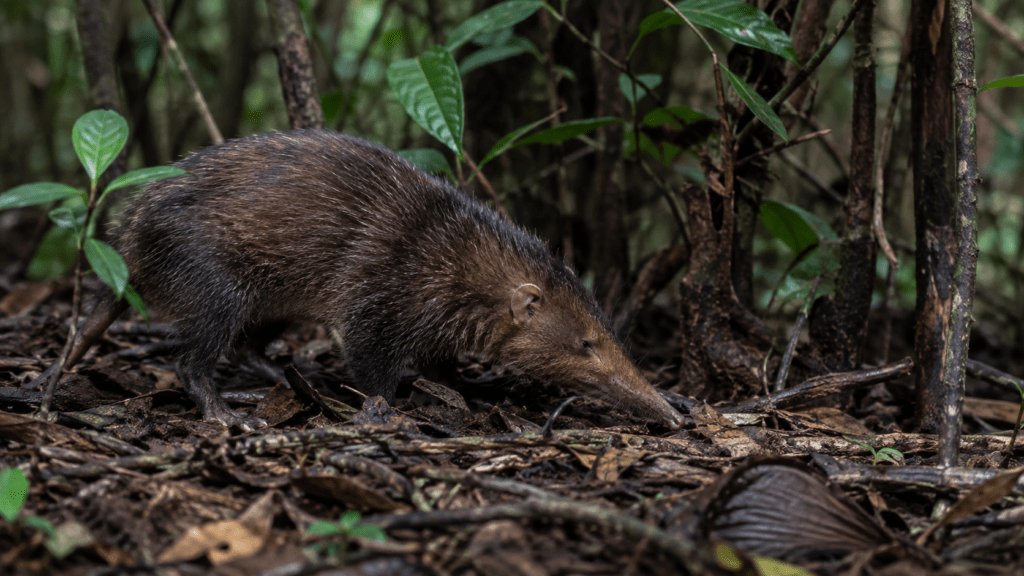
The Hispaniolan solenodon (Solenodon paradoxus) is one of the most distinctive mammals of Hispaniola. It is a small, nocturnal insect-eating mammal with a long snout and a venomous bite, and it belongs to one of the few surviving mammalian lineages unique to the Caribbean.
The species is particularly important because its survival is closely tied to the remaining forest habitats of Hispaniola. The Dominican Ministry of Environment identifies the solenodon among the country’s threatened endemic mammals and notes that habitat destruction and predation by introduced animals such as cats and mongooses are important pressures on threatened terrestrial mammals.
Protecting forests therefore does more than preserve trees. It protects one of the world’s rarest mammalian lineages and the ecological communities on which it depends.
Cuvier’s Hutia
Cuvier’s hutia (Plagiodontia aedium) is another endemic Hispaniolan mammal. Hutias are rodents, but this species is very different from the rats and mice familiar in urban environments. It is a native forest animal whose survival is closely associated with suitable habitat.
The Dominican government’s fauna information identifies Plagiodontia aedium as one of the island’s endemic mammals and has historically classified it as Endangered in the national assessment. Habitat destruction and introduced predators are among the pressures affecting threatened terrestrial mammals in the country.
An important conservation lesson comes from species such as the hutia: protecting an animal requires protecting the ecological conditions that allow it to reproduce, feed and shelter, rather than simply protecting individual animals.
Ricord’s Rock Iguana
Ricord’s rock iguana (Cyclura ricordii) is an endemic reptile associated particularly with the dry landscapes of southwestern Hispaniola. The Dominican Ministry of Environment highlights the Barahona region as an area of exceptional reptile endemism and identifies Ricord’s iguana as exclusive to that part of the island.
Its restricted distribution makes the species particularly sensitive to habitat degradation. Dry forests, scrublands and other ecosystems in the southwest face pressure from development, agriculture, extraction and other forms of land-use change.
Ricord’s iguana is also a reminder that endangered species are not limited to rainforests. Dry ecosystems can contain highly specialized species that exist nowhere else.
Hispaniolan Rhinoceros Iguana
The Hispaniolan rhinoceros iguana (Cyclura cornuta) is another large endemic reptile of Hispaniola. It is recognizable by the horn-like structures on its snout and is associated with dry forests and rocky habitats.
The species has been included among threatened reptiles in conservation assessments. Its long-term survival depends on maintaining suitable habitat and reducing pressures such as hunting, habitat degradation and interactions with introduced animals.
Large reptiles can play important ecological roles as herbivores and seed dispersers. Their decline can therefore affect more than the species itself.
Ridgway’s Hawk
Ridgway’s hawk (Buteo ridgwayi) is a rare bird of prey endemic to Hispaniola. It is one of the Caribbean’s most conservation-dependent raptors and has become an important symbol of bird conservation in the Dominican Republic.
Like many forest-dependent birds, its survival is affected by the loss and fragmentation of habitat. Predation and other pressures can also affect reproductive success. Because raptors occupy high positions in food webs, their conservation can provide information about the health of the ecosystems where they live.
Protecting native forest and maintaining connected habitats are therefore central to conserving this species.
West Indian Manatee
The West Indian manatee (Trichechus manatus), known locally as the manatí antillano, is one of the Dominican Republic’s most important marine conservation species. The national fauna information places the species in the country’s Critically Endangered category.
Manatees depend on shallow coastal and estuarine environments where they can find aquatic vegetation. Their populations can be affected by habitat degradation, human activity and accidental or deliberate killing.
The Dominican Republic has established protected areas and marine mammal sanctuaries that contribute to the protection of important coastal habitats. The country’s protected-area system includes the Estero Hondo and the Bancos de La Plata y La Navidad marine mammal sanctuaries.
Hawksbill Turtle
The hawksbill turtle (Eretmochelys imbricata) is globally classified as Critically Endangered by the International Union for Conservation of Nature. It occurs in tropical marine environments and is closely associated with coral reef ecosystems, which provide important feeding habitat.
The species faces multiple threats, including the loss of nesting habitat, collection of eggs, accidental capture in fishing gear, marine pollution and the historical trade in tortoiseshell. The degradation of coral reefs adds another layer of risk because reefs are important feeding areas.
For the Dominican Republic, protecting nesting beaches and coastal waters is therefore inseparable from protecting the turtle itself.
Leatherback Turtle
The leatherback turtle (Dermochelys coriacea) is the world’s largest living sea turtle and is classified as Critically Endangered by the IUCN. Unlike other sea turtles, it has a flexible, leathery shell rather than a hard carapace.
Leatherbacks are highly migratory, meaning that conservation cannot stop at the boundaries of one country. Threats include the loss of nesting beaches, accidental capture in fishing gear, collisions with vessels, egg collection and ingestion of marine debris.
The species illustrates why marine conservation requires international cooperation: a turtle that nests in the Dominican Republic may travel through the waters of several other countries during its lifetime.
Green Turtle and Other Sea Turtles
The green turtle (Chelonia mydas) and other sea turtles are also included in the Dominican Republic’s national conservation framework. The national Red List specifically identifies green turtles, hawksbills and leatherbacks among protected threatened species.
Sea turtles require protection throughout different stages of their life cycle. Nesting beaches must remain suitable for females and hatchlings, while nearshore and offshore habitats must provide adequate feeding grounds. Fishing interactions, coastal development, artificial lighting, pollution and illegal collection can all undermine conservation efforts.
Threatened Dominican Plants Are Part of the Same Crisis
Wildlife receives much of the public attention, but the conservation crisis also affects the country’s flora. The Dominican Republic has thousands of vascular plant species, including a very large number of species found only on Hispaniola or restricted to small parts of the country.
The 2016 national Red List of vascular flora evaluated 1,388 species and found that 1,330 fell into Critically Endangered, Endangered or Vulnerable categories. The National Botanical Garden reported particularly high levels of threat among groups such as orchids, palms and cacti.
Bayahibe Rose
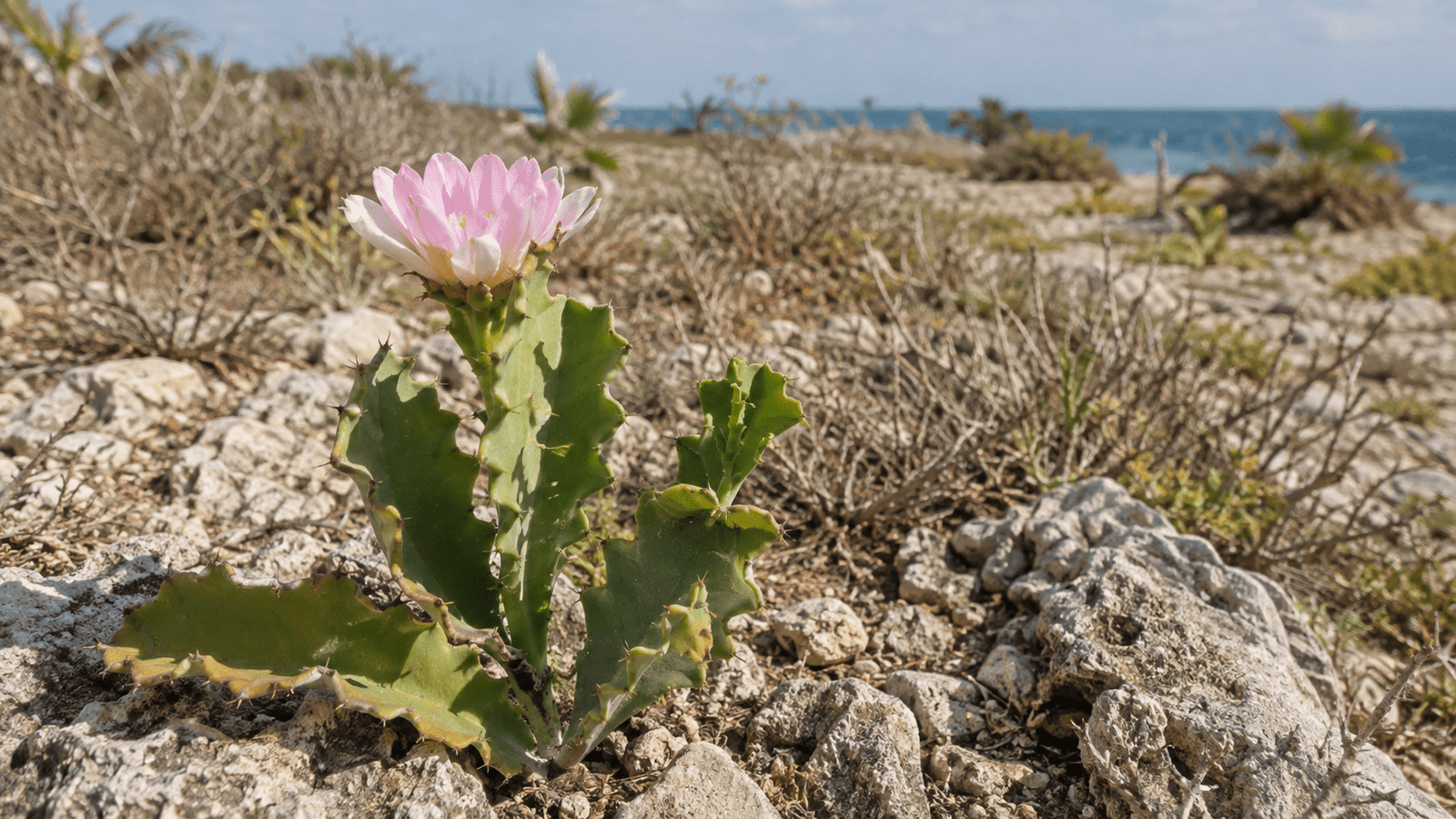
The Bayahibe rose (Leuenbergeria quisqueyana) is an endemic Dominican cactus and the country’s national flower. It is unusual because, unlike most cacti, it retains true leaves.
The species remains classified as Critically Endangered. Its restricted distribution and specialized habitat requirements make the protection of remaining wild populations particularly important.
Its status also demonstrates that national symbols can have conservation significance. Protecting the Bayahibe rose means protecting a plant that forms part of the Dominican Republic’s natural heritage as well as its cultural identity.
Other Threatened Native Plants
The National Botanical Garden has identified numerous other plants requiring conservation attention. Examples include Cola mora (Mora abbottii), an endemic tree classified as Endangered, as well as guanábana cimarrona (Annona montana) and algarrobita (Cynometra portoricensis), both reported under the Critically Endangered category in the national flora assessment.
Other threatened plants include higüerillo (Amphitecna latifolia) and maga (Hernandia sonora), both classified as Endangered in the information published by the National Botanical Garden.
The conservation of these species is important not only because of their rarity. Plants provide food, shelter, soil stabilization, carbon storage and habitat for other organisms. Losing a plant species can therefore produce ecological consequences that are much broader than the disappearance of one tree or shrub.
Why Are Species in the Dominican Republic Endangered?
The causes of species decline vary by habitat and species, but the Ministry of Environment identifies several recurring pressures. Among them are habitat destruction and fragmentation, deforestation, agricultural expansion, pollution, poorly planned tourism, demographic expansion, climate change and introduced non-native species.
Habitat Loss and Fragmentation
Habitat loss is one of the most important threats to biodiversity. When forests, wetlands, coastal areas or dry ecosystems are converted to other uses, species lose feeding grounds, nesting sites and shelter.
Fragmentation can be equally important. A large continuous forest may support populations that cannot survive in a series of isolated fragments. Small populations are also more vulnerable to local disasters, disease and genetic problems.
Introduced Predators and Invasive Species
Island ecosystems are especially vulnerable to introduced species because native animals evolved without many of the predators and competitors found on continents. The Dominican Ministry of Environment identifies introduced animals, including cats and mongooses, as a threat to native mammals.
Invasive plants and other non-native organisms can also alter habitats, compete with native species and disrupt ecological relationships.
Coastal Development and Tourism
The Dominican Republic’s beaches, coral reefs, mangroves and coastal ecosystems are economically important, but development can create pressure on the same environments that support endangered species.
For sea turtles, for example, the quality of nesting beaches is critical. Artificial lighting, construction, erosion, human disturbance and the loss of natural vegetation can make beaches less suitable for nesting.
Pollution and Marine Debris
Plastic and other marine debris can be particularly dangerous to marine animals. Leatherback turtles, for example, can ingest plastic because floating debris may resemble jellyfish, one of their principal food sources.
Pollution also affects coral reefs, wetlands, rivers and coastal habitats. Because species are interconnected through food webs and water systems, environmental degradation can affect several groups at the same time.

Climate Change
Climate change adds another layer of pressure. Rising temperatures, changing rainfall patterns, stronger climate extremes, sea-level rise and changes in marine ecosystems can affect species that already occupy small or fragmented habitats.
For species with highly restricted ranges, even relatively small changes in environmental conditions can have serious consequences. Climate change can also intensify existing problems such as drought, habitat degradation and coral bleaching.
Where Are Endangered Species Protected?
The Dominican Republic uses a national system of protected areas to conserve ecosystems and species. The Ministry of Environment reports that the National System of Protected Areas includes terrestrial and marine conservation units representing forests, wetlands, coastal ecosystems, dry habitats and other environments.
Among the country’s important conservation landscapes are Jaragua National Park, Sierra de Bahoruco National Park and Lago Enriquillo National Park. Together with surrounding areas, they form part of the Jaragua-Bahoruco-Enriquillo Biosphere Reserve.
The Ministry also reports that protected areas safeguard representative samples of many natural ecosystems and more than 90 percent of the endemic flora and fauna species reported in the country.
Protected areas are not a complete solution on their own. Species can move beyond their boundaries, while threats such as invasive species, illegal hunting, pollution and climate change can affect both protected and unprotected landscapes. Effective conservation therefore requires management, monitoring, enforcement, habitat restoration and cooperation with local communities.
What Is the Dominican Republic Doing to Protect Threatened Species?
The country’s conservation framework combines protected areas, species protection, scientific monitoring, habitat management and national Red List assessments.
The Ministry of Environment is responsible for biodiversity policy and the management of the country’s protected-area system. Its biodiversity authorities also maintain species information, monitor threatened wildlife and develop conservation measures.
The national Red List uses categories based on the criteria of the International Union for Conservation of Nature. The categories include Critically Endangered, Endangered and Vulnerable, which represent progressively lower but still significant levels of extinction risk.
National regulations provide protection for species included in the Red List. The framework prohibits activities including unauthorized hunting, capture, harassment, killing, trafficking, trade and illegal possession of listed species.
Conservation work also extends to plants. The National Botanical Garden has participated in programs such as Misión Rescate Lista Roja, designed to support the conservation and propagation of threatened native and endemic plants.
Why Endemic Species Are Especially Important
An endemic species is one that naturally occurs in a particular geographic area and nowhere else. Hispaniola has exceptionally high endemism, particularly among reptiles and plants.
This matters because extinction on Hispaniola can mean global extinction. If a species exists only on this island and disappears from its remaining habitat, there is no naturally occurring population elsewhere that can replace it.
The Dominican Ministry of Environment reports that the island’s reptiles include a very high proportion of endemic species. It also identifies four endemic mammal species in its fauna information: the Hispaniolan solenodon, Solenodon marcanoi, Cuvier’s hutia and the endemic bat Natalus major.
One of these, Solenodon marcanoi, is believed to be extinct and is known from fossil material. Its disappearance demonstrates that extinction is not merely a theoretical possibility for Hispaniolan wildlife.
What Can Visitors and Residents Do to Help?
Individual actions cannot replace national conservation policy, but they can reduce pressure on vulnerable species. The most useful approach is to avoid activities that directly harm wildlife and to support responsible management of natural areas.
- Do not buy wildlife or products made from protected species. This includes shells, corals, turtle products, wild-caught animals and other products whose legal origin cannot be demonstrated.
- Do not capture or feed wild animals. Human interaction can alter natural behavior and create additional risks.
- Keep beaches clean. Removing and properly disposing of plastic and other waste can reduce risks to marine wildlife.
- Respect protected areas. Follow park regulations, remain on authorized trails and avoid disturbing nesting or breeding animals.
- Choose responsible wildlife tourism. Activities should minimize disturbance and comply with local conservation rules.
- Do not introduce exotic animals or plants into natural habitats. Non-native species can become invasive and threaten native biodiversity.
- Support native plants. When landscaping, choosing appropriate native species can help create habitat while reducing pressure on wild populations.
For visitors, one of the simplest rules is also one of the most important: observe wildlife without interfering with it. A photograph taken from a respectful distance is preferable to handling, feeding or chasing an animal.