 25°C
25°C

What 7,000 Years of Fossils Reveal About Caribbean Reef Food Webs
A new Nature study has used nitrogen preserved in fossil fish ear stones and corals to reconstruct Caribbean reef food webs from about 7,000 years ago. The evidence from the Dominican Republic and Panama points to shorter food chains and less dietary specialization on modern reefs, offering a new way to understand how long-term ecological change has altered the way energy moves through these ecosystems.


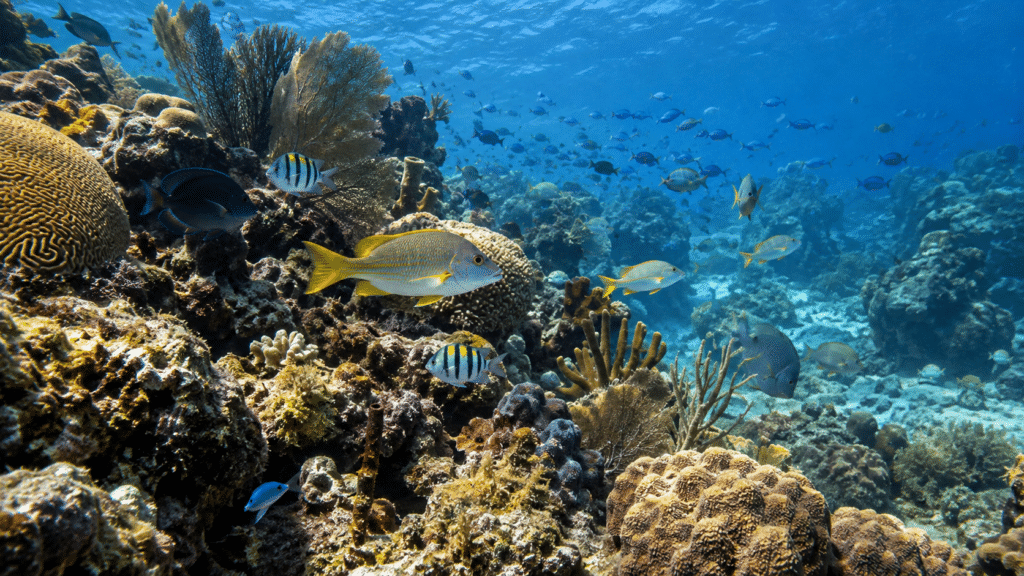
Coral reefs can look healthy from above while undergoing profound changes in the way energy moves through the ecosystem. A new study published in Nature provides an unusually long-term view of that process by comparing modern Caribbean reefs with reef communities that existed about 7,000 years ago, before widespread human impacts.
The researchers analyzed nitrogen isotopes preserved in tiny fish ear stones, known as otoliths, together with organic material preserved in coral skeletons. The samples came from two Caribbean regions: Bocas del Toro in Panama and the Enriquillo Basin in the Dominican Republic.
The results indicate that modern reef food webs are substantially more compressed than their mid-Holocene counterparts. Depending on the measure used, the researchers found food-chain length was roughly 40% shorter based on the observed trophic range, while their ecosystem-level analysis indicated a reduction of about 60–70%. They also found a marked reduction in the range of dietary strategies used by reef fishes.
Why scientists looked 7,000 years into the past
Understanding how coral reefs have changed is difficult because detailed ecological monitoring only covers a small fraction of their history. Modern surveys can show how coral cover, fish abundance and species composition have changed over recent decades, but they cannot directly reveal how a reef food web functioned thousands of years ago.
That historical gap matters because many of the pressures affecting Caribbean reefs developed gradually. Overfishing, coastal development, pollution, disease and climate-related warming have altered reef communities over different periods and at different intensities. Caribbean coral cover has declined dramatically since systematic monitoring began in the late 1970s, with studies documenting widespread shifts from coral-dominated toward algae-dominated communities.
The Nature study approaches the problem from a different direction. Rather than trying to reconstruct every species that lived on an ancient reef, the researchers examined chemical evidence that records where fish occupied the food chain.
How nitrogen isotopes reveal a food web
Nitrogen exists naturally in different forms, including nitrogen-14 and nitrogen-15. The ratio between these isotopes, expressed as δ15N, changes as nitrogen moves through a food web. Animals generally become enriched in nitrogen-15 relative to what they consume, creating a chemical signal that can be used to estimate trophic position.
In simple terms, organisms near the base of a food web tend to have lower δ15N values, while animals feeding higher in the food chain tend to have higher values. By measuring these differences across a community, scientists can reconstruct aspects of the vertical structure of a food web.
The study used a particularly valuable archive: fish otoliths. Otoliths are calcium-carbonate structures in the inner ears of bony fish that help with balance and orientation. They are extremely durable and can survive in sediments for thousands of years. Although most of an otolith is mineral, it also contains a small amount of organic material that can preserve nitrogen isotope information.
The researchers developed their analysis around this fossil-bound organic nitrogen. They also analyzed nitrogen preserved in coral material to establish the isotopic baseline of the environment. That baseline is important because changes in environmental nitrogen could otherwise make a modern and ancient community appear different even if the fishes’ feeding positions had not changed.
In both Panama and the Dominican Republic, the study found no significant change in the coral-derived nitrogen baseline between the prehistoric and modern samples. That allowed the researchers to interpret differences in fish δ15N primarily in terms of changes in trophic structure rather than simply changes in the starting nitrogen signal.
What the researchers actually sampled
The analysis focused on reef-associated fishes occupying different ecological roles rather than attempting to reconstruct the entire fish community.
The researchers examined 136 fish otoliths and co-occurring coral samples from both fossil and modern Caribbean reefs. The fish groups included gobies, cardinalfishes, silversides and grunts. These groups occupy different positions and feeding roles within reef ecosystems, making them useful for comparing trophic structure across time.
The prehistoric material came from reef sediments dating to approximately 7,000 years ago, during the mid-Holocene. The Dominican Republic samples were recovered from the Enriquillo Basin, an area that preserves unusually valuable evidence of ancient Caribbean reef environments. Modern material came from nearby contemporary reef settings, allowing the researchers to compare ancient and recent ecological conditions within the same broad regions.
The fossil reef sediments were excavated and sieved so that tiny otoliths could be recovered under a microscope. Because otoliths can be identified by their shape, the researchers were able to assign specimens to fish families and, where possible, to lower taxonomic levels.
The modern Caribbean reef food web is more compressed
One of the study’s central findings is that the distance between lower- and higher-trophic-level fishes has narrowed on modern reefs.
The researchers describe this as trophic simplification. A food web is not simply a straight line from plants to herbivores to predators. It is a network of many feeding relationships, with organisms consuming different resources and occupying overlapping but distinct ecological roles.
A more vertically extensive food web can contain more feeding steps between its base and its upper levels. A compressed food web has less separation between those positions. The study found that the modern reefs in both Panama and the Dominican Republic had substantially shorter food-chain lengths than the reefs represented by the mid-Holocene fossils.
Using the directly observed range of trophic positions, food-chain length was approximately 40% shorter on modern reefs in both regions. A separate ecosystem-level analysis, which incorporated the distribution and relative representation of the fish groups, produced a larger estimate: modern food chains were approximately 60–70% shorter than those reconstructed for the prehistoric reefs. These are different analytical measures of the same broader pattern rather than competing claims. turn0search0
Some fish moved down the food chain while others did not
The changes were not uniform across all fish groups.
In the Dominican Republic, modern grunts had mean δ15N values 2.4 parts per thousand lower than their fossil counterparts. Cardinalfishes showed an even larger difference, with modern values 3.7 parts per thousand lower.
Because nitrogen isotope values generally increase with trophic position, these differences indicate that these groups occupied lower trophic positions in the modern samples.
Other fish showed different patterns. Gobies, which occupy relatively low trophic levels, did not follow the same downward trajectory in both regions. Their modern δ15N values were higher than fossil values in Panama but lower in the Dominican Republic. Silversides showed a small decline in Panama and were not measured in the Dominican Republic because suitable specimens were unavailable.
This variation is important. The study does not describe a simple story in which every fish moved lower in the food chain. Instead, different components of the food web changed in different ways, producing an overall compression of trophic structure.
The bigger change may be what fish were eating
The most significant finding may not be the shift in trophic position itself, but the reduction in dietary diversity within the fish community.
The researchers found that modern reefs had substantially narrower nitrogen-isotope distributions than the prehistoric reefs. Their analysis showed reductions in trophic range of roughly 20–70%, depending on the family and metric used, with particularly strong evidence of reduced variation in the modern communities.
In ecological terms, this suggests that individual fish and fish groups may have become less specialized in their feeding strategies. Instead of different individuals exploiting a broad range of resources and creating many distinct pathways through which energy moves across the reef, more individuals may now be relying on overlapping resources.
The authors interpret this pattern as evidence of reduced ecological complexity. In the prehistoric reefs, greater dietary specialization would have created more distinct pathways for energy to move through the ecosystem. On modern reefs, those pathways appear to have become more similar and compressed. turn0search0
Why dietary specialization matters for reef resilience
Food-web complexity is not simply an abstract ecological measurement. It can influence how an ecosystem responds when conditions change.
Imagine a reef in which different fish individuals depend on a wide variety of prey. If one food source declines, only part of the community may be directly affected because other fish rely on different resources. A more specialized and diverse system can therefore contain multiple pathways for energy to move through the ecosystem.
The study’s authors argue that modern reefs have fewer such pathways. If more individuals depend on the same limited resources, a disturbance affecting those resources could have broader consequences.
This does not mean the study demonstrates that trophic simplification will inevitably cause reef collapse. Rather, the researchers argue that reduced trophic diversity and functional redundancy may lower the capacity of reef ecosystems to absorb future disturbances. The finding is therefore best understood as evidence of a potential reduction in ecological resilience, not as a prediction that a particular reef will collapse.
What the Dominican Republic adds to the study
The Dominican Republic is particularly important because the Enriquillo Basin preserves one of the Caribbean’s rare fossil reef records containing fish otoliths suitable for this type of analysis.
The site gives scientists an opportunity to compare an ancient Caribbean reef with a modern reef in the same broad geographic region. That makes the Dominican evidence more useful than a comparison between unrelated ecosystems separated by thousands of miles.
At the same time, the study should not be interpreted as a complete ecological history of all Dominican reefs. The analysis focused on selected fish families and particular fossil and modern reef deposits. It therefore provides evidence about trophic structure at the sampled sites rather than a comprehensive measurement of every reef surrounding the Dominican Republic.
That distinction is important for understanding what the study does and does not show. It provides direct evidence that the structure of a Caribbean reef food web has changed over thousands of years. It does not establish that every Dominican reef has experienced exactly the same changes or that one particular modern stressor is solely responsible.
The findings fit a much larger Caribbean reef story
The isotope evidence complements decades of research documenting major ecological changes across Caribbean reefs.
A comprehensive assessment of Caribbean reefs from 1970 to 2012 documented long-term declines in coral cover and reef health across the region. Subsequent research has described a broader transformation in which reefs have been affected by fishing, land-based pollution, coastal development, disease, warming and other interacting pressures.
Those changes can affect food webs in several ways. Removing large predatory fish can alter the upper levels of a food web. Reducing herbivorous fish can allow algae to expand. Coral loss can remove the three-dimensional habitat that supports many reef organisms. Pollution and warming can add further stress to both corals and fish.
NOAA identifies climate-related warming, disease, habitat degradation, land-based pollution and unsustainable fishing among the major threats facing Caribbean coral species. Research on Caribbean reefs has also linked overfishing and the loss of herbivores to changes in algal abundance and reef condition.
The new Nature study adds another dimension to that history: not simply how much coral remains or how many fish are present, but how the surviving organisms are connected through feeding relationships.
A new way to establish historical baselines
One of the broader scientific contributions of the research is methodological.
Ecologists have long used stable isotopes to investigate modern food webs. The challenge has been extending those measurements far enough into the past to establish a meaningful baseline before major human disturbance.
The combination of fossil otoliths, coral material and high-sensitivity nitrogen isotope analysis provides a way to reconstruct aspects of ancient ecosystem function directly from preserved biological material.
That opens the possibility of applying similar techniques to other fossil reef deposits. Researchers could potentially compare trophic structures across different regions, periods and environmental conditions, helping distinguish local ecological changes from broader Caribbean patterns.
What this means for understanding Caribbean reefs today
The importance of the study lies partly in what conventional monitoring cannot show.
A modern reef can be compared with a reef surveyed 10, 20 or 50 years ago. But those comparisons may still miss the ecological baseline that existed before major human pressure. Fossil evidence can extend that baseline thousands of years further into the past.
In the Dominican Republic, the Enriquillo Basin provides an unusually valuable window into that history. The fossil evidence suggests that the reef ecosystem once supported a broader range of trophic pathways than those detected in the modern comparison.
For scientists, that means reef recovery cannot necessarily be measured only by counting coral colonies or fish. An ecosystem might regain some physical structure while still functioning differently from its historical state.
For the wider Caribbean, the study reinforces the idea that reef degradation can involve changes in relationships among organisms, not only changes in the abundance of individual species.

Why the study matters beyond the fossil record
Coral reefs support complex communities of fish and invertebrates while providing food, coastal protection and economic benefits to many coastal populations. Their condition is therefore relevant far beyond marine biology.
The study does not provide a single solution for restoring Caribbean reefs, nor does it isolate one cause behind the trophic changes it documents. Its contribution is different: it establishes a longer historical reference point and shows that the organization of reef food webs has changed substantially over the period separating ancient and modern samples.
That historical perspective can change the questions scientists ask about reef conservation. Instead of asking only whether a reef has more coral or more fish than it did a few decades ago, researchers can also ask whether the ecosystem retains the diversity of feeding strategies and energy pathways that characterized older reef communities.
For the Dominican Republic, the Enriquillo Basin shows why the country’s geological record can be valuable to modern marine science. A reef preserved in sediments thousands of years ago can provide information about ecosystem function that cannot be recovered from contemporary observations alone.
The larger lesson is that coral reef degradation is not necessarily visible in a single measurement. The structure of the food web itself can change. By recovering chemical signals preserved in tiny fossil fish ear stones, scientists are beginning to reconstruct that hidden history—and to show how different today’s Caribbean reefs may be from the ecosystems that existed thousands of years ago.