 25°C
25°C

Climate Risk Perception Gaps Raise Questions for the Dominican Republic
A recent study of 60 decision-makers and risk-management technicians involved in the Dominican Republic’s disaster-management system found that overall risk perception was close to the researchers’ benchmark for adequate estimation, but several factors pointed to systematic underestimation—particularly understanding of risk, trust in institutions, personal involvement and organizational climate. The findings do not show that Dominican institutions are uniformly unprepared, nor do they measure the country’s physical climate risk directly. Instead, they reveal a narrower but consequential problem: whether people responsible for managing climate-related risks perceive those risks in ways consistent with the evidence available to them.


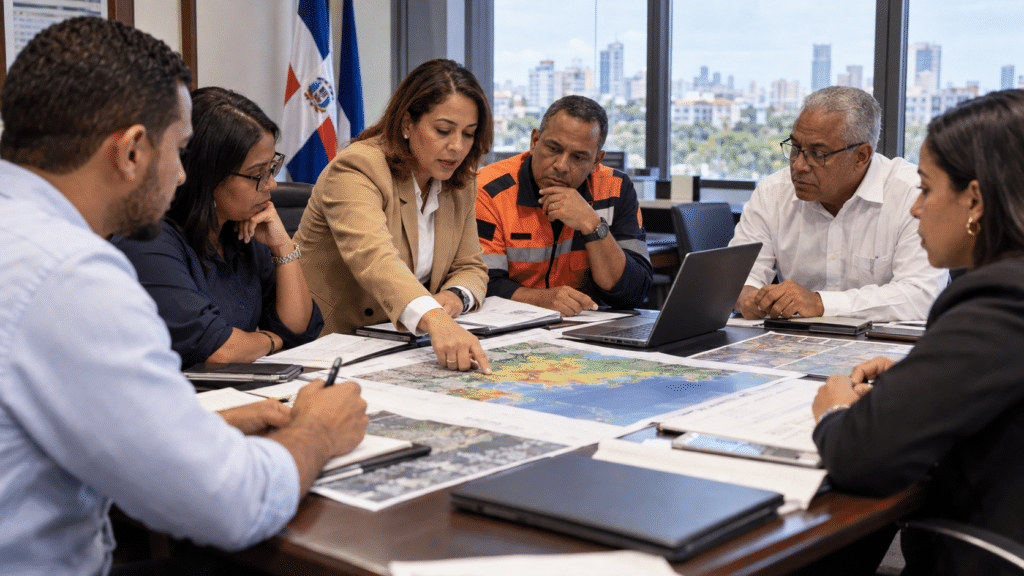
For a country exposed to hurricanes, intense rainfall, flooding, drought and rising temperatures, climate risk is not simply a question of what the physical environment may experience. It is also a question of how institutions understand those risks and translate that understanding into decisions. A study published in 2026 in the International Journal of Environmental Research and Public Health examined that institutional dimension in the Dominican Republic, focusing on people involved in disaster-risk management and climate-related decision-making.
The study’s central finding is more nuanced than a simple claim that Dominican officials underestimate climate change. The surveyed group produced an overall risk-perception score of 1.95 on a three-point scale, with 2 defined by the researchers as the benchmark for adequate risk estimation. Yet several individual dimensions fell well below that benchmark. The lowest scores concerned trust in institutions, organizational climate, understanding of risk and the perceived role of the media. These gaps, the authors argue, can make it harder to turn scientific knowledge into timely and coordinated action.
What the Study Actually Measured
The research was designed to measure risk perception, not to calculate the Dominican Republic’s physical exposure to climate hazards. That distinction matters. Risk perception describes how people understand, interpret and evaluate a hazard, including how familiar they are with it, how serious they believe its consequences could be, whether they feel personally exposed, and how much confidence they place in institutions responsible for managing it.
The researchers applied a perceived-risk-profile approach based on the psychometric paradigm and used the RISKPERCEP software system developed by an interdisciplinary team at the University of Havana. The questionnaire translated different aspects of risk perception into measurable variables. Responses were generally classified on a three-level scale: 1 for underestimation, 2 for adequate estimation and 3 for overestimation.
The survey contained 27 questions covering issues ranging from knowledge of climate change and greenhouse gases to perceptions of catastrophic potential, past disasters, personal involvement, institutional trust, organizational conditions and the role of the media. The study therefore looked at climate risk through several lenses rather than asking respondents simply whether they were worried about climate change.
Who Participated in the Research?
The researchers surveyed 60 people: 35 decision-makers and 25 risk-management technicians. The participants were drawn from different hierarchical levels of Civil Defense, members of the National System of Prevention, Mitigation and Response and collaborating personnel. Participation was voluntary, and respondents were selected because of their active involvement in disaster-management activities as part of their institutional responsibilities.
The sample included 44 men and 16 women. Four respondents were between 18 and 30, 24 were between 31 and 45, 20 were between 46 and 60, and 12 were older than 60. The researchers calculated a required sample of 58 under their stated assumptions and surveyed 60 people in practice.
Data were collected through KoboToolbox applications during consultative meetings and subsequently processed using Excel and RISKPERCEP. Because the study converted ordinal responses into numerical values and then averaged them, the authors explicitly described their resulting measure as a non-statistical Weighted Risk Perception Score. That methodological qualification is important: the scores are best understood as a structured diagnostic tool rather than as conventional continuous statistical measurements.
The Overall Result Was Close to Adequate—but the Details Matter
The group’s overall score of 1.95 fell inside the researchers’ defined range for adequate risk estimation, which extended from 1.68 to 2.23. At first glance, that might appear reassuring. But the aggregate score masks substantial differences among the variables that make up the profile.
| Risk-perception dimension | Mean score | Interpretation in the study |
|---|---|---|
| Institutional trust | 1.07 | Underestimation |
| Organizational climate | 1.27 | Underestimation |
| Role of the press or broadcast media | 1.43 | Underestimation |
| Understanding of risk | 1.40 | Underestimation |
| Personal involvement | 1.73 | Adequate estimation range |
| Past history of disasters | 1.97 | Adequate estimation range |
| Concern | 2.10 | Adequate estimation range |
| Catastrophic potential | 2.43 | Overestimation |
| Ability to control risk | 2.73 | Overestimation |
| Voluntariness | 2.87 | Overestimation |
The table illustrates why the headline finding should not be reduced to the overall average. Respondents tended to score some dimensions above the adequate range while scoring others considerably below it. The authors identify four variables as especially important contributors to overall risk underestimation: understanding of risk, personal involvement, institutional trust and organizational climate.
Knowledge Was One of the Clearest Weak Points
The variable measuring understanding of risk, known as COMP, received a mean score of 1.40, placing it firmly in the study’s underestimation range. The questions addressed subjects such as the origins of climate change, atmospheric composition, greenhouse gases and their sources, energy sustainability, threats associated with global warming and technologies for reducing emissions.
This does not mean that the surveyed professionals lacked knowledge of climate change in general. The study did not administer a conventional examination of professional competence, nor did it conclude that respondents were uninformed across the board. Rather, the result indicates that respondents’ answers to the specific knowledge-related questions were associated with a lower risk-perception score than the researchers considered adequate.
That distinction is particularly relevant for decision-making. A person can recognize climate change as a general problem while still underestimating the significance of a particular pathway—for example, the relationship between energy use, greenhouse-gas emissions and environmental sustainability. The study was designed to detect precisely these kinds of gaps.
Institutional Trust Was the Lowest-Scoring Dimension
The study’s lowest mean score was 1.07 for institutional trust. According to the researchers, this variable measures how respondents perceive institutions’ role in environmental management. The result falls well inside the underestimation range and was one of the four variables identified as a principal contributor to the group’s overall risk underestimation.
This finding should not be interpreted as a verdict on the performance of the Dominican government as a whole. The research measured respondents’ perceptions within a particular institutional population and did not independently audit the effectiveness of Dominican climate institutions.
It does, however, raise an important governance issue. Climate adaptation depends on more than technical forecasts. It also requires confidence that institutions can coordinate information, communicate warnings, allocate resources and sustain measures before and after disasters. In the Dominican context, climate governance involves multiple institutions rather than a single government agency.
The Ministry of Environment and Natural Resources maintains national climate-policy and adaptation instruments, while the National Council for Climate Change and Carbon Market is part of the country’s institutional climate-governance architecture. The ministry’s adaptation work includes the National Adaptation Plan process, while the council provides a national platform for climate policy and related initiatives.
Organizational Conditions Also Scored Low
The organizational-climate variable, CLIM, had a mean score of 1.27. In the study, this variable relates to the degree of organization perceived in efforts to adapt to and mitigate climate change. The questionnaire addressed the role of the state in areas including energy, the economy, transportation, food security, and protection of people and nature.
The result is significant because climate risk is rarely managed by one institution acting alone. Water, agriculture, infrastructure, health, transportation, tourism, emergency management and environmental protection can all be affected by the same hazard. A flood, for example, may simultaneously become a disaster-management issue, a public-health concern, an infrastructure problem and an economic disruption.
The study therefore points toward a problem of coordination as much as individual awareness. Its findings do not establish that institutional coordination causes lower risk perception, because the research was not designed as a causal study. They instead identify organizational climate as one of the dimensions associated with the observed risk-perception profile.
The Media Result Shows a Lack of Consensus
The variable measuring the role of the press and broadcast media had a mean score of 1.43. The researchers also found high dispersion in responses, indicating limited consensus among participants about the media’s role in communicating climate-related risks.
That finding matters because risk communication is part of preparedness. Scientific information only becomes useful for many people when it is communicated in a form they can understand and act upon. The study did not evaluate individual Dominican news organizations or determine which media outlets are more effective. It measured respondents’ perceptions of the media’s role and their preferred sources of information.
For international readers, this is an important distinction. The study is not evidence that Dominican journalism is failing to cover climate change. It is evidence that the professionals surveyed did not share a strong consensus about the role of mass media in climate-risk communication.
Some Risks Were Perceived as More Immediate or Controllable
The profile was not uniformly low. Several variables were above the study’s adequate-estimation range. The strongest examples were voluntariness, with a score of 2.87; ability to control risk, at 2.73; and catastrophic potential, at 2.43. Immediacy of consequences also scored above the adequate range, at 2.32.
These results suggest that respondents did not simply minimize every aspect of climate-related risk. Instead, their perceptions varied depending on the particular characteristic being evaluated. The research therefore describes a mixed profile: some dimensions were underestimated, others were judged as adequate, and several were overestimated.
This is one of the study’s most useful insights. Risk perception is not a single attitude. A decision-maker may recognize that a hazard can have catastrophic consequences while simultaneously reporting limited personal involvement or low institutional trust. Those perceptions can coexist, and an average score can conceal the tension between them.
The Gender Analysis Found No Statistically Significant Difference
The researchers retained gender as the only demographic comparison after finding no significant differences by age or educational level. Some variables showed somewhat higher risk-perception values among women, particularly immediacy of consequences, personal involvement, catastrophic potential and identification of victims. However, the authors reported that the overall differences in average risk perception by gender were not statistically significant.
The authors also acknowledge an important limitation: the sample contained substantially more men than women, with 44 men and 16 women. They noted that this imbalance could affect comparisons. The study therefore does not provide a basis for broad claims that one gender of Dominican decision-maker systematically perceives climate risk differently from another.
How the Findings Compare With the Physical Evidence
The study’s perception findings become more significant when placed alongside independent assessments of the country’s physical and economic exposure to climate change. The World Bank describes the Dominican Republic as highly vulnerable to both extreme natural events and slower changes such as rising temperatures and forest degradation. It identifies potential consequences for health, infrastructure, agriculture, tourism, forests and coastal ecosystems.
The World Bank’s Dominican Republic Climate and Development Report also projects substantial economic consequences under climate-change scenarios. Its country assessment says crop yields could decline by up to 30% and that climate-related losses could reduce potential GDP by as much as 17% by 2050 in a scenario without climate-change effects being incorporated. These are model-based projections, not forecasts of a single inevitable outcome, and they depend on assumptions about climate and development pathways.
CEPAL, the United Nations Economic Commission for Latin America and the Caribbean, has likewise examined the economic consequences of climate change in Central America, Panama and the Dominican Republic. A 2025 study using panel-data econometrics found a significant nonlinear relationship between temperature and per-capita economic growth and projected losses in per-capita GDP across the region under different climate scenarios.
These assessments are not direct tests of the 60 respondents’ perceptions. They answer a different question: what climate change could mean for physical systems and economic performance. But together they provide a useful comparison. The scientific and economic literature indicates substantial exposure and potential consequences, while the Dominican decision-maker study identifies gaps in how some dimensions of that risk are perceived.
Dominican Climate Policy Already Recognizes the Need for Adaptation
The perception study was conducted in a country that already has formal climate-adaptation instruments. The Dominican Ministry of Environment publishes the National Adaptation Plan for Climate Change 2015–2030 and other climate-policy documents. Its current National Adaptation Plan process is intended to strengthen the country’s ability to identify, prioritize, plan and implement adaptation measures over the medium and long term.
The National Council for Climate Change and Carbon Market also describes adaptation as a national priority, citing the country’s geographic position, social and economic characteristics and exposure to climate impacts. Its adaptation framework identifies risks involving temperature, rainfall patterns, storms and hurricanes, as well as consequences for agriculture, tourism, health, infrastructure and ecosystems.
The policy landscape is also evolving. In June 2026, the Ministry of Environment announced the Dominican Republic’s updated NDC 3.0, describing it as an updated national climate instrument with strengthened mitigation and adaptation goals and identifying climate finance as an essential condition for implementation.
That institutional context makes the study’s findings particularly relevant. The issue is not simply whether the country has climate plans. It is whether people responsible for implementing risk-management and sustainability measures have sufficiently aligned perceptions of risk, institutional roles and priorities to make those plans effective.
Why the Difference Between Perception and Evidence Matters
Risk perception and measured risk are not the same thing. Scientific assessments can estimate changes in temperature, precipitation, hazards, exposure and economic impacts. Perception describes how individuals interpret those risks. The two can diverge without either being reducible to a simple error.
For example, a disaster that occurs infrequently may be statistically significant while feeling remote to someone who has not experienced it personally. Conversely, a highly visible event may feel more immediate than its long-term probability warrants. Institutional trust, previous experience, perceived control and familiarity can all shape how a person evaluates risk.
The Dominican study was designed around precisely these differences. Its purpose was not to replace physical climate-risk assessments with opinions, but to use perception as a diagnostic layer within decision-making. The authors argue that identifying gaps in understanding, involvement, trust and organizational conditions can help reveal obstacles to preparedness and adaptation.
That approach is compatible with the broader logic of climate governance. A technically accurate risk assessment does not automatically produce a policy response. Someone must interpret the information, decide what deserves attention, coordinate with other institutions, communicate with affected communities and determine how limited resources should be allocated.
What the Study Does Not Prove
The findings should also be read within the study’s limitations. First, the sample consisted of 60 participants selected because of their involvement in disaster-management processes. It should not be treated as a representative survey of all Dominican public officials, businesses, communities or citizens. Nor can the results be generalized automatically to the entire government.
Second, the study measures perceptions rather than institutional performance. A low score for trust, for example, does not establish that an institution is objectively ineffective. Similarly, a low organizational-climate score does not prove that agencies are failing to coordinate in practice.
Third, the authors acknowledge that reducing responses to three categories simplifies the underlying information. They also note that resource and time constraints may have introduced bias that was not exhaustively analyzed. Future research could incorporate additional measures, including personality assessments, according to the authors.
These limitations do not invalidate the study. They define what it can reasonably tell us. Its strongest contribution is as a diagnostic study of a specific group of professionals and decision-makers, not as a comprehensive assessment of Dominican climate governance.
What the Findings Mean for Climate Preparedness
The practical implication is less about creating alarm than about improving the connection between evidence and decisions. If decision-makers have uneven perceptions of risk, preparedness systems can benefit from regular training, updated scientific information, clear institutional responsibilities and communication mechanisms that are tested before emergencies occur.
The Ministry of Environment’s adaptation work already includes efforts to build institutional capacity and develop vulnerability and climate-risk analysis. Its NAP project is specifically designed to strengthen the country’s ability to identify and prioritize adaptation needs and implement responses.
Recent government adaptation initiatives also illustrate the importance of translating national climate policy into territorial action. In 2026, the Ministry reported progress on an ecosystem-based adaptation program in the Mao and Guayubín river sub-basins, involving public institutions, communities and agricultural producers in Santiago Rodríguez and Dajabón. The initiative includes climate, water-resource and socioeconomic assessments as part of a broader adaptation-planning process.
Such programs do not prove that the problems identified by the study have been solved. They do show that the country has mechanisms through which scientific information, institutional coordination and local implementation can be brought together. The study suggests that the human and organizational side of that process deserves as much attention as the technical side.
Why This Matters Beyond Government Offices
Climate-risk perception affects more than emergency managers. Decisions about where homes are built, how infrastructure is designed, how water is managed, how agricultural systems prepare for drought, how tourism assets are protected and how health services anticipate climate-related pressures all depend on how risks are understood.
The World Bank identifies water, agriculture, housing, tourism, infrastructure and human health among the areas that could face significant climate-related pressures in the Dominican Republic. ECLAC’s regional economic research likewise connects climate variables with economic performance and development outcomes.

For international readers, this is why a study involving only 60 decision-makers can have broader relevance. The research is not a measurement of climate danger across the Dominican Republic. It is a window into one of the less visible components of resilience: whether the people involved in managing risk perceive different dimensions of that risk consistently enough to support coordinated action.
Frequently Asked Questions
Does the study show that Dominican officials underestimate climate change?
It shows systematic underestimation in several specific risk-perception variables among the surveyed group, particularly understanding of risk, institutional trust, organizational climate and the role of the media. It does not establish that all Dominican officials underestimate climate change, and the group’s overall score of 1.95 was close to the researchers’ benchmark for adequate estimation.
How many people participated in the study?
The study surveyed 60 people: 35 decision-makers and 25 risk-management technicians involved in the Dominican Republic’s disaster-management system. The sample included 44 men and 16 women.
What was the study’s main risk-perception finding?
The overall average score was 1.95 on the study’s three-point scale, but several individual dimensions were substantially lower. Institutional trust scored 1.07, organizational climate 1.27, understanding of risk 1.40 and the perceived role of the media 1.43.
Did the study measure actual climate hazards in the Dominican Republic?
No. It measured how a specific group of decision-makers and risk-management professionals perceived different characteristics of climate-related risk. Physical and economic exposure must be assessed through separate scientific and economic studies, such as climate-risk assessments and climate-development modeling.
Were there differences between men and women?
The researchers found some differences in individual variables, but reported that overall differences in average risk perception by gender were not statistically significant. They also noted the imbalance between male and female respondents as a limitation.
What climate risks are important for the Dominican Republic?
Official Dominican and international assessments identify multiple areas of concern, including extreme weather, rising temperatures, changing rainfall patterns, water resources, agriculture, health, infrastructure, tourism, coastal areas and ecosystems. The exact level of risk varies by location, sector and future climate scenario.
The Larger Lesson for the Dominican Republic
The study’s most important message is not that Dominican institutions are unaware of climate change. It is that risk perception can be uneven even among people whose professional responsibilities involve managing hazards. The overall score was close to the researchers’ adequacy benchmark, yet the underlying profile revealed sharp weaknesses in knowledge, institutional trust and organizational conditions.
That distinction matters because climate resilience depends on more than having plans on paper. The Dominican Republic has national adaptation policies, climate institutions and an expanding body of scientific and economic analysis. The continuing challenge is to ensure that information is understood, trusted and converted into coordinated decisions at the institutions and communities where climate risks ultimately materialize.
For a country whose development depends heavily on climate-sensitive sectors and infrastructure, the study provides a useful reminder that resilience has both a physical and a human dimension. Scientific evidence can describe the hazards. Institutions can establish plans. But preparedness also depends on whether decision-makers recognize the significance of those risks, understand their own role in addressing them and operate within organizations capable of acting on the information.