 23°C
23°C

Ocean Warming Raises Risks for Dominican Republic’s Coast
The Mediterranean is warming at up to four times the rate observed in some other parts of the planet, according to Spanish oceanographer Manuel Vargas, highlighting a broader ocean warming trend with direct implications for the Dominican Republic’s coastal ecosystems, beaches, tourism and fisheries.


The Mediterranean is warming at an exceptional rate, with some areas experiencing temperature increases three or four times faster than other parts of the planet, according to Manuel Vargas, an oceanographer and researcher at Spain’s Institute of Oceanography, part of the Spanish National Research Council (IEO-CSIC). The finding is part of a wider pattern in which the world’s oceans absorb most of the excess energy generated by global warming.
Vargas pointed to record temperatures recorded this summer in the Mediterranean, including 33.02°C at the Sa Dragonera buoy southwest of Mallorca and around 28°C at monitoring stations off Málaga. He described such temperatures as levels that would have been considered extremely unusual three decades ago.
The scientist said the connection between current ocean warming and human-caused climate change is clear, even though individual phenomena such as El Niño can make the relationship between particular weather events and long-term warming more complex. The broader scientific picture is that oceans absorb more than 90% of the excess heat associated with global warming, making them a major indicator of the planet’s changing climate.
What Ocean Warming Means for the Dominican Republic
The consequences are particularly relevant to the Dominican Republic, an island nation whose economy and communities are closely connected to the coast. The World Bank identifies the country as highly vulnerable to climate change and expects impacts on coastal areas, tourism, infrastructure and natural ecosystems to become increasingly significant by 2050.
Warmer seas do not affect the Dominican Republic in exactly the same way as the Mediterranean, and the available evidence does not support saying that Dominican waters are warming at the same rate described by Vargas for specific Mediterranean locations. The connection is instead regional and global: increasing ocean temperatures contribute to coral bleaching, ecosystem stress and changes in marine species, while rising temperatures across the Mediterranean offer another example of how rapidly climate conditions are changing in major coastal regions.
That distinction is important because the Dominican Republic already faces multiple pressures on its marine environment. A recent World Bank assessment found that the country’s coral reefs, mangroves and wetlands are under pressure from a combination of climate change, overfishing, pollution and coastal development. These ecosystems are important not only for biodiversity but also for protecting coastal areas and supporting tourism and other economic activity.
Coral Reefs Face Greater Heat Stress
Coral reefs are among the marine ecosystems most sensitive to rising sea temperatures. When prolonged heat stress causes corals to expel the algae on which they depend, bleaching can occur. If stressful conditions persist, corals can die and reef ecosystems can lose part of their ability to support marine life and protect coastlines.
The issue is global as well as regional. NOAA reported in June 2026 that the fourth global mass coral bleaching event, which began in 2023, had likely ended in mid-2025 after bleaching-level heat stress affected about 84% of the world’s coral reef area. The Caribbean has also experienced substantial long-term coral decline, although scientists emphasize that warming is only one of several pressures affecting reefs.
For the Dominican Republic, this matters because coral reefs, mangroves and seagrass ecosystems provide services connected to coastal protection, biodiversity, fishing and tourism. An Inter-American Development Bank study published in 2024 estimated that the economic value of ecosystem services provided by the country’s coral reefs, mangroves, seagrass meadows and marshes totals about $1.79 billion per year, equivalent to 1.58% of national GDP.
Beaches and Coastal Tourism Also Face Risks
Ocean warming is only one part of the coastal climate equation. Rising sea levels can increase exposure to erosion and flooding, while stronger climate-related hazards can add pressure to beaches and infrastructure. The World Bank has identified coastal zones and tourism among the areas expected to face significant climate impacts in the Dominican Republic over coming decades.
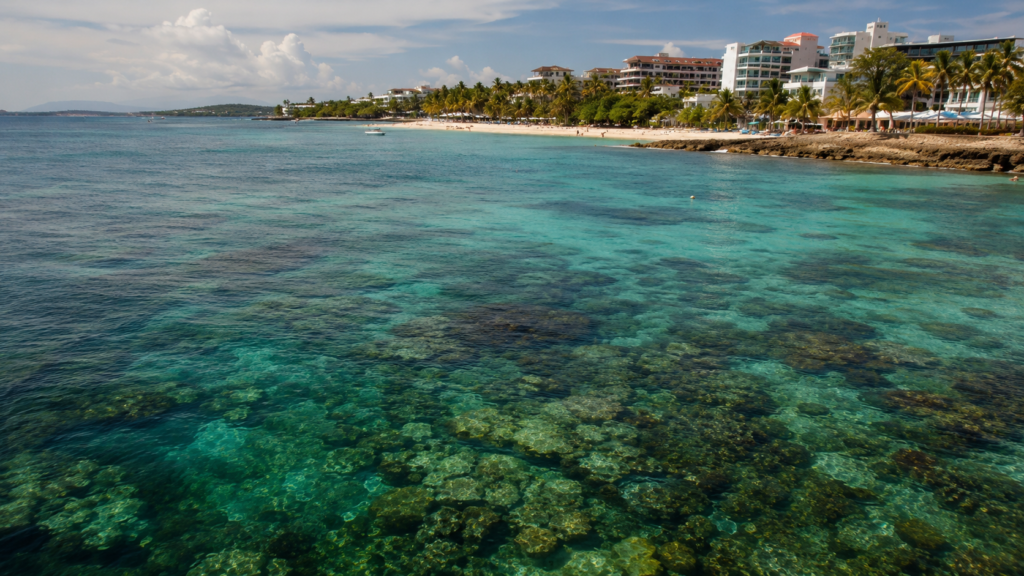
Research from the Inter-American Development Bank provides a more localized picture. In Bávaro, one of the Dominican Republic’s principal tourism destinations, only an estimated 5% to 10% of coral reefs were considered healthy in the assessment cited by the bank. In parts of Las Terrenas on the Samaná Peninsula, the coastline retreated by as much as 3.36 meters per year between 2003 and 2020.
These changes have practical consequences for a country whose international tourism industry depends heavily on beaches and coastal ecosystems. The loss or degradation of natural coastal defenses can increase exposure to storms and erosion, while deterioration of marine ecosystems can affect the environmental quality of destinations that attract visitors for beaches, diving, snorkeling and other marine activities.
Fisheries and Marine Species Could Also Change
Warming oceans can alter where marine species can live and reproduce. Globally, researchers have documented shifts in the distribution of fish as ocean temperatures change. For the Dominican Republic, that creates an additional concern because coastal communities and the broader blue economy depend on healthy marine resources.
The effects, however, cannot automatically be attributed to temperature alone. Overfishing, pollution, habitat degradation and coastal development can also change marine populations. Caribbean research has shown that local pressures have played a major role in coral decline, meaning that reducing those pressures can strengthen the ability of ecosystems to withstand climate-related stress.
This makes conservation and climate adaptation closely connected. Protecting reefs, mangroves and seagrass beds can help preserve biodiversity while maintaining natural coastal defenses and economic resources. The Dominican Republic is already pursuing coastal management initiatives that combine climate adaptation with the restoration and protection of strategic coastal areas.
A Growing Climate Challenge for the Dominican Republic
The World Bank estimates that, without adequate adaptation, climate change could reduce the Dominican Republic’s potential GDP by up to 16.7% by 2050 compared with a scenario without climate impacts. The projected losses are linked to several factors, including lower tourism demand, storms and flooding, and reduced labor productivity caused by higher temperatures.
Ocean warming therefore represents one component of a broader climate risk rather than an isolated environmental problem. For the Dominican Republic, the consequences extend from coral reefs and fisheries to beaches, coastal infrastructure and tourism-dependent communities.
The challenge is not simply to monitor higher sea temperatures but to reduce the additional pressures that make marine ecosystems less resilient. Protecting coastal habitats, improving fisheries management, reducing pollution and preparing infrastructure for rising sea levels can help limit the damage as the oceans continue to absorb the effects of global warming.