 26°C
26°C

Why Do Some People Loot During Emergencies? The Psychology, Law and Social Factors Behind the Crime
The looting that followed a major commercial fire in Santo Domingo Este has reignited debate in the Dominican Republic over why some people take advantage of disasters to steal—and whether harsher criminal penalties can deter the practice.


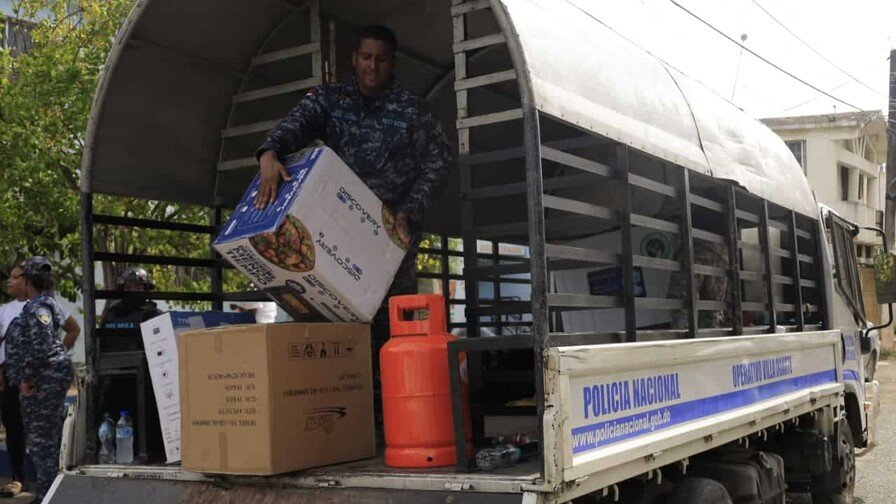
As firefighters battled a large blaze that engulfed an L&R Comercial appliance store in Santo Domingo Este on August 1, another crisis unfolded outside the building. Dozens of people entered the damaged premises and left carrying refrigerators, washing machines, televisions, fans and other household appliances while emergency crews focused on containing the fire.
Dominican National Police officers arrested 17 people caught in the act and recovered more than 170 stolen items, as well as a security monitor and a shotgun belonging to the business. Images of the looting quickly spread across social media, prompting renewed discussion about why disasters sometimes become opportunities for theft.
For sociologists, psychologists and legal experts, there is no single explanation. Instead, they describe a combination of social behavior, economic pressures, group dynamics and perceived legal risks that can influence individual decisions during moments of crisis.
When Social Rules Temporarily Break Down
One of the concepts most frequently cited by sociologists is situational anomie, a temporary weakening of the informal rules that normally regulate public behavior.
According to Dominican sociologist Joel Arboleda, disasters alter everyday social controls. Police officers, firefighters and emergency responders naturally prioritize saving lives and protecting the affected area, leaving fewer resources available to prevent property crimes. At the same time, community oversight also weakens as residents focus on the emergency itself.
Arboleda argues that many participants rationalize their actions rather than viewing them as outright criminal behavior. Common justifications include believing that a large company can absorb the financial loss, assuming insurance will cover the damage, or thinking that if many others are taking merchandise, the act becomes socially acceptable.
This interpretation reflects ideas developed by American sociologist Robert K. Merton, whose theory of anomie suggests that people may abandon accepted social norms when they perceive a disconnect between societal expectations and their ability to achieve desired goals through legitimate means.
The Influence of the Crowd
Sociologist Domingo Matías says crowds can significantly alter individual decision-making. Once people witness others taking merchandise without immediate consequences, the perception of acceptable behavior changes rapidly.
That observation is consistent with decades of international research into crowd psychology. Studies have shown that anonymity, reduced personal accountability and the belief that responsibility is shared among many participants can lower psychological barriers that would normally discourage criminal conduct.
Psychologist Philip Zimbardo described this phenomenon as deindividuation, a state in which individuals become more likely to engage in actions they would typically reject when acting alone.
Economic Pressures Can Shape Decisions
Sociologist Alexandra Vilorio believes economic conditions also play a role. In communities where purchasing appliances requires years of savings, an unexpected disaster may be viewed by some individuals as a rare opportunity to obtain expensive goods.
She emphasizes that this does not justify criminal behavior, but it helps explain why some people perceive the potential reward as greater than the risk of punishment.
“The perceived cost of breaking the law becomes lower than the expected benefit,” she explains.
Research Shows Looting Is Not the Typical Response to Disasters
Although looting often receives extensive media attention, international disaster researchers caution against assuming it is the dominant public reaction.
For more than five decades, scholars such as Enrico Quarantelli and Kathleen Tierney have documented human behavior following earthquakes, hurricanes and major fires. Their findings consistently show that cooperation, mutual aid and volunteerism are far more common than opportunistic theft.
Most communities respond to emergencies by helping neighbors, assisting rescue efforts and protecting vulnerable people. Looting tends to involve a relatively small number of individuals, even though dramatic images can create the impression that the behavior is widespread.
Organized Crime or Opportunism?
Criminologists generally distinguish between different forms of looting.
Some incidents involve organized criminal groups that exploit reduced police presence to steal valuable merchandise for resale. Others consist of opportunistic theft committed by individuals who act impulsively after observing others doing the same.
Legal experts note that these situations differ fundamentally from people taking food, water or essential supplies during humanitarian crises to survive. The Santo Domingo Este incident involved consumer electronics and household appliances, making it a case of property crime rather than survival-driven behavior.
The Legal Debate in the Dominican Republic
The incident has unfolded as the Dominican Republic updates its criminal legislation. The recently revised Penal Code introduces tougher sanctions for numerous offenses and modernizes the country’s criminal justice framework after decades under legislation dating back to the nineteenth century.
The discussion surrounding the new legal framework has also renewed attention to whether crimes committed during emergencies should receive harsher punishment because they exploit situations in which authorities are primarily focused on protecting lives and responding to disasters. Recent amendments to the Penal Code have sought to strengthen criminal sanctions in several areas while lawmakers continue reviewing additional reforms.
The Cost Extends Beyond Stolen Merchandise
For businesses, looting often causes damage well beyond the value of the stolen products. It can delay reopening, increase insurance costs, complicate investigations and deepen financial losses already caused by the original disaster.
For emergency responders, these incidents create additional challenges by diverting police resources away from rescue operations and forcing officers to address criminal activity while firefighters and medical teams continue responding to the emergency.
The events outside L&R Comercial illustrate how a single disaster can quickly evolve into multiple public safety challenges. While experts point to social, psychological and economic factors that help explain why some individuals loot during emergencies, they also stress that understanding those motivations should never be mistaken for justifying criminal behavior.