 28°C
28°C

Dominican Apartment Prices Hit $2,000 Per Square Meter, But Location Matters
Apartment asking prices in the Dominican Republic show a wide gap between luxury resort markets and major urban areas, with a national median of $2,000 per square meter based on 65,160 active listings analyzed through June 23, 2026.


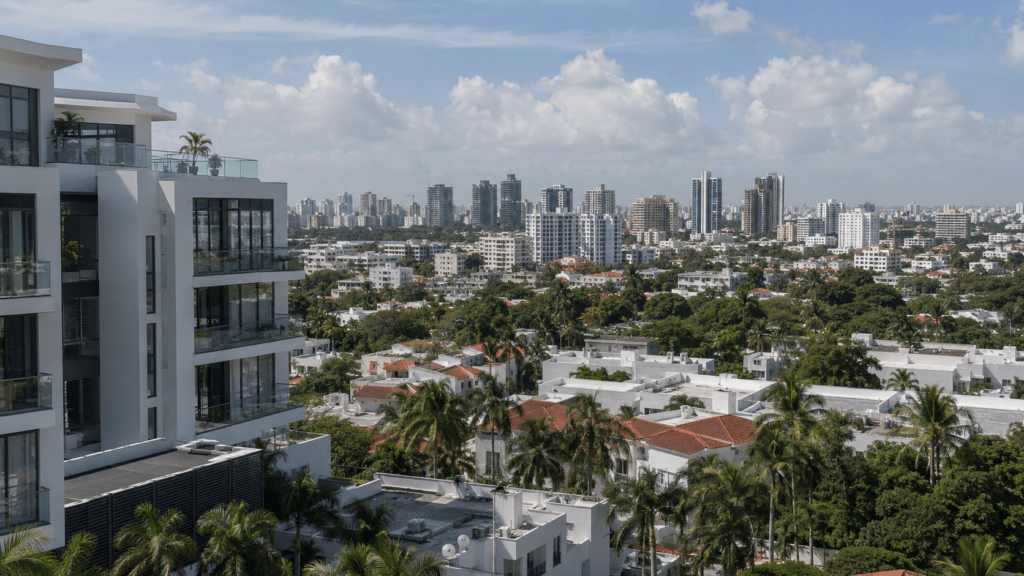
The Dominican Republic’s apartment market is becoming increasingly divided by location, with significant differences in asking prices between luxury resort destinations, central Santo Domingo and the country’s secondary urban markets. A market analysis covering 65,160 active apartment listings found a national median asking price of approximately US$2,000 per square meter, while the median apartment price was about US$210,000.
These figures provide a useful snapshot of the market, but they need to be interpreted correctly. The analysis is based on properties actively advertised on real estate portals, meaning that the figures represent asking prices rather than completed transaction prices. They therefore show what sellers are requesting rather than necessarily what buyers ultimately pay.
The geographic differences are nevertheless substantial. Cap Cana recorded the highest median asking price per square meter among the locations included in the analysis, at US$3,465. At the opposite end of the ranking, Santo Domingo Norte recorded a median of just US$1,029 per square meter.
The gap between those two markets illustrates why a single national benchmark can be misleading for buyers and investors. The same apartment budget can provide access to very different property sizes, locations and investment strategies depending on where the buyer chooses to purchase.
Tourist Destinations Lead the Market
The highest asking prices per square meter were concentrated in several of the Dominican Republic’s established tourist and resort destinations. Cap Cana ranked first at US$3,465 per square meter, followed by Cabarete at US$2,641 and Las Terrenas at US$2,375.
Bayahíbe, Punta Cana–Bávaro and Juan Dolio also recorded median asking prices above US$2,100 per square meter. The concentration of higher prices in these destinations reflects the particular characteristics of coastal residential markets, where apartments can serve both traditional residential demand and tourism-related accommodation.
Punta Cana–Bávaro was by far the largest tourist-market sample in the study, with 12,854 active apartment listings. This makes the market particularly important when interpreting the national figures because of the sheer volume of properties available for comparison.
The Distrito Nacional, which contains central Santo Domingo, had an even larger inventory, with 28,541 active listings. Its median asking price was US$2,119 per square meter, putting the capital’s central district above the national median and substantially above several municipalities surrounding it.
For investors considering vacation rental apartments, however, the price per square meter is only one part of the equation. Tourist-oriented properties can have different operating models from apartments intended primarily for long-term residents. Occupancy, rental rates, management expenses, maintenance and the seasonality of demand can all influence the investment outcome.
Why Apartment Size Matters When Comparing Prices
The distinction between price per square meter and total apartment price is particularly important in the Dominican Republic’s tourist markets. Bayahíbe provides a clear example. The destination recorded a median of approximately US$2,350 per square meter, but its median apartment price was only around US$165,000.
This apparent contradiction is largely explained by the characteristics of the units being offered. A smaller apartment can have a relatively high price per square meter while still carrying a lower total purchase price than a substantially larger apartment in another location.
For buyers, property size therefore needs to be considered alongside the headline price per square meter. Comparing only the total price can make an expensive market appear cheaper if its typical units are smaller, while comparing only the price per square meter can obscure the actual amount of capital required to purchase a typical property.
This distinction is especially relevant in markets where apartments are marketed to international buyers seeking second homes, investment properties or short-term rental opportunities. The appropriate comparison is often between similar properties with comparable sizes, locations, amenities and intended uses rather than between the headline median prices of entire municipalities.
Santo Domingo Shows a Sharp Geographic Divide
The differences within Greater Santo Domingo are almost as striking as those between the capital and the country’s resort destinations. The Distrito Nacional recorded a median asking price of US$2,119 per square meter, while Santo Domingo Este stood at US$1,120, Santo Domingo Oeste at US$1,058 and Santo Domingo Norte at just US$1,029.
That means the median asking price per square meter in the Distrito Nacional was more than twice the level recorded in Santo Domingo Norte. For buyers with a fixed budget, this difference can translate into considerably different apartment sizes and locations.
Santo Domingo Este is particularly relevant within this comparison because its residential market has continued to attract developers, buyers and investors. The municipality’s lower median asking price per square meter places it well below the Distrito Nacional, although its large and growing urban market makes it an important part of Greater Santo Domingo’s property landscape.
The differences become even more pronounced when the analysis moves from municipalities to individual sectors inside the Distrito Nacional. Piantini led the sector ranking at US$2,721 per square meter, followed by the Avenida Anacaona corridor at US$2,611 and Ensanche Paraíso at US$2,486.
Naco, one of the capital’s major high-density residential areas, recorded a median asking price of US$2,378 per square meter across 3,299 listings. These figures demonstrate how national and even municipal averages can hide significant differences between individual neighborhoods.
The highest median apartment ticket in the sector-level data was recorded along Avenida Anacaona, at approximately US$950,000. Los Cacicazgos followed with a median apartment price of about US$508,032. These figures are not directly comparable with lower-priced municipalities because the housing stock in these areas includes larger, higher-value apartments.
Santiago Offers a Lower Entry Point
Santiago de los Caballeros provides a very different pricing profile. The country’s second-largest city recorded a median asking price of approximately US$1,472 per square meter, based on 5,031 active listings in the analysis.
That level places Santiago well below the Distrito Nacional and the leading resort markets. It also illustrates the importance of distinguishing between the country’s major residential markets rather than treating the Dominican Republic as a single homogeneous property market.
Other markets below the national median included La Romana–Casa de Campo at approximately US$1,353 per square meter, Jarabacoa at US$1,350, Boca Chica at US$1,433, Santo Domingo Este at US$1,120, Santo Domingo Oeste at US$1,058 and Santo Domingo Norte at US$1,029.
The difference becomes even clearer when looking at the median total apartment price. Santo Domingo Norte recorded a median apartment price of approximately US$90,000, compared with about US$374,500 in Cap Cana.
For buyers, these numbers reinforce a basic point: location can have a larger effect on apartment prices than the national figure suggests. A national median can provide a useful starting point, but it is not a substitute for a local market comparison.
Price Growth Has Continued, but the Pace Has Moderated
Broader housing-market data provide additional context for the current pricing environment. A 2026 residential property market analysis based on Properstar asking-price data found that Dominican house prices increased by 7.74% year over year through the first quarter of 2026. However, that represented a slower pace of growth than the 10.25% recorded in 2025 and the 12.48% recorded in 2024.
After adjusting for consumer-price inflation, the increase was more modest, at approximately 2.97%. The same analysis showed that real house-price growth had slowed from 5.05% a year earlier and 8.84% in 2024.
This moderation is important when interpreting high asking prices in individual destinations. A market can have very expensive apartments without necessarily experiencing the same rate of price appreciation as in previous years. For investors, purchase price, rental income and expected capital appreciation should therefore be considered separately.
Rental Demand Adds Another Layer to the Market
The investment case for apartments also depends on whether the property is intended to generate rental income. Recent market research indicates that the Dominican Republic continues to offer relatively high gross rental yields, although returns vary considerably between cities and apartment types.
In Santo Domingo, average gross rental yields were estimated at approximately 9.09% in the first quarter of 2026, with two-bedroom apartments producing the highest average yield at around 9.87%. In Punta Cana and Bávaro, average gross rental yields were estimated at approximately 7.98%.
The difference illustrates why a lower purchase price does not automatically mean a better investment. Santo Domingo benefits from a deeper year-round tenant base, while the Punta Cana and Bávaro market has greater exposure to tourism and seasonal short-term rental demand.
Gross yields should also not be confused with net returns. Taxes, maintenance, vacancies, insurance, property management and agents’ fees can reduce the income ultimately received by the owner. Investors evaluating vacation rental apartments should therefore calculate expected net income rather than relying solely on advertised rental yields.
Construction Activity Supports Continued Housing Supply
The asking-price data also need to be viewed alongside the continued expansion of residential construction. According to the Dominican Republic’s National Statistics Office (ONE), multifamily apartments represented 39.1% of active construction projects recorded in the Metropolitan Region during the second half of 2025.
The ONE’s Register of Building Supply recorded 2,355 active multifamily apartment projects out of a total of 6,016 active projects in the Metropolitan Region. Apartments represented an even larger share when measured by construction area: approximately 4.18 million square meters, or 71.0% of the total construction area represented by the active projects in the registry.
The figures show that apartment construction is a major component of the country’s urban development pipeline. They also help explain why buyers have such a wide range of inventory to choose from in markets such as Santo Domingo and the country’s major tourist destinations.
At the national level, the construction sector has also continued to expand. The Central Bank reported that construction grew by 5.8% year over year during January and February 2026. By June, the sector recorded an even stronger 14.9% year-over-year expansion, contributing significantly to the growth of the monthly economic activity index.
The latest available edition of ONE’s Direct Housing Construction Cost Index at the time of this analysis covered June 2026. The index measures monthly changes in the direct cost of constructing different types of housing in the Distrito Nacional and Santo Domingo province, including multifamily buildings. It excludes items such as land, design, construction permits, financing costs and the construction company’s profit margin.
These construction indicators are relevant to apartment buyers because the price of existing and newly developed properties is influenced by the cost of bringing new units to market. They also provide a broader indication of the level of activity among developers and contractors.
Why Asking Prices Should Not Be Confused With Transaction Prices
One of the most important limitations of the 65,160-property analysis is methodological. The study measures asking prices on active listings. An asking price is the amount requested by a seller, not necessarily the amount eventually agreed between buyer and seller.
This distinction is particularly important in markets where individual properties can differ considerably in condition, age, floor level, views, amenities, parking spaces, furnishing and building quality. Two apartments in the same neighborhood may therefore have very different asking prices even if their advertised price per square meter appears similar.
The study also excludes extreme values and properties outside specified price and size ranges. Its data cutoff was June 23, 2026. Consequently, the figures should be viewed as a market snapshot rather than as a definitive valuation of every apartment in the Dominican Republic.
For a buyer negotiating an actual purchase, the most useful benchmark is likely to be a combination of comparable properties, recent market conditions, the specific building and the characteristics of the unit itself. Asking-price data are valuable for understanding the supply side of the market, but they do not replace an independent valuation or transaction-level analysis.
What the Numbers Mean for Buyers and Investors
The clearest conclusion from the data is that there is no single Dominican apartment market. There are multiple submarkets with very different pricing structures and investment profiles.
Luxury resort destinations such as Cap Cana command some of the country’s highest asking prices per square meter. Central Santo Domingo also sits toward the upper end of the market, particularly in high-value sectors such as Piantini, Avenida Anacaona, Ensanche Paraíso and Naco.
At the same time, Santiago and several municipalities surrounding the capital offer substantially lower entry prices. Santo Domingo Norte, for example, had a median apartment asking price of approximately US$90,000, while Cap Cana’s median was more than four times higher.
That does not automatically make the cheaper market a better investment or the more expensive market a worse one. The appropriate benchmark depends on the buyer’s objective. A resident looking for a primary home may prioritize commuting time, schools, services and neighborhood infrastructure. An investor may focus instead on rental demand, operating costs, occupancy and long-term appreciation.
International buyers considering coastal markets face another set of considerations. Tourism demand, short-term rental regulations, professional property management and the characteristics of the local visitor market can materially affect the economics of an apartment purchased as an investment.
The size of the apartment is equally important. A high price per square meter can coexist with a relatively modest total purchase price when units are small, while larger apartments can carry much higher median tickets even when their price per square meter is lower.
A Market That Requires Local-Level Analysis
The 2026 data point to a Dominican residential market that remains active but increasingly differentiated by geography. The national median of around US$2,000 per square meter is useful as a broad reference, but it conceals substantial variation between resort destinations, central Santo Domingo, the surrounding municipalities and secondary cities.
The combination of active listings, continued construction and relatively strong rental demand suggests that buyers have a large and increasingly diverse set of properties from which to choose. At the same time, the slowdown in the pace of overall house-price growth means that investors should be cautious about assuming that recent appreciation will automatically continue at the same rate.
For international buyers and investors, the most useful approach is therefore to compare properties within the same local market and, where possible, within similar price, size and quality categories. The national median is a starting point, not a valuation.

Ultimately, the appropriate benchmark depends heavily on the destination, property size and intended use. A resort apartment in Cap Cana, a high-end unit in central Santo Domingo and a more affordable apartment in Santiago or Santo Domingo Norte may all belong to the same national real estate market, but they serve very different buyers and investment strategies.