 25°C


The Real Cost of Owning a Car in the Dominican Republic
Buying a car in the Dominican Republic involves more than paying the asking price. Fuel, insurance, maintenance, annual vehicle taxes, parking and financing can add thousands of pesos to the cost of ownership. Official figures provide a starting point: the country had more than 6.19 million registered vehicles at the end of 2024, while annual circulation-tax fees for the 2025–2026 registration period ranged from RD$1,500 to RD$3,000 for passenger vehicles, depending on their manufacturing year. Understanding which costs are fixed, which depend on driving habits and which are difficult to predict helps buyers calculate a realistic budget before choosing a vehicle.


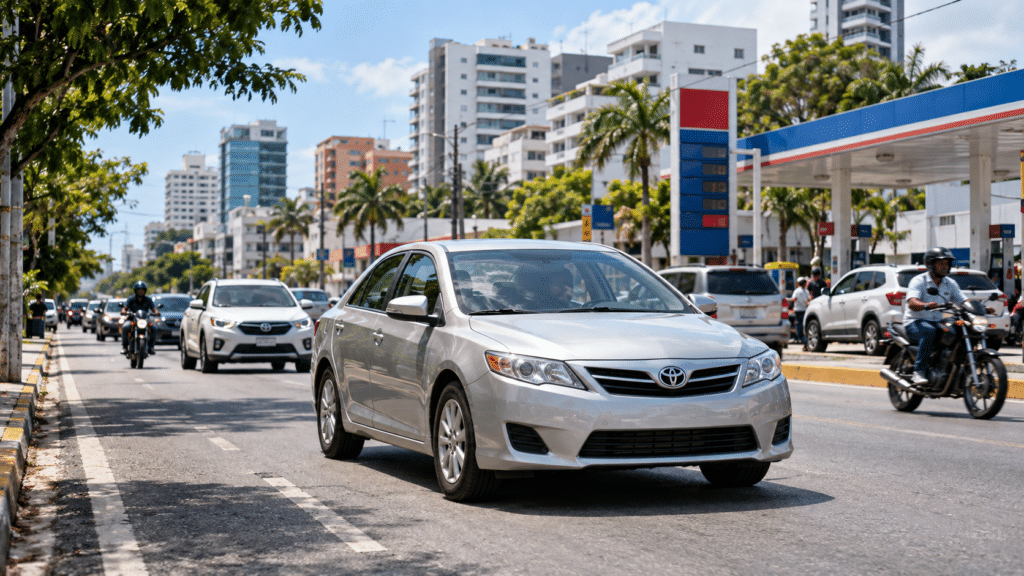
Buying a car in the Dominican Republic can make daily travel easier, but the financial commitment extends well beyond the purchase price. Owners must account for fuel, insurance, maintenance, vehicle taxes, parking, tolls and, when applicable, loan repayments. These expenses should also be considered alongside the cost of living in the Dominican Republic, particularly when calculating how much of a household budget can be allocated to transportation.
The scale of the market makes these expenses relevant to a large number of households. The Dominican Republic’s National Statistics Office (ONE), using administrative records from the Dirección General de Impuestos Internos (DGII), reported 6,194,052 registered motor vehicles at the end of 2024. That total included motorcycles, passenger cars, jeeps, buses, freight vehicles and other categories, rather than passenger cars alone.
There is no single reliable figure for the monthly cost of owning a car in the country. A driver who travels 500 kilometers per month in an efficient compact car will have a different budget from someone who drives 1,500 kilometers in an SUV, pays for daily parking and finances the purchase. The most useful approach is to calculate each expense separately and use actual vehicle specifications, current prices and personal driving habits wherever possible.
1. Fuel: How Much Does It Cost to Drive a Car in the Dominican Republic?
Fuel is one of the most frequent expenses for car owners. The total depends on the distance driven, the vehicle’s actual fuel economy, traffic conditions, engine condition and the price of gasoline or diesel.
Fuel prices in the Dominican Republic are published by the Ministry of Industry, Commerce and SMEs (MICM) and can change from week to week. For a dated reference, the government announced the following prices for September 19–25, 2026:
- Premium gasoline: RD$350.10 per gallon.
- Regular gasoline: RD$315.50 per gallon.
- Regular diesel: RD$267.80 per gallon.
- Premium diesel: RD$302.10 per gallon.
These are historical reference prices for the specified week, not a guarantee of the price at the pump today. Drivers should check the latest MICM fuel-price announcements before calculating their current budget.
Example: Monthly fuel costs for a gasoline car
Consider a car that averages 10 kilometers per liter and travels 1,000 kilometers per month. Using the regular gasoline price of RD$315.50 per gallon published for September 19–25, 2026, the calculation is as follows:
- Monthly distance: 1,000 kilometers.
- Assumed fuel economy: 10 kilometers per liter.
- Fuel required: 100 liters, or approximately 26.42 US gallons.
- Fuel price used: RD$315.50 per gallon.
- Estimated monthly fuel cost: RD$8,335.
This is an illustrative calculation, not an average measured cost for Dominican drivers. It assumes that the car consistently achieves 10 kilometers per liter and that the specified fuel price applies throughout the period.
The following comparison uses the same fuel price and assumed fuel economy to show how driving distance affects the budget.
| Monthly distance | Assumed fuel economy | Estimated monthly fuel cost | Estimated annual fuel cost |
|---|---|---|---|
| 500 km | 10 km/L | RD$4,167 | RD$50,008 |
| 1,000 km | 10 km/L | RD$8,335 | RD$100,016 |
| 1,500 km | 10 km/L | RD$12,502 | RD$150,024 |
| 2,000 km | 10 km/L | RD$16,669 | RD$200,032 |
These figures use the same September 2026 fuel-price benchmark throughout the year solely to make the comparison consistent. Actual annual expenditure will change when fuel prices, driving distance or fuel economy change.
How to estimate your own fuel budget
Use the following formula:
Monthly fuel cost = monthly kilometers ÷ kilometers per liter × 3.785 × price per gallon.
The calculation assumes that the fuel price is quoted per US gallon, equivalent to approximately 3.785 liters. If your vehicle’s manufacturer provides fuel economy in miles per gallon, convert the measurement before using this formula.
For a more accurate estimate, calculate fuel economy from your own driving records. Fill the tank, record the odometer reading, and calculate the distance traveled before the next comparable fill-up. Repeat the process over several tanks to reduce the effect of individual trips.
Stop-and-go traffic, frequent short journeys, air-conditioning use, tire pressure and vehicle condition can all affect real-world consumption. A car advertised as fuel-efficient may therefore cost more to operate than its specifications suggest.
2. Vehicle Insurance: Liability Coverage and Comprehensive Protection
Insurance is another essential part of the ownership budget. Its price depends on the vehicle’s insured value, age, model, intended use, driver profile, claims history, deductible and selected coverage.
In the Dominican Republic, compulsory motor insurance is governed by applicable legislation, including Law No. 146-02 on Insurance and Bonds. Basic third-party liability protection and comprehensive insurance are not equivalent products: liability coverage addresses covered claims by third parties, while broader policies may also cover damage to the insured vehicle, theft and other specified risks.
Why there is no single national insurance price
Two vehicles with similar purchase prices may receive different insurance quotations because their repair costs, theft risks, parts availability and coverage requirements differ. A newer vehicle with a high insured value may cost more to insure comprehensively than an older compact car, although the actual premium depends on the insurer’s underwriting criteria.
For this reason, a general price range should not be treated as an official average or a guaranteed quotation. Obtain written quotes from several authorized insurers using the same vehicle details and coverage limits.
Compare the following items before choosing a policy:
- Third-party liability limits and exclusions.
- Coverage for collision, theft and fire, where included.
- The deductible payable when making a claim.
- Coverage for natural events, glass damage or roadside assistance, if offered.
- Conditions governing authorized drivers and vehicle use.
- Payment schedules, cancellation terms and claim procedures.
Buyers financing a vehicle should also confirm whether the lender requires comprehensive insurance, a particular insured value or the lender’s interest to be recorded in the policy. The cost of that required coverage belongs in the financing budget.
3. Maintenance, Tires and Unexpected Repairs
Maintenance is difficult to estimate without knowing the vehicle’s make, model, age, mileage and service history. A newer car with a documented maintenance record may need only scheduled servicing in the short term, while an older used vehicle may require tires, suspension work, cooling-system repairs or other major expenses.
There is no single nationwide maintenance rate that reliably represents every car in the Dominican Republic. A realistic budget should therefore be based on the manufacturer’s service schedule and written estimates from workshops familiar with the specific vehicle.
Routine expenses to include
- Engine oil and filters: The cost and frequency depend on the engine, lubricant specification and service interval.
- Brakes: Pads, discs and other components wear at different rates depending on driving conditions and vehicle weight.
- Tires: Replacement costs depend on tire size, brand, availability and the number of tires requiring replacement.
- Battery: Replacement frequency varies with battery type, climate, use and charging-system condition.
- Alignment and balancing: These services may be required after tire replacement, suspension work or when symptoms indicate a problem.
- Cooling and air-conditioning systems: Inspections and repairs help prevent breakdowns and preserve operating performance.
- Mechanical and electrical repairs: Costs depend on the fault, labor requirements and the availability of replacement parts.
How much should you reserve each month?
Rather than applying an unsupported national average, ask a qualified workshop to estimate the next 12 months of scheduled maintenance for the vehicle under consideration. Divide that estimate by 12 to establish a basic monthly reserve, then add a separate allowance for wear items and unexpected repairs.
For example, if a workshop estimates that scheduled maintenance will cost RD$24,000 over the next year, the equivalent monthly reserve is RD$2,000. This is a calculation based on a hypothetical quotation, not a claim that RD$24,000 is the average annual maintenance cost in the Dominican Republic.
For used cars, a pre-purchase inspection can identify existing problems before the buyer assumes responsibility for them. The inspection should cover the engine, transmission, brakes, tires, suspension, cooling system, electronics and any warning signs of collision damage or poor repairs.
4. Marbete: The Annual Vehicle Circulation Tax
The marbete is the annual proof of payment of the Dominican Republic’s vehicle circulation tax, administered by the DGII. It is a recurring ownership expense and should be included in the annual budget.
For the 2025–2026 renewal period, the DGII established the following fees for passenger vehicles:
- RD$1,500: Vehicles manufactured through 2020.
- RD$3,000: Vehicles manufactured in 2021 or later.
These amounts were confirmed in the DGII’s announcement of October 20, 2025. The applicable rates for a subsequent renewal period should be checked against the latest official announcement rather than assumed to remain unchanged.
The same announcement established a RD$2,000 late-renewal surcharge for the 2025–2026 period after the applicable deadline. Additional sanctions can apply to vehicles with outstanding renewals from earlier periods.
Official details are available through the DGII vehicle circulation tax information page.
How to include the marbete in a monthly budget
Although the payment is annual, setting aside a small amount each month can prevent it from disrupting other expenses.
| Annual marbete fee | Equivalent monthly reserve |
|---|---|
| RD$1,500 | RD$125 |
| RD$3,000 | RD$250 |
These monthly figures are simple annual-cost divisions. They do not include late fees, previous unpaid renewals or other administrative expenses that may apply to a particular vehicle.
5. Parking and Toll Roads
Parking and tolls vary considerably according to where the owner lives, works and travels. A driver who parks on private property and rarely uses toll roads may spend very little on these items. Someone commuting daily to a commercial district or traveling regularly between provinces may face a much larger bill.
There is no meaningful universal monthly figure without specifying a route and parking pattern. To calculate the cost, record the number of paid parking sessions, the actual amount paid for each session and the tolls charged on regular journeys.
Example of a recurring parking expense
Suppose a driver pays RD$150 for parking on 20 working days each month. The resulting cost is RD$3,000 per month, or RD$36,000 per year. This is an illustrative scenario, not a published national parking tariff.
For tolls, use the published rates for the roads you actually travel. A driver should count both directions when a journey involves a toll in each direction and distinguish regular commuting from occasional weekend trips.
Parking and tolls are easy to overlook because they are often paid in small amounts. Recording them for several weeks can reveal whether they are a minor expense or a substantial part of the monthly transportation budget.
6. Car Financing: How Interest Changes the Purchase Cost
Financing can significantly increase the total amount paid for a vehicle. The result depends on the loan principal, interest rate, repayment term, fees, insurance requirements and the conditions of the loan agreement.
Published rates provide a useful reference, but advertised starting rates are not guarantees that every applicant will qualify. For example, Scotiabank República Dominicana published a reference rate starting at 12.50% annually for new-vehicle loans in July 2026, while its own disclosure states that rates can change with market conditions and bank policies.
The bank’s published information can be reviewed on its official loan-rate page.
Example: Financing RD$1 million over five years
Consider a hypothetical loan with the following terms:
- Loan principal: RD$1,000,000.
- Annual nominal interest rate: 12.50%.
- Repayment period: 60 monthly payments.
- Assumed structure: fixed-rate amortizing loan with equal monthly payments.
- Additional fees and insurance: excluded.
Using a standard monthly amortization calculation, the estimated payment would be approximately RD$22,498 per month. Over 60 payments, the borrower would pay about RD$1,349,876 in total, including approximately RD$349,876 in interest.
| Financing item | Illustrative amount |
|---|---|
| Amount borrowed | RD$1,000,000 |
| Monthly payment | RD$22,498 |
| Total of 60 payments | RD$1,349,876 |
| Total interest over five years | RD$349,876 |
This is a mathematical illustration, not a bank quotation. Actual contracts may use different interest calculations, fees, insurance charges or repayment conditions. The example also excludes the down payment and all running costs of the vehicle.
When comparing offers, examine the effective annual cost, the total amount repayable, the required down payment, the monthly installment, late-payment charges and any penalties or conditions for early repayment. A lower monthly payment can still result in a higher total cost if the repayment term is longer.
7. Depreciation: The Hidden Cost of Ownership
Depreciation is the reduction in a vehicle’s value over time. Unlike fuel or insurance, it is not normally a monthly cash payment, but it affects the financial cost of owning a car because the vehicle may sell for less than the purchase price.
The rate of depreciation varies by make, model, age, mileage, condition, accident history, maintenance record and demand in the Dominican used-car market. Changes in the local automotive market, including vehicle availability, import trends and buyer preferences, can also influence resale values.
A single national depreciation percentage would be misleading without a defined group of vehicles and a reliable dataset of actual transaction prices. Asking prices on vehicle marketplaces can help identify market expectations, but they do not prove what buyers ultimately pay.
How to estimate depreciation for a specific car
Compare the purchase price with realistic resale estimates for similar vehicles of different ages and mileage. Where possible, use completed sales or independent valuations rather than relying only on advertised prices.
For example, if a car costs RD$1,200,000 and its estimated resale value after three years is RD$900,000, the estimated depreciation is RD$300,000 over that period, equivalent to approximately RD$8,333 per month. Both values are hypothetical; the calculation does not represent an observed market average.

Depreciation matters particularly to buyers who plan to replace a vehicle every few years. It also helps explain why a car with a lower purchase price is not necessarily the cheapest to own: a model with stronger resale demand may retain more of its original value.
8. Other Expenses to Consider Before Buying
Some costs depend on the vehicle’s ownership history and the buyer’s circumstances. They may not recur every month, but failing to account for them can make the initial purchase more expensive than expected.
Transfer, registration and documentation
Buyers of used vehicles should confirm the requirements and applicable charges for transferring ownership, updating records and obtaining the relevant documentation. They should also verify the vehicle’s legal status and whether there are outstanding obligations or restrictions affecting the transfer.
Consult the DGII before completing the transaction, and make sure the seller’s identity and the vehicle’s documentation match the details of the proposed sale.
Pre-purchase inspection
An independent mechanical inspection is an additional upfront expense, but it can help identify defects that would otherwise lead to immediate repair costs. This is particularly important for older vehicles or cars with incomplete maintenance histories.
Emergency reserve
Owners should retain accessible funds for unexpected repairs, insurance deductibles and other urgent expenses. The appropriate reserve depends on the vehicle’s age, condition, repair costs and the owner’s financial circumstances. A newer vehicle under warranty may require a different reserve from an older car with high mileage.
9. What Does It Cost to Own a Car Each Month?
A useful estimate must distinguish recurring operating costs from financing and non-cash costs such as depreciation. The following scenario combines the earlier fuel calculation with an illustrative marbete reserve and parking expense. It is not a national average or a complete estimate of all car ownership costs.
| Expense | Illustrative monthly amount | Basis |
|---|---|---|
| Fuel | RD$8,335 | 1,000 km monthly, 10 km/L and RD$315.50 per gallon |
| Marbete reserve | RD$125–RD$250 | Annual fee of RD$1,500 or RD$3,000, based on the 2025–2026 rates |
| Parking | RD$3,000 | Hypothetical RD$150 per day for 20 days |
| Insurance | Obtain a quotation | Depends on the vehicle, driver and coverage |
| Maintenance and repairs | Obtain a vehicle-specific estimate | Depends on mileage, condition and service requirements |
| Tolls | Calculate from actual routes | Depends on trip frequency and applicable tariffs |
| Loan payment | RD$22,498 in the financing example | Hypothetical RD$1 million loan at 12.50% over 60 months |
| Depreciation | Estimate separately | Depends on the vehicle’s changing market value |
Under these assumptions, the fuel, marbete reserve and parking alone would total approximately RD$11,460–RD$11,585 per month. Adding the illustrative loan payment would raise the subtotal to approximately RD$33,958–RD$34,083, before insurance, maintenance, tolls, repairs and depreciation.
The financing installment should not be treated as an additional ownership cost when calculating economic cost without adjustment: part of each payment repays the loan principal, while interest is a financing expense. The installment is nevertheless essential when assessing the actual monthly cash flow required to keep the vehicle.
10. How to Choose a Car That Fits Your Budget
The best purchase is not necessarily the cheapest vehicle available. It is the one whose purchase price, operating costs, reliability, safety and resale prospects fit the buyer’s needs and financial capacity.
Before deciding, compare several vehicles using the same assumptions for monthly mileage, fuel prices, insurance coverage and ownership period. Understanding trends in the automotive industry, including vehicle availability, pricing and resale demand, can also help buyers make more informed decisions. Request insurance quotations, obtain maintenance estimates and check the current marbete requirements. If financing is involved, compare the total repayment amount rather than choosing solely by the monthly installment.
For used cars, check the maintenance record, verify the documentation and arrange an independent inspection before paying a deposit or completing the purchase. A vehicle with an attractive asking price may become expensive if it requires immediate repairs or has a poor service history.
Buyers comparing vehicles in the local market can browse cars for sale in the Dominican Republic on Yacarros.com. Comparing prices and specifications is a useful first step, but advertised prices should be treated as asking prices rather than confirmed transaction values.
Sources for Checking Current Vehicle Costs
Because fuel prices, taxes, loan rates and insurance quotations can change, the most reliable budget combines official information with vehicle-specific estimates.
- DGII: Vehicle circulation tax and marbete requirements.
- MICM: Official fuel-price announcements.
- Office of National Statistics: Vehicle fleet statistics and transport data.
- Scotiabank República Dominicana: Published loan rates and conditions.
Use these sources to verify the charges and rates that apply when you buy the vehicle. For insurance, maintenance, parking and depreciation, obtain quotations or estimates that reflect the actual car and how you intend to use it.