 22°C
22°C

How Many Cars Are in the Dominican Republic?
The Dominican Republic had 1,188,583 registered automobiles at the end of 2025, according to the latest full-year data from the Dirección General de Impuestos Internos (DGII). That figure is different from the country’s total motor-vehicle fleet, which reached 6,640,871 registered units, because motorcycles alone accounted for 3,846,694 of them. The distinction matters: official statistics measure vehicles registered in the national fleet, not necessarily the number physically circulating on roads on any given day.


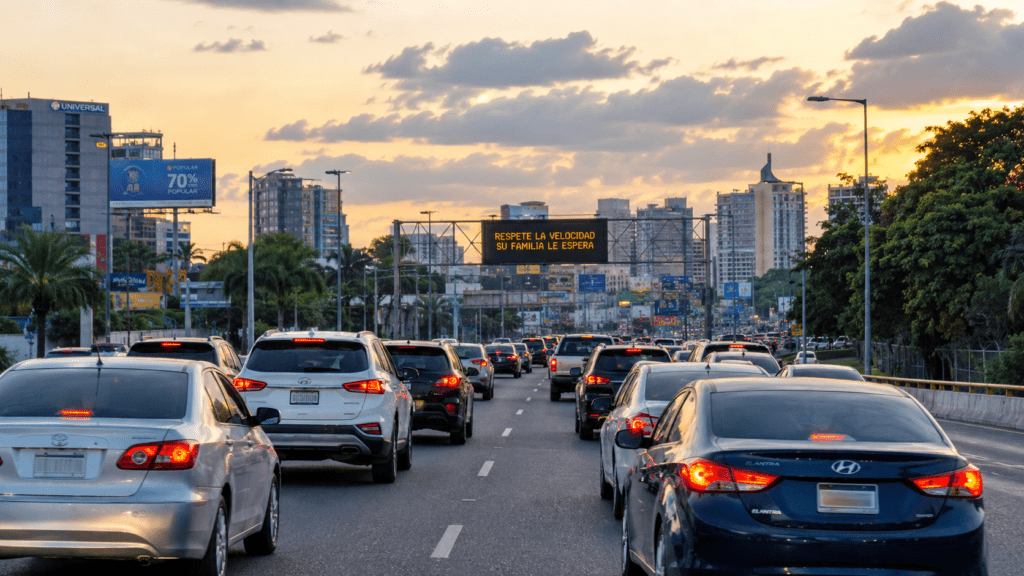
The Dominican Republic has a large and rapidly expanding vehicle fleet, but the number of cars is considerably smaller than the headline figure often cited for the country’s entire vehicle population. According to the latest complete annual statistics published by the Dirección General de Impuestos Internos (DGII), the country had 1,188,583 registered automobiles as of December 31, 2025. The broader motor-vehicle fleet totaled 6,640,871 units.
That distinction is important for anyone researching transportation in the Dominican Republic. The official term is parque vehicular, or registered vehicle fleet. It includes automobiles, motorcycles, jeeps, cargo vehicles, buses, heavy machinery, dump trucks and other categories. It therefore should not be interpreted as a precise count of vehicles that are physically moving on the roads at any particular moment.
How Many Cars Are Registered in the Dominican Republic?
At the end of 2025, the Dominican Republic had 1,188,583 registered automobiles. DGII classifies automobiles separately from motorcycles, jeeps, cargo vehicles and other categories. Its automobile category includes private vehicles as well as urban and interurban public automobiles.
| Vehicle category | Registered units in 2025 | Share of total fleet |
|---|---|---|
| Motorcycles | 3,846,694 | 57.9% |
| Automobiles | 1,188,583 | 17.9% |
| Jeeps | 797,851 | 12.0% |
| Cargo vehicles | 575,928 | 8.7% |
| Autobuses | 147,479 | 2.2% |
| Heavy machinery | 29,140 | 0.4% |
| Dump trucks | 28,402 | 0.4% |
| Other vehicles | 26,794 | 0.4% |
| Total | 6,640,871 | 100% |
The figures show why saying that the Dominican Republic has 6.6 million “cars” would be inaccurate. Nearly 58% of the registered fleet consists of motorcycles, while automobiles account for 17.9%. Jeeps, which include the category commonly associated with SUVs in everyday Dominican usage, represent another 12%.
How Many Vehicles Are There in the Dominican Republic Altogether?
If the question refers to all registered motor vehicles rather than passenger automobiles, the latest complete annual figure is 6,640,871 vehicles. The DGII recorded this total at December 31, 2025, representing an increase of 446,819 vehicles compared with the 6,194,052 registered at the end of 2024. The year-over-year increase was approximately 7.2%.
The expansion has continued into 2026. Reporting based on DGII figures indicated that the national registered fleet had reached 6,794,081 vehicles by April 2026. However, this later figure should not be confused with a new full-year fleet estimate, and the available April reporting does not provide the same complete category breakdown as the DGII’s annual 2025 bulletin.
For evergreen comparisons, the most reliable benchmark is therefore the latest completed annual DGII dataset: 1,188,583 automobiles within a total registered fleet of 6,640,871 vehicles at the end of 2025.
How Fast Is the Number of Cars Growing?
The automobile fleet increased between 2024 and 2025, although its growth was much slower than that of motorcycles and jeeps. The DGII recorded 1,157,870 automobiles in 2024 and 1,188,583 in 2025, an increase of 30,713 vehicles, or approximately 2.7%.
The number of new automobile registrations also declined compared with the previous year. In 2024, 36,175 automobiles received their first plate as new entries into the registered fleet. In 2025, the number was 30,713. In the DGII’s methodology, “new entry” includes both new and used vehicles receiving their first plate in the country, so the figure should not be interpreted simply as new cars sold by dealers.
This is one of the clearest indications that the growth of Dominican mobility is not being driven primarily by conventional automobiles. The evolution of vehicle registrations also reflects broader changes in the automotive industry in the Dominican Republic, including shifts in consumer demand, vehicle imports and the types of vehicles entering the national market. Motorcycles and jeeps expanded more rapidly during the same period, changing the composition of the national fleet.
Why Do Motorcycles Matter So Much to the Vehicle Count?
Motorcycles are the dominant vehicle category in the Dominican Republic. At the end of 2025, the DGII registered 3,846,694 motorcycles, compared with 1,188,583 automobiles. In other words, there were more than three motorcycles for every registered automobile in the national fleet.
The difference is even more significant when new registrations are considered. During 2025, 314,727 motorcycles entered the registered fleet, compared with 30,713 automobiles. Motorcycles therefore accounted for the overwhelming majority of new vehicle additions during that year.
This helps explain why estimates based only on the number of cars can give an incomplete picture of transportation in the Dominican Republic. Motorcycles are a central part of everyday mobility, including personal transportation and economic activities such as deliveries and other forms of work that depend on two-wheeled vehicles.
Where Are Most Cars Registered?
The registered automobile fleet is highly concentrated in the country’s principal urban areas. According to reporting based on the 2025 DGII bulletin, 39.2% of registered automobiles were associated with the Distrito Nacional, while another 23.6% were registered in the province of Santo Domingo.
This concentration is significant because the DGII statistics are based on the registration information associated with vehicle owners. They do not necessarily mean that every automobile registered in a particular province spends all of its time there. A vehicle registered to an owner in Santo Domingo, for example, can routinely travel to other provinces.
The same limitation applies to the broader national fleet. Registration statistics are useful for understanding the size and composition of the vehicle population, but they are not equivalent to a real-time traffic count.
Does the Registered Fleet Equal the Number of Cars Actually on the Road?
No. The registered fleet should not be treated as a real-time count of vehicles actively circulating. A vehicle can remain registered while being temporarily unused, undergoing repairs, stored, or otherwise absent from traffic on a particular day.
The DGII’s statistics describe the stock of vehicles recorded in its database at a specified date. They are therefore the appropriate source for answering how many vehicles are registered, but a different type of study would be required to determine how many vehicles are physically operating on roads at a given time.
This distinction is especially important in discussions about congestion. A city can have a large registered fleet without all of those vehicles being present on its streets simultaneously. Traffic volumes depend on factors such as commuting patterns, time of day, road capacity, public transportation, commercial activity and vehicles traveling between jurisdictions.
How Old Are Cars in the Dominican Republic?
The Dominican vehicle fleet is relatively old when the entire registered population is considered. DGII data for 2025 show that 83.7% of registered vehicles had a manufacturing year of 2020 or earlier, while vehicles manufactured from 2021 onward represented 16.3% of the total fleet.
The automobile category follows the broader pattern of an established vehicle stock rather than a fleet dominated by recently manufactured cars. The 2025 DGII table records 1,171,454 automobiles manufactured in 2020 or earlier, alongside smaller numbers manufactured in subsequent years.
That distinction matters when evaluating the country’s automotive market. The number of registered automobiles reflects decades of accumulated registrations, not simply recent vehicle sales. As a result, the size of the fleet and the number of new vehicles entering the market are two different indicators.
What Is the Difference Between Cars, Jeeps and Other Vehicles?
One source of confusion in Dominican vehicle statistics is everyday terminology. The official categories used by government agencies do not always correspond perfectly to the way people describe vehicles in ordinary conversation.
The DGII identifies automobiles as one category and jeeps as another. In 2025, the two categories contained 1,188,583 and 797,851 registered units respectively. The DGII also notes that its automobile category includes private automobiles and public urban and interurban automobiles.
For that reason, a question about “cars” can produce different answers depending on what the person means. If “cars” means the official DGII automobile category, the answer is 1,188,583 at the end of 2025. If the term is being used informally to mean all four-wheeled passenger vehicles, the relevant figure would be broader and would require combining official categories rather than simply quoting the automobile total.
How Has the Dominican Vehicle Fleet Changed Over Time?
The national vehicle fleet has expanded substantially over the past two decades. Data compiled by the Oficina Nacional de Estadística (ONE) show the total registered fleet increasing from 2,734,740 vehicles in 2010 to more than 6.19 million in 2024. The long-term increase reflects the expansion of the country’s vehicle population across multiple categories, particularly motorcycles. This growth is part of a much longer automotive history in the Dominican Republic, dating back to the country’s earliest automobiles and the gradual development of private transportation.
The 2024 DGII report recorded 6,194,052 registered vehicles, while the 2025 report raised the total to 6,640,871. The increase of 446,819 units in one year was substantially larger in absolute terms than the 384,916-unit increase recorded during 2024.
The composition of the fleet has changed along with its size. Motorcycles have become the dominant category, while automobiles now represent less than one-fifth of all registered vehicles. This means that the evolution of Dominican transportation cannot be understood simply by tracking conventional passenger cars.
What Does the Number Mean for Traffic in the Dominican Republic?
A fleet of more than 6.6 million registered vehicles has important implications for mobility, but the national total alone cannot measure congestion. Traffic conditions vary significantly between locations, and the concentration of registered vehicles is particularly high in the country’s main urban centers.
The Distrito Nacional and Santo Domingo province account for a substantial portion of the national vehicle population, while Santiago de los Caballeros is another major concentration of registered vehicles. This means that the impact of vehicle growth is not distributed evenly across the Dominican Republic.
For residents and visitors, this distinction is practical. A national vehicle count provides context for the scale of motorization, but actual travel conditions depend much more directly on the city, road, time of day and type of transportation being used.
What Is the Best Official Figure to Use?
For a question about the number of cars in the Dominican Republic, the strongest official reference is the annual DGII Parque Vehicular bulletin. The agency publishes detailed statistics by vehicle class, province, origin, brand, color, manufacturing year and other characteristics.
The latest completed annual edition reports 1,188,583 automobiles and 6,640,871 vehicles in total at December 31, 2025. The first figure is the appropriate answer when “cars” means automobiles under the DGII classification; the second is the appropriate figure when the question concerns the entire registered motor-vehicle fleet.
Because the fleet continues to change during 2026, later monthly or partial-year figures may be higher. Those figures should be labeled according to their reference date rather than presented as if they were a completed annual count.
Frequently Asked Questions
How many cars are in the Dominican Republic?
The Dominican Republic had 1,188,583 registered automobiles at the end of 2025, according to the DGII. This is the official automobile category and does not include motorcycles, jeeps, cargo vehicles, buses or other classes.
How many vehicles are registered in the Dominican Republic?
The country had 6,640,871 registered motor vehicles at the end of 2025. Motorcycles accounted for 3,846,694 of those units, or 57.9% of the total.
Are motorcycles included in the number of cars?
No. In the official DGII classification, motorcycles are a separate vehicle category. They represent the largest component of the national vehicle fleet and therefore should not be added to the automobile figure unless the question concerns the entire motor-vehicle population.
How many new cars were registered in 2025?
The DGII recorded 30,713 automobiles entering the registered fleet in 2025. Its definition of new entry includes new and used vehicles receiving their first plate in the Dominican Republic, so this is not necessarily the same as the number of brand-new cars sold by dealerships.
Is 6.6 million the number of cars actually driving on Dominican roads?
No. The 6.6 million figure represents the registered vehicle fleet at the end of 2025. It is not a real-time traffic count and should not be interpreted as the number of vehicles simultaneously operating on Dominican roads.
Are there more motorcycles than cars in the Dominican Republic?
Yes. At the end of 2025, the DGII registered 3,846,694 motorcycles compared with 1,188,583 automobiles. Motorcycles therefore outnumbered automobiles by more than three to one.
The Bottom Line
The most precise answer depends on what is meant by “cars.” Under the Dominican Republic’s official DGII classification, the country had 1,188,583 registered automobiles at the end of 2025. If the question refers to all registered motor vehicles, the figure was 6,640,871. Motorcycles made up 57.9% of that larger fleet, making them the defining component of Dominican vehicle ownership and mobility.
The figures also show why the terms “cars,” “vehicles,” “registered fleet” and “vehicles circulating” should not be used interchangeably. The official statistics provide a reliable measurement of the registered vehicle population, while actual traffic on Dominican roads varies by place and time. For future comparisons, the annual DGII fleet bulletin remains the clearest benchmark because it identifies both the reference date and the official vehicle categories.