 25°C
25°C

Aproleche Calls for Stronger Link Between Agriculture and Tourism
The Dominican Republic’s expanding tourism industry could create a larger domestic market for farmers, ranchers and food producers if hotels and restaurants increase their purchases from local suppliers, according to Eric Rivero, president of the Dominican Association of Milk Producers (Aproleche).


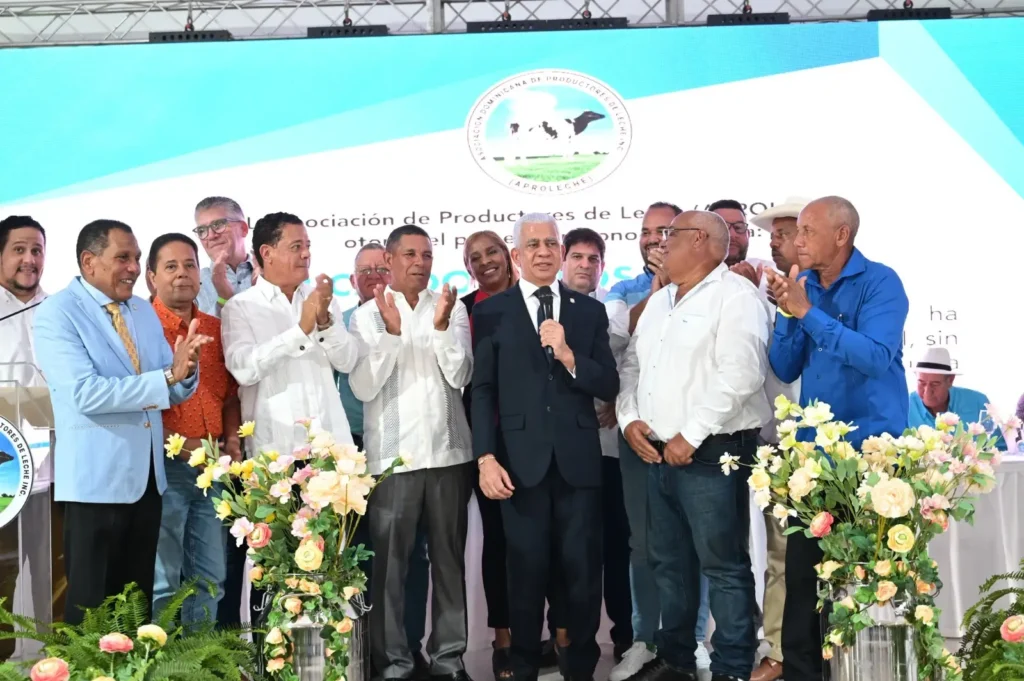
The Dominican Republic’s tourism growth is opening a potentially significant market for local agriculture, but stronger coordination between hotels, restaurants, producers and government agencies will be needed to capture more of that demand, according to Eric Rivero, president of the Dominican Association of Milk Producers (Aproleche).
Speaking during the opening of the 2026 Feria del Cupey, Rivero proposed building a closer alliance between the tourism industry and the country’s agricultural sector so that a greater share of the food consumed by hotels and restaurants can be supplied by Dominican farms, cooperatives and collection centers.
His proposal comes as tourism continues to expand. The Dominican Republic received 8,556,416 visitors between January and August 2026, including more than 6.6 million arrivals by air and nearly 1.95 million cruise passengers. The total represented a 6.9% increase compared with the same period in 2025, according to figures presented by Tourism Minister David Collado.
Tourism represents a major food market
Rivero argued that the continued construction of hotels should generate opportunities beyond employment and tourism-related services by creating additional demand for agricultural products produced within the Dominican Republic.
“Every new hotel that is built should represent a new opportunity for national production,” Rivero said, describing the objective as the creation of a broad economic cycle linking tourism spending with agricultural production.
The potential market is substantial. Ministry of Tourism data show that the tourism sector recorded more than RD$352.2 billion in formal purchases during 2023, a 13.2% increase from the previous year. The ministry said accommodation and food and beverage activities accounted for 73.6% of those purchases.
The 2023 figures include purchases across agriculture, goods, transportation and other categories, illustrating the scale of the supply chains connected to tourism. Hotel purchases alone accounted for RD$175.7 billion, according to data from the Ministry of Tourism cited in reports on the sector.
For agricultural producers, a larger share of that spending could translate into more stable markets for milk, meat, vegetables, fruit and other locally produced food, provided suppliers can meet the volume, quality, safety and consistency requirements of large hospitality businesses.
From individual suppliers to coordinated supply chains
Rivero called for closer coordination among the Ministry of Agriculture, the Ministry of Tourism, hotels, food industries and producer organizations.
Such coordination could allow producers to better understand the quantities and specifications required by the hospitality sector, while giving hotels and restaurants greater visibility over the availability of locally produced food.
The challenge is not simply to increase agricultural production. Large hotels and restaurant groups typically require reliable year-round supply, consistent quality, sanitary compliance, standardized packaging and predictable delivery schedules. Connecting smaller farms and cooperatives to that market therefore requires organization as well as production capacity.
“Tourism needs food and the countryside needs markets,” Rivero said, arguing that linking the two sectors could help distribute more of the economic activity generated by tourism throughout the domestic economy.
He pointed to the development strategy underway in Cabo Rojo, in the southwestern province of Pedernales, as an example of the type of regional economic connection that could emerge as tourism infrastructure expands.
A growing tourism industry creates new supply opportunities
The scale of tourism demand has increased considerably in recent years. The latest visitor figures indicate that the sector is continuing to expand in 2026, while the government has set its sights on reaching 12 million visitors for the full year.
For the agricultural sector, the opportunity extends beyond selling individual products. Stronger links with tourism can encourage investment in processing, cold storage, distribution, quality control and other services needed to move food efficiently from farms to hotels and restaurants.
It could also create incentives for producers to organize collectively. Cooperatives and collection centers can help aggregate supply from smaller farms, making it easier for large buyers to source consistent volumes without having to negotiate separately with numerous individual producers.
For the tourism industry, greater use of domestic suppliers could also reduce dependence on imported products in categories where Dominican producers are capable of meeting demand. However, the degree to which local sourcing can expand will depend on competitiveness, price, quality, logistics and the ability of suppliers to satisfy hospitality-sector standards.
Rice production adds another dimension
Rivero also addressed the debate surrounding the Dominican Republic’s rice sector, expressing support for Decree 693-24, which established tariff measures affecting rice imports as part of the country’s agricultural trade framework.
His comments come amid renewed discussions with the United States over access for U.S. rice under the Dominican Republic-Central America-United States Free Trade Agreement (CAFTA-DR).
The U.S. government has called for the repeal of Decree 693-24, arguing that the measure affects the market-access commitments applicable to U.S. rice under the trade agreement. The Dominican government and U.S. representatives have been discussing the broader bilateral trade agenda.
U.S. government trade information says the decree, issued in December 2024, established a 23,300-metric-ton tariff-rate quota for U.S. rice, with imports above that volume subject to a 99% tariff.
Rivero said defending Dominican rice production should not be interpreted as rejecting international trade or the country’s treaty obligations. Instead, he argued that the economic and social importance of domestic rice production should be considered in discussions over market access.
Connecting tourism demand with domestic production
The broader issue raised by Aproleche is how much of the economic activity generated by tourism can remain within the Dominican economy through domestic supply chains.
Tourism creates demand not only for hotel rooms and restaurants but also for food, transportation, construction, manufacturing, logistics and other services. The Ministry of Tourism’s 2023 purchasing data demonstrate the size of those interconnected markets.
Increasing the participation of Dominican agricultural producers would require sustained coordination rather than isolated purchasing agreements. Producers would need access to financing, technology, technical assistance and reliable distribution networks, while hotels and restaurants would need suppliers capable of meeting their operational requirements.
Rivero’s proposal therefore places the relationship between tourism and agriculture within a wider discussion about domestic supply chains. As visitor numbers continue to grow, the size of the tourism market could provide additional opportunities for Dominican producers if the two sectors can develop the mechanisms needed to connect supply with demand.