 25°C
25°C

Food Manufacturing in the Dominican Republic: 7 Key Sectors Shaping a $2.9B Industry
Food manufacturing in the Dominican Republic is a diversified industrial sector that connects local agriculture, imported raw materials, consumer markets, tourism and international trade. Its main activities include dairy processing, meat and poultry, wheat milling, bakery products, sauces and prepared foods, cocoa and coffee processing, fruit products, alcoholic and non-alcoholic beverages, and other packaged foods. The sector also has a growing export dimension, supported by the country's location, trade agreements, established industrial companies and access to Caribbean, U.S. and European markets.


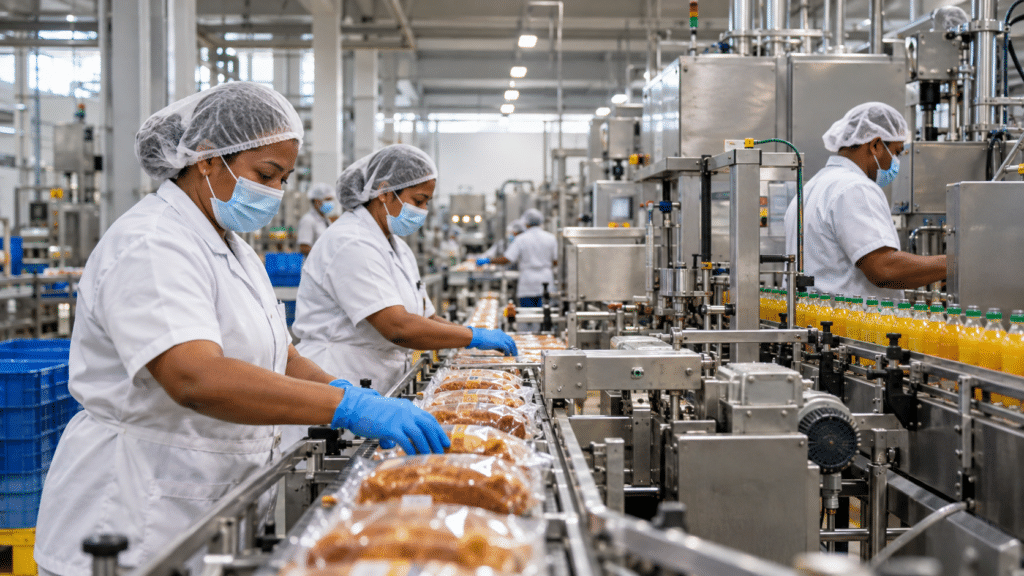
Food manufacturing in the Dominican Republic occupies an important position between agriculture and the wider consumer economy. The industry converts domestic and imported agricultural commodities into products sold through supermarkets, neighborhood stores, restaurants, hotels, institutional buyers and export markets. Its scale also reflects the country’s role as a major Caribbean tourism destination, where food and beverage demand extends well beyond the resident population.
The sector is broader than traditional food processing. It includes dairy products, meat and poultry processing, flour and milling, bakery products, pasta, sauces and seasonings, canned and prepared foods, cocoa and coffee products, juices, bottled water, soft drinks, beer, rum and other beverages. According to the U.S. Department of Agriculture’s Foreign Agricultural Service, the Dominican Republic’s food processing industry was valued at about $2.9 billion in 2024, with processed beverages and related products adding another significant component.
What Does the Dominican Food Manufacturing Industry Produce?
The industry combines large domestic producers, international companies, specialized agro-industrial businesses and smaller processors. Its product mix reflects both Dominican consumption patterns and opportunities to transform agricultural commodities into higher-value goods.
| Segment | Representative Products | Key Inputs |
|---|---|---|
| Dairy | Milk, cheese, yogurt, butter and other dairy products | Fluid milk, powdered milk, cultures, fats and packaging |
| Wheat and bakery | Flour, bread, crackers, cookies and pasta | Imported wheat, flour, fats, sugar, yeast and packaging |
| Beverages | Beer, rum, soft drinks, juices, water and malt beverages | Sugar, grains, fruits, water, alcohol inputs, concentrates and packaging |
| Cocoa and coffee | Cocoa beans, cocoa liquor, powder, butter, roasted coffee and specialty coffee | Cocoa and coffee produced by Dominican agricultural suppliers |
| Prepared foods | Sauces, seasonings, canned foods, coconut products, snacks and prepared meals | Vegetables, fruits, grains, oils, spices, proteins and packaging |
| Fruit processing | Juices, pulps, jams, purees and other fruit products | Passion fruit, citrus, tropical fruits and other agricultural products |
| Meat and poultry | Processed poultry, pork, beef and prepared meat products | Domestic production and imported meat, feed inputs and packaging |
Major Food and Beverage Manufacturers
The Dominican market includes a mixture of long-established domestic companies and international groups. The exact competitive landscape varies by product category, and no single group dominates the entire food manufacturing industry.
Grupo Rica
Grupo Rica is one of the country’s best-known food companies, with more than five decades of activity in the Dominican food industry. Its portfolio includes milk and dairy products, juices and drinks, cheese and butter. The company’s history began with Pasteurizadora Rica in 1966 and later expanded into juice, UHT milk and other processed products.
Dairy is particularly important because it links industrial processors with domestic livestock production while also competing with imported dairy products. USDA data indicates that the Dominican dairy market reached approximately $828 million in 2024 when local production and imports are considered.
Nestlé Dominicana
Nestlé has an established presence in the Dominican Republic. Nestlé’s global factory information has identified two Dominican facilities serving categories including powdered and liquid beverages, milk products and ice cream, and prepared dishes and cooking aids.
The company’s presence illustrates how the Dominican market combines local manufacturing with multinational supply chains. International manufacturers can use the country not only as a consumer market but also as part of broader regional production and distribution networks.
Goya Foods
Goya Foods operates a Dominican Republic facility in San Cristóbal. The company describes the Dominican Republic as one of the countries where it maintains manufacturing and distribution facilities within its international network.
Goya’s business demonstrates the importance of products aimed at Caribbean and Latin American consumers, particularly packaged foods with strong cultural and regional demand.
Cervecería Nacional Dominicana and the beverage industry
The beverage segment includes major breweries and producers of alcoholic and non-alcoholic drinks. Cervecería Nacional Dominicana is a major domestic beverage manufacturer, while other producers include rum companies, soft-drink manufacturers and specialized beverage businesses.
ProDominicana’s exporter directory also identifies companies producing beer, non-alcoholic malt beverages, carbonated drinks, rum, juices, water, flavored water and isotonic beverages.
Raw Materials and Agricultural Inputs
One of the defining characteristics of Dominican food manufacturing is the combination of domestic agricultural inputs with substantial imports. The balance varies considerably by product.
Domestic agriculture supplies important inputs such as milk, cocoa, coffee, tropical fruits, sugar-related products, vegetables, livestock and poultry. This creates opportunities for agro-industrial integration, particularly when processors can transform perishable agricultural products into shelf-stable or higher-value goods.
At the same time, the country depends heavily on imports for several essential ingredients. Wheat is a clear example: the Dominican Republic does not produce wheat commercially and therefore depends entirely on imports for its milling industry. In 2025, wheat imports were valued at approximately $175 million, with the United States supplying about 80 percent of the total.
Other important imported inputs include edible oils and fats, powdered milk, certain cheeses, grains, food ingredients and specialized additives. The United States is a particularly important supplier of agricultural commodities and food ingredients. U.S. agricultural exports to the Dominican Republic exceeded $2.16 billion in 2024, according to USDA.
Wheat Milling, Bakery Products and Pasta
Wheat milling is a strategically important part of the food-processing chain because flour feeds a large domestic bakery and pasta industry. USDA identifies Molinos Modernos and Grupo Bocel as the two leading local milling companies, together processing nearly 80 percent of Dominican wheat imports. Their output supplies flour as well as much of the country’s pasta, crackers and cookies.
The bakery market combines industrial production with thousands of smaller businesses. Traditional bread, including products such as pan de agua and pan sobao, remains important because of its affordability and cultural significance, while packaged bakery products serve supermarkets and convenience-oriented consumers.
USDA estimated retail bakery sales at approximately $374 million in 2025, with cakes and other packaged products contributing to growth. Small bakeries nevertheless remain important suppliers to traditional neighborhood stores known as colmados.
Dairy Processing
Dairy is one of the industry’s most developed value chains. Local milk production supports processors making fluid milk, cheese, yogurt and butter, but domestic supply does not cover the full range of products consumed in the country.
More than half of domestic fluid milk is processed into cheese, according to USDA, while a much smaller share goes into yogurt. The cheese industry also includes more than 400 small and medium-sized rural processing facilities, alongside larger industrial producers.
Imports remain important. The Dominican dairy market recorded approximately $498 million in imports in 2024, while domestic production was estimated at $330 million. This gap creates both competition for local processors and opportunities for investment in production capacity, quality, cold-chain infrastructure and product diversification.
Cocoa, Coffee and Tropical Fruit Processing
Some of the country’s most distinctive food-processing opportunities are connected to agricultural products with strong international recognition.
Cocoa industry is particularly relevant because processors can capture more value by moving beyond raw beans into cocoa liquor, powder, butter, nibs and other ingredients. ProDominicana’s 2025 exporter directory includes companies offering fermented and unfermented cocoa beans as well as processed cocoa products such as defatted powder, cocoa butter, cocoa liquor and nibs.
Coffee offers a similar pathway. In addition to conventional coffee, the export directory includes specialty coffee businesses, illustrating the potential to move from agricultural production toward roasting, branding, packaging and higher-value differentiated products.
Tropical fruit processing is another natural area for industrial development. Juices, pulps, jams, purees and frozen products can extend the commercial life of agricultural commodities and make products easier to distribute domestically and internationally. The ProDominicana export directory includes Dominican companies producing fruit pulps, juices, passion-fruit products and other processed agricultural foods.
The Domestic Market
The domestic market is supported by a population of roughly 11.4 million people, high urbanization and a large tourism industry. The Dominican Republic is the largest economy in the Caribbean, and more than 85 percent of its population was estimated to live in urban areas in 2024.
Food manufacturers therefore sell through several distinct channels. Modern supermarkets and hypermarkets are expanding, but traditional colmados, public markets and wholesalers remain important. USDA estimates that supermarkets account for only about 25 percent of retail sales, meaning manufacturers must often design distribution systems that can serve both sophisticated modern retailers and highly fragmented traditional channels.
Tourism adds another layer of demand. Hotels, restaurants and institutional buyers purchase food and beverages in large quantities and often require consistent specifications, food-safety documentation, reliable delivery and specialized products. This creates a market that can support both domestic manufacturers and foreign suppliers.
Food Manufacturing and Tourism
Tourism is an important indirect driver of food manufacturing because hotels, restaurants and other hospitality businesses consume large volumes of food, beverages and ingredients. The Dominican Republic received approximately 11.2 million non-resident visitors in 2024, according to U.S. trade and USDA sources.
The relationship works in both directions. Tourism increases demand for meat, dairy, beverages, bakery products, fresh produce and processed foods, while stronger local manufacturing can reduce logistics costs and provide hotels and restaurants with locally produced alternatives to imported goods.
This does not mean every food category can be supplied domestically. Imports remain essential for products and ingredients where local production is insufficient, and hospitality operators often require specialized international products. The opportunity for manufacturers is therefore not simple import substitution, but a combination of local sourcing, efficient importing and value-added processing.
Supply Chains and Logistics
Food manufacturing depends on reliable movement of agricultural inputs to factories and finished products to retailers, restaurants and ports. The Dominican Republic’s geographic position gives it access to North American, Caribbean and European markets, while its ports and airports support international distribution.
The supply chain is nevertheless exposed to commodity prices, shipping costs, weather conditions, energy costs, exchange-rate movements and changes in agricultural supply. Imported wheat provides a clear example: because domestic wheat production is effectively absent, the milling industry is directly exposed to international wheat markets.
Cold-chain infrastructure is particularly important for dairy, meat, frozen foods and some beverages. Investments in refrigeration, warehousing, food-grade transportation and inventory management can therefore improve both domestic distribution and export competitiveness.
Exports of Processed Food and Beverages
Food manufacturing is part of a broader Dominican export economy that reaches more than 150 destinations and includes more than 2,600 export products, according to ProDominicana’s current data dashboard.
Processed food and beverage exports are diverse rather than concentrated in a single category. Export offerings documented by ProDominicana include cocoa products, coffee, juices and fruit products, sauces and tomato products, coconut products, beer, malt beverages, rum, specialty foods and other processed agricultural goods.
The United States is a particularly important market because of geographic proximity and the CAFTA-DR trade agreement, which provides preferential market access for qualifying goods. The Dominican Republic also maintains preferential commercial relationships with the European Union through the Economic Partnership Agreement and with other regional partners.
For food manufacturers, export competitiveness depends on more than tariffs. Product specifications, sanitary registrations, labeling, traceability, packaging, shelf life and consistency are critical to entering and maintaining international markets.
Food Safety and Regulatory Requirements
Food manufacturing is subject to sanitary and technical requirements designed to protect consumers and regulate products placed on the Dominican market. The General Directorate of Drugs, Food and Sanitary Products (DIGEMAPS), a decentralized institution under the Ministry of Public Health, is the national contact point for Codex Alimentarius food standards.
Processed foods and dairy products require sanitary registration for market access in the Dominican Republic. Product certification can also involve the Dominican Institute for Quality (INDOCAL), which is responsible for national product certification and standards-related functions.
For exporters, additional requirements may apply depending on the destination country and product. Plant and animal products can require phytosanitary or animal-health certificates, while goods benefiting from preferential trade agreements may require documentation demonstrating origin.
Investment in Food Manufacturing
Food and beverages are explicitly identified by ProDominicana as part of the country’s manufacturing investment sector. The agency presents the industry alongside other manufacturing activities and highlights agro-industry as an area with opportunities for investment and supply-chain development.
The broader investment environment benefits from the Dominican Republic’s location between North America, Latin America and Europe. ProDominicana identifies CAFTA-DR and the European Union’s Economic Partnership Agreement as mechanisms providing preferential access to large consumer markets.
Foreign investment is also relevant to the country’s manufacturing ecosystem. OECD analysis shows that manufacturing represented about 11 percent of greenfield foreign investment in the Dominican Republic between 2014 and 2024, while manufacturing was also a major sector for mergers and acquisitions during 2018-2024.
Investors should distinguish between general manufacturing incentives and incentives available under particular legal regimes, such as free trade zones. The applicable benefits depend on the investment structure, activity, location and regulatory status. ProDominicana’s investment information identifies tax exemptions and other incentives associated with qualifying manufacturing activities and provides procedures for establishing operations.
Where the Growth Opportunities Are
The strongest opportunities are not necessarily in producing more of the same products. They are increasingly linked to value addition, supply-chain integration, product differentiation and export readiness.
Higher-value agricultural processing
Cocoa, coffee, tropical fruit and coconut products offer opportunities to increase the value captured before export. Processing, roasting, extraction, packaging and branding can create additional stages between farm production and the final consumer.
Cold-chain and dairy capacity
The difference between domestic dairy production and total market demand demonstrates room for additional processing capacity and specialized products. Investments in refrigeration, quality systems, cheese production, yogurt, ingredients and other dairy categories can address both domestic and hospitality demand.
Bakery, pasta and grain-based products
Wheat milling is already a significant industrial activity, but the broader value chain includes pasta, crackers, cookies, packaged bread and other products. The scale of wheat imports means efficient milling and downstream processing can remain important components of the food industry.

Export-oriented processed foods
Products with long shelf lives and manageable logistics can be particularly suitable for regional exports. Sauces, canned products, cocoa ingredients, coffee, snacks, beverages and fruit preparations can reach overseas markets without the same constraints faced by highly perishable products.
Private-label and contract manufacturing
The growth of modern retail and international distribution creates potential for manufacturers capable of meeting standardized specifications at scale. Contract manufacturing and private-label production can allow Dominican factories to serve foreign buyers without relying entirely on the development of their own consumer brands.
Food ingredients and intermediate products
There is also an opportunity beyond finished consumer products. Cocoa ingredients, fruit concentrates, flours, flavor systems and other intermediate products can supply other food manufacturers domestically and abroad. This approach can diversify revenue and integrate producers more deeply into regional supply chains.
Key Constraints on Industry Growth
Growth opportunities must be considered alongside structural constraints. The most important include dependence on imported commodities, fragmentation in some agricultural supply chains, quality and certification requirements, energy and logistics costs, cold-chain requirements and exposure to international commodity prices.
Access to agricultural inputs is another important consideration. For example, the Dominican Republic imports substantial quantities of wheat, dairy products, soybean meal, corn and other commodities. USDA data shows that the country imported 1.65 million metric tons of corn in 2024, while soybean-meal imports reached 602,713 metric tons. These commodities are particularly important to livestock and poultry supply chains.
Trade policy can also affect manufacturers. CAFTA-DR has progressively reduced tariffs on many products, but specific commodities can remain subject to tariff-rate quotas or other measures. Rice is a notable example following Dominican Decree 693-24, which established a preferential quota for U.S. rice and a substantially higher tariff outside the quota.
What Makes the Dominican Republic Relevant for Food Manufacturing?
The country’s main industrial advantage is the combination of several factors rather than one isolated feature. It has a sizeable domestic market, a large tourism sector, agricultural production, established food manufacturers, international companies, access to major trade partners and a geographic position close to the United States and other Caribbean markets.
For companies sourcing inputs, the same geography can shorten supply chains from North America compared with more distant production locations. For exporters, proximity to the United States and Caribbean markets can reduce transit times for selected products. For manufacturers serving hotels and restaurants, the domestic tourism industry creates a large institutional customer base.
The result is a food-processing ecosystem with two complementary sides: a domestic market large enough to support significant production and an export platform capable of connecting selected Dominican products with international consumers.