 24°C
24°C

Medical Device Manufacturing in the Dominican Republic
Medical device manufacturing has become one of the Dominican Republic’s most important export industries, combining free-zone incentives, proximity to the United States, established multinational supply chains and a growing base of skilled manufacturing workers. In 2024, medical equipment exports reached about US$2.8 billion, while accumulated sector investment reached US$1.94 billion; by October 2025, the industry supported 33,525 direct jobs and an estimated 83,637 indirect jobs.


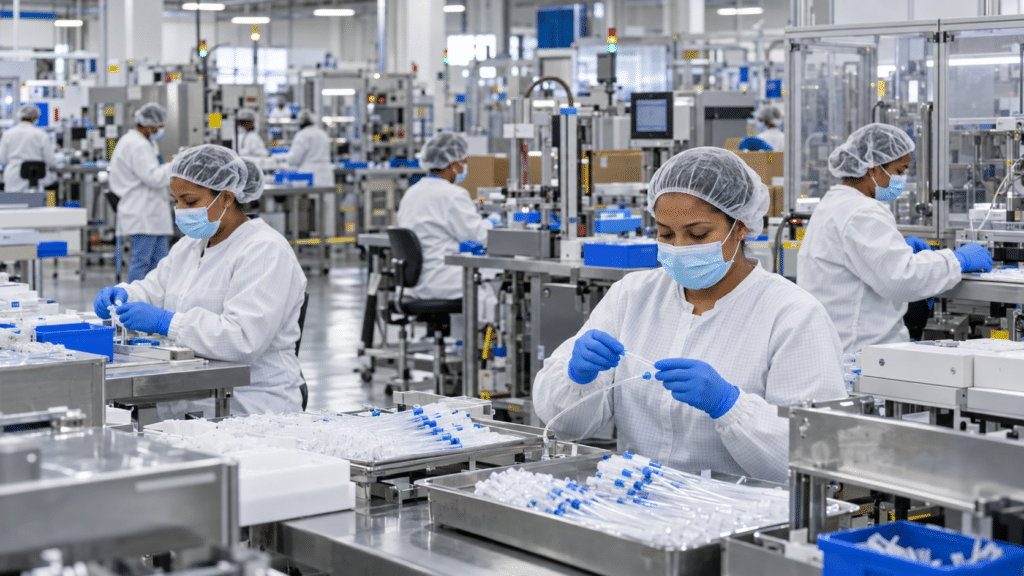
The Dominican Republic has developed one of the Caribbean’s most significant medical device manufacturing clusters, with production concentrated largely in the country’s free trade zones. What began more than four decades ago with relatively simple disposable medical products has evolved into an export-oriented industry integrated into the global supply chains of companies such as Medtronic, Cardinal Health, Baxter, Becton Dickinson, Fresenius Medical Care, B. Braun and Medline. The sector now combines large-scale assembly and manufacturing with increasingly sophisticated engineering, quality-control and production capabilities.
How the Dominican Republic Became a Medical Device Manufacturing Hub
The emergence of medical device manufacturing in the Dominican Republic is closely connected to the country’s free trade zone model. Manufacturing of medical and pharmaceutical products in free zones dates back more than 40 years, giving companies and workers a long period in which to accumulate manufacturing experience and develop familiarity with the quality requirements of international healthcare companies. ProDominicana identifies Surges as an early pioneer in the production of disposable medical equipment in the country.
The industry subsequently benefited from a combination of factors that are particularly relevant to medical device companies. The Dominican Republic is close to the United States, the world’s largest healthcare market, while its ports and transport infrastructure allow manufacturers to integrate production into international supply chains. The country also participates in the CAFTA-DR trade agreement with the United States and five Central American countries, which has progressively liberalized trade in goods and strengthened investment and supply-chain links between the member economies.
Location is particularly important for medical devices because many products are relatively high-value compared with their weight and must move reliably between factories, distribution centers and hospitals. A manufacturer in the Dominican Republic can therefore combine Caribbean proximity with access to the U.S. market while maintaining a production base with lower labor costs than many locations in the United States.
The country has also accumulated an industrial workforce familiar with clean manufacturing environments, assembly processes, documentation, quality control and international compliance requirements. The Inter-American Development Bank notes that medical device operations in the Dominican Republic range from basic assembly to automated and semi-automated assembly and packaging, while global medical technology companies use Dominican facilities as part of their broader manufacturing networks.
The Role of Free Trade Zones
Free trade zones are central to the Dominican medical device industry rather than simply being a secondary incentive. Most of the sector’s major manufacturing operations are located inside these industrial parks, where companies can take advantage of a regulatory and fiscal framework designed specifically to support export-oriented manufacturing.
The scale of the sector illustrates this relationship. Dominican government data reported that 42 medical device manufacturing companies were operating in the country’s free zones in 2025. Medical equipment exports reached approximately US$2.8 billion in 2024, equivalent to 33.4% of free-zone exports and 22.2% of the Dominican Republic’s total exports.
The broader medical and pharmaceutical products category reported by ProDominicana generated US$2.7626 billion in free-zone exports in 2024, up 10.9% from 2023 and equivalent to 32.8% of total free-zone exports. The slight difference between this figure and the government’s US$2.8 billion medical-equipment figure reflects differences in sector definitions and statistical classifications rather than a contradiction in the underlying trend.
The free-zone regime also gives manufacturers an established industrial environment in which infrastructure, logistics and export procedures are already geared toward international production. ProDominicana lists tax exemptions available to qualifying manufacturing and biomedical investment projects, including exemptions on income tax and certain costs associated with establishing initial operations.
For multinational manufacturers, this structure can reduce the cost and complexity of establishing a production platform while allowing the Dominican facility to become part of a much larger global network. That integration is important because medical devices are subject to strict quality, traceability and regulatory requirements in their destination markets.
What Medical Devices Are Manufactured in the Dominican Republic?
The Dominican industry is particularly strong in disposable medical products, surgical supplies and other devices that can be manufactured through highly controlled assembly and production processes. Government data identify a broad range of products made in the country, including transfusion products, blood-pressure monitoring equipment, surgical disposables, surgical sutures, ostomy bags, neurosurgical valves, biopsy needles and respiratory products.
The sector is broader than disposable products alone. Research by the Inter-American Development Bank found that Dominican manufacturers produce products ranging from sutures, ostomy bags and intravenous sets to components for capital medical equipment. Most production remains concentrated in lower-risk Class 1 devices, although companies such as Medtronic have expanded into higher-risk Class 3 products.
U.S. International Trade Commission research also points to an increase in the sophistication of Dominican medical device exports. Between 2013 and 2023, U.S. imports from the Dominican Republic of electro-surgical instruments and appliances increased sharply, indicating that Dominican production has expanded beyond traditional low-complexity disposables into more technically demanding categories.
| Product category | Examples manufactured in the Dominican Republic |
|---|---|
| Surgical products | Sutures, surgical disposables, procedure-related products and instruments |
| Transfusion products | Equipment and consumables used in blood-transfusion procedures |
| Patient-care products | Ostomy bags, disposable medical products and related supplies |
| Diagnostic and monitoring products | Blood-pressure monitoring devices and selected electro-medical products |
| Specialized devices | Biopsy needles, neurosurgical valves and other therapeutic devices |
| Respiratory products | Respiratory-care equipment and related products |
Trade data provide additional evidence of the breadth of production. In 2024, Dominican exports of syringes were valued at approximately US$916,000, with the United States accounting for about US$866,000. Exports of ventilators, CPAP and BiPAP equipment, oxygen concentrators and related respiratory products were valued at approximately US$31.3 million, with the United States receiving about US$19.0 million.
Which Companies Manufacture Medical Devices in the Dominican Republic?
The presence of major multinational companies is one of the clearest indicators of the maturity of the Dominican cluster. In 2025, the Dominican government identified seven of the world’s ten largest medical device manufacturers as having operations in the country: Medtronic, Cardinal Health, Baxter, Becton Dickinson, Fresenius Medical Care, B. Braun and Medline.
These companies operate as part of global manufacturing networks rather than producing exclusively for the Dominican market. The International Finance Corporation has described the Dominican plants of several global medtech companies as components of international value chains supplying different segments of the medical products industry.
Edwards Lifesciences provides another example. The company began Dominican operations in 2000 with approximately 600 employees. By the opening of a second plant in Haina in 2018, its local workforce had reached about 1,800, and the company was manufacturing technologies associated with critical care and surgical monitoring. Edwards continues to list Haina among its major manufacturing locations.
Cardinal Health is another example of the type of operation established in the country. Its Dominican facility in the Las Américas Free Zone is registered with the U.S. Food and Drug Administration and manufactures products including surgical gowns, drapes, surgical procedure trays and related medical supplies. Its facility also holds certifications covering ISO 13485 and the Medical Device Single Audit Program.
Where Are Dominican Medical Devices Exported?
The United States is by far the most important destination market. According to Dominican government figures reported in 2025, 72.2% of medical device exports went to the United States, followed by Puerto Rico at 6.0%, the Netherlands at 5.0% and China at 2.6%.
This concentration is closely connected to geography, trade policy and the structure of the companies operating in the country. Many Dominican facilities belong to U.S.-based multinational manufacturers whose global distribution systems are centered on the U.S. market. CAFTA-DR also provides an important framework for trade and investment between the Dominican Republic and the United States.
The market structure is not exclusively North American, however. ProDominicana identifies Puerto Rico, the Netherlands, Germany, Japan, China and Italy among the other important destinations for Dominican medical and pharmaceutical products. This gives the industry exposure to multiple international markets even though the United States remains dominant.
Trade data also show that individual product categories can have different destination patterns. For example, the Dominican Republic exported respiratory equipment to the United States, New Zealand, China, Germany, Costa Rica and Italy in 2024, demonstrating that the country’s manufacturing base is connected to markets beyond its principal U.S. destination.
Investment in the Medical Device Industry
Investment has risen alongside exports. Dominican government figures place accumulated investment in the medical equipment sector at US$1.9404 billion through 2024. That represented 25.1% of total investment registered in the country’s free zones.
Other research reaches a similar conclusion. The Inter-American Development Bank reports that foreign direct investment in the sector approximately doubled over a five-year period to around US$2 billion, while the companies operating in the industry employed roughly 32,350 people based on 2024 data. Differences between these figures and the Dominican government’s later figures reflect differences in dates, classifications and measurement.
The scale of investment matters because medical device production requires more than inexpensive labor. Plants must meet demanding quality standards, maintain controlled production environments, invest in specialized machinery and train employees to follow detailed manufacturing and traceability procedures. Once these capabilities are established, they can create a strong incentive for multinational companies to expand existing Dominican operations rather than move production elsewhere.
Employment and the Development of Manufacturing Skills
The sector has become a substantial source of formal industrial employment. As of October 2025, medical device manufacturing companies were reported to generate 33,525 direct jobs and approximately 83,637 indirect jobs. Women accounted for 53.6% of the direct workforce, according to Dominican government figures.
The workforce story is important because the industry’s long-term competitiveness increasingly depends on technical capabilities rather than labor costs alone. Manufacturing engineers, quality specialists, technicians, supervisors and workers trained in controlled production processes all form part of the ecosystem required by multinational medical technology companies.
The U.S. International Trade Commission has highlighted the country’s growing pool of university graduates and skilled workers as one factor supporting medical device investment. The industry therefore contributes not only to employment but also to the gradual development of capabilities in engineering, production management and quality systems.
There are limits, however. An OECD assessment found that medical device companies historically had relatively low levels of local sourcing because the domestic industrial base had not developed the specialized suppliers required by the industry. In one analysis, local sourcing by medical device firms in free zones was only 3%.
That gap represents both a constraint and a potential source of future growth. Developing more Dominican suppliers of molded components, plastic tubing, metal components, packaging, sterilization and laboratory services could allow a larger share of the industry’s economic activity to remain within the country. The IFC has specifically identified several of these activities as opportunities for private-sector development around the existing medtech cluster.
Regulatory Standards and Access to the U.S. Market
Medical devices are different from many conventional manufactured exports because production quality must satisfy the requirements of the destination market. Dominican factories supplying the United States therefore operate within a regulatory environment connected to U.S. Food and Drug Administration requirements, as well as international quality-management standards.
ProDominicana highlights the Dominican industry’s record with the FDA and other international health agencies as an important component of its investment proposition. The presence of FDA-registered establishments in the country provides concrete evidence that Dominican plants participate in regulated international medical-device supply chains.
The country’s position is also reinforced by CAFTA-DR. The agreement entered into force for the Dominican Republic in 2007 and provides a framework covering tariff treatment, customs administration, technical barriers to trade, investment and other areas relevant to international manufacturing.
Medical Devices and the Dominican Republic’s Vaccine Ecosystem
Vaccines are related to the country’s broader healthcare manufacturing ambitions, but they should not be confused with the medical-device industry itself. The Dominican Republic has built a substantial capacity for manufacturing medical devices and pharmaceutical products, while domestic vaccine production has historically been much more limited.
A regional analysis of vaccine production capabilities found that the Dominican Republic did not have its own vaccine production facility and reported zero local vaccine production at the time covered by the study. The country’s national immunization system has therefore depended substantially on vaccines produced elsewhere.
That distinction became particularly visible during the COVID-19 pandemic. The Dominican Republic received vaccines manufactured internationally, including CoronaVac from Sinovac, which was authorized for emergency use in the country in February 2021. Sinovac reported that nearly 16 million doses of CoronaVac had been shipped to the Dominican Republic.
The vaccine issue is nevertheless relevant to the future of healthcare manufacturing in the country. The World Health Organization and the Pan American Health Organization have increasingly emphasized regional production of vaccines, diagnostics and other health technologies as a way to improve supply security. PAHO reported that in 2025 regional manufacturers supplied about 25% of the demand for influenza vaccines purchased through its Regional Revolving Funds, with agreements expected to cover up to 65% of demand from regional producers from 2026.
For the Dominican Republic, this creates a potential distinction between two development paths: continuing to deepen its established medical-device manufacturing base, or expanding further into pharmaceuticals, biotechnology and biologics where the technical and regulatory requirements are different. The country’s existing free-zone infrastructure, export logistics and experience with regulated healthcare products could provide a foundation, but vaccine manufacturing requires specialized biological-production capabilities that cannot simply be transferred from conventional medical-device assembly.
Why Nearshoring Supports Future Growth
One of the industry’s most important structural advantages is its position within the broader nearshoring trend. Companies seeking to diversify supply chains away from concentrated Asian production bases can consider locations closer to the U.S. market, particularly for products where delivery times, regulatory control and supply-chain resilience matter.
The U.S. Department of Commerce identifies the Dominican Republic’s geographic position, competitive labor costs, modern shipping and port infrastructure, and extensive free-zone network as factors supporting continued manufacturing growth. It also notes that CAFTA-DR can help the country compete with manufacturing locations in China and Southeast Asia.
Medical devices are particularly compatible with this strategy because the industry depends on reliable international logistics and long-term relationships between manufacturers and multinational buyers. Once a plant is qualified within a company’s global supply chain, moving production involves regulatory validation, quality-system changes and significant operational costs. That can make established facilities strategically valuable.
What Could Drive the Next Stage of Growth?
The Dominican medical device industry enters its next stage from a much stronger position than it had a decade ago. The combination of roughly US$2.8 billion in annual medical equipment exports, more than US$1.9 billion in accumulated investment, more than 33,000 direct jobs and the presence of seven major global manufacturers gives the country an established industrial base rather than a new-sector profile.
One potential source of growth is upgrading the complexity of products manufactured locally. The historical concentration in disposables and lower-risk devices has provided scale and employment, but moving into more sophisticated components, therapeutic devices, diagnostics and automated production could increase the value captured within the country. The rise of electro-surgical exports and the presence of Class 3 production provide evidence that this process is already occurring in parts of the industry.
A second opportunity is the development of local suppliers. More domestic companies capable of meeting the quality, traceability and certification requirements of multinational manufacturers could strengthen the industrial ecosystem and reduce dependence on imported inputs. The IFC has identified component manufacturing, sterilization, laboratory testing and packaging as areas where additional local capacity could support the existing cluster.
A third factor is the broader regional health-security agenda. The United States has described the Dominican Republic as a leading exporter of medical devices in the region and as having significant local production capacity. In 2024, the two countries also announced cooperation through the Economic and Health Dialogue of the Americas, which includes supply-chain resilience and health-security issues.
The Main Challenges for the Industry
Rapid growth does not eliminate structural challenges. The industry remains heavily dependent on the U.S. market, with more than seven-tenths of exports going there according to 2025 government figures. This concentration creates exposure to changes in U.S. demand, trade policy, regulatory requirements and the investment decisions of multinational companies.
The sector also needs to continue developing technical skills and domestic suppliers. The OECD has previously identified limited local sourcing as a weakness of newer free-zone industries, including medical devices, while the IFC has pointed to gaps in regulatory infrastructure, quality-management capabilities and specialized support services as areas requiring further development.
Energy, water use, waste management and infrastructure are additional considerations for a manufacturing industry operating under increasingly demanding environmental and quality standards. Maintaining the reliability and cost competitiveness of industrial infrastructure will therefore remain important as production becomes more automated and technically sophisticated.
The central question for the Dominican Republic is consequently no longer whether it can manufacture medical devices at scale. The industry’s export figures, investment base, workforce and multinational presence demonstrate that capability. The next stage is whether the country can deepen the ecosystem around those factories, increase local value added, develop higher-complexity production and broaden the range of health technologies manufactured for international markets.