 25°C
25°C

Dominican Free Trade Zones: The Industries Driving Exports
Dominican free trade zones have evolved far beyond traditional apparel manufacturing, becoming a diversified export platform that produces medical devices, pharmaceuticals, electronics, tobacco products, footwear, textiles, agro-industrial goods and other manufactured products while also supporting call centers, business-process outsourcing and specialized services. In 2025, companies operating under the regime generated more than US$8.6 billion in exports and employed about 200,000 people, according to the Dominican Republic's National Council of Export Free Zones (CNZFE).


What Industries Operate in Dominican Free Trade Zones?
The Dominican Republic’s free trade zone regime covers a broad range of manufacturing and export-oriented services. The framework is established primarily by Law 8-90 on the Promotion of Free Trade Zones, which allows authorized companies to introduce, store, package, recycle, manufacture, assemble, refine, process and handle products and equipment, as well as provide a range of services such as telecommunications, data processing, translation and computing.
This legal structure has allowed the sector to develop into a diversified industrial platform. The CNZFE’s 2025 statistical report recorded 200,237 direct jobs across free zone activities. The largest employment groups included tobacco and its derivatives, call centers and business-process outsourcing, apparel and textiles, medical and pharmaceutical products, and electrical and electronic products.
The importance of the regime is also reflected in exports. Official CNZFE data show that free zone exports reached US$8.55 billion in 2025, accounting for 53.7% of the Dominican Republic’s combined national and free zone exports in that year.
| Industry | Main Products or Activities | Role in the Free Zone Regime |
|---|---|---|
| Medical and pharmaceutical products | Medical devices, pharmaceutical products, components and specialized equipment | One of the most important high-value export sectors |
| Electrical and electronics | Electrical components, electronic products, cable harnesses and related components | Supports advanced manufacturing and global supply chains |
| Apparel and textiles | Clothing, textile articles, uniforms and specialized textile products | Long-established manufacturing and employment base |
| Tobacco and derivatives | Cigars and processed tobacco products | Major export and employment activity with a strong Dominican production base |
| Footwear and components | Shoes and footwear components | Important specialized manufacturing activity |
| Agro-industrial products | Processed agricultural and food-related products | Connects export manufacturing with Dominican agricultural inputs |
| Call centers and BPO | Customer service, data processing and business support | Represents the service side of the free zone model |
| Other manufacturing | Plastics, chemicals, jewelry, paper, metals, sports goods and other products | Broadens the industrial base and reduces concentration in a few sectors |
Medical Devices and Pharmaceuticals
Medical devices and pharmaceutical products are among the most strategically important activities within the Dominican free zone system. Companies in this segment manufacture and assemble products used by healthcare providers and medical industries, ranging from specialized devices and components to other regulated medical products.
The sector is significant because it represents a move toward higher-value manufacturing rather than relying exclusively on labor-intensive production. CNZFE data identify medical and pharmaceutical products as one of the leading activities in the sector, while official 2026 export figures show that medical and pharmaceutical products generated US$966 million in exports during the first four months of the year.
The type of manufacturing can vary considerably from one company to another. Recent approvals illustrate this diversity: companies have been authorized to manufacture temperature probes for medical and industrial use, while other operations focus on medical devices and related products.
For the Dominican Republic, the importance of this industry extends beyond export value. Medical manufacturing requires specialized production processes, quality controls and technical skills, helping connect the country to international supply chains in a sector where reliability and regulatory compliance are essential.
Electrical and Electronics Manufacturing
Electrical and electronic products form another important pillar of Dominican free zone manufacturing. The category includes electrical components, electronic equipment and specialized assemblies used in broader industrial supply chains.
Production can involve component assembly rather than the manufacture of complete consumer electronics. Cable harnesses, electronic components, sensors and other specialized parts can be produced for incorporation into larger products or systems. Recent CNZFE approvals, for example, have included manufacturers of electronic scales, temperature-related devices and cable harnesses.
The sector’s importance lies partly in its connection to global manufacturing networks. Electronics production requires consistency, process control and reliable logistics, making free zones useful as an export-oriented manufacturing environment.
Official figures also show the sector’s scale. Electrical and electronic products accounted for 10,216 direct jobs in 2025, representing 5.1% of free zone employment.
Apparel and Textile Manufacturing
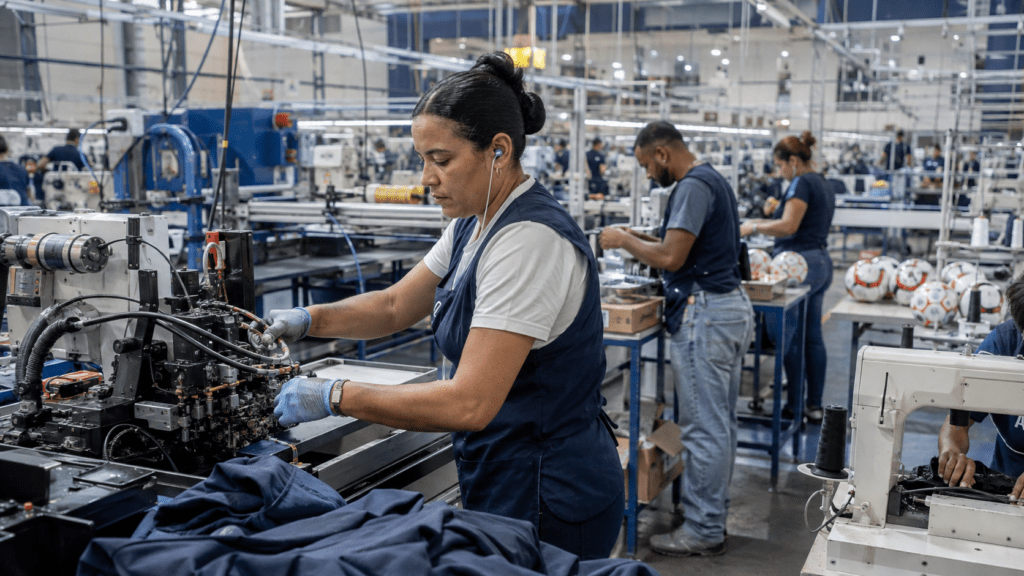
Apparel and textiles remain one of the best-established industries in Dominican free trade zones. Companies manufacture clothing and other textile products for export, while some operations specialize in technical, tactical or medical textile applications.
The industry has evolved from conventional garment production toward a wider range of specialized products. A 2026 CNZFE list of newly approved companies, for example, included a manufacturer of tactical and medical textile articles as well as a company producing sports goods and textile products.
Textiles also have a distinct legal position within the Dominican free zone framework. Law 56-07 declared the textile, apparel and accessories chain, as well as footwear and leather manufacturing, a national priority and established a specific regulatory regime for these industries.
In employment terms, apparel and textiles remained one of the country’s largest free zone activities in 2025, with 34,321 direct jobs, or 17.1% of sector employment.
Tobacco and Cigar Manufacturing
Tobacco and its derivatives occupy a particularly important position in the Dominican export economy. Free zone companies manufacture cigars and process tobacco, combining industrial operations with a product category for which the Dominican Republic has an established international reputation.
The industry was the largest free zone employment category in the CNZFE’s 2025 statistical report, with 38,622 direct jobs, equivalent to 19.3% of total employment.
Production can include cigar manufacturing and tobacco processing. The activity is not limited to large industrial operations: CNZFE approvals in 2025 and 2026 included new companies dedicated to cigar manufacturing and tobacco processing.
Tobacco is important to the free zone regime because it combines export manufacturing, specialized labor and a product with strong international demand. It also illustrates how the Dominican model accommodates both traditional manufacturing and more specialized production.
Footwear and Footwear Components
Footwear and its components represent another established manufacturing activity. Companies in this category produce shoes and components used in footwear manufacturing, supplying international markets through the export-oriented free zone system.
The sector is smaller than medical products, tobacco, textiles or electronics, but it remains an important part of the manufacturing mix. The CNZFE recorded 5,782 direct jobs in footwear and components in 2025, representing 2.9% of total free zone employment.
Footwear also benefits from the specialized treatment established under Law 56-07, which includes footwear and leather manufacturing within the priority industrial chain covered by the legislation.
The presence of footwear manufacturers contributes to the sector’s diversification and maintains production capabilities in a traditional export manufacturing category while other free zone activities move toward more technologically intensive industries.
Agro-Industrial Products and Food
Agro-industrial production and food manufacturing connect the free zone system with agricultural and food-processing activities. Companies in these categories can process agricultural inputs and manufacture products prepared for international markets.
The 2025 CNZFE employment data distinguish between products classified as agro-industrial and those classified specifically as food. Agro-industrial products accounted for 5,416 direct jobs, while food activities accounted for 736.
The distinction is useful because agro-industrial production can encompass a wider range of processed agricultural goods, while the food category captures specific food-manufacturing operations. Both demonstrate that the free zone regime is not limited to apparel, electronics or medical manufacturing.
This segment also provides an avenue for adding value to products before they enter export markets. Instead of exporting an agricultural commodity in a minimally processed form, an industrial operation can undertake processing, packaging or other manufacturing steps within the export-oriented framework.
Call Centers, BPO and Export Services
The Dominican free zone system includes a substantial services component. Under Law 8-90, authorized companies can provide activities such as design, telemarketing, telecommunications, data entry, translation and computing, alongside other related services.
In practice, this has helped create a large base of call centers and business-process outsourcing, commonly known as BPO. These companies can provide customer service, data processing, administrative support and other services to international clients.
Call centers and BPO represented 37,218 direct jobs in 2025, or 18.6% of total free zone employment, making the category the second-largest employment activity after tobacco and its derivatives. Separate service activities accounted for another 8,749 jobs.
The growth of services is important because it shows that free zones are not simply physical manufacturing parks. The regime can also support exportable activities based on telecommunications, information processing and specialized human capital.
Plastics, Chemicals and Other Industrial Products
A significant part of the free zone economy falls outside the best-known sectors. The 2025 employment statistics include plastics, chemicals, paper and printing, metals, wood, glass, construction materials and other manufacturing activities.
Plastic products accounted for 5,544 direct jobs in 2025, while chemical products represented 2,175. Carton, printing and paper products accounted for 3,254 jobs, and metals and metal products represented 616.
These industries matter because they provide inputs and finished goods across different value chains. They also demonstrate the breadth of activities permitted within the regime, which can accommodate specialized manufacturing rather than restricting companies to a narrow list of products.
Recent approvals illustrate this continuing diversification. New companies have included manufacturers of aluminum doors and windows, electronic equipment, specialized medical probes and other industrial products.
Jewelry and Precision Manufacturing
Jewelry is another established free zone activity. Companies in this category manufacture jewelry and related products for export, adding a specialized, relatively high-value segment to the manufacturing base.
The sector employed 1,782 people in 2025, equivalent to 0.9% of total free zone employment.
Its importance is less about employment volume than diversification. Jewelry manufacturing demonstrates that the free zone framework can support products where design, precision, skilled labor and export logistics are more important than simple mass production.
Sports Goods and Recreational Products
Sports and recreational goods form a smaller but increasingly varied category. Products can include sporting equipment, protective gear, bags, caps, footwear and other related goods.
One 2026 company approved under the regime was authorized to manufacture sports products including bats, balls, gloves, protective helmets, rackets, sports bags, caps and footwear, alongside textile manufacturing.
The category accounted for 959 direct jobs in 2025. Although it represents only 0.5% of total free zone employment, its presence adds another layer of product diversification and illustrates how manufacturers can combine different production capabilities within the same export-oriented environment.
Logistics, Commercial and Other Specialized Activities
Some free zone operations are not primarily manufacturers. The regime also accommodates commercial, logistics and other specialized activities connected with international trade.
Law 8-90 permits the transfer of raw materials, machinery and other inputs between authorized companies subject to the applicable customs rules. The legislation also establishes specific provisions for logistics and commercialization activities.
The broader logistics ecosystem has gained additional legal definition through Law 30-24, which regulates logistics centers, their operators and logistics operating companies in the Dominican Republic. The CNZFE lists the legislation among the country’s current legal instruments related to the free zone framework.
This matters because modern export manufacturing depends not only on factories but also on storage, transportation, inventory management and efficient movement of goods. Specialized logistics operations can therefore support the competitiveness of manufacturers operating within the wider export ecosystem.
Why the Industry Mix Matters
The diversity of Dominican free trade zones is strategically important because it reduces dependence on a single manufacturing activity. The sector combines labor-intensive industries such as apparel and tobacco with more specialized activities such as medical devices, electronics and business services.
The employment structure provides a clear illustration. In 2025, tobacco and derivatives, call centers and BPO, apparel and textiles, and medical and pharmaceutical products together accounted for more than 70% of direct free zone employment. At the same time, smaller categories such as plastics, chemicals, jewelry, agro-industrial products, footwear and sports goods broadened the industrial base.
Export performance reinforces the importance of this diversification. Free zone exports reached US$8.55 billion in 2025, compared with US$7.96 billion in 2023 and US$8.50 billion in 2024, according to CNZFE data.
The sector’s evolution is also visible in new investments. Companies approved in 2025 and early 2026 have included operations involving medical devices, electronic products, tobacco, textiles, sports goods, logistics and specialized industrial equipment.
How the Free Zone Regime Supports These Industries
The industrial diversity of the Dominican free zones is closely connected to the incentives and customs framework established by law. The CNZFE states that companies operating under the regime can receive exemptions provided under Article 24 of Law 8-90, including exemptions from several taxes and duties, subject to the conditions established by the legislation.

The regime also facilitates the importation of raw materials, machinery and equipment required for production. The CNZFE provides a formal authorization process for qualifying companies to import these inputs free of applicable taxes under the relevant provisions.
For companies producing goods for international markets, this structure can reduce the customs and tax friction associated with bringing production inputs into the country and then exporting finished goods. It is one of the central reasons the regime has become an important platform for multinational and Dominican manufacturers.
The framework does not mean that every product can automatically enter the Dominican domestic market under the same conditions. Law 8-90 establishes specific rules for domestic sales, including differentiated treatment for certain textile, apparel, footwear and leather products and conditions applicable to other goods.
Which Industries Are Most Important?
There is no single way to measure the importance of an industry. Employment, export value, investment, technological complexity and integration into international supply chains can produce different rankings.
By employment in 2025, tobacco and derivatives led the sector, followed by call centers and BPO, apparel and textiles, and medical and pharmaceutical products. By export significance, medical and pharmaceutical products, tobacco and derivatives, and electrical and electronic products are among the leading categories highlighted by the CNZFE.
This distinction is important. A sector with relatively fewer workers can still have a major economic impact if its products have high export value. Medical devices and advanced manufacturing provide a clear example of this pattern.