 25°C
25°C

Manufacturing Costs in the Dominican Republic: 8 Key Costs to Know
Manufacturing costs in the Dominican Republic depend on far more than wages. Labor, electricity, imported inputs, industrial space, transportation, financing, taxes, maintenance and compliance can materially change the economics of a factory, while free-zone and other investment regimes can significantly alter the cost structure for qualifying operations. Official data show that raw materials and production inputs are the dominant cost component for Dominican manufacturers, making sourcing, logistics, energy efficiency and plant utilization particularly important when evaluating whether to establish production in the country.


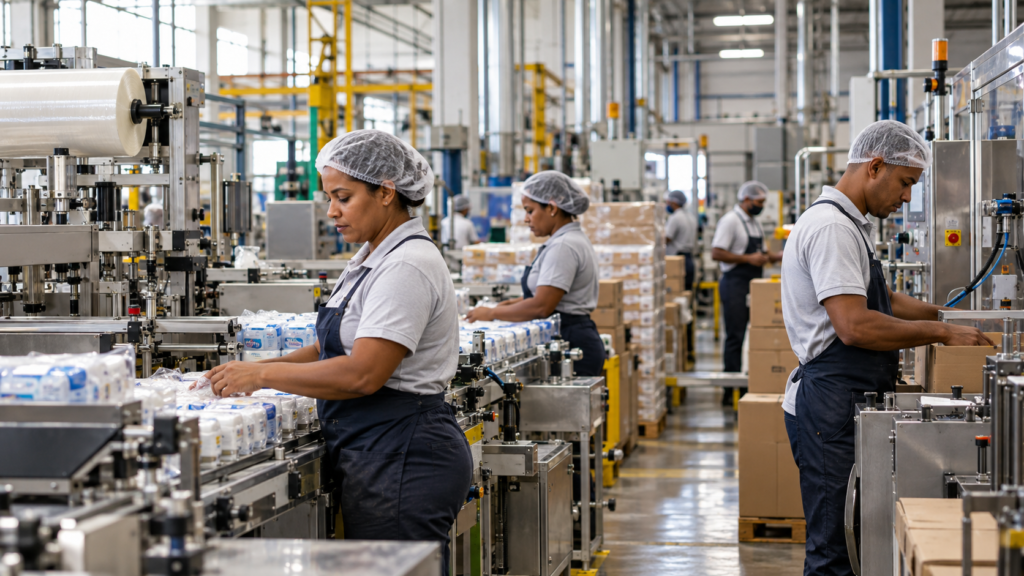
Evaluating manufacturing costs in the Dominican Republic requires a broader approach than comparing local wages with those in another country. A manufacturer must consider the complete cost of converting imported or locally sourced inputs into finished goods and delivering them to customers. That includes payroll, electricity, industrial space, machinery, raw materials, freight, customs, financing, maintenance, insurance, taxes and regulatory compliance.
The structure of those costs varies substantially according to the industry, production technology, location, energy intensity, percentage of imported inputs and destination of the finished goods. An export-oriented factory operating under a special regime can have a very different cost profile from a conventional manufacturer selling primarily into the Dominican domestic market.
How Much Does It Cost to Manufacture in the Dominican Republic?
There is no single manufacturing cost per unit or standard factory cost for the Dominican Republic. The most useful starting point is the country’s official data on the composition of industrial expenditure. The National Statistics Office (ONE) reports that raw materials and materials consumed in the production of goods represented 70.7% of manufacturing costs and expenses in its 2023 data, while other costs and expenses accounted for 29.1%.
This means that the cost of inputs can matter much more than the headline wage level. A labor-intensive manufacturer may be highly sensitive to payroll, while a capital-intensive or materials-intensive factory may find that imported commodities, energy, freight and working capital have a greater effect on unit costs.
| Cost Category | What It Includes | Why It Matters |
|---|---|---|
| Labor | Wages, social contributions, benefits, recruitment and training | Particularly important for labor-intensive production |
| Raw materials | Local and imported materials, components, ingredients and packaging | The largest aggregate manufacturing cost category |
| Energy | Electricity, fuel, backup generation and related systems | Critical for energy-intensive factories and cold-chain operations |
| Industrial property | Land, factory buildings, rent, construction and fit-out | Determines initial capital requirements and fixed overhead |
| Logistics | Ocean freight, trucking, warehousing, ports and customs-related expenses | Important for both imported inputs and exports |
| Financing | Loans, interest, working capital and banking costs | Affects both startup investment and operating cash flow |
| Taxes and duties | Income taxes, import duties, VAT/ITBIS and other applicable charges | Can vary substantially by business structure and incentive regime |
| Other operating costs | Maintenance, insurance, water, waste management, IT and compliance | Often overlooked in initial feasibility studies |
1. Labor Costs in the Dominican Republic
Labor is one of the most visible components of manufacturing cost, but the relevant figure is not simply the legal minimum wage. A factory’s true labor cost includes base wages, mandatory employer contributions, overtime, paid leave, bonuses and other employment-related expenses, as well as recruitment, training, transportation and employee benefits where these are necessary to attract and retain workers.
For conventional private-sector employers, the applicable minimum wage depends on company size and other classification criteria. A 2025 labor resolution established that, from June 1, 2026, the minimum monthly wage is RD$21,000 for workers in companies with 151 or more employees and annual gross sales above RD$202 million, and RD$17,701.25 for workers in companies with up to 150 employees and annual gross sales up to RD$202 million.
These figures should not be treated as a representative manufacturing salary. Skilled operators, maintenance personnel, engineers, supervisors, quality specialists and managers can earn considerably more. The appropriate labor budget therefore depends on the production process and the skill mix required.
Labor costs in free zones
Export manufacturers should analyze the free-zone labor market separately. The National Council of Export Processing Zones (CNZFE) publishes average weekly wages by activity, providing a more useful reference for companies considering export manufacturing.
For 2025, average weekly operator wages in selected free-zone industries ranged from approximately RD$4,815.69 in electrical and electronic products to RD$5,251.14 in medical and pharmaceutical products. Average weekly technical wages ranged from RD$8,204.86 in jewelry to RD$9,463.20 in medical and pharmaceutical products.
Those averages are useful for benchmarking, but they are not a complete payroll budget. An investment model should add employer contributions, overtime, absenteeism, recruitment, training, employee transportation where applicable and other labor-related expenses.
2. Electricity and Energy Costs
Electricity can be one of the most strategically important operating costs for a manufacturer. Its impact depends heavily on the production process. A packaging plant, assembly operation or warehouse may have a relatively modest electricity requirement, while refrigeration, plastics, metals, chemicals, food processing and other continuous processes can consume substantial amounts of power.
The Dominican industrial environment also makes energy reliability relevant to cost calculations. A factory may need backup generation, voltage-management equipment, batteries or other infrastructure depending on its process and location. These investments should be treated as part of the total cost of production rather than as purely technical expenditures.
CNZFE’s investment guidance gives a reference range of approximately US$0.13 to US$0.18 per kWh for electricity for non-regulated users in free-zone parks. Actual electricity costs vary according to consumption profile, contract, tariff structure and facility.
Energy should therefore be modeled on a cost-per-unit basis. A manufacturer should estimate kilowatt-hours consumed per unit of output, multiply that by the expected effective electricity cost and then add the cost of backup generation and maintenance where required.
3. Land, Factory Space and Industrial Facilities
The cost of establishing a factory varies considerably according to whether a company purchases land, leases an existing building, constructs a new plant or operates inside an industrial or free-zone park.
Leasing an existing industrial facility can reduce initial capital expenditure and shorten the time required to begin production. Building a purpose-designed plant provides greater control over production flow, utilities and expansion capacity but requires substantially more upfront capital.
For companies considering free zones, CNZFE reports industrial-park rental prices in a broad range of approximately US$1.80 to US$9.50 per square foot per year. The range reflects differences between parks and facilities rather than a national industrial-property average.
Location also affects the economics. A facility closer to ports may reduce inland transportation and inventory costs, while a location outside the main industrial corridors can offer lower property costs but increase commuting, logistics or supplier-access expenses.
Land is not the only property cost
A feasibility study should include more than rent or the purchase price of the land. Other costs can include site preparation, construction, electrical infrastructure, water systems, drainage, fire protection, warehouse equipment, security, loading docks, offices and production-line installation.
For this reason, comparing two locations solely by annual rent can produce a misleading result. A slightly more expensive facility can have a lower total cost if it requires less investment in utilities, has better access to highways or ports and reduces employee transportation costs.
4. Raw Materials and Imported Inputs
Raw materials are particularly important because they represent the largest component of manufacturing expenditure in official national statistics. ONE’s manufacturing data for 2023 shows that raw materials and materials consumed in production accounted for 70.7% of the industry’s cost-and-expense structure.
The share varies by industry. Food processing, for example, may be heavily exposed to agricultural commodities and packaging, while electronics manufacturing can be dominated by imported components. Metal fabrication can be highly sensitive to international steel prices, while pharmaceutical and medical-device manufacturers may depend on specialized imported materials.
The Dominican Republic’s import structure confirms the importance of imported industrial inputs. In the first four months of 2025, machinery and mechanical equipment represented 8.21% of imports by customs chapter, electrical machinery 6.43%, plastics and plastic manufactures 4.30%, and iron and steel 3.67%.
Companies should therefore calculate not only the supplier’s quoted price but the landed cost of each imported input. That means incorporating freight, insurance where applicable, customs duties, port and handling expenses, inland transportation and any other charges necessary to place the input inside the factory.
5. Transportation and Logistics Costs
Transportation costs operate at several stages of the manufacturing chain. A company may pay to move imported materials from a port to its plant, transport domestic inputs from suppliers to the factory, move finished goods to distribution centers and deliver exports from the factory to a port or airport.
The Dominican Republic’s geography provides relatively short maritime connections to the United States and other Caribbean markets, but logistics costs still depend on shipment size, container utilization, port selection, product characteristics and inland distance.
For an export-oriented manufacturer, the relevant calculation is the total logistics cost per finished unit. A product with a low factory cost can lose its advantage if it is expensive to transport because it is bulky, heavy, temperature-sensitive or inefficiently packaged.
Manufacturers should also consider inventory costs. Longer or less predictable supply chains require more safety stock, which ties up working capital. A supplier located farther away may offer a lower unit price but create a higher total cost once inventory financing and replenishment requirements are included.
6. Financing and Cost of Capital
Financing costs affect manufacturing at two different stages: the initial investment required to establish the plant and the working capital required to operate it.
Initial investment can include land, buildings, machinery, production lines, utilities, vehicles, information systems and pre-operating expenses. Working capital is required for inventories, accounts receivable, payroll and supplier payments before sales revenue is collected.
The cost of borrowing in the Dominican Republic changes over time with monetary and financial-market conditions. The Central Bank reported an average weighted active banking rate of 14.08% in August 2026, while the monetary policy rate stood at 5.25% in September 2026. These are economy-wide reference indicators, not guaranteed manufacturing loan rates.
The financing model should therefore use actual bank quotations rather than assuming that the central-bank policy rate is the rate available to a manufacturing company. The company’s credit profile, collateral, currency, loan maturity, project risk and banking relationship can all affect the final borrowing cost.
Currency risk also matters
Manufacturers that borrow in Dominican pesos but purchase materials or sell products in U.S. dollars can face currency mismatches. The reverse can also occur. A financial model should therefore test exchange-rate scenarios instead of treating the peso-dollar exchange rate as a fixed assumption.
This is particularly important when a factory imports a large share of its inputs. A depreciation of the peso can increase the local-currency cost of imported materials, machinery, spare parts and freight.
7. Taxes, Duties and Investment Incentives
Taxes can materially change the cost structure of a manufacturing project, but the applicable burden depends on the company’s activity, legal structure, destination of its products and whether it qualifies for a special regime.
Under the general corporate regime, the Dominican Republic’s corporate income tax rate is 27%. For fiscal years 2026 through 2028, the rate rises to 30% for taxpayers with annual income of at least RD$1 billion, subject to the rules established by the tax legislation.
That general rate should not simply be applied to every manufacturing project. Companies operating in export-processing zones can qualify for substantial exemptions under the applicable regime. The Dominican tax authority states that qualifying free-zone operators and companies established within them receive 100% exemptions from several taxes, including corporate income tax and import duties on qualifying inputs, equipment and materials used to establish and operate the free-zone business.
There are also other special regimes. For example, the Special Border Development Zone created under Law 12-21 provides qualifying industrial and agro-industrial companies in designated provinces with specified tax and customs exemptions.
The implication for investors is important: tax treatment should be modeled after the company has identified its actual legal and operational structure. Comparing a standard domestic manufacturer with a qualifying free-zone exporter using only the statutory corporate tax rate can materially distort the investment analysis.
8. Maintenance, Compliance and Other Operating Costs
Manufacturing budgets frequently underestimate costs that do not appear in the headline investment figure. These can include preventive maintenance, spare parts, laboratory testing, quality assurance, waste management, insurance, security, IT systems, professional services, environmental compliance and equipment calibration.
Maintenance deserves particular attention because production downtime can cost much more than the repair itself. A factory that imports specialized machinery may also need to hold critical spare parts locally because waiting for an overseas shipment can interrupt production.
Compliance costs depend on the industry. Food, pharmaceutical, medical-device, chemical and other regulated manufacturers can require additional testing, certifications, documentation, inspections and specialized personnel. These expenses should be incorporated into the operating model from the beginning.
What Do Dominican Manufacturers Say About Cost Pressures?
Official business surveys provide useful context for understanding which costs are most sensitive to changing economic conditions. In its April-June 2025 survey of manufacturers, the Central Bank found that the most frequently cited negative causes affecting production costs were increases in national and international raw-material and input prices, increases in the exchange rate, higher electricity tariffs and higher fuel prices.
The same survey shows why manufacturing competitiveness cannot be reduced to labor costs. Exchange rates can affect imported inputs, energy prices can affect factory overhead, and changes in commodity prices can quickly alter gross margins even when payroll remains stable.
How Manufacturing Costs Compare Across Different Factory Models
The cost structure depends heavily on the type of production being considered. A labor-intensive operation will place more weight on wages and employee-related costs. A highly automated facility will shift the balance toward machinery, depreciation, maintenance, electricity and financing.
| Factory Model | Costs Likely to Matter Most | Key Cost Risk |
|---|---|---|
| Labor-intensive assembly | Labor, facility, supervision, logistics | Wage increases and employee turnover |
| Food processing | Raw materials, packaging, energy, labor, cold chain | Commodity prices and energy costs |
| Electronics | Imported components, labor, quality control, logistics | Exchange rates and global component prices |
| Metal manufacturing | Steel or other metals, electricity, machinery, transport | Commodity prices and energy consumption |
| Pharmaceutical or medical manufacturing | Specialized inputs, skilled labor, quality systems, compliance | Certification, quality and imported-input costs |
| Highly automated production | Machinery, depreciation, energy, financing, maintenance | Capital utilization and downtime |
This distinction is essential when comparing the Dominican Republic with another manufacturing location. The relevant question is not whether one country’s average wage is lower, but whether its total landed cost per finished unit is competitive for the specific production process.
Domestic Production Versus Free-Zone Manufacturing
One of the most important strategic decisions is whether the operation should be established under the conventional domestic regime or within a qualifying free-zone structure.
A conventional manufacturer can access the domestic market directly and may be better suited to businesses whose principal customers are Dominican consumers or companies. Its cost structure includes the taxes, duties and regulatory obligations applicable to ordinary domestic operations.
A qualifying free-zone manufacturer can benefit from significant fiscal and customs exemptions, but the regime is designed primarily around export-oriented activity and has its own qualification, operational and reporting requirements. The tax authority states that qualifying free-zone companies receive exemptions on corporate income tax and various import-related taxes and duties, subject to the conditions of the regime.
Therefore, the comparison should be based on the complete economics of the project rather than simply asking which regime has lower taxes.

| Factor | Conventional Manufacturing | Qualifying Free-Zone Operation |
|---|---|---|
| Domestic market orientation | Generally straightforward | Subject to free-zone rules for local sales |
| Corporate income tax | General regime, subject to applicable rules | Significant exemption under the free-zone regime |
| Import duties on qualifying inputs | Depends on product and applicable tariff treatment | Broad exemptions can apply to qualifying operations |
| Industrial space | Wide choice of private locations and facilities | Typically located within approved free-zone parks or designated facilities |
| Export orientation | Optional | Central to the regime |
| Regulatory framework | General manufacturing rules | Additional free-zone qualification and compliance requirements |
How to Calculate the Real Cost of Manufacturing
A serious feasibility study should calculate the cost of manufacturing on a per-unit basis rather than relying on broad national averages.
The first step is to calculate the fully landed input cost. For imported materials, this should include the supplier price, freight, insurance where applicable, customs duties and charges, port handling and inland transportation.
The second step is to calculate direct production costs. This includes direct labor, electricity, fuel, water and other consumables directly associated with production.
The third step is to allocate factory overhead. Depreciation, rent, maintenance, quality control, supervision, security, insurance and other factory expenses should be allocated across expected production volumes.
The fourth step is to calculate logistics after production. This includes warehousing, transportation to customers or ports, export documentation and other distribution expenses.
Finally, the company should add financing costs and evaluate the tax consequences under the actual investment structure. This produces a much more useful estimate of the project’s economics than simply comparing hourly wages or factory rent.
A Practical Manufacturing Cost Model
A basic investment model can be organized around the following categories:
- Direct materials: local and imported raw materials, components and packaging.
- Direct labor: operators and other employees directly involved in production.
- Factory overhead: electricity, water, maintenance, depreciation, rent and supervision.
- Logistics: inbound freight, customs, ports, warehousing and outbound transportation.
- Administrative expenses: management, accounting, legal, IT and general office costs.
- Quality and compliance: testing, certification, inspections and regulatory requirements.
- Financing: interest and other costs associated with investment and working capital.
- Taxes and duties: applicable taxes after accounting for available incentives.
The model should then calculate the cost per unit at several capacity levels. A factory running at 40% utilization can have a much higher fixed cost per unit than the same plant operating at 80% or 90% utilization.
Location Can Change the Cost Structure
Choosing a manufacturing location is a cost optimization exercise rather than simply a search for the cheapest industrial land.
Santo Domingo provides access to the country’s largest concentration of consumers, services and business infrastructure, while Santiago and other industrial centers can provide access to established manufacturing ecosystems and labor pools. Free-zone parks in different regions can offer different combinations of rental costs, labor availability, infrastructure and logistics.
A company should therefore compare locations using a total-cost model that includes the factory, employee transportation, inbound logistics, outbound logistics, utilities, security, access to suppliers and proximity to ports or airports.
The cheapest building can be the more expensive option if it causes higher transportation costs, requires substantial infrastructure investment or makes it difficult to recruit and retain employees.
What Can Make Manufacturing in the Dominican Republic More Competitive?
Several factors can improve the economics of a Dominican manufacturing operation.
High capacity utilization
Fixed costs such as rent, depreciation, supervision and certain administrative expenses are spread across more units when a plant operates at higher utilization. This can materially reduce unit costs once production reaches efficient scale.
Local sourcing
Where reliable domestic suppliers exist, local sourcing can reduce exposure to freight, customs procedures and exchange-rate movements. However, a local supplier should be evaluated on total delivered cost and quality rather than price alone.
Efficient energy use
Energy-efficient equipment, production scheduling and appropriate electrical infrastructure can reduce operating expenses in power-intensive factories. The potential savings should be calculated against the additional capital required.
Export-oriented structures
For companies that qualify, free-zone incentives can significantly change the tax and customs component of manufacturing costs. The benefit depends on the company’s eligibility and operating model rather than simply on its physical location.
Supplier integration
Developing reliable local suppliers can reduce inventory requirements and shorten replenishment times. It can also create a stronger domestic industrial ecosystem around the factory.
Common Mistakes When Estimating Dominican Manufacturing Costs
The most common error is comparing only wages. Labor may be important, but official manufacturing data shows that materials represent the largest aggregate component of industry costs.
Another common mistake is ignoring the landed cost of imported inputs. A component quoted at the factory gate in another country is not equivalent to a component delivered to a Dominican production line.
Companies can also underestimate working capital. Import lead times, minimum order quantities and customer payment terms can require significant cash to remain tied up in inventory and receivables.
A further error is assuming that a tax incentive automatically makes a project competitive. Incentives can reduce taxes and duties, but they cannot compensate indefinitely for inefficient production, low capacity utilization, high logistics costs or an unsuitable location.
What Should a Company Include in a Dominican Manufacturing Feasibility Study?
Before committing capital, a company should prepare a detailed five- to ten-year financial model using project-specific quotations wherever possible.
- Define the production process and expected annual capacity.
- Determine the number and type of employees required for each production shift.
- Obtain quotations for land, factory space or construction.
- Calculate electricity, fuel and water consumption based on the actual equipment.
- Obtain supplier quotations for both domestic and imported materials.
- Calculate the landed cost of imported inputs.
- Obtain freight and inland transportation quotations.
- Determine the applicable tax, customs and investment regime.
- Obtain financing terms based on the actual project.
- Model different capacity-utilization and exchange-rate scenarios.
- Calculate the final cost per unit and compare it with alternative production locations.
This process is more reliable than using a generic national estimate because manufacturing competitiveness is ultimately determined by the economics of a specific factory producing a specific product for a specific market.