 23°C
23°C

Mangrove Degradation Linked to $75 Million Economic Exposure in Dominican Republic
A study published in Ocean & Coastal Management finds that mangrove degradation is closely associated with short-term declines in economic growth, international tourist arrivals and tourism accommodation capacity in the Dominican Republic, while also identifying a statistically significant long-term relationship between mangrove natural capital and gross domestic product. Using 29 years of annual data, from 1995 through 2023, researchers estimate that the economic exposure associated with observed mangrove degradation is approximately US$75 million per year—a figure that should not be interpreted as a direct government loss, budget shortfall or cash payment, but as an estimate of economic value exposed to continued ecosystem degradation.


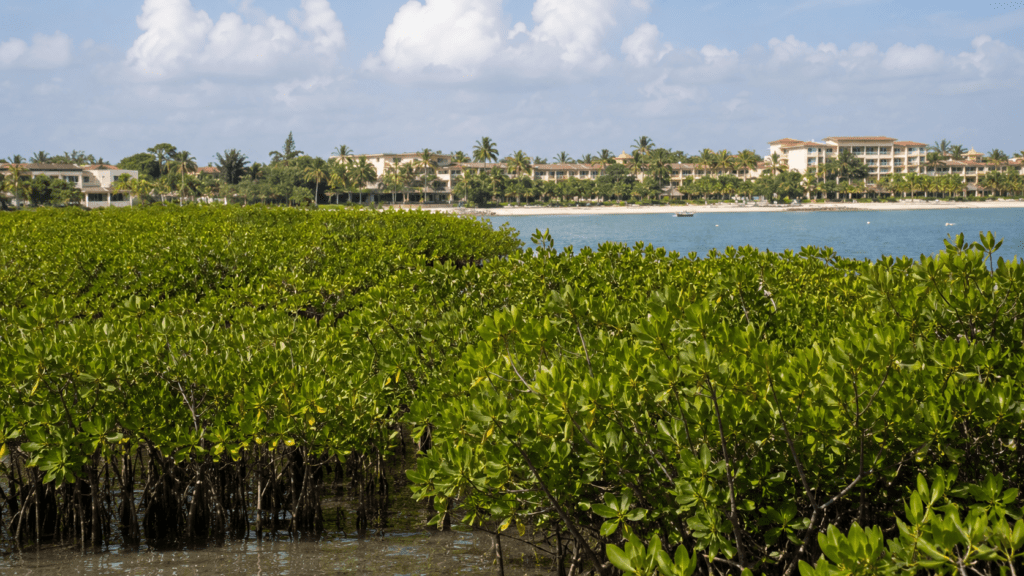
Mangroves are often discussed as an environmental asset: coastal forests that provide habitat for fish and wildlife, store carbon and help protect shorelines. But a new study from researchers at the Instituto Tecnológico de Santo Domingo (INTEC) puts another dimension of their value under scrutiny: their relationship with the Dominican Republic’s tourism-dependent economy.
The research, by Víctor Gómez-Valenzuela, Katerin Ramírez and Solhanlle Bonilla-Duarte, examines the relationship between mangrove natural capital and three major economic variables—real gross domestic product (GDP), international tourist arrivals and tourism accommodation capacity. Rather than examining a single coastal development project or measuring the economic value of one mangrove site, the researchers use a national time-series model covering 29 years, from 1995 through 2023.
The central finding is that mangrove degradation is associated with negative short-run changes in GDP growth, tourist arrivals and accommodation capacity. The study also finds a statistically significant long-run relationship between mangrove capital and GDP. Based on observed degradation rates, the researchers estimate annual economic exposure of approximately US$75 million, equivalent to 4.2% of the estimated value of the Dominican Republic’s coastal and marine ecosystem services.
That last figure requires particular care. The study does not say that the Dominican government loses US$75 million in tax revenue every year, nor does it establish a US$75 million annual decline in tourism receipts. “Economic exposure” refers to the estimated economic value associated with the ecosystem degradation identified by the study. It is better understood as an estimate of economic value at risk or affected by ecological deterioration than as a conventional accounting loss.
What the Study Investigated
The researchers set out to answer a relatively unusual question: can the condition of a natural ecosystem be linked statistically to the broader economic dynamics of a tourism-dependent island country?
The Dominican Republic provides a particularly relevant setting because a substantial share of its tourism activity is concentrated along coastal areas. The country’s tourism economy depends not only on hotels and airports but also on the environmental conditions that make coastal destinations attractive and functional. Mangroves form part of that wider coastal system alongside coral reefs, seagrass meadows, beaches and estuaries.
The study therefore treats mangrove natural capital as an economic variable rather than as a purely ecological indicator. The analysis asks whether changes in mangrove capital are associated with changes in the country’s economic performance and tourism infrastructure over time.
This approach is different from a conventional study that maps where mangroves have disappeared. Geographic information systems and satellite imagery can show where habitat has changed. The INTEC study instead examines whether ecological changes are reflected in national-level economic time series.
Why the Researchers Used a VECM
The technical centerpiece of the research is a Vector Error Correction Model, or VECM. For readers unfamiliar with econometrics, the important point is that a VECM is designed for situations in which several variables move over time and may influence one another while also sharing a longer-term equilibrium relationship.
Imagine, for example, that GDP, tourism arrivals, hotel capacity and mangrove capital all tend to rise or fall over long periods, but not necessarily at the same speed. A simple correlation could show that two variables move together. It would not tell researchers whether that relationship persists over decades, how short-term changes differ from long-term tendencies, or whether the variables adjust after a temporary disruption.
A VECM is designed to examine those dynamics. It combines two ideas. The first is cointegration: different non-stationary time series can nevertheless share a stable long-run relationship. The second is short-run adjustment: when the variables temporarily move away from that long-run relationship, the model can estimate how the system responds.
In this study, the researchers first examined whether the individual series had the statistical properties required for this type of analysis. They then used the Johansen approach to test for cointegration before estimating the VECM. The baseline model identified a rank-1 cointegrating relationship, meaning the four-variable system contained one statistically significant long-run equilibrium relationship.
This matters because simply putting GDP and mangrove coverage into a conventional regression could obscure the distinction between long-term equilibrium and short-term fluctuations. The VECM allows the researchers to examine both horizons within the same framework.
What the 29 Years of Data Showed
The dataset covers annual observations from 1995 through 2023. That period captures major changes in the Dominican economy and tourism sector, including rapid expansion of tourism infrastructure, the global financial crisis, the disruption caused by the COVID-19 pandemic and the subsequent recovery.
The four variables examined were real GDP, international tourist arrivals, tourism accommodation capacity and mangrove natural capital. The inclusion of accommodation capacity is important because it provides a bridge between environmental conditions and the physical infrastructure of the tourism industry.
The researchers also carried out diagnostic and robustness procedures rather than relying on a single statistical result. The study reports robustness checks for pre-crisis and pre-COVID periods, with the long-run relationship remaining stable across those sub-periods.
The study also uses Granger-causality testing. In this context, “Granger causality” should not be confused with proof of physical or economic causation. It tests whether past values of one variable contain information that helps predict another variable within the model. The researchers found that mangrove capital temporally precedes GDP, tourist arrivals and accommodation capacity.
That finding strengthens the case for treating mangrove conditions as an important component of the system rather than simply another variable moving alongside tourism. But it does not, by itself, prove that every observed economic change was caused by mangrove degradation.
The Short-Run Relationship With GDP and Tourism
The most immediate result is the relationship between mangrove degradation and short-term economic performance. The study reports statistically significant negative effects associated with mangrove degradation on GDP growth, international tourist arrivals and accommodation capacity.
The reported significance levels are p = 0.001 for GDP growth, p = 0.046 for tourist arrivals and p = 0.052 for accommodation capacity. These results indicate that the strongest statistical relationship in the short-run findings is the one involving GDP growth, while the accommodation-capacity result sits close to the conventional 5% threshold used in many statistical analyses.
The distinction is important. The study does not claim that removing a specific area of mangrove forest automatically causes a measurable fall in national GDP or hotel construction. Rather, the VECM detects a statistically meaningful relationship within a system of national economic and ecological time series.
Impulse-response analysis adds another dimension by examining how the system responds after an identified shock. According to the study, ecological shocks are followed by declines in GDP, tourist arrivals and tourism infrastructure in the short run. For policymakers, the significance is less about predicting the precise effect of any individual mangrove disturbance and more about recognizing that ecological deterioration can appear alongside broader economic stress in a tourism-dependent economy.
The Long-Run Relationship Is Even More Important
The short-run results matter, but the long-run relationship is arguably the more consequential finding for economic policy.
The Johansen cointegrating vector identifies a statistically significant positive relationship between mangrove capital and GDP. In practical terms, the study’s model suggests that economies with greater mangrove natural capital are associated with a higher long-run equilibrium level of economic output, after accounting for the other variables included in the system.
The implication is not that mangroves independently determine the country’s GDP. The Dominican economy is influenced by many factors that are not captured by a four-variable ecological-economic model, including investment, productivity, trade, monetary conditions, labor markets, global demand and geopolitical developments.
Instead, the result points to mangrove ecosystems as part of the country’s underlying economic capital. When that natural capital is degraded, the model indicates that the long-run economic equilibrium can be constrained.
This is one reason the study’s findings go beyond the conventional argument that mangroves should be conserved because they are environmentally valuable. The researchers are effectively asking policymakers to consider natural ecosystems as productive assets that can support economic activity over time.
What the US$75 Million Estimate Actually Means
The headline figure from the study is the estimated US$75 million in annual economic exposure associated with observed mangrove degradation rates.
It would be misleading to describe this as “US$75 million lost from the Dominican economy every year” without qualification. The study does not present it as a line item in national accounts, a direct reduction in tax collections or a specific amount of tourism revenue that disappeared because mangroves were degraded.
The term economic exposure is important because it describes the economic value that is vulnerable to, associated with or potentially affected by environmental deterioration. In this study, the estimate is derived from the relationship between observed degradation and the estimated value of coastal-marine ecosystem services. The researchers report that US$75 million represents approximately 4.2% of the estimated value of those coastal-marine ecosystem services.
That distinction changes how the number should be interpreted. It is not a bill sent to the Dominican government. It is not evidence that tourism companies collectively lose US$75 million in annual profits. Nor does it mean that restoring mangroves would automatically generate US$75 million in additional GDP or government revenue each year.
Instead, the estimate provides a monetary way of expressing the scale of economic value associated with ecological degradation. It gives policymakers an order of magnitude for considering the economic significance of mangrove conservation alongside its ecological benefits.
Why Mangroves Matter to Tourism
The connection between mangroves and tourism is not limited to whether visitors see mangrove forests during a vacation. Mangroves perform functions throughout the coastal system on which tourism depends.
Dominican environmental authorities identify mangroves as providing services including coastal protection, erosion control, water-quality functions, fish habitat, biodiversity protection and carbon storage. They can also contribute to recreation and ecotourism. These services are particularly relevant in a country where much of the tourism industry is concentrated around coastal destinations.
The Ministry of Environment and Natural Resources’ climate-adaptation guidance describes mangroves as providing protection against wind and waves, helping control flooding and coastal erosion, filtering water, supporting fisheries and providing habitat for marine species. The ministry also recognizes their role as carbon sinks.
The relationship with tourism is therefore partly indirect. A healthy mangrove system can support fisheries and water quality, reduce some forms of coastal vulnerability and contribute to the broader ecological character of a destination. Tourism businesses may benefit from those services even when the services do not appear as a separate item on a hotel’s balance sheet.
The Dominican Republic’s Mangrove Resource
Official Dominican statistics illustrate the scale of the ecosystem being discussed. The National Statistics Office, known as ONE, reported approximately 269.94 square kilometers of mangrove forest in its 2022 forest-cover statistics, based on information from the Ministry of Environment and Natural Resources.
A separate preliminary Ministry of Environment 30×30 compendium identifies approximately 273 square kilometers of mangrove coverage in its 2022 assessment. The small difference between the figures should not be treated as evidence of a rapid ecological change; they come from different official products and methodologies.
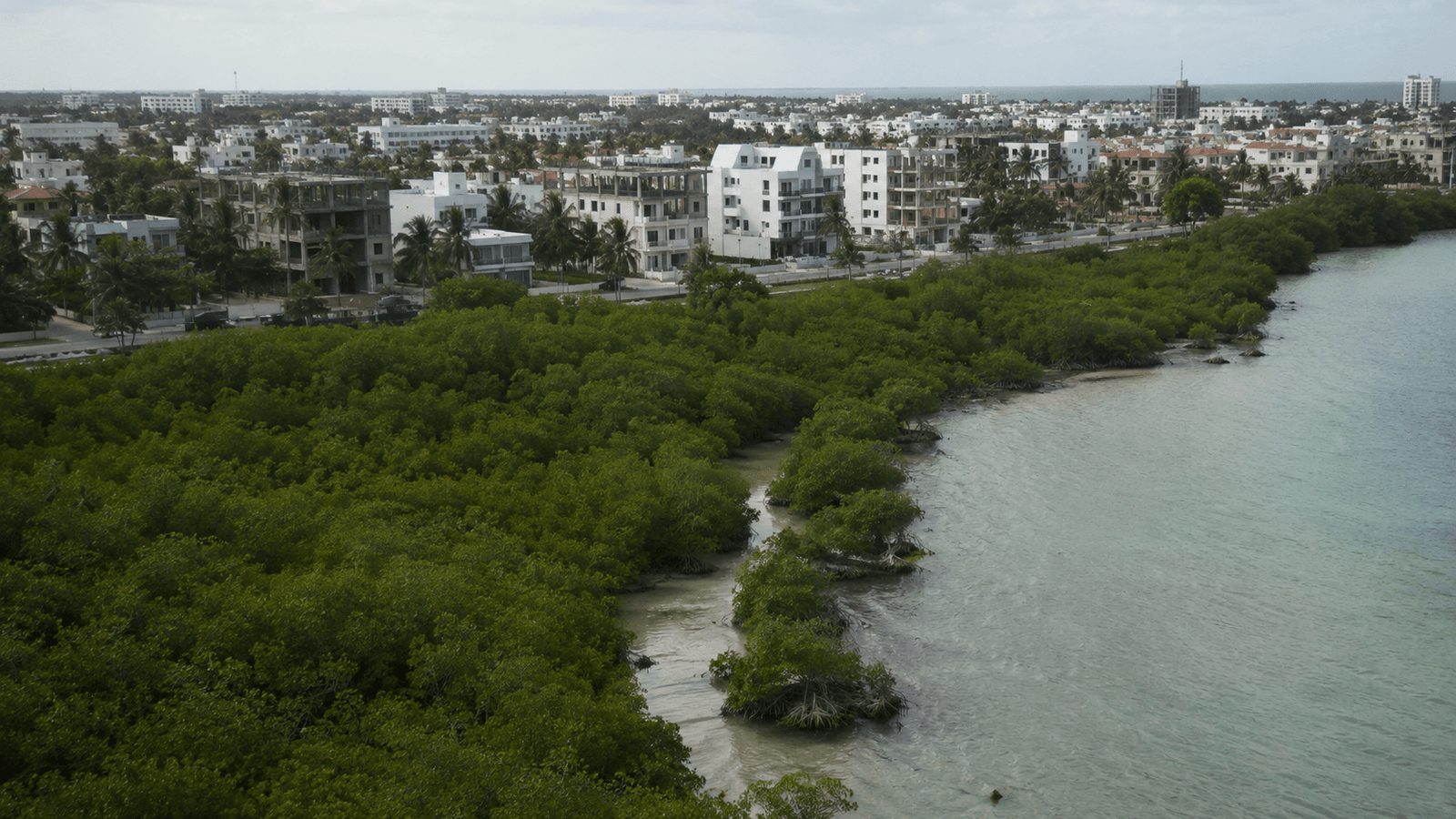
The ministry’s material also shows why mangrove conservation is closely connected to land-use planning. Mangrove systems occur in several important coastal regions, including areas associated with Monte Cristi, Samaná and La Altagracia, while some identified mangrove areas are located close to cities and transportation infrastructure.
The country’s environmental authorities have documented multiple pressures on mangroves, including deforestation, water pollution, development and climate-related pressures. The existence of protected areas can provide an important layer of protection, but protected status does not eliminate all ecological pressures or guarantee that an ecosystem will remain intact.
The Broader Tourism Economy Helps Explain the Stakes
The study’s focus on tourism is not incidental. Tourism is one of the Dominican Republic’s major sources of foreign exchange and has become deeply integrated with the country’s coastal development model.
According to the Central Bank of the Dominican Republic, tourism revenue reached US$9.751 billion in 2023. The same official tourism statistics reported 87,723 available hotel rooms that year. These figures provide context for why changes in tourist arrivals and accommodation capacity matter beyond the tourism industry itself.
The study does not claim that mangroves account for a specific percentage of tourism revenue. Its contribution is different: it statistically links mangrove capital to tourism and macroeconomic variables over time.
That distinction is essential. Tourism is affected by a wide range of factors, including air connectivity, international income, destination competitiveness, hotel investment, exchange rates, safety perceptions, marketing, weather and global economic conditions. Mangrove condition is one component within this larger system.
What the Study Does Not Prove
The research is significant, but its conclusions need to remain within the limits of the method.
First, the study is based on annual national-level data. Twenty-nine observations provide a relatively small sample for a macroeconomic model. The researchers specifically chose a VECM because it is suited to small annual datasets of this kind, but a small sample still limits how much statistical complexity can be supported.
Second, statistical association is not the same as proof of a one-way causal mechanism. The study’s Granger tests show temporal precedence within the model, while its impulse-response analysis examines the consequences of modeled shocks. Neither means that mangrove degradation is the sole or necessarily dominant cause of changes in GDP or tourism.
Third, national GDP and tourist arrivals are influenced by many variables that cannot all be included in a four-variable model. A change in tourism could result from global recession, a pandemic, airline capacity, consumer preferences or other factors that have nothing directly to do with mangroves.
Finally, the US$75 million estimate should not be converted into a forecast of future annual losses. The figure is associated with the degradation rates observed in the study’s framework. If degradation rates change, ecosystem-service valuations change or economic relationships evolve, the corresponding estimate could also change.

Why the Findings Matter for Economic Policy
The study’s broader policy argument is that environmental conservation should not be treated solely as a separate biodiversity policy. For a coastal tourism-dependent country, natural-capital management can also be part of economic policy.
That does not mean that every mangrove conservation project should be justified solely by its potential economic return. Mangroves have ecological, social and climate-related functions that cannot necessarily be reduced to a single monetary figure.
But the economic evidence can change the policy conversation. If ecosystem degradation is associated with lower short-term economic performance and a weaker long-run equilibrium relationship with GDP, then conserving mangroves can be viewed as protecting part of the productive foundation on which coastal economic activity depends.
This perspective also favors prevention. Once a mangrove system has been removed or severely altered, replacing its full range of ecological functions may be difficult, time-consuming or uncertain. Protecting existing natural capital can therefore be economically relevant even when the benefits are not immediately visible in conventional financial accounts.
What This Means for the Dominican Tourism Model
The research does not call for an end to coastal tourism or development. Instead, it highlights a potential tension within the tourism model: the same coastal environment that attracts investment and visitors also contains natural systems whose degradation can undermine the conditions supporting that economic activity.
For planners, that means mangrove protection cannot be considered in isolation from infrastructure decisions. Roads, hotels, drainage systems, marinas, wastewater management and urban expansion can alter water flows and coastal habitats. Environmental assessments therefore have an economic dimension as well as an ecological one.
The Ministry of Environment already recognizes the importance of maintaining ecosystem integrity in climate adaptation and environmental-impact assessment. Its guidance notes that projects can support ecosystem adaptation by avoiding physical damage, maintaining the flows that sustain ecosystems and preventing pollution or other forms of degradation.
The new econometric evidence adds another layer to that discussion: the potential macroeconomic consequences of losing natural capital.
A Different Way to Think About Natural Capital
The most important contribution of the study may ultimately be conceptual.
Traditional economic statistics tend to focus on produced assets—buildings, roads, machinery and infrastructure—while natural ecosystems can remain largely invisible in national economic performance measures until their degradation produces a visible cost.
Mangroves challenge that distinction. They are living infrastructure. They occupy land, regulate ecological processes, support fisheries, protect coastlines and contribute to the environmental quality of tourism destinations. Much of their value is delivered without a direct market transaction.
By incorporating mangrove natural capital into a VECM alongside GDP and tourism variables, the researchers attempt to make some of those relationships visible in macroeconomic terms.
The result does not mean that nature can be assigned a single definitive price. It means that ignoring natural capital can leave an important part of the economic system outside the analysis.
The Bottom Line for the Dominican Republic
The study’s significance lies less in the headline number than in the relationship behind it. The research suggests that mangroves should not be treated as an environmental asset existing outside the national economy. Within the Dominican Republic’s tourism-dependent development model, mangrove natural capital is statistically connected to economic growth, tourism demand and accommodation capacity.
The estimated US$75 million in annual economic exposure provides one way to quantify the scale of that connection, but it must be interpreted carefully. It is not a government bill, a confirmed annual GDP loss or a forecast of tourism revenue that would disappear if mangroves continued to deteriorate. It is an estimate tied to observed degradation and the economic value of coastal-marine ecosystem services.
The larger message is more durable. Coastal ecosystems can function as productive economic infrastructure even when their services do not appear directly in conventional accounts. For the Dominican Republic, where tourism depends heavily on the quality and resilience of coastal destinations, maintaining that natural infrastructure is not simply an environmental objective. The evidence presented by Gómez-Valenzuela, Ramírez and Bonilla-Duarte suggests it is also relevant to the country’s long-term economic resilience.
Primary sources: The original study by Víctor Gómez-Valenzuela, Katerin Ramírez and Solhanlle Bonilla-Duarte in Ocean & Coastal Management; research materials from the Instituto Tecnológico de Santo Domingo (INTEC); official statistics from the Banco Central de la República Dominicana and the Oficina Nacional de Estadística (ONE); and environmental documentation from the Dominican Republic’s Ministry of Environment and Natural Resources.