 23°C
23°C

Economic Growth in the Dominican Republic
The Dominican Republic has experienced one of Latin America's stronger long-term growth performances, although its expansion has not been uniform. Real GDP grew 5.0% in 2024 after slowing sharply to 2.2% in 2023, while the economy expanded by 2.1% in 2025 according to the Central Bank. The important question is therefore not simply how fast the economy grows, but what drives those changes: domestic demand, tourism, investment, services, manufacturing, exports, remittances and the country's exposure to international conditions.


Economic growth means that an economy produces more goods and services over time. For the Dominican Republic, the most useful measure is real GDP growth, which adjusts for changes in prices and therefore focuses on changes in the volume of economic activity. Looking at real GDP makes it possible to distinguish genuine expansion from growth in the peso value of production caused mainly by inflation.
The Dominican growth story is notable because the country has combined relatively rapid long-term expansion with periods of sharp disruption and subsequent recovery. Real GDP contracted by 7.9% in 2020 during the pandemic, rebounded by 14.0% in 2021, then expanded by 5.2% in 2022 before slowing to 2.2% in 2023. Growth recovered to 5.0% in 2024 and then moderated to 2.1% in 2025. These figures show an economy capable of growing quickly, but also one whose annual performance can change substantially when domestic or international conditions shift.
What Economic Growth Actually Measures
GDP, or gross domestic product, measures the value of final goods and services produced within a country’s economy. Real GDP growth compares the volume of production across periods after removing the effect of changing prices.
This distinction matters in the Dominican Republic because nominal GDP can rise simply because prices are higher. A business may charge more for the same amount of output, increasing its revenues in pesos without producing proportionally more goods or services. Real GDP is designed to separate this price effect from the change in economic production.
Growth also does not mean that every person or business becomes better off at the same rate. GDP measures aggregate production. It does not directly measure income distribution, household financial security, job quality, inequality or the quality of public services. A strong GDP expansion can therefore coexist with significant differences in economic conditions among households and regions.
The Long-Term Growth Pattern
The Dominican Republic’s long-term performance stands out within Latin America and the Caribbean. The World Bank’s historical data show real GDP growth averaging several percentage points a year over extended periods, with particularly strong performance in the decades before the pandemic. GDP growth was 4.9% in 2019, following rates of 7.1% in 2018 and 3.9% in 2017.
The broader pattern is more important than any single annual figure. The country moved through periods of strong expansion supported by rising domestic demand, investment, tourism, services and exports, interrupted by external shocks and domestic adjustments. The result has been a substantial increase in real economic output and income per person over the long run.
World Bank data illustrate this structural change: GDP per capita at current prices rose from about US$2,831 in 2000 to US$10,876 in 2024. Because this is a nominal measure, it should not be interpreted as a direct measure of real living-standard growth, but it provides context for the scale of the country’s economic transformation.
The Major Expansion Before the Pandemic
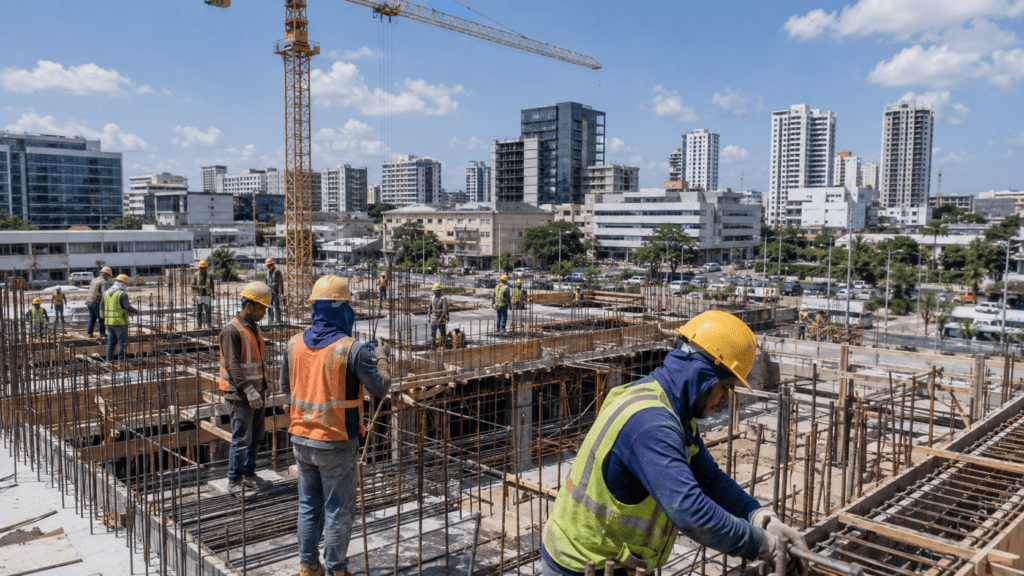
Before the COVID-19 shock, the Dominican Republic was already experiencing sustained economic expansion. Real GDP growth reached 7.1% in 2018 and 4.9% in 2019. The economy benefited from a combination of domestic consumption, investment, tourism, construction, services and manufacturing.
This period illustrates an important feature of Dominican growth: it has not depended on one activity alone. Tourism has generated foreign demand, construction has responded to investment and urban development, manufacturing has connected the country to international supply chains, while commerce and financial services have supported domestic demand.
The country’s ability to attract foreign direct investment has also contributed to productive capacity. Investment in tourism, manufacturing, mining, energy and other activities can increase output not only through the spending associated with the initial project but also through the additional production generated once the new assets begin operating.
The 2020 Collapse and the 2021 Rebound
The pandemic created an unusually sharp interruption. Real GDP contracted by 7.9% in 2020, according to World Bank data. The decline was closely associated with the disruption of economic activity and international travel, which was particularly important for a country with a large tourism industry.
The subsequent recovery was exceptionally rapid. Real GDP increased by 14.0% in 2021, followed by another 5.2% expansion in 2022. The 2021 figure partly reflects the mathematical effect of recovering from the unusually low level recorded during the previous year, so it should not be interpreted as a normal sustainable annual growth rate.
The rebound was supported by the reopening of economic activity, the recovery of tourism and domestic demand, stronger international conditions and the normalization of sectors that had been heavily affected by the pandemic. The speed of the recovery demonstrated the economy’s capacity to reactivate production when mobility, demand and international travel returned.
Why Growth Slowed in 2023
After the post-pandemic rebound, growth slowed markedly. Real GDP expanded by only 2.2% in 2023, compared with 5.2% in 2022. The slowdown was part of a normalization process after the exceptional post-pandemic rebound, but tighter financial conditions and weaker momentum in domestic demand also played a role.
Higher interest rates can affect economic growth because they make borrowing more expensive. Households may postpone credit-financed purchases, while companies may delay investment projects whose expected returns no longer justify higher financing costs. The effects can spread through construction, commerce, real estate and other interest-sensitive activities.
External conditions also matter. The Dominican Republic is highly integrated into international tourism, trade and financial flows, so weaker global demand or tighter international financial conditions can affect domestic activity even when local economic fundamentals remain relatively strong.
The 2024 Recovery
The economy returned to 5.0% real GDP growth in 2024. The Central Bank described this as growth around the economy’s potential and identified strong performance in services as a major factor. Services grew 5.5%, with hotels, bars and restaurants expanding 9.6%, financial services 8.3% and commerce 5.5%. Local manufacturing and free-zone manufacturing both grew 4.3%.
The composition of that growth is important. A recovery driven by a broad group of activities is different from one dependent on a single temporary boost. In 2024, tourism-related activity, financial services, commerce and manufacturing all contributed to the expansion, showing how domestic demand and internationally connected services can reinforce one another.
Monetary conditions also became more supportive as inflation moderated. Consumer-price inflation ended 2024 at approximately 3.35%, within the Central Bank’s target range of 4% plus or minus 1 percentage point. More stable inflation creates room for financial conditions to become less restrictive, although monetary policy affects economic activity with a lag.
Why Growth Slowed Again in 2025
The economy expanded by 2.1% in 2025, considerably below the 5.0% recorded in 2024. The Central Bank’s data show the slowdown clearly, while the International Monetary Fund reported 3.0% growth in its November 2025 Article IV projection rather than the later observed outcome. The distinction is important: forecasts and realized GDP growth should not be treated as interchangeable.
The 2025 slowdown followed the strong 2024 rebound and reflected softer economic momentum. It does not mean that the economy entered a recession. Rather, production continued to increase, but at a much slower pace than the year before.
The Central Bank’s data also show that the slowdown was followed by a renewed acceleration during the first half of 2026, when real GDP growth reached 4.5% year over year. That recovery provides another illustration of how quickly Dominican growth can change as domestic and external conditions shift.
What Has Driven Dominican Economic Growth?
There is no single explanation for the Dominican Republic’s growth record. Its performance has resulted from several mutually reinforcing drivers.
Domestic Consumption
Household consumption is one of the most important sources of domestic demand. When employment and household income increase, consumers spend more on food, housing, transportation, telecommunications, restaurants, retail goods and other services.
Remittances strengthen this channel. Money sent by Dominicans living abroad enters household budgets and can support consumption, housing investment, education and other spending. World Bank data show personal remittances received by the Dominican Republic were equivalent to about 9% of GDP in 2024.
Consumption can therefore support growth even when export performance is not the main source of momentum. But consumption alone does not explain long-term productivity growth; sustained development also requires investment and improvements in productive capacity.
Tourism
Tourism is a major growth engine because it brings foreign demand directly into the domestic service economy. International visitors purchase hotel rooms, meals, transportation, entertainment, excursions and other services. Hotels and tourism businesses also purchase inputs from domestic suppliers.
The sector’s influence extends into construction, agriculture, commerce, transportation and financial services. When international tourism expands, the effects can therefore reach businesses that are not themselves classified as tourism companies.
Investment
Investment increases the economy’s capacity to produce. New factories, hotels, energy infrastructure, commercial buildings, machinery and technology can all raise future output.
Foreign direct investment is particularly relevant because it can bring not only capital but also technology, management expertise and access to international distribution networks. The Dominican Republic has attracted substantial investment into tourism, manufacturing, energy, mining and real estate.
Domestic investment matters just as much. A Dominican company that expands a factory, opens a new store or purchases more efficient equipment is increasing productive capacity from within the economy.
Services
Services have become the largest and broadest component of economic activity. The 2024 recovery demonstrated their importance: according to the Central Bank, services grew 5.5%, led by hotels, bars and restaurants, financial services and commerce.
The strength of services also makes the Dominican economy less dependent on traditional commodity production. Financial services, telecommunications, transportation, commerce and professional activities can grow alongside tourism and manufacturing.
Manufacturing and Free Zones
Manufacturing contributes to growth by increasing domestic production and connecting the Dominican Republic to international supply chains. Free-zone companies are particularly important because they produce primarily for external markets.
The diversification of free-zone production has also changed the nature of this growth engine. Medical devices, pharmaceuticals, electrical products, footwear and other manufactured goods have expanded alongside traditional industries such as textiles and tobacco-related production.
Exports
Exports contribute to growth by bringing foreign demand into the economy. Merchandise exports include manufactured products, agricultural goods and minerals, while tourism functions as a major export of services.
Export growth can produce a particularly powerful effect when it encourages companies to expand productive capacity. A factory receiving more foreign orders may invest in machinery and hire workers, while tourism demand can encourage hotel construction and additional service capacity.
Why the Dominican Republic Has Grown Faster Than Much of the Region
Comparing growth rates helps put the Dominican performance into perspective. The World Bank’s April 2026 regional outlook reported Dominican real GDP growth of 5.0% in 2024, compared with 2.8% in Chile, 1.5% in Colombia, 1.4% in Mexico, 2.9% in Panama and 3.5% in Peru. The comparison shows that the Dominican Republic was among the faster-growing larger economies in Latin America that year.
| Economy | Real GDP growth, 2024 |
|---|---|
| Dominican Republic | 5.0% |
| Chile | 2.8% |
| Colombia | 1.5% |
| Mexico | 1.4% |
| Panama | 2.9% |
| Peru | 3.5% |
Comparisons need to be interpreted carefully because countries have different economic structures and can be affected by very different shocks. Panama’s economy, for example, is strongly influenced by the Canal and logistics, while Chile and Peru are more exposed to commodity cycles. Mexico is much larger and more integrated into North American manufacturing. A higher growth rate does not automatically mean that one economy is more developed or that its population has a higher standard of living.
The Role of Productivity in Long-Term Growth
Strong growth over several decades cannot be explained only by putting more people to work or building more hotels. Productivity is essential: it measures how efficiently labor and other resources are transformed into economic output.
Productivity can increase when workers acquire better skills, companies adopt new technologies, infrastructure improves, logistics become more efficient or businesses become better organized. It can also rise when capital is allocated toward more productive activities.
This is one reason the Dominican growth story has evolved beyond agriculture toward services, manufacturing, tourism and other higher-value activities. The structural shift allows the economy to produce more with a broader combination of skills, capital and technology.
Why Growth Does Not Always Feel the Same to Everyone
A 5% increase in real GDP does not mean that every household earns 5% more. GDP is a measure of total production, not an equal distribution of income.
Different sectors can grow at very different rates. Tourism may expand rapidly while agriculture faces a difficult season. Construction can weaken while financial services remain strong. A household whose income depends on a growing sector may experience the expansion differently from one whose employer is under pressure.
Population growth also matters. If GDP grows faster than the population, output per person generally rises; if population grows at a similar rate, the improvement in GDP per capita can be much smaller. For that reason, GDP per capita and productivity are useful complements to headline GDP growth.
Growth Versus GDP Per Capita
Economic growth is often discussed in terms of total GDP, but international comparisons become more meaningful when population is considered. The Dominican Republic’s population has grown over time, so part of the increase in total production reflects a larger number of people participating in the economy.
World Bank data show nominal GDP per capita of about US$10,876 in 2024. The same source reports population growth of about 0.8% that year. Because the GDP-per-capita figure is measured at current prices, however, it should not be used as a direct substitute for real GDP-per-capita growth.
The distinction is important for understanding living standards. A country can record rapid total GDP growth while the gain in output per person is smaller. Long-term improvements in living standards depend on sustained increases in real output per person, productivity, employment quality and access to economic opportunities.
Why Growth Can Accelerate or Slow So Quickly
The Dominican economy responds to several variables at once. Domestic interest rates influence borrowing and investment. International interest rates affect financial conditions and capital flows. Tourism depends on international travel. Remittances depend partly on economic conditions in countries where Dominican migrants live. Manufacturing depends on foreign demand and global supply chains. Commodity prices affect mining and import costs.

Because these forces interact, a change in one area can reinforce or offset another. Strong tourism can support growth even when manufacturing is weak. Higher interest rates can slow construction while strong exports support industrial production. Lower inflation can improve household purchasing power and create room for monetary easing.
This explains why annual GDP growth should be interpreted as the result of several simultaneous forces rather than as the consequence of a single sector.
What Could Sustain Growth Over the Long Term?
The country’s long-term growth prospects depend on whether it can continue increasing productivity while preserving macroeconomic stability. Investment in infrastructure, education, energy, digital connectivity and human capital can expand productive capacity.
Further diversification can also reduce dependence on any single source of foreign income. Expanding advanced manufacturing, strengthening domestic suppliers to tourism and free zones, improving agricultural productivity and developing higher-value services can create additional growth channels.
Maintaining access to international markets is equally important. Trade agreements, logistics infrastructure and a stable investment environment allow Dominican companies to reach larger markets and encourage foreign companies to establish productive operations in the country.
The World Bank’s April 2026 outlook projected Dominican real GDP growth of 3.6% for 2026 and 4.4% for 2027. These are forecasts rather than guaranteed outcomes, but they illustrate the expectation that growth can return toward a stronger medium-term pace after the 2025 slowdown.