 22°C
22°C

What Documents Do You Need To Import Or Export From The Dominican Republic?
International trade in the Dominican Republic requires more than a commercial invoice and a transport document. Importers and exporters may need customs declarations, invoices, bills of lading or air waybills, certificates of origin, permits, sanitary or phytosanitary certificates and other documents depending on the merchandise, transport method and destination market. The exact documentation is determined by the nature and classification of the goods and, for exports, by the requirements of the destination country.


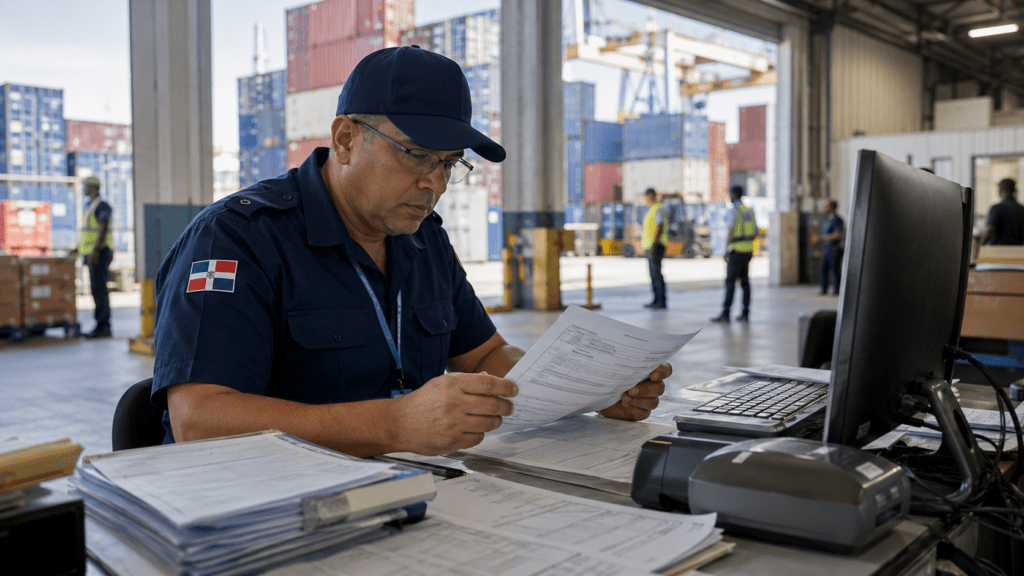
The Dirección General de Aduanas (DGA) is the Dominican Republic’s main customs authority. Its customs procedures require supporting documentation for import and export declarations, while specialized government agencies may require additional certificates or permits for regulated products. The documentation should be prepared before the shipment is presented for clearance.
Commercial Documents
Commercial Invoice
The commercial invoice identifies the seller, buyer, merchandise, quantities and transaction value. It is a fundamental document for customs valuation and is required to support the Dominican customs declaration. The DGA states that the commercial invoice and the transport document are required for the Declaración Única Aduanera (DUA).
For exports, the DGA also requires the original commercial invoice when the shipment results from an international sale of merchandise. In certain non-sale situations, such as personal effects, donations or some temporary shipments, a packing list containing the characteristics and estimated value may be used instead.
Packing List
The packing list provides a detailed breakdown of the shipment, including packages, quantities and the identification of the goods. It is particularly useful when customs or the carrier needs to verify the physical contents of a shipment against the commercial documentation. For certain exports that are not based on a sale, the DGA expressly allows a packing list with the goods’ characteristics and estimated value to support the declaration.
Customs Documents
Declaración Única Aduanera (DUA)
The Declaración Única Aduanera (DUA) is the electronic customs declaration used to provide information about an import or export operation through the DGA’s system. It identifies the merchandise and the relevant customs information needed for clearance.
For an import declaration, the DGA identifies the commercial invoice and the bill of lading or air waybill as core supporting documents. Export declarations can require additional documents depending on the merchandise and applicable regime.
Transport Documents
Bill of Lading (B/L)
A Bill of Lading (B/L) is the principal transport document for maritime cargo. It identifies the shipment and provides the information used to connect the merchandise with the carrier and the transport operation. The DGA requires a bill of lading or equivalent transport document to support customs declarations for maritime shipments.
Air Waybill (AWB)
An Air Waybill (AWB) serves the corresponding function for air cargo. It identifies the shipment, carrier and transport details and is used as supporting documentation for customs clearance. The DGA specifically recognizes an AWB as an alternative to a B/L for the relevant transport operations.
Other Transport Documents
Depending on the transport mode and operation, other transport documents may be used. Dominican customs documentation refers to bills of lading, air waybills and other transport documents, while consolidated cargo can involve both a master transport document and a house document issued by the consolidator.
Certificates And Proof Of Origin
Certificate of Origin
A Certificate of Origin establishes the origin of merchandise when an applicable trade agreement or customs procedure requires it. It can be especially important when the importer seeks preferential tariff treatment under a trade agreement such as DR-CAFTA. The DGA identifies the certificate of origin as a supporting document when applicable.
The certificate should not be confused with the commercial invoice. The invoice documents the commercial transaction, while the certificate of origin addresses the regulatory origin of the goods for purposes established under the applicable trade regime.
Phytosanitary And Zoosanitary Certificates
A phytosanitary certificate may be required for plants and products of plant origin, while a zoosanitary certificate may apply to animals and products of animal origin. These documents demonstrate compliance with agricultural health requirements and are issued or controlled by the competent authorities.
ProDominicana identifies commercial invoice, export declaration, certificate of origin, transport document and phytosanitary certificate among the basic export documents, while noting that requirements depend on the product and destination market.
Permits, Licenses And Certificates Of No Objection
Some goods require documents beyond the standard customs package. Depending on the product, an importer or exporter may need a permit, license, sanitary certificate, phytosanitary or zoosanitary authorization, certificate of no objection or other regulatory approval.
The DGA’s export rules expressly require permits, certificates, certificates of no objection or licenses when they are applicable to the merchandise or customs regime.
For example, regulated medical products can require documentation from the health authorities, while agricultural products may require agricultural health certificates. The DGA’s SIREVUCE system provides product-specific information on documents and regulatory procedures; one current example lists a commercial invoice, technical information, sanitary registration and transport document for a regulated medical-product importation.
Documents That Depend On The Operation
| Document | When it is used |
|---|---|
| Commercial invoice | International sale of merchandise; supports customs valuation and the customs declaration. |
| Packing list | Detailed identification of packages and contents; particularly useful for customs and transport verification. |
| DUA | Required customs declaration for imports and exports through the DGA system. |
| Bill of Lading | Maritime shipments. |
| Air Waybill | Air shipments. |
| Certificate of Origin | When origin must be demonstrated, including where preferential tariff treatment is claimed. |
| Phytosanitary certificate | Applicable agricultural products of plant origin. |
| Zoosanitary certificate | Applicable animals and products of animal origin. |
| Permit, license or certificate of no objection | Regulated products or special customs regimes requiring authorization. |
Export Documentation Also Depends On The Destination
Exporters should distinguish between documents required by the Dominican Republic and documents required by the destination country. ProDominicana notes that export requirements depend both on the characteristics and nature of the product and on the market to which it will be shipped.
This means that a Dominican exporter may satisfy the country’s customs requirements but still need additional documentation requested by the importing country, such as a particular origin certificate, sanitary certificate, product registration or other market-specific document.
Checking The Documentation Before Shipment
The most reliable approach is to identify the product’s tariff classification and determine its regulatory requirements before the goods leave the country of origin. The DGA’s SIREVUCE platform provides product-specific regulatory information, while VUCE is used for various foreign-trade procedures involving government agencies.
The basic document set should therefore be treated as a starting point rather than a universal checklist. A straightforward commercial shipment may need only the standard commercial, customs and transport documents, while food, medicines, agricultural goods, chemicals, animals or other regulated products can require additional certificates or permits.