 22°C
22°C

What You Can’t Import Into the Dominican Republic — And What Requires Special Permits
Importing goods into the Dominican Republic is not simply a matter of declaring a shipment and paying customs duties. Certain products cannot legally enter the country at all, while others may be imported only after obtaining permits, sanitary registrations, licenses, certificates of no objection or other approvals from the competent authority. The Dirección General de Aduanas (DGA), the Dominican customs authority, coordinates border control with agencies responsible for health, agriculture, the environment, telecommunications, taxation, public security and other regulated sectors. The distinction matters because an importer who treats a restricted product as an ordinary commercial good can face detention of the shipment, re-export requirements, administrative penalties, seizure and, in serious cases, criminal proceedings.


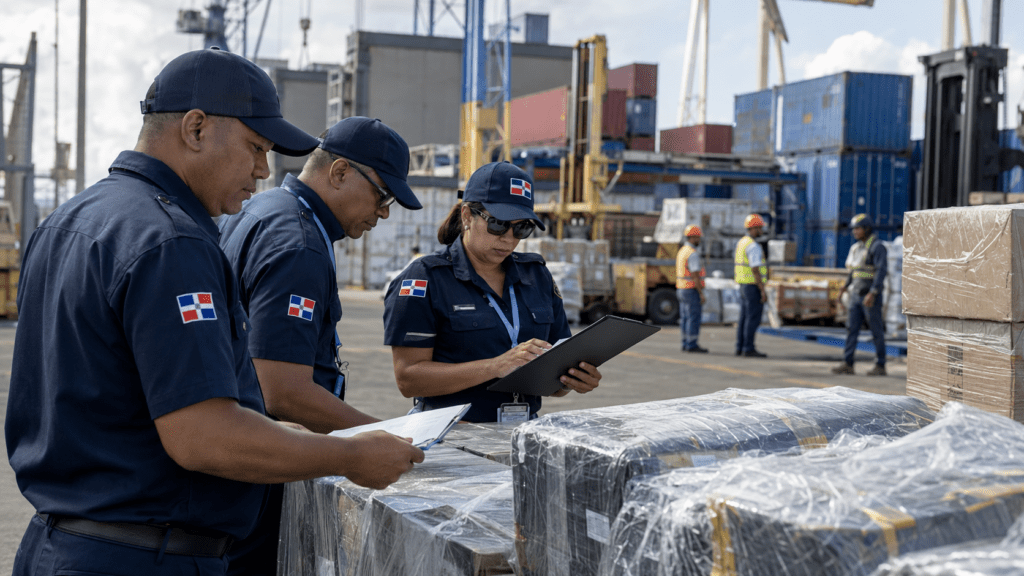
Dominican import rules divide controlled merchandise into several practical categories. Some goods are prohibited because their entry is not authorized under the applicable law. Others are restricted: they may enter, but only when the importer satisfies requirements imposed by the authority responsible for that product. A third group consists of goods that may require a special license, sanitary registration, certificate, prior authorization or certificate of no objection before customs can release them.
The distinction is particularly important because customs clearance does not replace the regulatory approval required by another government agency. The Dirección General de Aduanas (DGA) administers customs control, but the agency that regulates the product may have to approve the importation before the goods can be released. Dominican customs expressly recognizes restricted merchandise as goods whose import or export requires a permit, no-objection document, certification, procedure, special license or authorization from a competent government body.
How Prohibited, Restricted And Controlled Goods Differ
A prohibited import is a product whose entry is barred by the applicable Dominican legislation. A restricted import is different: the product itself is not necessarily banned, but its entry is conditional on compliance with regulatory requirements. The same broad category can therefore contain both lawful and unlawful imports depending on the product, its composition, intended use, quantity, origin and applicable authorization.
This distinction explains why there is no single universal list that can safely answer every import question. A product’s tariff classification and description may trigger requirements from one or several authorities. The DGA’s Sistema de Información Regulatoria de la Ventanilla Única de Comercio Exterior (SIREVUCE) was created to help importers identify requirements by tariff subheading and product description, including sanitary and administrative measures.
In practice, an importer should determine the product’s regulatory status before shipment, rather than waiting for customs to identify a missing permit at the port or airport. A customs declaration, commercial invoice and payment of duties do not cure the absence of a mandatory license or regulatory approval.
Weapons, Ammunition And Security-Related Goods
Firearms, ammunition and related articles are among the most sensitive categories. Dominican customs identifies firearms, narcotics, psychotropic substances, contaminating substances and other goods affecting national security as prohibited or restricted articles for travelers.
Dominican legislation also imposes a specific prohibition on the importation of firearms, their parts and corresponding ammunition for trade with private individuals. Decree No. 309-06 places responsibility for enforcing that prohibition on the authority responsible for interior and police matters.
This means that a private importer should not assume that a firearm or ammunition purchased legally in another country can simply be shipped to the Dominican Republic and declared at customs. The regulatory treatment is materially different from that of ordinary consumer merchandise.
Other military, security or controlled equipment may involve additional authorities depending on the nature and intended use of the goods. Where a product is controlled under a special law, customs clearance is therefore only one part of the process.
Narcotics, Psychotropic Substances And Controlled Drugs
Narcotic drugs and psychotropic substances are subject to a substantially stricter regime than ordinary medicines. The distinction between an ordinary pharmaceutical product and a controlled substance can be legally significant even when both are intended for legitimate medical use.
For medicines subject to controlled-drug rules, DIGEMAPS — the Dirección General de Medicamentos, Alimentos y Productos Sanitarios, within the Ministry of Public Health — identifies circumstances in which a valid Class B controlled-drug permit and an import permit under Law 50-88 must be presented.
Consequently, a foreign prescription, pharmacy receipt or ordinary commercial invoice should not be treated as a substitute for a Dominican authorization when the product falls within the controlled-drug regime.
Medicines, Medical Products And Health-Regulated Goods
Medicines and other products intended for human health are regulated principally through the Dominican health authorities. DIGEMAPS administers sanitary registration requirements for medicines, medical products, cosmetics and other regulated products.
For imported medicines, the sanitary-registration process can require documents such as a current certificate of free sale from the country of origin, manufacturing certificates, powers of representation and, where applicable, controlled-drug permits and import permits.
The requirement is broader than simply obtaining permission for one shipment. A sanitary registration may be a prerequisite for the lawful importation and commercialization of the product in the Dominican market. DIGEMAPS states that sanitary registration is mandatory for the importation, storage, transportation, distribution and use of the regulated products covered by its procedures.
Importers should therefore distinguish between personal medication carried by a traveler and a commercial importation intended for distribution. The applicable requirements can differ significantly depending on quantity, product classification and intended use.
Food And Beverages
Food products are not automatically prohibited, but many are subject to sanitary controls before they can be commercially imported. DIGEMAPS provides a specific sanitary-registration procedure for imported food and beverages. The documentation can include a certificate of free sale from the country of origin, information about the importer or local representative, product composition, manufacturing information, compliant labeling and samples for analysis.
The regulatory burden therefore depends on the type of food and how it will enter the country. A packaged food sold commercially is not necessarily treated in the same way as food carried by a traveler for personal consumption.
The DGA’s traveler guidance specifically states that food products must be declared and that their control can fall within the responsibilities of health, plant-health or animal-health authorities, depending on the product.
Plants, Seeds, Fruits And Other Plant Products
Plants and products of plant origin are controlled primarily to prevent the introduction of pests, diseases and other threats to Dominican agriculture. The Ministry of Agriculture, through its plant-health authorities, establishes the phytosanitary conditions applicable to products originating in particular countries.
The Ministry’s import procedure states that the applicant must obtain information on the phytosanitary conditions applicable to the product and that, through the Ventanilla Única de Comercio Exterior (VUCE), the plant-health division may issue a phytosanitary no-objection guide and, when appropriate, an import authorization.
This category can include seeds, live plants, fruits, vegetables, plant materials and other agricultural products. Requirements vary according to the commodity and country of origin, which is why a product that is routinely admitted from one origin may face different conditions from another.
Travelers should pay particular attention to fresh agricultural products. The DGA specifically lists plants and agricultural products among goods subject to regulation by the Ministry of Agriculture.
Animals, Animal Products And Wildlife
Live animals and products of animal origin may require veterinary or sanitary controls before importation. The regulatory framework can apply to both the animal itself and products, parts or derivatives originating from animals.
Wildlife introduces an additional layer of regulation. The Ministry of Environment and Natural Resources administers permits and no-objection procedures for protected species and species regulated under the Convention on International Trade in Endangered Species of Wild Fauna and Flora (CITES).
For CITES-regulated specimens, the Dominican environmental authority’s import procedure requires an original CITES export certificate from the country of origin, technical inspection at the port of entry and a corresponding Dominican import permit. The environmental permit does not replace the phytosanitary or zoosanitary authorization issued by the agricultural authorities.
The environmental legislation also prohibits the introduction of exotic species that could become invasive or otherwise harm ecosystems, native species, human health or the country’s economy.
This is an important example of why one product may require more than one approval. A protected animal or plant can simultaneously be subject to environmental, phytosanitary or zoosanitary controls.
Alcohol, Tobacco And Electronic Cigarettes
Alcoholic beverages, tobacco products and electronic cigarettes are subject to special tax and regulatory controls. The Dirección General de Impuestos Internos (DGII) administers the importer licensing regime for these products in addition to the customs requirements applicable at the border.
The DGII’s current service for an importer license covers alcoholic beverages, tobacco products and electronic cigarettes. The licensing framework requires the importer to satisfy tax-registration and compliance conditions, and the authorization is separate from ordinary customs clearance.
For alcoholic products, product-level authorization can also require sanitary registration, brand documentation, product labels and a certificate of free sale from the country of origin. The DGII’s published requirements show that importers may need to obtain approval for the specific products they intend to import.
The tax authorities also apply fiscal-control mechanisms to certain alcohol and tobacco imports. These can include requirements relating to warehouses, security controls, fiscal seals and controls at release.
For travelers, ordinary duty-free allowances do not eliminate the possibility of regulatory controls. The DGA’s traveler guidance establishes specific limits for alcohol and tobacco and separately identifies prohibited or restricted merchandise.
Chemicals, Hazardous Substances And Environmental Controls
Chemicals are another category in which the product may be importable only after regulatory review. The Ministry of Environment and Natural Resources provides a specific certificate of importation of chemical substances for products or substances that are not prohibited in the Dominican Republic but require authorization before customs clearance.
The application can require a safety data sheet and, depending on the substance, authorization or permits from the Ministry of Public Health, Ministry of Agriculture or Ministry of Defense. Environmental authorities evaluate hazardous, toxic or convention-controlled substances against the applicable list of prohibited or restricted chemicals.
This means that the commercial name of a chemical is not enough to establish whether it can be imported. Its composition, concentration, intended use and regulatory classification may determine which authority must approve it.
Fertilizers can also require a separate environmental authorization. The Ministry of Environment describes this procedure as a certificate of no objection for the importation of fertilizer substances that are not prohibited domestically or internationally.
Hazardous Waste And Secondary Raw Materials
Hazardous waste is subject to particularly strict environmental restrictions. Dominican Law No. 225-20 provides that hazardous waste may not be imported into the country for treatment or confinement. The law also requires illegally imported waste to be returned to its country of origin within a prescribed period, with the responsible company bearing the return costs.
Other categories of waste and secondary raw materials may be subject to authorization and conditions rather than an absolute prohibition. The Ministry of Environment can impose limitations and require financial guarantees or insurance to cover potential environmental damage and related contingencies.
The distinction is crucial for companies dealing with recyclable materials, industrial by-products or waste streams. A material described commercially as recyclable does not automatically escape the legal definition or regulatory controls applicable to waste.
Telecommunications And Radio Equipment
Telecommunications equipment is subject to technical regulation by the Instituto Dominicano de las Telecomunicaciones (INDOTEL). Under the General Telecommunications Law, terminals, equipment or systems capable of connecting directly or indirectly to a public telecommunications network, or using the public radio spectrum, generally require the corresponding certificate of homologation.
The law also establishes homologation as a requirement for commercialization of telecommunications equipment in the Dominican Republic. Equipment intended to use radio spectrum is subject to particular technical controls.
This can affect products that consumers might otherwise regard as ordinary electronics, including certain radio transmitters, telecommunications terminals and other equipment capable of connecting to public networks. Importers should therefore verify whether the specific model requires homologation before shipment.
The DGA has also warned travelers about non-homologated equipment among products subject to restrictions, reinforcing the fact that personal carriage does not necessarily eliminate technical requirements.
Counterfeit And Intellectual-Property-Infringing Goods
Customs control also extends to goods suspected of infringing intellectual-property rights. The customs regulations identify merchandise that is allegedly infringing intellectual-property rights among categories that can be subject to customs intervention.
This can include counterfeit branded products, unauthorized reproductions and other goods whose importation raises intellectual-property concerns. The issue is separate from whether customs duties have been paid: paying the applicable taxes does not legalize a counterfeit product.
Importers dealing in branded merchandise should therefore maintain documentation showing the lawful origin of the goods and, where relevant, authorization from the rights holder or legitimate supply chain documentation.
Used Vehicles And Other Specifically Regulated Goods
Some restrictions apply to particular products because of their age, condition or characteristics rather than because the product category is inherently prohibited. The DGA states, for example, that Dominican law prohibits the importation of used vehicles more than five years old, using a specific calendar calculation for determining the vehicle’s age.
Used goods can also be subject to special controls under trade agreements, customs legislation or sector-specific rules. Historical trade documentation, for example, identifies used clothing and used tires among products subject to specified import controls in the relevant trade framework.
Because product restrictions can change according to legislation and trade commitments, an importer should verify the exact tariff classification and current regulatory treatment rather than relying on a generic description such as “used goods.”

Who Can Intervene At The Border?
The Dirección General de Aduanas is the principal border-control authority for customs purposes. Its role includes examining declarations, verifying documentation, inspecting shipments and enforcing customs legislation. However, regulated merchandise frequently requires the intervention of another government authority.
| Category | Potential authority | Typical control or authorization |
|---|---|---|
| Medicines and health products | Ministry of Public Health / DIGEMAPS | Sanitary registration, import authorization or controlled-drug permit where applicable |
| Food and beverages | Ministry of Public Health / DIGEMAPS | Sanitary registration and supporting documentation |
| Plants and plant products | Ministry of Agriculture | Phytosanitary requirements and import authorization |
| Animals and animal products | Ministry of Agriculture | Veterinary, zoosanitary or quarantine controls |
| Protected wildlife and CITES specimens | Ministry of Environment | Environmental import permit, CITES documentation and inspection |
| Chemicals and hazardous substances | Ministry of Environment and, depending on the product, other ministries | Certificate or authorization for importation |
| Alcohol, tobacco and electronic cigarettes | DGII | Importer license and product-specific controls |
| Telecommunications equipment | INDOTEL | Homologation certificate where required |
| Firearms and ammunition | Security authorities and customs | Highly restricted authorization regime; commercial importation for private individuals is prohibited under applicable rules |
| Hazardous waste | Ministry of Environment | Import restrictions and environmental authorization; hazardous waste for treatment or confinement is prohibited |
The table is a practical guide rather than a substitute for product-specific classification. A single shipment can involve multiple authorities. A chemical used in agriculture, for example, can potentially trigger environmental and agricultural controls in addition to customs requirements.
The Role Of VUCE And SIREVUCE
The Ventanilla Única de Comercio Exterior (VUCE) is an important mechanism for managing import and export authorizations. The Ministry of Agriculture uses VUCE for phytosanitary import procedures, while other government agencies use the broader system for regulated trade procedures.
The DGA’s SIREVUCE provides regulatory information by tariff subheading and product description, including applicable permits and sanitary or administrative measures.
This makes the system particularly useful before a shipment leaves the exporting country. Instead of waiting for a customs officer or courier company to identify a problem, an importer can determine which approvals are associated with the merchandise and prepare the documentation in advance.
What Happens When A Required Permit Is Missing?
The most immediate consequence is often retention or objection to customs clearance. The DGA states that courier shipments may be held when a special permit is required, including permits from the Ministry of Public Health, Ministry of Agriculture or INDOTEL.
A shipment may therefore remain in customs custody while the importer attempts to satisfy the applicable requirement. Whether the missing authorization can be obtained after arrival depends on the particular regulation. Some products cannot simply be regularized after importation, especially where the underlying law prohibits their entry.
For merchandise that cannot legally remain in the country, customs law provides mechanisms for re-export. The Law on Customs includes an infraction relating to failure to re-export goods whose importation is prohibited within the period granted by the DGA.
Seizure, Fines And Criminal Liability
The consequences become considerably more serious when the conduct amounts to an customs offense rather than a simple documentation problem. Law No. 168-21 establishes categories of customs crimes including contraband, customs fraud, unlawful removal of customs-secured goods, document falsification and other offenses.
Under the law, customs fraud can result in a fine calculated in relation to unpaid customs taxes, with additional criminal consequences in circumstances involving prohibited, restricted, controlled, falsified or adulterated goods, or products connected with illicit trade or risks to national security, health or the environment.
Contraband is treated separately. The law defines contraband broadly to include introducing or removing merchandise while evading customs control and identifies prohibited or restricted merchandise among circumstances that can constitute customs contraband. The statutory penalties can include imprisonment and a fine based on the value of the merchandise.
Importantly, the legal exposure is not necessarily limited to the person who physically carries the goods across the border. The customs law addresses conduct involving the transportation, sale, storage, acquisition, concealment and other handling of merchandise that has not complied with customs control.
The DGA also has authority to administer the confiscation of certain regulated or restricted merchandise where the legal conditions for administrative confiscation are satisfied. The agency specifically identifies alcoholic beverages, tobacco products and fuels among examples covered by the relevant customs framework.
Why Commercial Imports Require More Planning Than Personal Luggage
Travelers and commercial importers do not necessarily face identical requirements. The DGA’s traveler manual establishes specific allowances and declaration rules for personal luggage, gifts, food, medicines, alcohol, tobacco and other articles. Commercial quantities, however, can trigger customs and regulatory procedures that do not apply to an ordinary passenger carrying a limited personal quantity.
This distinction is particularly important for people sending merchandise through courier services. A package that looks like an ordinary consumer shipment can be held if its contents require a permit or if the quantity suggests a commercial purpose. The DGA expressly lists commercial quantities and shipments requiring special permits among situations that can receive additional customs treatment.
Documents Importers Should Verify Before Shipping
The exact documentation depends on the merchandise, but regulated imports commonly require more than a commercial invoice. Depending on the category, an importer may need a sanitary registration, import permit, phytosanitary authorization, zoosanitary documentation, environmental certificate, CITES documentation, tax license, product approval or telecommunications homologation.
For imported health products, authorities may also require foreign certificates to be legalized or apostilled, together with powers of representation and manufacturing or quality documentation.
For agricultural products, the Ministry of Agriculture requires applicants to provide documentation such as identification and a pro forma invoice and processes the applicable authorization through VUCE.
For chemicals, the environmental authority can require a safety data sheet and supporting authorizations from other ministries where applicable.
For CITES-regulated wildlife, the importer must pay particular attention to the original foreign export certificate and the Dominican import permit, as well as inspection at the entry point.
Common Import Errors To Avoid
One of the most common mistakes is assuming that a product is legal to import simply because it is legal to purchase in the country of origin. Dominican law applies its own prohibitions and regulatory controls, and a foreign retailer’s ability to sell a product says nothing by itself about whether it can be imported into the Dominican Republic.
Another frequent mistake is treating customs clearance as the same thing as regulatory approval. Customs can process the import declaration, but a specialized agency may still need to authorize the product. The DGA’s own guidance confirms that shipments can be retained specifically because a permit from another authority is missing.
A third error is relying on a product’s generic commercial name instead of its precise classification. Chemicals, medicines, agricultural products, telecommunications equipment and food products can have different requirements depending on their technical characteristics.
Finally, importers should not assume that a permit obtained for one product automatically covers another. The DGII, for example, states that importers wishing to bring in products not covered by their existing alcohol or tobacco authorization must obtain authorization for the additional products.
How To Check A Product Before Importing It
The safest approach is to establish the regulatory status of the merchandise before the supplier ships it. The first step is to identify the exact product, including its composition, model, intended use, quantity, country of origin and tariff classification.
- Identify the exact merchandise. Obtain the technical description, ingredients or composition, model number, intended use and commercial presentation.
- Determine the tariff classification. The tariff subheading can affect the applicable customs and regulatory requirements.
- Check SIREVUCE and VUCE. Use the available regulatory information to identify permits, sanitary measures and administrative requirements.
- Identify the competent specialized authority. Depending on the product, this may be DIGEMAPS, the Ministry of Agriculture, the Ministry of Environment, INDOTEL, DGII or another government institution.
- Obtain approvals before shipment when required. Do not assume that a missing authorization can always be obtained after the merchandise arrives.
- Prepare customs documentation. The regulatory authorization must be consistent with the commercial invoice, packing list, transport documents and customs declaration.
- Confirm whether the shipment is personal or commercial. Quantity and intended use can change the applicable treatment.
The DGA’s SIREVUCE system is particularly relevant because it was designed to consolidate regulatory information and allow importers and exporters to consult requirements by product and tariff classification.
Official Regulatory Sources
Import rules should be checked against the competent Dominican authorities because requirements vary by product and can change through laws, regulations, resolutions and administrative procedures.
- Dirección General de Aduanas (DGA) — customs rules, traveler requirements and customs procedures.
- Law No. 168-21 on Customs — principal customs legal framework.
- DGA Traveler Manual — personal luggage, declarations and restricted articles.
- DIGEMAPS — medicines, food, beverages, cosmetics and other sanitary-regulated products.
- Ministry of Agriculture VUCE — agricultural import requirements and phytosanitary procedures.
- Ministry of Environment and Natural Resources — environmental permits, chemicals, wildlife and waste controls.
- INDOTEL — telecommunications equipment and homologation.
- DGII — tax and licensing controls for alcohol, tobacco and related products.