 25°C
25°C

Dominican Republic Free Zones: The Jobs Powering a Growing Industrial Sector
Free trade zones are one of the Dominican Republic’s most important sources of formal employment, supporting more than 200,000 direct jobs by the end of 2025. Their labor footprint extends well beyond traditional manufacturing: tobacco, textiles, medical devices, electronics, business-process outsourcing and other services now account for large shares of employment, while women represent more than half of the workforce. The sector has also become more geographically diversified and more technically oriented, although average pay remains substantially different between production and technical occupations.


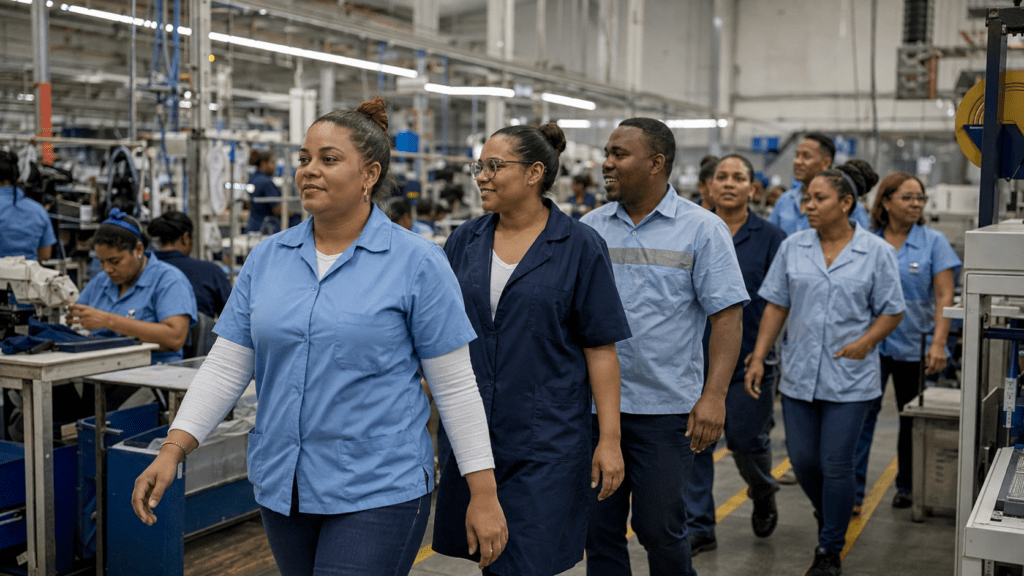
Free trade zones have played a central role in the Dominican Republic’s employment model for decades. Created to attract export-oriented investment, these industrial and service operations employ workers in manufacturing, logistics, business-process outsourcing, medical-device production, electronics, tobacco, apparel and other activities. By the end of 2025, the sector reported 200,231 direct jobs and 858 operating companies, according to the Consejo Nacional de Zonas Francas de Exportación (CNZFE), the government body responsible for regulating and promoting the free trade zone regime.
The scale of that workforce makes free trade zones an important source of formal employment, particularly in provinces where industrial activity is a major part of the local economy. At the same time, the composition of these jobs has changed significantly. The sector is no longer dominated exclusively by traditional factory positions: technical and administrative occupations have gained ground, while newer activities such as medical devices, electronics, logistics and export services have expanded.
How Many People Work in Dominican Free Trade Zones?
The Dominican Republic recorded 200,231 direct free trade zone jobs in December 2025, according to data supplied by the CNZFE to the Central Bank of the Dominican Republic. This represented a new high for the sector. The CNZFE’s 2025 statistical report also records 200,237 jobs in its detailed employment tables, a small difference resulting from the statistical series used in the report. For consistency, the annual headline figure of 200,231 is used here.
| Year | Direct jobs |
|---|---|
| 2022 | 192,461 |
| 2023 | 198,034 |
| 2024 | 198,552 |
| 2025 | 200,231 |
The longer-term picture is more revealing than the annual change. Employment stood at 146,535 in 2006 and fell sharply during the following years, reaching 110,728 in 2009. It subsequently recovered as the sector expanded into new industries and markets. By 2019, employment had reached 172,711. The COVID-19 shock pushed the broader employment series lower in 2020, but the recovery was rapid: the CNZFE reported 179,455 jobs in 2021, 187,869 in 2022, 193,344 in 2023 and 193,398 in 2024 in its occupational series.
The strongest recent rebound occurred after the pandemic. The CNZFE and government authorities reported that employment increased from 119,974 jobs in April 2020, the low point associated with the pandemic, to 200,134 in October 2025. That represents cumulative growth of about 67% over five years. The annual data therefore show not just a gradual expansion, but a substantial recovery followed by continued growth.
Where Are Free Trade Zone Jobs Located?
Free trade zone employment is distributed across several parts of the Dominican Republic, although the country’s northern industrial corridor and the Santo Domingo metropolitan area account for the largest concentrations.
| Region | Jobs in 2025 | Share |
|---|---|---|
| North | 73,931 | 36.9% |
| Ozama or Metropolitan | 71,014 | 35.5% |
| South | 32,267 | 16.1% |
| East | 23,025 | 11.5% |
The figures show a relatively broad geographic footprint. The North accounted for about 37% of employment, while the Ozama or Metropolitan region, which includes the National District and Santo Domingo province, accounted for another 35.5%. Together, these two areas represented roughly seven out of every 10 free trade zone jobs in 2025.
The South and East also have significant employment bases. The South accounted for 16.1% of jobs, while the East represented 11.5%. This distribution matters because free trade zones can provide formal employment in areas where the industrial base is otherwise narrower than in the country’s largest urban centers.
Santiago is particularly important within the northern region. The CNZFE’s historical provincial data show that Santiago has long been one of the country’s largest free trade zone employment centers. San Cristóbal, Santo Domingo, San Pedro de Macorís, La Romana and other provinces also have substantial concentrations.
The sector can be especially important relative to the size of local formal labor markets. A CNZFE-reported study based on data from the tax authority and the free trade zone council found that free trade zone companies accounted for 54.2% of formal employment in San Cristóbal, 42.6% in Barahona, 41% in San Pedro de Macorís, 25.7% in Santiago, 25.8% in Hato Mayor and 24.1% in La Vega. These figures illustrate why the sector’s importance cannot be measured only by its national job total.
What Types of Jobs Do Free Trade Zones Provide?
The occupational structure has changed substantially over time. Traditional production workers still make up the largest category, but technical and administrative positions have become much more important.
| Occupation | 2024 jobs* | Share |
|---|---|---|
| Production workers | 122,564 | 63.4% |
| Technicians | 49,025 | 25.3% |
| Administrative staff | 21,809 | 11.3% |
*The CNZFE occupational table excludes employment reported for free trade zone operators, so these figures should not be treated as a complete count of all sector employment.
In 2024, production workers accounted for 63.4% of the occupational total, technicians for 25.3% and administrative employees for 11.3%. This represents a major structural change from 2004, when production workers accounted for 86% of employment. Over the same period, the share of technical positions increased from 9.1% to 25.3%, while administrative employment rose from 4.9% to 11.3%.
The change is significant because it indicates that employment growth has not simply meant adding more traditional assembly-line positions. The expansion of medical-device manufacturing, electronics, global services, logistics and other more technically demanding operations has increased demand for workers with specialized skills.
Which Industries Employ the Most Workers?
The sector’s employment base is highly diversified compared with the traditional image of Dominican free trade zones as primarily textile factories. The CNZFE’s 2025 data show several major employment clusters.
| Activity | Jobs in 2025 | Share |
|---|---|---|
| Tobacco and derivatives | 38,622 | 19.3% |
| Call centers/BPO | 37,218 | 18.6% |
| Apparel and textiles | 34,321 | 17.1% |
| Medical and pharmaceutical products | 33,454 | 16.7% |
| Electrical and electronic products | 10,216 | 5.1% |
| Services | 8,749 | 4.4% |
| Footwear and components | 5,782 | 2.9% |
| Plastic products | 5,544 | 2.8% |
| Agro-industrial products | 5,416 | 2.7% |
Tobacco and its derivatives were the largest employment category in 2025, with 38,622 jobs. This was followed closely by call centers and business-process outsourcing, with 37,218 jobs, and apparel and textiles, with 34,321.
Medical and pharmaceutical manufacturing employed another 33,454 people. Its importance is notable because medical-device manufacturing is one of the activities associated with the sector’s shift toward higher-value production. Electrical and electronic products employed more than 10,000 people, while services, footwear, plastics and agro-industrial products each represented smaller but significant employment pools.
The combined figures for tobacco, BPO, apparel and textiles, and medical and pharmaceutical products show that the four largest activities alone accounted for more than 70% of reported sector employment in 2025. At the same time, the presence of numerous smaller activities gives the labor market a broader industrial base.
Women Represent More Than Half of the Workforce
Women are a particularly important part of free trade zone employment in the Dominican Republic. The CNZFE’s 2025 regional table records 106,827 female workers and 93,410 male workers, making women slightly more than half of the reported workforce.
Government and CNZFE communications have summarized this as approximately 54% of sector employment being held by women, or more than 106,000 workers. The gender balance varies substantially by occupation and industry. In the 2024 occupational data, for example, women held 76,295 of the 122,564 production jobs, while men accounted for the larger share of technical positions.
This occupational pattern helps explain why the gender composition of the sector differs from that of the wider private labor market. Free trade zones have historically created large numbers of production jobs suitable for workers entering formal manufacturing employment, while the expansion of technical occupations has increased demand for more specialized skills.
What Are Free Trade Zone Salaries?
The CNZFE publishes average weekly wages for production workers and technicians. These figures provide a useful sector-level reference, although they should not be interpreted as a universal wage for every employee. Pay varies by occupation, industry, employer, location, experience and skill level.
| Year | Average weekly wage — production workers | Average weekly wage — technicians |
|---|---|---|
| 2022 | RD$4,222.63 | RD$7,032.10 |
| 2023 | RD$4,628.53 | RD$7,573.56 |
| 2024 | RD$4,879.08 | RD$8,236.75 |
| 2025 | RD$5,202.02 | RD$8,935.15 |
In 2025, the reported average weekly wage was RD$5,202.02 for production workers and RD$8,935.15 for technicians. Compared with 2024, those averages increased by 6.6% and 8.48%, respectively.
Using four weeks simply as an illustrative monthly conversion would produce approximately RD$20,808 for production workers and RD$35,741 for technicians. These should not be treated as official monthly salaries because the CNZFE reports the underlying figures on a weekly basis.
The wage data also show a substantial long-term increase in nominal pay. Average weekly earnings for production workers rose from RD$1,465.19 in 2006 to RD$5,202.02 in 2025. For technicians, the corresponding increase was from RD$3,009.97 to RD$8,935.15.
These averages should nevertheless be read with care. They do not establish that every free trade zone worker earns more than the national average, nor do they show the distribution of wages within each occupation. In particular, a sector-wide average can conceal substantial differences between entry-level production work and specialized technical positions.
How the Employment Model Has Changed
The history of free trade zone employment shows a transition from a predominantly labor-intensive model toward a more diversified production and services platform.
In the early 2000s, the overwhelming majority of jobs were concentrated in traditional production. By 2024, production workers represented 63.4% of the occupational total rather than 86%. Technical jobs had nearly tripled as a share of employment, reaching 25.3%, while administrative positions more than doubled their share.
The industrial mix has changed alongside the occupational structure. In 2025, medical products, electronics, BPO, services and other activities complemented the traditional strengths of tobacco and apparel. This matters for the labor market because different industries require different combinations of language skills, technical knowledge, quality-control expertise, digital skills and manufacturing experience.
The expansion of services is particularly notable. Government and sector representatives reported 45,460 service-related jobs in October 2025, up 6.03% from October 2024. The broader services category includes activities that are different from factory production and can create employment opportunities for workers with language, customer-service, information-technology and other skills.
Free Trade Zones as a Source of Formal Employment
The importance of free trade zones is not limited to the number of jobs they generate. Their geographic distribution means that they can have a disproportionately large effect on formal employment in individual provinces.
San Cristóbal provides one of the clearest examples. According to the CNZFE-reported study, free trade zone companies represented more than half of formal employment in the province. Barahona and San Pedro de Macorís also showed very high levels of dependence on the sector relative to their formal labor markets.
This geographic role is one reason the establishment, reopening or expansion of industrial parks can have consequences beyond the companies operating inside them. New facilities create direct positions, while the concentration of workers and companies can support demand for transportation, food services, maintenance, logistics and other local activities. The size of those indirect effects, however, depends on the methodology used to measure them and should not be confused with the CNZFE’s official direct-employment count.
Training and the Changing Skills Profile
The growing share of technical jobs has increased the importance of workforce training. The sector works with the Instituto Nacional de Formación Técnico Profesional (INFOTEP), the Dominican Republic’s national vocational training institution, to provide training for workers and companies.
Between 2020 and October 2025, the sector reported 24,494 training activities carried out in coordination with INFOTEP and companies, totaling 606,292 hours of technical training. These programs are relevant to the sector’s shift toward more specialized production because medical devices, electronics, logistics and technology-enabled services require different competencies from traditional apparel manufacturing.
For workers, this transition creates both opportunities and challenges. Employees with technical qualifications, foreign-language skills or specialized manufacturing experience can compete for positions that are generally associated with higher average pay. At the same time, companies expanding into more complex activities face a greater need for workers who already possess, or can quickly acquire, those skills.
Why Free Trade Zone Employment Matters to the Dominican Economy
Employment is only one part of the free trade zone model, but it is central to its economic significance. The sector combines export production, foreign and domestic investment, industrial infrastructure and formal employment in a geographically dispersed network of parks and companies.
The sector’s export performance reinforces the employment relationship. The CNZFE reported US$8.6046 billion in free trade zone exports in 2025, while the number of operating companies reached 858. The Central Bank separately reported 200,231 direct jobs at the end of the year.
The sector has also strengthened its links with domestic suppliers. Purchases from local companies increased from approximately RD$83 billion in 2020 to more than RD$155.4 billion in 2024, according to government figures. This suggests that the economic footprint of free trade zones extends beyond payrolls inside industrial parks, although local purchases and employment are separate measures and should not be treated as equivalent.
What the Employment Data Say About the Sector
Several conclusions emerge from the available official data.
- Employment has recovered strongly from the pandemic shock. The sector moved from its 2020 employment low to more than 200,000 direct jobs by the end of 2025.
- The labor market is becoming more diversified. Tobacco, apparel, BPO and medical products are major employers, while electronics, services, plastics, footwear and other activities provide additional employment.
- Technical employment is becoming more important. Technicians represented 25.3% of the occupational total in 2024, compared with 9.1% in 2004.
- Women are a majority of workers. The 2025 CNZFE data show more than 106,000 female workers, or roughly 54% of the sector’s employment.
- Geography matters. The North and the Ozama or Metropolitan region together accounted for about 72% of employment in 2025, but free trade zones are also important employers in southern and eastern provinces.
- Wages differ sharply by occupation. The 2025 average weekly wage for technicians was substantially higher than the average for production workers.
Taken together, these trends show that free trade zones remain a major source of employment while gradually changing the type of work they provide. The sector still depends heavily on production labor, but the growth of technical, administrative and service positions has made its workforce more diverse than it was two decades ago.