 25°C
25°C

Dominican Republic’s Livestock Industry: The Sectors Driving a Growing Food Market
The livestock industry in the Dominican Republic is a broad food-production sector spanning cattle, beef, dairy, poultry, eggs, pork, goats, sheep and honey. It combines thousands of producers with processors, distributors, retailers and institutional buyers, while imports fill important gaps in products such as pork, beef and dairy. Official data show that livestock production has expanded in several major categories, although animal disease, productivity, feed costs, biosecurity and access to modern processing remain important factors for producers and investors.


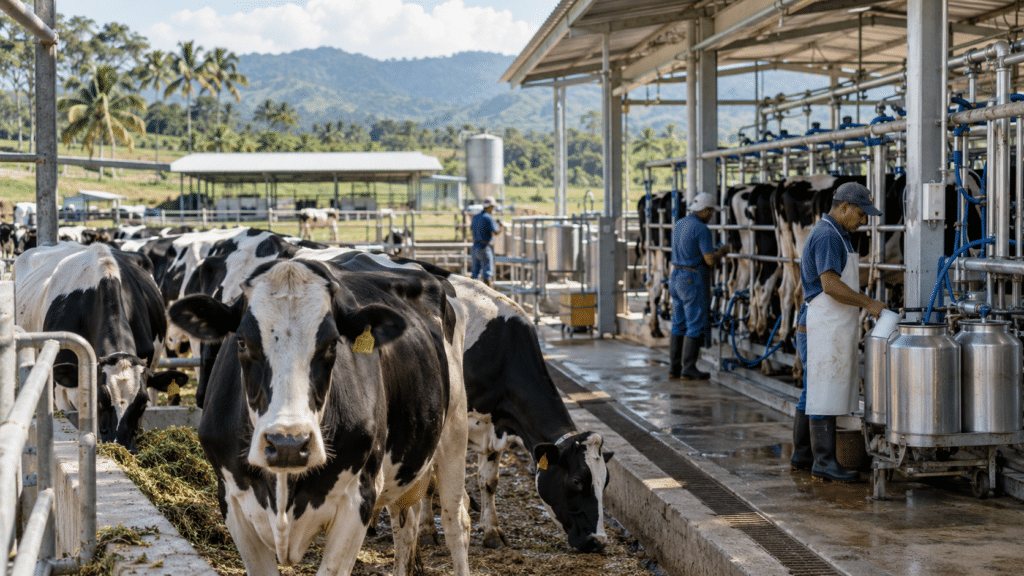
The livestock industry in the Dominican Republic is one of the country’s most important components of food production. The sector includes cattle raised for beef and milk, poultry for meat and eggs, pigs, goats, sheep and apiculture, together with the processing, distribution and commercial activities built around these products.
Its importance extends beyond farms. Livestock production connects rural producers with feed suppliers, veterinarians, slaughterhouses, dairy plants, food manufacturers, supermarkets, restaurants and institutional food programs. The result is a value chain in which domestic production and imported products coexist.
Official Dominican statistics group beef, pork, chicken, eggs, milk and honey within the livestock subsector. Between 2020 and 2024, national livestock production totaled more than 177.6 million quintals, while 2024 reached 38.23 million quintals, 6% above the previous year according to the Ministry of Agriculture. Eggs, poultry, milk and cattle have been among the principal areas of production growth, while pork has faced significant disruption from African swine fever.
What Does the Livestock Industry Produce?
The Dominican livestock economy is more diverse than the term “cattle industry” might suggest. Its principal commercial segments include beef cattle, dairy cattle, poultry meat, eggs and pork, with smaller but relevant activities involving goats, sheep and honey.
| Segment | Main Products | Role in the Market |
|---|---|---|
| Cattle | Beef, live cattle, milk and dairy inputs | Important domestic source of meat and raw milk |
| Dairy | Fresh milk, UHT milk, cheese, yogurt and other products | Large processing and consumer market with domestic and imported supply |
| Poultry | Chicken meat and related products | Major source of animal protein for the domestic market |
| Eggs | Table eggs and processed egg products | Large domestic production with export potential |
| Pork | Fresh and processed pork products | Important market affected by African swine fever and increased imports |
| Goats and sheep | Meat and breeding animals | Smaller specialized livestock segment |
| Beekeeping | Honey and related products | Smaller agricultural activity with commercial and rural importance |
FAO livestock statistics also distinguish among meat, milk, eggs, hides, skins, honey and other animal products, allowing the sector to be analyzed beyond the principal commercial categories.
Beef Cattle and the Dominican Meat Industry
Beef production is based largely on cattle raised under tropical conditions, with farms ranging from traditional operations to more technically managed enterprises. Cattle can be raised specifically for meat, for milk or under mixed systems.
The beef value chain begins with breeding and animal management and continues through feeding, veterinary services, transport, slaughter and meat distribution. Slaughterhouses therefore occupy an important position between producers and final consumers.
Official livestock statistics illustrate one of the sector’s measurement challenges. DIGEGA, the Directorate General of Livestock, notes that part of beef production is collected from urban slaughterhouses while another portion is estimated from municipal and backyard slaughter facilities. This means that official production figures should be interpreted with an understanding of the data-collection methodology.
Beef is also an important import category. U.S. agricultural exports of beef and beef products to the Dominican Republic reached $120 million in 2024, according to the U.S. Department of Agriculture, with U.S. suppliers accounting for 96% of U.S.-reported beef and beef-product exports to the Dominican market. Demand is supported by retail and food-service consumption, including the hospitality industry.
This creates a market in which domestic cattle production competes and interacts with imported meat. For investors, the distinction is important: an opportunity in livestock farming is not necessarily the same opportunity as an investment in meat processing, cold storage, premium cuts or food-service distribution.
Dairy Farming and Milk Production
The dairy industry is one of the most developed livestock value chains in the Dominican Republic. It links cattle farmers with collection centers, transport systems, processors and manufacturers of milk and dairy products.
DIGEGA reported 215.6 million liters of milk during the first quarter of 2025. Its methodology indicates that 53% of milk production is collected through the MEGALECHE program and the remaining 47% is estimated from producers outside the program.
The processing side includes large domestic companies and multinational manufacturers. Grupo Rica, for example, operates Pasteurizadora Rica and Lechería San Antonio and has developed a vertically connected dairy model involving milk production, processing and distribution. Its San Antonio dairy farm is located in Barahona and supplies milk used in its dairy products.
Nestlé Dominicana is another important participant in the dairy value chain. The company states that it receives more than 100,000 liters of fresh milk daily from local producers and works with more than 600 livestock farmers. Its Dominican operations include two factories.
The presence of large processors creates a structured market for producers who can meet requirements for milk quality, hygiene, cooling and consistency. Grupo Rica has described the importance of farm-level hygiene, cooling systems, mechanical milking and quality controls in its relationship with dairy farmers.
Why Dairy Imports Remain Important
Domestic milk production does not eliminate the need for imported dairy products. The Dominican market includes imported cheese, milk ingredients, infant formula and other dairy products alongside locally processed milk.
According to the USDA Foreign Agricultural Service, dairy products represented 19% of the Dominican Republic’s consumer-oriented agricultural import market in 2024, with imports valued at approximately $544 million. The report identifies infant formula and preparations for infant use, Cheddar and Colby cheese, and fresh cheese among leading products.
This distinction matters when assessing the dairy sector. An increase in dairy imports does not necessarily mean that domestic milk production is declining. Imported products may occupy categories in which local production is insufficient, more expensive, differently processed or subject to consumer preferences and trade arrangements.
Poultry: Chicken as a Core Protein Market
Poultry is one of the central pillars of the Dominican livestock industry. The sector includes breeding, hatcheries, feed, broiler production, processing, cold-chain logistics and retail distribution.
National production of finished chickens increased from 178.9 million units in 2020 to a preliminary 258.19 million in 2024, according to Ministry of Agriculture data. The same series shows that production rose each year during the period covered.
The poultry industry has a relatively integrated production structure compared with many smaller livestock activities. Commercial operations depend on reliable supplies of feed, chicks, veterinary inputs and processing capacity. Biosecurity is particularly important because disease outbreaks can affect production volumes, trade and operating costs.
The government has worked with poultry-sector organizations on biosecurity, technical assistance, financing and modernization. Official reporting attributed part of the 2025 increase in chicken and egg production to measures involving biosecurity, technical support, financing, infrastructure improvements and automation.
Imports are nevertheless part of the poultry market. U.S. exports of poultry and poultry products to the Dominican Republic reached $128 million in 2024, up 57% from 2020, according to the USDA.
Egg Production and the Expansion of the Layer Industry
Eggs occupy a particularly important position in the Dominican food system because they provide an accessible source of animal protein and are used across household, restaurant and food-processing markets.
Official agricultural data show egg production rising from approximately 2.75 billion units in 2020 to a preliminary 3.96 billion units in 2024. The 2024 figure represented an increase of 13.03% over 2023. The Ministry of Agriculture also reported an estimated apparent domestic consumption of 6.09 million quintals of eggs.
The government has also identified export potential in the egg sector. In 2025, the Ministry of Agriculture reported domestic production of more than 340 million eggs per month, although monthly production figures and annual official series should not be treated as interchangeable measures.
For the industry, the main commercial requirements include flock management, feed efficiency, genetics, disease prevention, egg handling, grading, packaging and distribution. Investment in these areas can affect productivity without necessarily requiring the construction of a completely new production system.
The Pork Industry and African Swine Fever
Pork is a major livestock category, but it faces a substantially different risk profile from poultry and dairy because of the continuing impact of African swine fever (ASF).
ASF is a highly contagious viral disease affecting domestic and wild pigs. It does not infect people, but it can cause severe losses in pig populations and disrupt agricultural trade. There is no treatment or widely available vaccine that replaces prevention and biosecurity as the primary control measures.
USDA reporting has described ASF as a significant and continuing challenge in the Dominican Republic. Its December 2025 assessment stated that the disease had become endemic, with outbreaks increasing during the first half of 2025. The same report said local pork production had declined and U.S. pork exports to the Dominican Republic reached a record 119,384 metric tons in 2024.
Dominican government reporting likewise linked a sharp decline in pig production during the first nine months of 2025 to renewed ASF outbreaks, animal culling and temporary closures of affected farms.
The consequence is a livestock market in which pork imports have become particularly important. USDA data indicate that U.S. pork and pork-product exports to the Dominican Republic were valued at $322 million in 2024, while the category represented 11% of the country’s consumer-oriented agricultural import market.
Goats, Sheep and Honey
Goat and sheep production is considerably smaller than poultry, cattle and pork, but these activities form part of the country’s diversified livestock base. They can be relevant in areas where smaller-scale producers combine animal husbandry with other agricultural activities.
Honey is another established livestock-related product. DIGEGA collects production information through technical beekeeping personnel and commercial records, while also providing services related to honey production and commercialization.
These smaller categories can present different investment characteristics from industrial poultry or dairy. Their development may depend more heavily on aggregation, quality control, processing, branding and market access than on very large-scale primary production.
How the Livestock Supply Chain Works
The livestock supply chain in the Dominican Republic can be understood as a series of connected stages rather than as a single farming activity.
- Genetics and breeding: producers obtain breeding animals, chicks, semen or other genetic inputs depending on the species.
- Feed and forage: farms depend on pasture, forage crops, grains, protein ingredients, minerals and commercial feed.
- Animal production: livestock is raised for meat, milk, eggs, breeding or other products.
- Veterinary and biosecurity services: disease prevention, vaccination, testing and farm management protect productivity.
- Collection and transport: milk, eggs and live animals move from farms into processing or commercial channels.
- Processing: slaughterhouses, dairy plants, egg facilities and food manufacturers convert primary products into consumer goods.
- Cold chain and distribution: refrigerated logistics are particularly important for meat and dairy.
- Retail and food service: supermarkets, wholesalers, restaurants, hotels and institutional buyers connect products with consumers.
This structure means that investment opportunities are not limited to owning livestock. Feed production, veterinary services, genetics, farm technology, milk collection, slaughtering, cold storage, packaging and distribution can all form separate businesses within the wider value chain.
Major Companies and Industry Participants
The livestock economy includes large processors and manufacturers as well as numerous specialized farms and smaller businesses. Because the sector is fragmented across different animal categories, there is no single company that represents the entire Dominican livestock industry.
Grupo Rica is particularly relevant to dairy. Its corporate structure includes Pasteurizadora Rica and Lechería San Antonio, while its history shows the development of UHT milk processing, distribution infrastructure and relationships with domestic dairy farmers.
Nestlé Dominicana is another major dairy-sector participant and reports direct relationships with local cattle farmers supplying fresh milk.
The poultry sector contains a much larger number of specialized producers and processors. Commercial directories identify numerous poultry and egg companies across provinces including Santiago, Espaillat, La Vega, Santo Domingo and Valverde, illustrating the geographic concentration of poultry activity in several agricultural regions.
For investors, company analysis should therefore be performed by subsector. A dairy processor, poultry integrator, feed manufacturer and beef distributor operate under different cost structures, regulatory requirements and disease risks.
Domestic Consumption and Food Demand
Livestock products occupy a central position in Dominican food consumption. Chicken, eggs, beef, pork and dairy are widely incorporated into household diets, restaurants and the tourism and hospitality industry.
Domestic demand also supports industrial food manufacturing. Milk and dairy ingredients enter processed foods, while poultry and meat are distributed through supermarkets, wholesalers, restaurants and institutional channels.
The School Feeding Program operated by INABIE, the National Institute for Student Welfare, is another important institutional food market. INABIE manages suppliers and establishes quality, safety and nutritional requirements for food delivered through the national school system, which covers more than 7,000 public educational centers according to its service information.
Institutional procurement can therefore create demand for producers and processors that meet formal specifications. It also illustrates why food safety, traceability, packaging and delivery capacity can be as important as primary production when competing for large buyers.
Imports and the Role of International Trade
The Dominican livestock market is not self-contained. Imports supply substantial volumes of meat and dairy products, while domestic producers supply much of the country’s fresh food demand and selected processed categories.
The CAFTA-DR trade framework is especially important because it governs agricultural trade between the Dominican Republic, the United States and Central American partners. The United States reports that its agricultural exports to the Dominican Republic increased from $1 billion in 2007 to $2 billion in 2024, with the agreement’s tariff schedule reaching full implementation for U.S. exports on January 1, 2025.
Several livestock products have been subject to specific tariff-contingent or safeguard arrangements under the Dominican Republic’s implementation of the agreement. Official trade-agency information identifies categories including beef cuts, pork, chicken parts, milk, milk powder and several types of cheese.
For businesses involved in importing animals or animal products, market access also depends on sanitary controls. DIGEGA requires importers of animals, animal products and by-products to submit documentation through the country’s foreign-trade single-window system and undergo risk assessment.

Animal Health and Biosecurity
Animal health is one of the most important structural issues in Dominican livestock production. Disease outbreaks can reduce animal numbers, interrupt farm operations, increase costs and alter import requirements.
DIGEGA, the Directorate General of Livestock, is the government’s specialized institution for livestock policy and animal health. Its responsibilities include disease prevention, animal movement controls, quarantine, veterinary regulation and technical assistance.
Its services include farm sanitation for bovine tuberculosis and brucellosis, animal-movement permits, quarantine for imported animals, veterinary-product registration and assistance with milk-quality production.
For investors, biosecurity should therefore be treated as a core operating requirement rather than an administrative detail. Farm location, animal movement, visitor controls, sanitation, veterinary monitoring, vaccination where applicable and traceability can materially affect the resilience of an operation.
Where Investment Opportunities Exist
The livestock industry offers opportunities across several levels of the value chain. The strongest business case for a particular project depends on its ability to solve a specific production, processing, logistics or market-access problem.
Modern Livestock Farms
Investment can focus on improving productivity through better genetics, controlled breeding, animal nutrition, water systems, pasture management, housing, milking equipment and data-based farm management.
Dairy Collection and Processing
Milk collection, cooling, quality testing and processing remain strategically important because the value of fresh milk depends heavily on rapid collection and appropriate handling. Opportunities may include collection centers, refrigeration, specialty dairy products and processing technologies that improve shelf life.
Poultry Technology
Poultry operations can invest in automated feeding, climate control, monitoring systems, energy efficiency, waste management, processing equipment and biosecurity infrastructure. The growth of chicken and egg production makes productivity improvements commercially relevant across the chain.
Feed and Animal Nutrition
Feed is a major operating cost for intensive livestock production. Businesses that improve feed efficiency, local sourcing, storage, formulation and distribution can potentially serve multiple livestock segments rather than depending on a single farm or animal category.
Cold Chain and Meat Processing
Cold storage, slaughter, cutting, packaging and refrigerated transport can add value between farms and consumers. These activities are particularly relevant in markets where imported products and domestic products compete for retail and food-service customers.
Veterinary and Biosecurity Services
The disease risks associated with pigs, poultry and cattle create demand for diagnostics, veterinary services, farm sanitation, traceability and biosecurity technology. DIGEGA’s extensive animal-health service structure illustrates the importance of these functions in the sector.
Export-Oriented Production
Export opportunities are particularly relevant to products with a combination of domestic production capacity, manageable sanitary requirements and access to external markets. Eggs have been highlighted by Dominican authorities as a product with export potential, while processed foods can benefit from the country’s position within Caribbean and North American trade networks.
Government Support and the Investment Environment
The Dominican government has dedicated institutions and programs to livestock development. CONALECHE, the National Council for the Regulation and Promotion of the Dairy Industry, is responsible for policies intended to promote the growth, productivity and competitiveness of the dairy sector. Government open-data records also show financing programs directed toward livestock farmers, processors and institutions connected to the dairy chain.
ProDominicana, the country’s investment and export promotion agency, identifies livestock farming as an investment area within agriculture and promotes projects involving sustainable livestock production, among other agricultural activities. Its investment information also describes tax and administrative incentives that may apply to qualifying agricultural projects, subject to the applicable legal conditions.
Investors should verify the precise eligibility requirements of any incentive before incorporating it into a financial model. Agricultural incentives, sanitary authorizations, land-use requirements, tax treatment and environmental approvals can depend on the structure and location of the project.
Key Risks for Livestock Investors
Livestock investment involves risks that are different from those of conventional manufacturing or real estate. The most important are often biological, operational and market-related.
- Animal disease: outbreaks can cause mortality, compulsory culling, movement restrictions and trade disruptions.
- Feed costs: intensive poultry and pork production can be sensitive to the price and availability of feed ingredients.
- Climate exposure: heat, drought, storms and water availability can affect animal productivity and forage.
- Market prices: meat, eggs and milk prices can fluctuate with supply, imports and consumer demand.
- Import competition: trade agreements and imported products can influence domestic market prices.
- Cold-chain requirements: perishable products require reliable refrigeration from production through retail.
- Regulation: animal movement, imports, exports, veterinary products and food safety are subject to official controls.
These risks make operational planning particularly important. A profitable farm on paper can produce very different results if disease protection, feed procurement, water supply or market access are inadequately managed.
What Makes the Dominican Livestock Market Distinct?
The Dominican Republic combines a substantial domestic food market with proximity to the United States, a large tourism sector and access to regional trade agreements. This creates both domestic and export-oriented possibilities.
The country’s geography also allows livestock production to coexist with diverse agricultural systems. Dairy and beef cattle can be integrated with pasture and forage production, while poultry and egg operations tend to concentrate around commercial infrastructure, feed supply and established distribution networks.
At the same time, the market illustrates the importance of specialization. The economics of a dairy farm are fundamentally different from those of a broiler operation, egg farm or pig farm. Investors therefore need to evaluate individual value chains rather than treating “livestock” as a single homogeneous industry.
Frequently Asked Questions
What are the main livestock products in the Dominican Republic?
The principal livestock products include beef, pork, chicken, eggs, milk and honey. Goat and sheep production also form part of the national livestock sector. Official Dominican agricultural statistics use these categories to measure the livestock subsector.
Is the Dominican Republic self-sufficient in livestock products?
Not across all categories. Domestic production supplies major portions of the food market, but imports are significant for products such as pork, beef and dairy. The scale of imports varies by product and is affected by domestic production, consumer demand, trade rules and sanitary conditions.
How important is poultry production?
Poultry is one of the country’s largest livestock activities. Official data show finished-chicken production reaching a preliminary 258.19 million units in 2024, while egg production reached approximately 3.96 billion units.
What is the main challenge facing Dominican pork production?
African swine fever is the principal structural challenge identified in recent official reporting. The disease has reduced local pork production and contributed to greater reliance on imported pork and pork products.
Which institutions regulate livestock production?
DIGEGA is the principal government institution responsible for livestock policy and animal health. Other institutions have responsibilities related to dairy development, agricultural policy, trade, taxation, food procurement and investment promotion.
Can foreign investors invest in Dominican livestock farming?
Livestock farming is included among the agricultural sectors promoted by ProDominicana for investment. A specific project, however, must meet the applicable corporate, land-use, tax, sanitary, environmental and commercial requirements.
What should an investor examine before starting a livestock project?
The most important areas are animal health, farm location, water and feed availability, genetics, labor, veterinary support, processing capacity, cold-chain logistics, market access, import competition and regulatory requirements. Disease-control planning is particularly important in poultry and pork.
The Outlook for the Dominican Livestock Industry
The Dominican livestock industry combines established domestic demand with significant processing capacity and a continuing role for imports. Recent production data show expansion in eggs, poultry, milk and cattle, while pork remains under pressure from African swine fever.
The next phase of development is likely to depend less on simply increasing the number of animals and more on productivity, biosecurity, processing, traceability, cold-chain infrastructure, animal nutrition and market integration. These improvements can increase the value generated at several stages of the supply chain.
For international investors, the market is best understood as a collection of interconnected industries rather than one livestock business. Dairy, poultry, eggs, beef, pork, feed, veterinary services and food processing each have distinct economics and risks. The combination of domestic food demand, tourism, regional trade access and an established agricultural base gives the sector a broad commercial foundation, while animal disease and import competition remain central considerations for any long-term strategy.