 25°C
25°C

Agribusiness in the Dominican Republic: How the Sector Works
Agribusiness in the Dominican Republic extends far beyond farming. It encompasses the businesses, infrastructure and services that connect agricultural production with processing, distribution, domestic consumption and international markets, making the sector an important part of the country's economic and rural landscape.


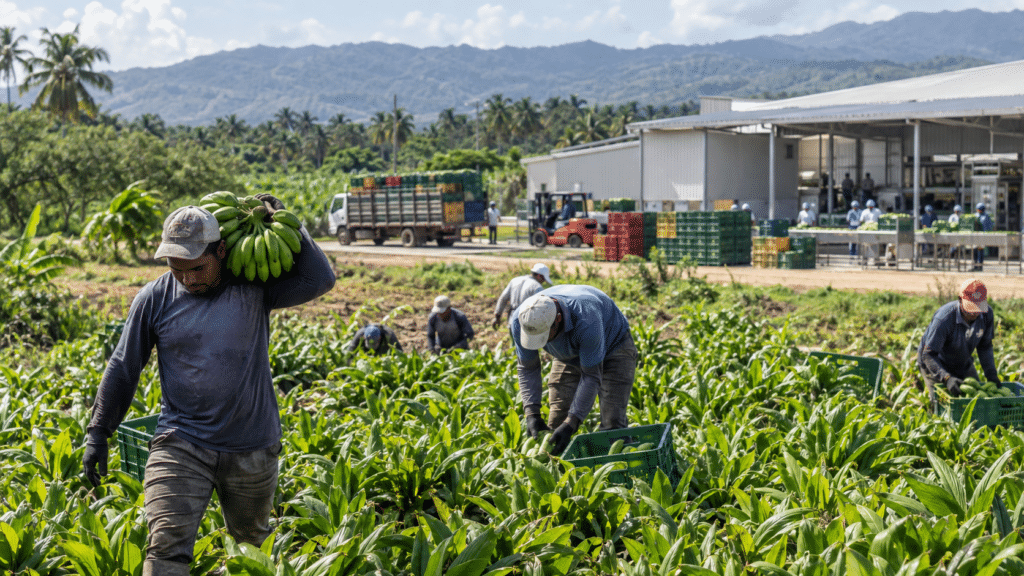
Agribusiness in the Dominican Republic is best understood as a value chain rather than a single industry. Farmers and livestock producers are at its foundation, but the commercial system also includes suppliers of seeds and agricultural inputs, irrigation and equipment providers, processors, packers, cold-storage operators, transport companies, wholesalers, retailers, exporters, financial institutions and other specialized service providers.
This distinction matters because agricultural products create economic value at multiple stages between the farm and the final consumer. A crop can begin as a raw agricultural product and then acquire additional value through sorting, packaging, processing, branding, logistics and access to export markets. The same principle applies to livestock, fisheries and other parts of the Dominican food system.
The Dominican Republic combines a substantial domestic food market with an agricultural sector capable of supplying international buyers. The Central Bank reported that agriculture’s real value added increased by 5.4% in 2025, with notable production increases in products including coconut, cocoa, sugar cane, avocado, plantains, bananas, pigeon peas, beans, rice and cassava.
What Is Agribusiness?
Agribusiness refers to the commercial activities connected with agricultural production and the movement of food and agricultural products through the economy. It includes both activities that occur before production and those that take place after products leave the farm.
The concept therefore includes much more than agricultural land and farm operations. A company manufacturing animal feed, a distributor supplying fertilizers, a food processor buying locally grown fruit, a refrigerated logistics operator transporting meat, and an exporter preparing agricultural products for an overseas customer can all form part of the agribusiness system.
The Food and Agriculture Organization describes agribusiness and agrifood value chains as encompassing business activities that connect production with consumption. Processing and other downstream activities can create additional value while providing markets and services that allow food to move through the system.
For the Dominican Republic, this approach provides a useful way to understand why agriculture has implications for manufacturing, transportation, commerce, exports, employment and rural development.
How the Dominican Agribusiness Value Chain Works
The value chain can be simplified into several interconnected stages. In practice, businesses may operate across more than one stage, while the structure varies considerably by product.
1. Agricultural Inputs and Services
The chain begins before a crop is planted or an animal is raised. Producers require inputs and services such as seeds, fertilizers, crop-protection products, animal feed, veterinary services, machinery, irrigation equipment, technical assistance and financial services.
This creates a business segment that depends on agricultural production without necessarily producing food itself. Input suppliers are affected by planting decisions, weather conditions, commodity prices, production costs and demand from farmers.
Technology is also becoming increasingly relevant. Agricultural businesses can use digital tools for production planning, monitoring, traceability, inventory management, logistics and market information. FAO identifies digital innovation and stronger links between value-chain participants as important areas for agrifood-system development.
2. Primary Production
Farms, plantations, livestock operations and fisheries represent the production stage. The Dominican Republic has a diversified agricultural base that includes staple crops, tropical fruits, export-oriented commodities and livestock production.
Different production systems serve different markets. Some products are primarily oriented toward domestic consumption, while others have established links with international buyers. Production can also be organized through individual farms, cooperatives, producer associations, commercial agricultural companies or arrangements connecting farmers with processors and exporters.
In 2025, the Dominican Republic recorded growth in agricultural production across several important crops. According to the Central Bank, coconut production increased 11.5%, cocoa 11.4%, sugar cane 10.3%, avocado 9.1%, plantains 7.9% and bananas 7.3%. These figures illustrate the breadth of agricultural activity feeding the wider agribusiness system.
3. Collection, Storage and Aggregation
Once agricultural products leave farms, they need to reach buyers while maintaining the quality required by the market.
Aggregation is particularly important when production comes from many small or medium-sized farms. Intermediaries, cooperatives, collection centers and specialized buyers can consolidate volumes, sort products and connect producers with processors, wholesalers or exporters.
Storage and post-harvest handling can determine how much of the original agricultural production ultimately becomes commercially valuable. Perishable products require particularly careful management of temperature, packaging, timing and transportation.
4. Processing and Agro-Industry
Processing is one of the stages where agriculture becomes directly connected with manufacturing.
Depending on the product, processing may involve cleaning, grading, milling, drying, roasting, freezing, preserving, extracting, fermenting, cooking, packaging or transforming a raw agricultural product into a finished or semi-finished good.
The economic significance of this stage is substantial because processing can extend shelf life, improve consistency, create branded products and open markets that may not exist for unprocessed commodities.
For example, agricultural commodities such as cocoa and coffee can move through several stages before reaching a consumer. Fruit can be sold fresh or transformed into juice, pulp, preserves or other processed products. Cassava, rice and other crops can similarly enter different processing and distribution channels.
FAO notes that adding value through processing and other activities can strengthen rural employment, income generation and the integration of producers into broader food value chains.
5. Packaging and Quality Control
Packaging is not simply a final cosmetic step. It can determine whether a product meets the specifications of a supermarket, food processor, hotel, restaurant or foreign buyer.
Commercial buyers may require particular sizes, grades, packaging formats, labeling, traceability procedures and quality standards. Export-oriented businesses may face additional requirements associated with the destination market.
As a result, companies operating in agribusiness increasingly need to understand quality management as part of the commercial process rather than as a separate technical function.
6. Distribution and Logistics
Transportation connects farms and processing facilities with domestic and international markets. The logistics chain can include trucking, warehouses, distribution centers, ports, airports, refrigeration and inventory management.
For perishable agricultural products, logistics becomes especially important because delays can reduce quality and increase losses. Export businesses must also coordinate documentation, customs procedures, packaging, shipping schedules and the requirements of overseas buyers.
This makes transportation and logistics an integral part of agribusiness rather than an external activity. The performance of one stage can directly affect the profitability of another.
7. Wholesale and Retail
Domestic distribution ultimately connects agricultural products with supermarkets, traditional markets, restaurants, hotels, food-service companies, institutional buyers and other consumers.
The Dominican Republic’s tourism industry creates an additional commercial channel for food producers and distributors. Hotels and restaurants require reliable supplies of fresh produce, meat, dairy products, beverages and other food inputs.
This connection between agriculture and tourism is particularly relevant because food demand generated by visitors becomes part of the market for Dominican producers, processors and distributors.
8. Export Markets
International trade gives Dominican agribusinesses access to customers beyond the domestic market. Export-oriented businesses must combine production capacity with quality control, packaging, logistics, market knowledge and compliance with destination-country requirements.
Dominican exporters operate across a range of agricultural products. ProDominicana’s 2025 exporter directory, for example, includes companies exporting fresh fruits, lemons, pineapples, avocados, mangoes, pitahayas, tropical vegetables and organic bananas.
Export development can therefore involve more than increasing production. It can require improving post-harvest handling, developing processing capacity, establishing reliable logistics and identifying markets willing to pay for specific quality characteristics.
Major Agribusiness Segments in the Dominican Republic
The Dominican agribusiness economy is diversified. Its main segments include both traditional agricultural activities and increasingly sophisticated downstream businesses.
Cocoa and Chocolate
Cocoa is an important example of how agricultural production can connect with international value chains. The commercial opportunity extends beyond growing cocoa beans to fermentation, drying, quality control, specialty markets and potentially further processing.
The Central Bank recorded an 11.4% increase in cocoa-bean production in 2025, illustrating the importance of the crop within the country’s agricultural production base.
Bananas and Plantains
Bananas and plantains are important food crops and illustrate two different dimensions of agribusiness. Plantains have strong domestic-market relevance, while bananas can also form part of export-oriented value chains.
FAO has identified opportunities in the Dominican banana sector involving productivity, modernization, logistics, market diversification and greater development of agro-industrial processing.
Avocados and Tropical Fruits
Avocados and other tropical fruits connect Dominican agriculture with both domestic consumers and international markets. Their commercial value depends heavily on quality, timing, handling, packaging and the ability to maintain product condition during transportation.
The tropical-fruit segment also creates opportunities for processing, including juices, frozen products, pulp and other forms of value addition.
Sugar and Sugar-Based Industries
Sugar cane represents one of the country’s historically important agricultural-industrial activities. The value chain extends from cultivation and harvesting to processing and distribution, linking agricultural production with industrial facilities and commercial markets.
Production of sugar cane increased 10.3% in 2025, according to Central Bank data.
Rice and Other Staple Crops
Rice, beans, cassava, corn and other staples are closely connected to domestic food demand. Their value chains include farmers, input suppliers, mills, wholesalers, retailers and food-service businesses.
Food security also influences these markets. FAO reported in 2026 that around 60% of the Dominican Republic’s cereal consumption requirements were being covered by imports, with corn demand supported particularly by the poultry-feed sector.
This illustrates an important characteristic of agribusiness: domestic production and imports can coexist within the same value chain. A food-processing or livestock business may depend partly on locally produced agricultural goods and partly on imported inputs.
Livestock and Poultry
Livestock and poultry connect agriculture with feed production, veterinary services, processing, cold storage, distribution and retail. The sector therefore creates demand for businesses that operate both upstream and downstream from farms.
Feed markets are particularly important because the cost and availability of inputs can affect the economics of meat and poultry production.
Coffee and Specialty Agricultural Products
Coffee demonstrates the potential for differentiation through quality, origin, processing and branding. Although agricultural production is the foundation, higher-value opportunities can emerge through roasting, packaging, specialty marketing, tourism-related experiences and direct-to-consumer channels.
Such models illustrate why agribusiness should not be viewed exclusively as a commodity business. The same agricultural product can generate very different economic outcomes depending on how it is processed, positioned and marketed.

Why Agribusiness Matters to the Dominican Economy
Contribution to Economic Activity
Agriculture and the broader agro-food system connect multiple parts of the Dominican economy. In 2025, the agropecuario sector as a whole grew 3.7% in real terms, while agriculture alone grew 5.4%, according to the Central Bank.
The broader significance is larger than the agricultural production figures themselves because agricultural activity generates demand for transportation, machinery, financial services, packaging, manufacturing and commerce.
Employment and Rural Economies
Agribusiness supports employment directly on farms and indirectly through processing, transportation, commerce, food services and related businesses.
Formal employment statistics provide only part of this picture because agricultural activity includes businesses and workers operating through different organizational structures. In the first quarter of 2025, the Dominican Republic’s formal-employment statistics recorded 32,047 formal jobs in agriculture, livestock, forestry and fishing.
The formal figure should not be interpreted as the total number of people whose livelihoods depend on agribusiness. The wider value chain includes informal activity, self-employment, seasonal labor and employment in downstream sectors.
Food Supply and Domestic Demand
Agribusiness is also closely tied to food availability. Producers and processors supply households, supermarkets, restaurants, hotels and other institutions, while imports supplement domestic production where local supply does not fully meet demand.
This creates business opportunities but also exposes companies to fluctuations in international commodity prices, exchange rates, transportation costs, weather conditions and global supply chains.
Exports and Foreign Exchange
Export-oriented agriculture provides Dominican companies with access to international demand and allows agricultural products to generate export revenues.
However, competing internationally requires more than having a product available. Exporters must consistently meet buyer specifications, manage logistics, comply with applicable standards and maintain reliable supply. This is why improvements in processing, quality control and traceability can be as important as increasing production volumes.
Where the Business Opportunities Are
The most interesting opportunities in Dominican agribusiness are not necessarily limited to acquiring agricultural land or operating a farm. Many gaps exist between production and the final customer.
Agro-Processing
Processing can transform commodities into products with longer shelf lives, different market applications or higher unit values. Businesses can potentially operate in areas such as fruit processing, drying, freezing, milling, roasting, food ingredients and packaged foods.
Cold Chain and Storage
Perishable products require appropriate storage and transportation. Investments in refrigeration, warehouses, temperature monitoring and distribution infrastructure can therefore support multiple agricultural value chains.
Packaging
Exporters and domestic food companies need packaging adapted to the characteristics of their products and the requirements of their customers. Packaging businesses can therefore participate in agribusiness without directly producing food.
Logistics and Distribution
Specialized logistics providers can serve farms, processors, supermarkets, restaurants and exporters. Opportunities can include transportation, warehousing, inventory management, route optimization and temperature-controlled distribution.
Agricultural Technology
Technology can address problems involving irrigation, farm monitoring, production planning, traceability, inventory management and market access. The opportunity is particularly relevant where digital tools can reduce costs or improve coordination between producers and buyers.
Financing and Agricultural Services
Agriculture requires working capital and investment throughout the production cycle. Financing can be needed for land preparation, inputs, equipment, livestock, irrigation, storage and processing.
In 2025, the Banco Agrícola reported disbursements of RD$18.35 billion for agriculture, RD$3.99 billion for livestock and RD$3.55 billion for other related purposes.
Commercial lending conditions are another factor for agribusiness investors. The Central Bank reported that the average active lending rate for agricultural financing fell from 15.94% in May 2025 to 13.92% in January 2026.
Small and Medium-Sized Businesses in Agribusiness
Agribusiness is not dominated exclusively by large agricultural companies. Small and medium-sized businesses can participate at numerous points in the value chain, including farming, collection, processing, transport, packaging, food manufacturing and distribution.
The National Statistics Office’s 2025 formal business directory counted 2,509 formal enterprises in agriculture, livestock, forestry and fishing. Of these, 2,045 had between one and 10 employees and another 385 had between 11 and 50 employees.
These figures cover the formal enterprises classified directly under agriculture, livestock, forestry and fishing. They do not capture the full agribusiness ecosystem, which extends into manufacturing, commerce, transportation and other sectors.
This distinction is important for understanding the structure of the industry. A food-processing company may be classified as manufacturing even though its business model depends heavily on agricultural suppliers. Similarly, a logistics company may be classified under transportation while serving agricultural exporters.
Challenges Facing Dominican Agribusiness
Climate and Weather Risk
Agriculture is exposed to drought, excessive rainfall, hurricanes, heat and other weather events. Climate conditions can affect yields, production schedules, infrastructure and input costs.
FAO identifies climate change, resource degradation, food losses and market volatility among the challenges affecting Dominican agrifood systems.
Post-Harvest Losses
Producing more is not always sufficient if significant quantities of food lose value after harvest. Better storage, refrigeration, packaging, transportation and processing can reduce losses while improving the commercial return from agricultural production.
Market Volatility
Farmers and agribusinesses can be affected by changes in international commodity prices, input costs, transportation expenses and consumer demand. Businesses with narrow margins can be particularly sensitive to these fluctuations.
Access to Finance
Agricultural businesses often require capital before revenue is generated from a harvest or production cycle. The timing of cash flows can therefore make financing more complicated than in businesses with continuous sales.
Fragmentation of Supply
Where processors and exporters depend on large numbers of small producers, maintaining consistent volumes and quality can be challenging. Producer organizations, collection systems, contracts and technical assistance can help coordinate supply.
Infrastructure and Logistics
Roads, irrigation, storage, electricity, refrigeration, ports and other infrastructure affect the cost and reliability of moving agricultural goods. Improvements in one part of the chain can sometimes create benefits throughout the system.
The Importance of Value Addition
One of the central business questions in agribusiness is whether a product should be sold as a raw commodity or transformed into a higher-value product.
Processing does not automatically guarantee higher profitability. It introduces additional costs, including equipment, labor, energy, packaging, quality control, financing and distribution. But when the economics are favorable, processing can create new markets and reduce dependence on the price of an unprocessed commodity.
This is particularly relevant for a country such as the Dominican Republic, where agricultural products can serve domestic consumers, tourism businesses and international buyers.
The broader principle is that value can be created at multiple points in the chain. A farmer can improve value through quality and productivity. A processor can create value through transformation. A logistics company can create value through reliability and reduced losses. An exporter can create value through market access. A brand can create value through differentiation and consumer recognition.
What Investors and Entrepreneurs Should Understand
Agribusiness investment requires looking at the entire chain rather than evaluating production in isolation.
Before entering a particular segment, a business needs to understand the availability and cost of raw materials, the reliability of supply, the target market, processing requirements, logistics, working-capital needs, regulatory requirements and potential customers.
For export-oriented businesses, market access should be considered from the beginning. A product may be technically exportable but commercially difficult to sell if supply is inconsistent or if the producer cannot meet the quality, packaging and delivery specifications expected by buyers.
For domestic businesses, the strongest opportunities may instead be connected to supermarkets, restaurants, hotels, food manufacturers and institutional buyers.
The FAO’s work on Dominican value chains similarly emphasizes analyzing market structures, identifying inefficiencies and strengthening relationships between producers, buyers and other participants. Its recent analysis of the Dominican banana chain is one example of this value-chain approach.
The Future of Agribusiness in the Dominican Republic
The future of Dominican agribusiness will depend not only on agricultural production but on how effectively the country connects production with markets.
Several trends are likely to remain important: greater use of technology, improved irrigation, better post-harvest handling, more efficient logistics, stronger traceability, climate adaptation, higher-quality processing and increased integration between producers and buyers.
Export diversification can also create opportunities. Instead of depending exclusively on a small number of commodities or destinations, businesses can seek different markets and develop products adapted to specific consumer preferences.
There is also room for greater integration between agriculture and other sectors of the Dominican economy. Tourism creates demand for food; manufacturing can transform agricultural raw materials; logistics connects producers with domestic and foreign customers; financial services provide capital; and technology can improve efficiency across the chain.
Understanding Agribusiness as a Complete Business Ecosystem
Agribusiness in the Dominican Republic is ultimately an ecosystem connecting farms with consumers.
The agricultural producer is the starting point, but the economic value of food and agricultural commodities is shaped by everything that happens afterward: collection, storage, processing, packaging, transportation, marketing, distribution and export.
This is why the sector creates opportunities beyond traditional farming. Businesses can participate by supplying inputs, providing technology, processing food, managing cold chains, developing packaging, financing production, distributing products or connecting Dominican producers with international markets.
The country’s agricultural base remains an important foundation. In 2025, agriculture grew 5.4% in real terms, while the broader agropecuario sector grew 3.7%. For businesses and investors, however, the more important question is how efficiently that production can be connected to consumers and transformed into competitive products.
Understanding the complete value chain provides a clearer picture of where the economic opportunities are, where bottlenecks exist and why developments in agriculture can have consequences far beyond the farm.