 25°C
25°C

Dominican Agribusiness: $3.6B Export Sector Opens New Investment Opportunities
The Dominican Republic's agricultural sector is emerging as a broader investment proposition than primary production alone. Agriculture accounts for about 4.5% of GDP, supports more than 365,000 direct jobs and generates more than $3.6 billion in agricultural exports, according to the Dominican Ministry of Agriculture. The opportunity extends across farming, food processing, controlled-environment agriculture, cold storage, logistics, export services and agricultural technology, supported by domestic food demand, tourism, international market access and the country's location between North America, Europe and the wider Caribbean.


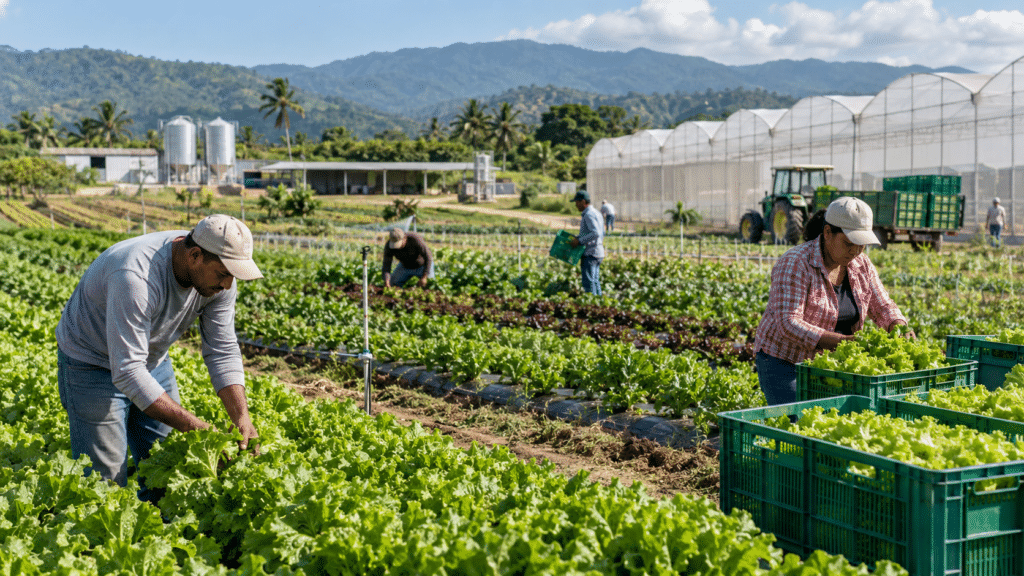
The Dominican Republic’s agribusiness sector combines a large domestic food market with established agricultural production and access to international markets. For investors, the opportunity is not limited to acquiring farmland or developing a crop operation. Value can also be created by processing agricultural products, improving storage and distribution, introducing agricultural technology, and building supply chains that connect producers with hotels, retailers and export markets.
Why Dominican Agribusiness Is Attracting Investment Interest
Agriculture remains an important part of the Dominican economy. The Ministry of Agriculture reported in 2026 that the sector contributes about 4.5% of GDP, generates more than 365,000 direct jobs and accounts for more than $3.6 billion in agricultural exports. The ministry also said the country produces roughly 90% of the food consumed domestically, highlighting the sector’s role in both food security and commercial activity.
The investment case is broader than those figures suggest. Demand comes from households, supermarkets, food manufacturers, restaurants and the country’s large tourism industry. The U.S. Department of Agriculture’s Foreign Agricultural Service reported that U.S. exports of consumer-oriented food products to the Dominican Republic reached $1.2 billion in 2024, while total imports in this category reached $2.8 billion. This indicates substantial demand for food products in addition to the country’s domestic agricultural production.
For investors, that combination creates several possible entry points: increasing agricultural productivity, replacing or complementing imports, processing locally produced commodities, improving post-harvest handling, and developing export-oriented supply chains.
1. Agricultural Production and Technified Farming
Primary agricultural production remains one of the most direct ways to participate in the sector. ProDominicana identifies tropical crops, livestock, aquaculture, organic food production and modern greenhouses among the country’s agricultural investment areas.
The more significant opportunity for investors may be technified production rather than simply expanding cultivated land. Irrigation, protected agriculture, mechanization, crop monitoring and improved farm management can increase consistency and productivity while reducing exposure to some operational risks.
Greenhouse agriculture is particularly relevant where quality, uniformity and year-round production are important. Controlled environments can also help producers meet specifications required by institutional buyers, retailers and export markets.
Investment decisions in primary agriculture should nevertheless consider water availability, soil conditions, climate exposure, access to labor, proximity to processing facilities and transportation costs. Agricultural land alone does not guarantee a competitive operation.
2. Food Processing and Agroindustrial Manufacturing
Processing can capture more value from agricultural production than the sale of raw commodities alone. Opportunities include fruit and vegetable processing, dairy products, meat and poultry processing, beverages, packaged foods and ingredients for the hospitality and food-service industries.
The domestic market provides an important demand base. In 2024, the Dominican Republic imported $2.8 billion in consumer-oriented agricultural products, according to the U.S. Department of Agriculture. At the same time, domestic producers exported $2.2 billion of consumer-oriented agricultural products. The coexistence of substantial imports and exports points to a market in which investors can examine both import substitution and export-oriented processing.
Processing facilities can also create stronger links between farmers and international buyers. A plant that provides grading, packaging, freezing, drying, extraction or other forms of processing may be able to serve several markets rather than depending on a single crop or customer.
3. Cold Storage and Post-Harvest Infrastructure
Perishable agricultural products require reliable handling between farms, processing facilities, distribution centers and final buyers. This makes cold storage and post-harvest infrastructure a potential investment area alongside agricultural production itself.
Facilities can include refrigerated warehouses, pre-cooling systems, temperature-controlled transport, sorting and packing centers, and specialized storage for products with different temperature or humidity requirements.
The opportunity is particularly relevant for businesses serving fresh produce, meat, dairy and other temperature-sensitive products. For exporters, maintaining product quality after harvest can be as important as increasing production at the farm level.
Investors evaluating this segment should examine location carefully. A cold-storage facility needs efficient connections to production areas, processing plants, major consumption centers, ports or airports, depending on its business model. Electricity reliability, backup systems, energy costs and utilization rates are also critical considerations.
4. Agricultural Logistics and Distribution
Logistics is another part of the agribusiness value chain where investment can extend beyond farming. The Dominican Republic’s geographic position gives it commercial links with North America, Europe, Latin America and the Caribbean. ProDominicana highlights the country’s ports, airports, road network and trade agreements as factors supporting its role as a regional business hub.
For agricultural companies, the relevant opportunity is not simply moving products from one place to another. Modern agricultural logistics can integrate collection, quality control, inventory management, refrigerated transport, warehousing and export documentation.
Businesses that connect fragmented producers with large buyers can also create value through aggregation. A distributor capable of collecting standardized volumes from multiple farms may help smaller producers participate in supply chains that would otherwise require larger and more consistent production capacity.
5. Export-Oriented Agribusiness
Export agriculture is one of the country’s most established commercial opportunities. The Dominican Republic benefits from preferential access to major markets through agreements including DR-CAFTA with the United States and Central America and the Economic Partnership Agreement with the European Union.
ProDominicana states that these agreements provide preferential access to more than 1.2 billion consumers. For agricultural investors, the practical value depends on the individual product, applicable rules of origin, sanitary and phytosanitary requirements, tariffs and buyer specifications.
Export-oriented projects should therefore be designed around the target market from the beginning. Production standards, traceability, packaging, certifications, cold-chain requirements and shipping arrangements can determine whether a product is commercially viable overseas.
6. Agricultural Technology and Precision Farming
Technology can address several structural challenges in agriculture without requiring investors to own large farms. Potential areas include precision irrigation, farm-management software, satellite and drone monitoring, sensors, automated greenhouse systems, weather monitoring and digital traceability.
The Dominican Ministry of Agriculture has also identified technology, mechanization and better agricultural information as areas for development. In 2026, the ministry said data from the National Agricultural Registry would help guide investment, credit, technical assistance, mechanization and agricultural insurance.
This creates potential opportunities for technology providers serving farmers, cooperatives, processors and distributors. The strongest business models are likely to be those that solve measurable operational problems, such as reducing water use, improving yields, lowering losses or providing the traceability required by buyers.
7. Aquaculture and Livestock
Livestock and aquaculture form additional components of the country’s agricultural investment landscape. ProDominicana specifically identifies livestock farming and aquaculture among the areas available to investors.
Opportunities can exist across the value chain, including production, animal nutrition, genetics, veterinary services, processing, cold storage and distribution. Investors should evaluate these activities as integrated supply chains rather than isolated production projects because feed costs, biosecurity, processing capacity and market access can materially affect margins.
For aquaculture, site conditions, water quality, species selection, environmental requirements and access to reliable markets are particularly important. As with other agricultural projects, environmental authorization and sector-specific requirements should be assessed before committing capital.
8. Organic and Higher-Value Food Production
Consumer demand for differentiated food products can create opportunities beyond conventional commodity agriculture. ProDominicana identifies organic food production as an investment area, reflecting demand for products positioned around specific production standards and consumer preferences.
However, premium positioning requires more than labeling a product as higher quality. Investors need to consider certification, traceability, production practices, packaging, market access and the willingness of target consumers or buyers to pay for the differentiation.
Products aimed at export markets may also need to comply with certification systems and importing-country requirements. The economics therefore depend on the entire value chain rather than the farm-gate price alone.
9. Supplying the Tourism and Hospitality Industry
Tourism creates an important downstream market for Dominican agriculture. The country’s tourism industry generates demand for meat, poultry, seafood, dairy, fruit, vegetables, beverages and processed foods across hotels, restaurants and institutional food services.
The U.S. Department of Agriculture reported that sustained demand from tourism and retail contributed to growth in the Dominican consumer-oriented food market. In 2024, U.S. consumer-oriented food exports to the country increased 10% to $1.2 billion.
This creates potential for suppliers capable of meeting the volume, consistency, food-safety and delivery requirements of large hospitality buyers. Investors may therefore find opportunities in aggregation, processing, packaging and distribution as well as primary production.
10. Import Substitution and Local Food Manufacturing
The scale of food imports creates another potential investment route: producing locally what the market currently sources from abroad, where local production can compete on cost, quality, reliability or freshness.
This does not mean that every imported product represents an attractive manufacturing opportunity. Imported goods may benefit from economies of scale, established supply chains or lower production costs elsewhere. A viable project requires analysis of raw-material availability, energy costs, labor, packaging, financing, logistics and market pricing.
The strongest opportunities may occur where local agricultural inputs can support a competitive processing operation. Investors can then combine domestic production with manufacturing and distribution instead of competing solely as a commodity producer.
Competitive Factors Investors Should Examine
| Factor | Why It Matters |
|---|---|
| Market access | Trade agreements and geographic proximity can support access to major consumer markets, subject to product-specific requirements. |
| Domestic demand | Food consumption, retail and tourism provide potential markets before an investor even considers exports. |
| Climate and land | Tropical conditions and agricultural land support a wide range of crops, while individual projects still require site-specific analysis. |
| Infrastructure | Roads, ports and airports influence the cost and reliability of agricultural supply chains. |
| Processing capacity | Local processing can increase value capture and reduce dependence on raw-commodity sales. |
| Technology | Automation, irrigation, monitoring and traceability can improve productivity and consistency. |
| Export standards | Sanitary, phytosanitary, certification and traceability requirements can determine access to specific markets. |
Investment Incentives and Regulatory Considerations
Foreign investors generally receive national treatment under Dominican investment law, although sector-specific permits, registrations and licenses can still apply. ProDominicana states that there is no general special requirement for foreign investors beyond the formalities applicable to the relevant activity.
For the agricultural sector, ProDominicana lists exemptions covering income tax, construction permits, land purchases and certain equipment, materials and furnishings required for initial installations and operations. The availability and applicability of incentives should be confirmed for the specific project and its legal structure before investment decisions are made.
Agricultural projects may also require environmental authorization, land-use approvals, construction licenses and other sector-specific procedures. Investors should establish the permitting pathway early, particularly for projects involving water use, processing facilities, livestock, aquaculture or significant construction.
Key Risks in Dominican Agribusiness
Agriculture remains exposed to risks that are different from those found in many other investment sectors. Weather events, water availability, pests, diseases, commodity prices, labor availability and logistics can all affect financial performance.
Export projects face additional risks related to international prices, exchange rates, shipping costs, buyer concentration and market-access requirements. A project designed around a single crop or export destination can therefore have a different risk profile from a diversified operation serving several markets.
Food processing and logistics projects have their own challenges, including energy costs, plant utilization, food-safety compliance, working capital and the reliability of agricultural suppliers. These factors should be incorporated into financial models before capital is committed.
How to Evaluate an Agribusiness Investment
Agribusiness investors can evaluate opportunities by starting with the entire value chain rather than focusing on a single asset. The key question is where the largest commercial constraint exists and whether the proposed investment can solve it efficiently.
- Define the target market. Establish whether the project will primarily serve domestic consumers, tourism, food manufacturers or export markets.
- Secure the supply base. Assess whether farms, suppliers or producers can provide the required quantity, quality and consistency of raw materials.
- Calculate logistics requirements. Model transportation, storage, refrigeration, ports, airports and delivery times where relevant.
- Confirm regulatory requirements. Identify environmental, sanitary, land-use, construction, corporate and export requirements before development.
- Test processing economics. Determine whether local processing creates sufficient additional value to justify the required capital investment.
- Model climate and market risks. Stress-test production, commodity prices, exchange rates, energy costs and potential disruptions.
- Assess scalability. Consider whether the business can expand production, processing capacity or export markets without creating disproportionate costs.
Where the Largest Value-Chain Gaps May Be
The investment opportunity in Dominican agribusiness is not necessarily concentrated in one crop or subsector. A more useful way to view the market is to identify gaps between production and the final customer.
Those gaps can include insufficient processing capacity, fragmented supply, limited cold storage, inefficient distribution, inconsistent product quality, inadequate traceability or a lack of technology capable of improving farm-level productivity.
This approach can lead to investment models that combine several activities. For example, a business could connect agricultural producers with a processing facility and then integrate cold storage and export logistics. Such a model can create value at multiple points of the supply chain while reducing dependence on a single agricultural activity.
Frequently Asked Questions
What are the main investment opportunities in Dominican agribusiness?
Key areas include agricultural production, greenhouses, livestock, aquaculture, food processing, cold storage, logistics, export-oriented businesses, agricultural technology and organic food production. ProDominicana identifies agriculture as an investment sector and specifically highlights tropical crops, livestock, aquaculture, organic production and modern greenhouses.
Is Dominican agribusiness focused mainly on exports?
No. The sector serves both domestic and international markets. Domestic demand comes from households, retail, restaurants, food manufacturers and tourism, while agricultural exports provide an important international market. Investors can therefore evaluate domestic supply, import substitution and exports as separate or complementary strategies.
Does the Dominican Republic offer incentives for agricultural investors?
ProDominicana lists agricultural incentives that include 100% exemptions on income tax, construction permits, land purchases and certain equipment, materials and furnishings required for initial installations and operations. The exact application should be verified for the specific investment project.
What are the main risks of investing in Dominican agriculture?
Important risks include weather and climate exposure, water availability, pests and diseases, commodity-price volatility, logistics, labor, energy costs and export-market requirements. Processing and logistics projects also face utilization and working-capital risks.

Can agricultural technology be an investment opportunity?
Yes. Potential areas include precision irrigation, greenhouse automation, farm-management systems, monitoring, traceability, mechanization and other technologies that can improve productivity or reduce losses. The commercial opportunity depends on whether the technology solves a measurable problem for farmers or downstream buyers.
Conclusion
Dominican agribusiness offers investment opportunities across a much broader value chain than primary agriculture alone. The combination of established production, a significant domestic food market, tourism demand, export activity and international market access creates potential for businesses involved in farming, processing, storage, logistics and technology.
The most important distinction for investors is between simply entering agriculture and building a competitive agribusiness. Projects that address identifiable supply-chain needs, achieve reliable quality and connect efficiently with domestic or international buyers can participate in several layers of value creation. At the same time, agricultural, regulatory, environmental and market risks require project-specific due diligence before capital is committed.