 25°C
25°C
Dominican Republic 2027 Budget Raises Public Investment
The Dominican government has submitted its proposed 2027 national budget to Congress, projecting 4.75% real economic growth while increasing public capital spending to RD$257.8 billion. The proposal places investment, education, health and social protection at the center of government spending as lawmakers begin reviewing the plan.


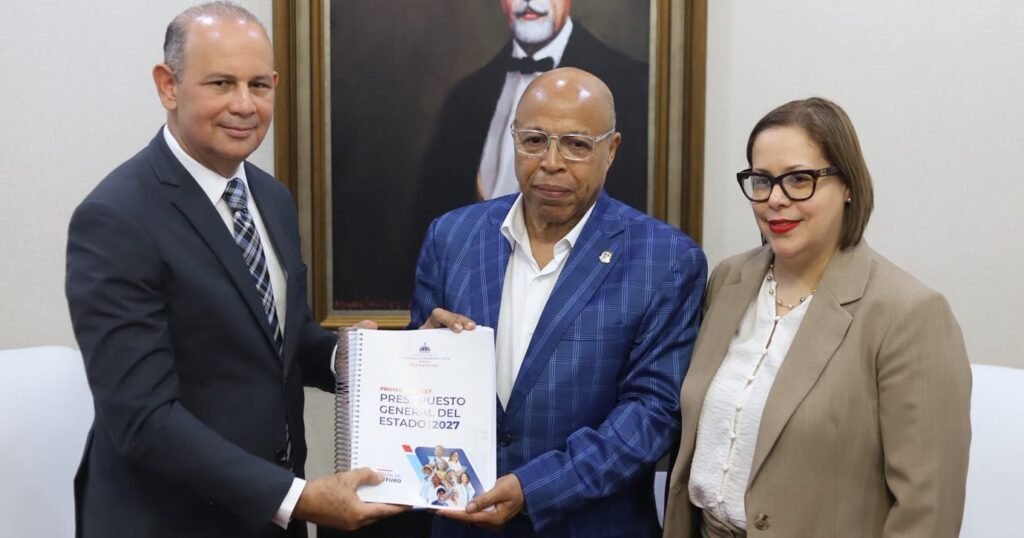
The Dominican Republic’s proposed 2027 budget puts public investment at the center of the government’s economic strategy, with capital spending in the central government set at RD$257.8 billion, up 19.7% from the initial 2026 budget. The proposal was submitted to Congress on September 23 by the Executive Branch through the Ministry of Finance and Economy and the Directorate General of Budget (Digepres).
The budget framework is based on projected real GDP growth of 4.75% and average inflation of 4.5% in 2027. On a consolidated basis, it includes RD$2.084 trillion in expenditures, RD$1.620 trillion in revenue and a spending ceiling of RD$1.945 trillion.
The figures make infrastructure and other capital projects a larger component of the government’s spending plans than current expenditure, which is projected to rise 12.3%. The Ministry of Finance and Economy said the approach is intended to preserve resources for infrastructure, public services and productive capacity.
Investment Projects Account for a Major Share of Capital Spending
Of the central government’s capital budget, RD$111.6 billion is assigned to 1,306 public investment projects carrying SNIP codes. The projects cover transportation, roads, electricity, water and sanitation, healthcare, education, agricultural production, climate resilience and digital transformation.
Transportation is allocated RD$113.4 billion. Among the projects highlighted in the proposal are RD$6.4 billion for the Santiago de los Caballeros Monorail, RD$1.5 billion for the expansion of Santo Domingo Metro Line 2 and RD$1.6 billion for climate-resilient road infrastructure.
Electricity and water infrastructure also receive substantial allocations. The proposal includes RD$3.45 billion for medium- and low-voltage network improvements, RD$2.64 billion for reducing technical losses and RD$1.88 billion for the Montegrande Dam. Housing and community services receive RD$38.3 billion, with most of that amount directed toward drinking water supply.
Education, Health and Social Protection Remain Central
Social spending represents the largest broad area of the proposal. Education is allocated RD$364.4 billion at the functional level, while health receives RD$198.7 billion and social protection, including pensions, assistance and social housing, is allocated RD$317.3 billion.
Within the central government budget, the Ministry of Education would receive RD$365.6 billion, 10.1% more than in the approved 2026 budget. Together with the Ministry of Higher Education, Science and Technology, education-related allocations reach RD$391.3 billion.
The proposal also includes RD$30.8 billion for school meals serving approximately 1.96 million students and RD$4.1 billion for student support services aimed at about 1.85 million vulnerable students. The Ministry of Public Health and Social Assistance is assigned RD$198.7 billion, a 10% increase.
Fiscal Deficit and Debt Strategy
For the central government, the proposal estimates revenue of RD$1.511 trillion against expenditures of RD$1.838 trillion. The projected primary balance remains positive at RD$24.0 billion, equivalent to 0.3% of GDP, while the overall fiscal balance shows a deficit of RD$327.3 billion, or 3.4% of GDP.
The government plans to finance the deficit through domestic and global bond issuances as well as resources from multilateral and bilateral institutions. The financing strategy is framed within the country’s Medium-Term Debt Strategy for 2024-2028.
The budget also links spending to the National Development Strategy, the National Multiannual Public Sector Plan and Meta RD 2036. The government says more than RD$500.6 billion in the 2027 budget is linked to the National Development Strategy, with 65.6% of that amount associated with social development.
Congress Must Review the Proposal Before 2027
The proposal follows a national consultation process in which 32 Development Council sessions identified 503 citizen demands for consideration in the budget formulation. The government says those priorities were incorporated into a framework focused on human capital, physical capital, productivity and institutional strengthening.
The submission now moves the proposal into the legislative phase. Congress must debate and approve the 2027 General State Budget before the end of 2026 for it to take effect on January 1, 2027. The budget’s final allocations may therefore change during congressional consideration.
For businesses and investors, the proposed increase in capital expenditure provides a clear indication of where the government expects public resources to support economic activity in 2027, particularly transportation, infrastructure, energy, water and other productive sectors. The proposal also maintains social spending and a positive primary balance within a fiscal framework centered on containing the growth of public debt relative to GDP.