 22°C
22°C

Largest Companies in the Dominican Republic Shape the Economy
The largest companies in the Dominican Republic are concentrated across banking, energy, telecommunications, retail, tourism, manufacturing and agroindustry, but no single ranking captures their economic weight accurately. Banks are measured primarily by assets and credit, utilities by generation capacity and infrastructure, retailers by sales and employment, and exporters by foreign-exchange earnings and international reach. A useful picture therefore requires looking at several objective measures together, rather than treating companies from completely different sectors as if they were directly comparable.


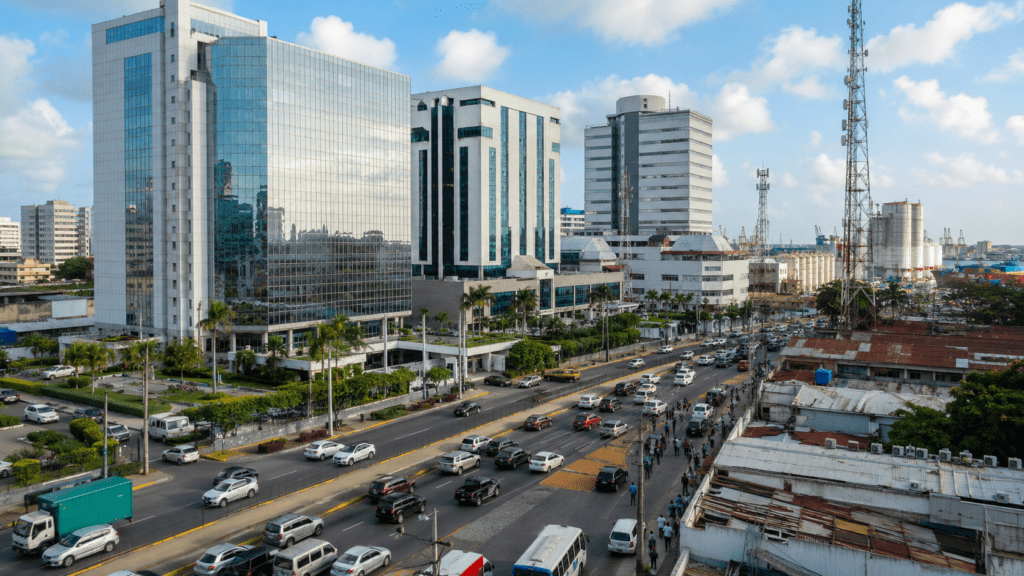
The Dominican Republic has one of the Caribbean’s most diversified private sectors, with large companies operating alongside multinational corporations, state-owned enterprises and family-controlled business groups. Their importance extends well beyond corporate balance sheets: major firms finance households and businesses, generate electricity, connect consumers to telecommunications networks, supply supermarkets and manufacturers, support tourism infrastructure, create employment and contribute significant tax revenue.
There is no comprehensive public database that ranks every company operating in the country by a single comparable measure such as annual revenue. That limitation matters. A bank with more than RD$1 trillion in assets cannot be compared directly with a retailer on the basis of assets, while a power company may have enormous infrastructure and generation capacity without having the same revenue profile as a financial institution. The most meaningful approach is therefore to identify companies with exceptionally large or strategically important footprints using the measures publicly available.
How to Measure the Largest Companies in the Dominican Republic
The companies discussed here are selected using several objective indicators rather than a single numerical ranking. These include total assets, revenue, lending, market presence, installed capacity, employment, investment, tax contributions, exports and strategic importance to the national economy.
This approach also explains why some companies appear prominently even when their exact Dominican revenue is not publicly disclosed. A company may be economically significant because it controls essential infrastructure, employs thousands of people, operates a major tourism ecosystem or represents a substantial share of national production or exports.
| Company or Group | Sector | Key measurable indicator | Why it matters |
|---|---|---|---|
| Banreservas | Banking | More than RD$1.28 trillion in assets at the end of 2025 | Largest financial institution and major source of credit |
| Grupo Popular | Financial services | RD$1.119 trillion in consolidated assets in 2025 | Largest private financial group by consolidated assets |
| AES Dominicana | Energy | 937 MW in operation and US$1.7 billion in assets in Q1 2025 | Major electricity generator and LNG infrastructure operator |
| EGE Haina | Energy | 1,319.6 MW installed capacity and more than US$1.7 billion in assets | One of the country’s largest power-generation platforms |
| Claro Dominicana | Telecommunications | More than RD$25 billion in fiscal contributions in 2024 | Major national connectivity and digital infrastructure provider |
| Grupo Ramos | Retail | More than 8,000 employees and 78 establishments reported in 2024 | Large private employer and leading retail operator |
| Central Romana Corporation | Agroindustry, tourism and real estate | Large diversified operating footprint in La Romana | Combines sugar, manufacturing, tourism, real estate and logistics |
| Cervecería Nacional Dominicana | Manufacturing and beverages | Recognized by ProDominicana among major industrial investors/exporters | Major consumer-goods manufacturer and exporter |
| CEMEX Dominicana | Construction materials | Major cement manufacturing operation | Supplies a strategic input for construction and infrastructure |
| BHD | Banking and financial services | Large banking and financial-services platform with multiple subsidiaries | One of the country’s principal private financial institutions |
Banreservas: The Country’s Largest Banking Institution
Banco de Reservas de la República Dominicana, commonly known as Banreservas, is the clearest example of a company whose economic importance is best measured by balance-sheet size and financing capacity rather than conventional sales.
At the end of 2025, Banreservas reported assets of more than RD$1.28 trillion. Its gross loan portfolio reached approximately RD$628.1 billion, while the bank said it held 36.7% of the assets of the multiple-banking system based on information available in late 2025. It also reported that 95% of its loan portfolio was directed to the private sector.
The bank’s economic role is particularly broad because it finances businesses, households, construction, industry, small and medium-sized enterprises and tourism. Banreservas reported more than RD$61 billion in tourism financing at the end of 2025 and said it accounted for 45% of tourism-sector lending based on Superintendency of Banks data cited by the institution.
Its position is also unusual because Banreservas is a public financial institution. Its scale means that it is not simply one of the country’s biggest companies; it is an important channel through which financing reaches major productive sectors of the Dominican economy.
Grupo Popular: The Largest Private Financial Group
Grupo Popular is the most prominent privately controlled financial group in the Dominican Republic by consolidated assets. Its principal banking subsidiary is Banco Popular Dominicano, while the wider group includes businesses in areas such as pensions, investment management, fiduciary services and digital banking.
For 2025, Grupo Popular reported RD$1.119 trillion in consolidated assets, up 11.7% from the previous year. Its net loan portfolio reached RD$656.8 billion and deposits totaled RD$777.5 billion. The group reported net consolidated profit of RD$34.8 billion after income tax.
Banco Popular Dominicano alone reported assets of RD$929.7 billion at the end of 2025, with a net loan portfolio of RD$579.1 billion and deposits of RD$702.9 billion.
The significance of Grupo Popular therefore extends beyond its size as a corporate group. Through lending, deposits, payments, investment products and pension-related services, its subsidiaries form part of the financial infrastructure through which households and businesses participate in the economy.
BHD: A Major Private Banking and Financial Platform
BHD is another major private financial group and an important counterpart to Banreservas and Grupo Popular. Its operations extend beyond commercial banking into insurance, payment infrastructure, fiduciary services and other financial activities.
The group’s 2025 financial statements show the breadth of that platform. Among its associated companies were Mapfre BHD Seguros, Mapfre Salud and CardNet, with the latter reporting RD$7.4 billion in assets and RD$6.7 billion in revenue in 2025. The financial statements also show the scale of the wider ecosystem around BHD rather than treating the bank as an isolated business.
BHD is consequently important not only because of the size of its banking operation, but because private financial groups such as BHD provide credit, insurance, payment services and investment infrastructure that support companies and consumers across the economy.
AES Dominicana: A Strategic Power and Natural Gas Company
Energy companies occupy a special position in any assessment of corporate importance because electricity generation and fuel infrastructure underpin virtually every other productive sector.
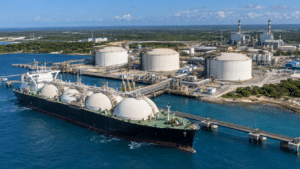
AES Dominicana is one of the country’s most important electricity-generation platforms. Its first major Dominican investment came in the 1990s, followed by the development of the AES Andrés complex, which includes a 319 MW combined-cycle plant, a liquefied natural gas terminal and associated pipeline infrastructure.
AES’s Q1 2025 investor presentation reported 937 MW in operation, five generation assets and total assets of approximately US$1.7 billion. The company also identified its LNG terminal as the country’s only facility of its kind and reported a 16% share of installed generation capacity.
The scale is also visible in revenue. AES España B.V., AES Andrés and Dominican Power Partners reported combined revenue of approximately US$1.005 billion for the first nine months of 2025.
These figures illustrate why energy companies should be considered among the largest economic actors even when their business model differs substantially from banking or retail. Their assets are tied to infrastructure that affects the reliability, cost and diversification of the national electricity system.
EGE Haina: One of the Dominican Republic’s Largest Power Producers
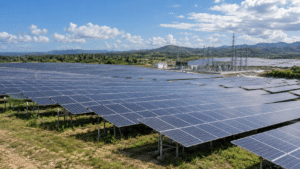
Empresa Generadora de Electricidad Haina (EGE Haina) is another major force in the electricity sector. The company operates a diversified portfolio of thermal, natural-gas, wind and solar facilities and has become increasingly important to the country’s transition toward renewable generation.
EGE Haina reports more than US$1.7 billion in assets and an installed capacity of 1,319.6 MW across 15 generating facilities. In 2025, it generated 3,689.9 GWh of net electricity, equivalent to 12.6% of demand on the National Interconnected Electric System and 25% of the electricity used by unregulated users.
The company also reported EBITDA of US$158 million in 2025. Its renewable portfolio reached 516 MW, while 70% of its 2025 generation came from renewable sources and natural gas.
EGE Haina is therefore important for two different reasons: its current contribution to electricity supply and its growing role in renewable-energy investment. Its economic footprint reaches beyond its own revenue because electricity availability is an input into manufacturing, tourism, commerce and households.
Claro Dominicana: Telecommunications Infrastructure at National Scale
Claro Dominicana is one of the country’s most economically significant telecommunications companies. Its importance is difficult to measure through a conventional local revenue ranking because the Dominican operation is part of the broader América Móvil group, but several indicators demonstrate the scale of its local footprint.
Claro reported that it contributed more than RD$25 billion in fiscal revenues in 2024. It also said it had invested more than US$4.5 billion in infrastructure in the Dominican Republic over the previous 15 years, demonstrating the capital intensity of the telecommunications business.
The company describes itself as the country’s leading telecommunications operator and has continued expanding fiber-optic infrastructure. In 2025, it introduced XGS-PON fiber technology in the Dominican Republic, with a theoretical capacity of up to 10,000 Mbps for both downloads and uploads.
Its economic relevance goes beyond subscriber numbers. Telecommunications networks are now basic infrastructure for banking, tourism, logistics, remote work, e-commerce, government services and business operations. That makes large telecom operators strategic infrastructure providers as much as consumer-service companies.
Grupo Ramos: Retail, Employment and Domestic Consumption
Grupo Ramos represents a different type of corporate scale. Instead of being defined mainly by assets or infrastructure, its importance is visible through employment, store coverage, consumer traffic and its position in domestic retail.
The company describes itself as the leader in Dominican retail sales and reported more than 8,000 employees and 78 commercial establishments in a 2024 corporate publication. Its stores operate under brands including Sirena, Sirena Market, Aprezio and Multiplaza, and the company reported more than 60 million visits annually.
Retailers have an important economic function because they sit at the intersection of consumers, domestic producers, importers, logistics companies and food manufacturers. A large supermarket and department-store network therefore generates economic activity far beyond its own payroll.
Grupo Ramos also illustrates why employment can be a useful criterion when assessing large private companies in the Dominican Republic. A business with thousands of direct employees and a nationwide distribution network can have a significant economic footprint even when its detailed financial statements are not publicly available.
Central Romana Corporation: A Diversified Economic Ecosystem
Central Romana Corporation is one of the country’s most distinctive large business groups because its footprint combines agriculture, manufacturing, tourism, real estate, logistics and services rather than focusing on a single industry.
ProDominicana identifies Central Romana as a major company operating in La Romana across agriculture, manufacturing, tourism, real estate and services. Its businesses include Costasur, Casa de Campo Resort & Villas, La Marina de Casa de Campo, La Romana International Airport, the Port of La Romana, a cruise terminal, Productos Higüeral and Azúcar Papagayo, among others.
This concentration makes Central Romana particularly important to the economy of La Romana and the eastern tourism corridor. Its activities connect agricultural production with manufacturing and tourism infrastructure, creating a business ecosystem rather than a single standalone company.
The group is also an example of why a simple nationwide ranking can obscure regional economic power. A company may not publish a consolidated figure that can be directly compared with a bank’s assets, yet its influence over employment, infrastructure, exports, tourism and local supply chains can be substantial.
Cervecería Nacional Dominicana: Manufacturing and Exports
Cervecería Nacional Dominicana is a major industrial company and one of the best-known large consumer-goods manufacturers in the country. Its significance is tied to domestic production, distribution, employment, supply chains and exports.
ProDominicana has identified Cervecería Nacional Dominicana among important companies in the country’s industrial and export sectors. The agency’s sectoral material lists the company among major exporters and places it within the agroindustrial and industrial structure that links Dominican manufacturing to international markets.
The company matters economically because beverage manufacturing creates demand for packaging, logistics, agriculture, advertising, distribution and retail services. Its role therefore extends beyond the value of the products leaving its factories.
CEMEX Dominicana: A Major Supplier to Construction
CEMEX Dominicana is part of the international CEMEX group and operates in one of the most important industrial segments for the Dominican economy: cement and construction materials.
Cement production is strategically significant because it supplies housing, commercial buildings, roads, ports, hotels and other infrastructure. CEMEX’s corporate reporting identifies CEMEX Dominicana as a controlled operating company in the Dominican Republic.
The company is therefore best understood as a major industrial infrastructure supplier rather than simply another consumer-facing corporation. Its economic footprint is closely linked to construction activity, one of the sectors that connects private investment, public infrastructure and tourism development.
Why Banking Companies Dominate the Largest-Company Lists
One striking feature of any list of the Dominican Republic’s largest companies is the prominence of banks. That is not necessarily because banks generate more conventional sales than manufacturers or retailers. It is because banking balance sheets contain large volumes of deposits, loans, investments and other financial assets.
The scale of the national financial system helps explain this effect. The Dominican Republic’s financial system reached approximately RD$4.19 trillion in total assets by November 2025, according to information cited by Banreservas from the Banco Central. The loan portfolio exceeded RD$2.30 trillion, while public deposits reached approximately RD$2.27 trillion in local currency.
For that reason, asset-based rankings naturally place Banreservas and Grupo Popular near the top. It would be misleading, however, to conclude that a bank with RD$1 trillion in assets is economically “larger” in every sense than an energy company with billions of dollars invested in generation infrastructure or a retailer employing thousands of people.
Why Energy and Telecommunications Companies Are Economically Different
Energy and telecommunications companies demonstrate another problem with conventional rankings: infrastructure creates value that is not captured by revenue alone.
A power generator can own hundreds of megawatts of capacity and supply a significant share of national electricity demand. A telecommunications operator can invest billions of dollars in fiber, mobile networks and other infrastructure used by millions of people. These assets enable other companies to operate, making their indirect economic importance larger than a simple corporate-sales comparison suggests.
This is particularly relevant in the Dominican Republic because tourism, manufacturing, logistics, retail and financial services all depend on reliable electricity and communications. The country’s large energy and telecom companies therefore function as part of the economic infrastructure supporting other large businesses.
Foreign-Owned Companies Also Belong on the List
The phrase “largest companies in the Dominican Republic” should not be confused with “largest Dominican-owned companies.” The country attracts substantial foreign direct investment, and many of the largest businesses operating locally are subsidiaries or affiliates of international groups.
ProDominicana reported a record US$5.03 billion in foreign direct investment in 2025 and more than US$60 billion in accumulated FDI stock. The agency also reported merchandise exports of US$15.93 billion in 2025, highlighting the scale of the country’s integration with international capital and trade.

That means companies such as AES Dominicana, Claro Dominicana and CEMEX Dominicana should be considered part of the country’s corporate landscape even though their ultimate parent companies are headquartered abroad. Their local investments, employment, infrastructure and tax contributions have direct economic consequences inside the Dominican Republic.
What Makes a Company Economically Important in the Dominican Republic?
Corporate size is only one part of the picture. The companies with the greatest economic significance tend to combine several characteristics:
- Large balance sheets: particularly relevant for banks and financial groups that provide credit and manage deposits.
- High capital investment: important in energy, telecommunications, construction materials and tourism.
- Employment: a useful measure for retailers, manufacturers and diversified business groups.
- Exports: especially important for companies generating foreign-exchange earnings through agriculture, manufacturing, beverages, tobacco and free-zone production.
- Tax contribution: a direct indicator of the fiscal importance of large businesses.
- Infrastructure: companies operating electricity networks, telecommunications systems, ports, airports or other strategic assets can have an impact far beyond their direct sales.
- Supply-chain effects: large companies create demand for thousands of smaller suppliers, contractors, distributors and professional-service firms.
Using several measures gives a more realistic picture than a single ranking. It also makes it possible to compare companies within their economic context without pretending that a bank, supermarket chain, electricity generator and cement producer have identical business models.
Are These the Only Large Companies in the Dominican Republic?
No. The Dominican corporate sector is much broader than the companies highlighted here. Other important businesses operate in mining, free-zone manufacturing, tourism, aviation, food processing, pharmaceuticals, insurance, logistics, construction, petroleum products and consumer goods.
ProDominicana’s investment and export materials, for example, identify companies such as Gildan, Brugal, Ron Barceló, Gerda u Metaldom, Fenwal and Aeropuertos Dominicanos Siglo XXI among significant participants in different export, manufacturing, logistics and investment categories.
The absence of a company from the main group above should therefore not be interpreted as evidence that it is small. In many cases, the difficulty is simply that reliable, current and directly comparable financial information is not publicly disclosed for privately held companies.
The Bigger Picture: Large Companies Reflect the Structure of the Economy
The country’s biggest companies provide a useful map of the Dominican economy itself. Banking reflects the expansion of credit and financial inclusion. Energy reflects the need for reliable generation and diversification of the electricity mix. Telecommunications reflects the growing importance of digital infrastructure. Retail reflects domestic consumption and nationwide distribution. Tourism-related businesses show the importance of foreign visitors and real estate investment, while agroindustry and manufacturing connect domestic production with exports.
This diversification is one reason the Dominican economy cannot be understood through one or two corporate sectors. Large companies operate across interconnected value chains, and their economic importance often comes from the relationships they maintain with thousands of smaller businesses.
For readers, investors and researchers trying to understand the Dominican business environment, the most useful question is therefore not simply “Which company is number one?” A better question is: which companies control the assets, infrastructure, employment, financing, production and trade flows that matter most to the country?