 23°C
23°C

Dominican Republic Economic Outlook: Growth, Investment And Risks
The Dominican Republic enters the second half of 2026 with economic activity recovering faster than it did in 2025, although inflation and external energy shocks have complicated the near-term picture. The economy grew 4.5% in the first half of 2026 according to the Central Bank's activity indicator, while tourism, foreign investment, exports, remittances, construction and financial services have provided important support. The baseline outlook remains favorable: the World Bank projects growth of 3.6% in 2026 and 4.4% in 2027, while the Dominican authorities see 2026 growth toward the upper end of a 4.0%-4.5% range.


The Dominican Republic’s economic outlook for the coming years is broadly positive, but it is no longer a story of growth insulated from external shocks. The economy slowed sharply in 2025, when real GDP growth was 2.1%, but activity accelerated during the first half of 2026. The central question for the next several years is therefore whether the country can convert that rebound into sustained growth while keeping inflation under control and managing exposure to oil prices, global financial conditions, trade policy and weaker demand in major external markets.
The Current Economic Picture
The latest available data point to a meaningful recovery. The Dominican Republic’s monthly economic activity indicator, known as the IMAE, increased 6.4% year over year in June 2026. Growth averaged 5.0% during the April-June quarter and 4.5% during the first half of the year. Construction, mining, free-zone manufacturing, financial services and tourism-related activities were among the main contributors to the acceleration.
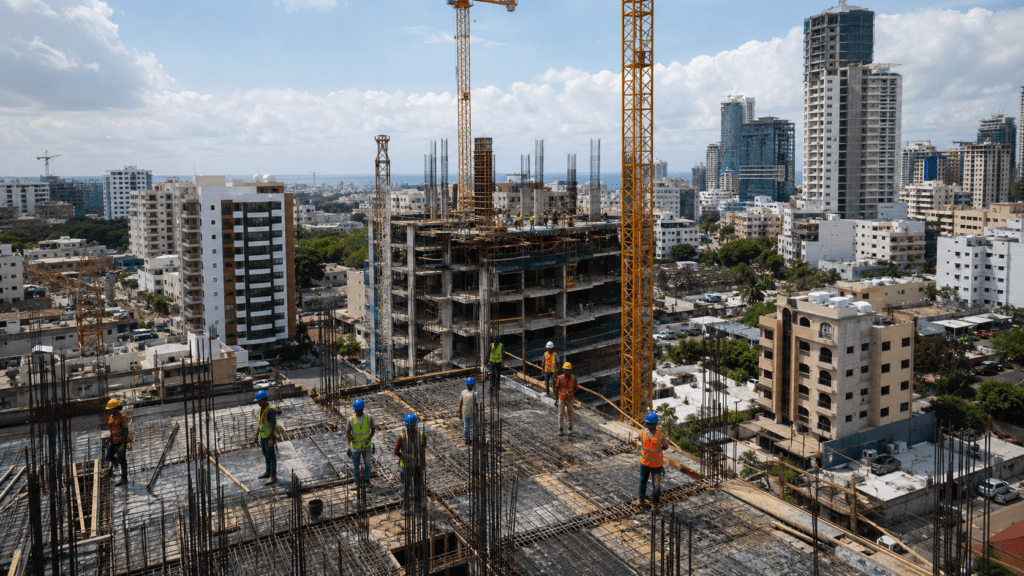
Construction was particularly important. Its real value added increased 14.9% in June, with the Central Bank attributing the performance to stronger private investment, greater public capital spending and improved access to financing. Credit to construction was 22.6% higher than a year earlier at the end of June. Mining also expanded rapidly, while financial intermediation benefited from stronger private-sector credit.
| Indicator | Latest available position | What it indicates |
|---|---|---|
| Real GDP growth, 2025 | 2.1% | A significant slowdown from 2024 |
| IMAE growth, June 2026 | 6.4% year over year | Strong acceleration in economic activity |
| IMAE growth, January-June 2026 | 4.5% | Recovery during the first half of 2026 |
| Inflation, June 2026 | 5.67% year over year | Above the Central Bank’s target range |
| Core inflation, June 2026 | 4.96% | Within the target range |
| Policy interest rate, July 2026 | 5.25% | Monetary policy remains relatively restrictive |
These figures should not be interpreted as a guarantee that the economy will continue growing at the June pace. Monthly indicators can be volatile, and part of the current improvement represents a recovery from the weaker conditions of 2025. The more important signal is that the recovery has broadened across investment, services, manufacturing and external sectors.
Growth Forecasts For 2026 And Beyond
Forecasts vary depending on the institution and the timing of the estimate. The World Bank projects real GDP growth of 3.6% in 2026 and 4.4% in 2027, with medium-term growth supported by private investment, construction, consumption, remittances, tourism, gold exports and foreign direct investment. The International Monetary Fund’s November 2025 baseline was more optimistic, projecting 4.5% growth in 2026 followed by a return toward a long-term rate of about 5%.
The Dominican Central Bank’s more recent assessment is also constructive. After the stronger first half of 2026, it said growth could reach the upper end of its 4.0%-4.5% range for the year. This makes the current official picture more favorable than some earlier forecasts, although the differences between institutions demonstrate why forecasts should be treated as scenarios rather than fixed outcomes.
| Period | Forecast or assessment | Status |
|---|---|---|
| 2025 | 2.1% real GDP growth | Actual |
| 2026 | 4.0%-4.5% range, with growth expected near the upper end | Current Central Bank assessment |
| 2026 | 3.6% growth | World Bank forecast |
| 2026 | 4.5% growth | IMF forecast published in late 2025 |
| 2027 | 4.4% growth | World Bank forecast |
| Medium term | Around 5% in the IMF baseline | Longer-term forecast |
The most reasonable interpretation is that the Dominican Republic is likely to return to relatively strong growth, but the pace will depend on investment, external demand, financial conditions and the ability of domestic policies to maintain macroeconomic stability. A return to the country’s previous trend growth is plausible, but it should not be treated as automatic.
Inflation And Interest Rates
Inflation is the main domestic variable complicating the near-term outlook. Consumer prices increased 5.67% year over year in June 2026, above the Dominican Central Bank’s 4% target with a tolerance band of plus or minus 1 percentage point. Core inflation, however, was 4.96%, remaining within the target range. This distinction matters because headline inflation has been strongly affected by energy and other volatile components.
Higher fuel prices have been an important source of pressure. The Central Bank linked the recent increase in inflation to higher international oil prices and geopolitical tensions in the Middle East. Its forecasts indicate that headline inflation could remain above the target range for part of the year before returning toward the target during the second half of 2026.
The Central Bank kept its policy rate at 5.25% in July 2026. That stance gives policymakers room to respond if inflation becomes persistent, while also allowing the recovery in credit and economic activity to continue. Private-sector credit in both local and foreign currency was growing by about 9.1% year over year in June, suggesting that financial conditions were already supporting domestic demand.
For the medium term, the baseline assumption is that inflation will remain close to the 4% midpoint of the Central Bank’s target. The main threat to that scenario is not necessarily excessive domestic demand but a renewed external cost shock, particularly involving oil, food, freight or exchange-rate pressures.
Investment And Construction
Investment is one of the strongest reasons for a positive medium-term outlook. Foreign direct investment reached approximately US$3.28 billion during the first half of 2026, up 7.7% from the same period a year earlier. About two-thirds of the inflow consisted of new capital contributions, while energy and tourism remained the two largest destination sectors. Real estate development and mining were also significant recipients.
The Central Bank expects foreign direct investment to exceed US$5.3 billion for the full year. That would reinforce a long-standing feature of the Dominican economy: external investment not only finances productive capacity but also helps support foreign-exchange availability and the balance of payments.
Domestic investment is also recovering. The strong expansion in construction during 2026 points to activity in housing, tourism-related developments, infrastructure and other projects. Continued construction growth could have broad spillovers because the sector purchases materials and services from domestic suppliers and generates employment.
The main issue is whether the investment cycle remains productive and diversified. Strong construction numbers can support growth in the short run, but the medium-term payoff will depend on whether capital spending expands productive capacity, improves infrastructure and increases the economy’s ability to generate higher-value exports.
Tourism Remains A Core Growth Engine
Tourism is likely to remain one of the Dominican Republic’s most important sources of growth and foreign exchange. During the first half of 2026, international visitor arrivals exceeded 6.5 million, while tourism revenue reached approximately US$6.72 billion, 15.3% above the same period in 2025.
In June alone, 816,512 tourists arrived, an increase of 6.0% from June 2025. The hotels, bars and restaurants sector grew 4.6% year over year in that month. The combination of rising arrivals and higher tourism receipts provides support not only to hotels but also to transportation, retail, food services, construction, real estate and other local businesses.
The outlook therefore remains favorable, but tourism is not risk-free. The sector is highly exposed to economic conditions in major source markets, airline capacity, fuel costs, international security perceptions and changes in household travel budgets. A slowdown in the United States or other major tourist markets would likely be transmitted to the Dominican economy through visitor numbers and tourism spending.
Consumption And Household Demand
Private consumption should remain an important source of domestic demand. The World Bank expects resilient private consumption, supported in part by strong remittance inflows. This is particularly relevant because remittances provide household income that is not directly tied to domestic employment conditions.
Credit conditions are another supporting factor. Earlier monetary easing had already reduced lending rates across several categories, including consumer and mortgage loans. By June 2026, total private-sector credit was growing by 9.1% year over year. If inflation moderates and financial conditions remain stable, household borrowing and spending could continue to support economic activity.
There is, however, a limit to how far consumption can drive long-term growth. Household spending supports businesses and employment, but sustainable improvements in living standards ultimately require productivity gains, better jobs, investment and higher-value economic activity. The strongest outlook is therefore one in which consumption grows alongside investment and exports rather than replacing them.
Employment And The Labor Market
The labor market has continued to expand alongside the economic recovery. Preliminary Central Bank data for January-March 2026 show 5.24 million people employed, including formal and informal workers, an increase of 118,631 workers, or 2.3%, from the same quarter of 2025.
Employment gains have been particularly visible in sectors connected with services and domestic demand. Hotels, bars and restaurants recorded a 7.1% increase in employment in the first-quarter comparison, while commerce increased 2.2%. Financial intermediation and related activities rose 7.7%, and education increased 5.8%.
The composition of employment remains important. The Dominican labor market contains a large informal component, meaning that headline employment growth does not necessarily translate into equivalent gains in job quality, productivity or household security. Over the longer term, one of the economy’s central challenges will be to turn strong activity in tourism, manufacturing, services and investment into more productive and better-paid employment.
Trade, Exports And Foreign Exchange
The external sector provides another important pillar for the outlook. Total exports reached US$8.75 billion during the first six months of 2026, up 16.6% from the same period of 2025. Gold exports were particularly strong, rising 68.8% to approximately US$1.59 billion, helped by higher production and favorable international prices.
Free-zone exports reached US$4.36 billion, an increase of 3.2%. The sector is strategically important because it links the Dominican Republic to international manufacturing supply chains and provides an opportunity to benefit from shifts in global production.
The country also entered the second half of 2026 with substantial foreign-exchange buffers. International reserves were around US$15.8 billion, equivalent to roughly 11% of GDP and about six months of imports according to the Central Bank. Strong tourism receipts, remittances, exports and foreign investment have helped support exchange-rate stability.
This external position reduces the probability that a temporary external shock will immediately become a balance-of-payments crisis. It does not eliminate the country’s exposure to international conditions, however. The Dominican Republic remains an importer of energy and many manufactured goods, so higher global commodity prices can simultaneously increase inflation and the cost of imports.
The International Environment
The global backdrop is less predictable than the domestic recovery might suggest. The IMF’s July 2026 outlook projects global growth of 3.0% in 2026 and 3.4% in 2027. At the same time, it raised its global headline inflation forecast for 2026 to 4.7%, noting that the disinflation process had stalled.
For the Dominican Republic, the most important external variables are likely to be the United States economy, energy prices, global interest rates, international trade policy and tourism demand. The United States is particularly important because of its role in tourism, remittances, trade and investment flows.
Changes in global trade policy could have mixed effects. Greater trade fragmentation can reduce global commerce and increase uncertainty, but it can also encourage companies to relocate supply chains closer to the United States. The Dominican Republic could benefit from such trade diversion if it can attract investment into manufacturing and logistics while maintaining competitive infrastructure and regulatory conditions.
Oil represents a more direct vulnerability. The country is a significant energy importer, so a prolonged increase in crude prices would raise transportation and production costs, put upward pressure on inflation and potentially weaken household purchasing power. Conversely, a normalization of energy prices would remove one of the principal current sources of inflationary pressure.
Key Risks To The Economic Outlook
The baseline scenario is positive, but several risks could produce a materially weaker outcome.
- Higher oil prices: A prolonged energy shock could push inflation higher, reduce real household income and increase production costs.
- Weaker U.S. growth: A slowdown in the United States could reduce tourism, remittances, exports and investment.
- Tighter global financial conditions: Higher international interest rates could raise financing costs and reduce capital flows into emerging markets.
- Trade fragmentation: New tariffs or supply-chain disruptions could hurt exporters, although some trade diversion could benefit the Dominican Republic.
- Natural disasters: Hurricanes, floods and other climate-related events can disrupt infrastructure, agriculture, tourism and public finances.
- Domestic reform delays: Slower progress on fiscal, energy and structural reforms could limit productivity gains and reduce the economy’s medium-term growth potential.
- Persistent inflation: If external price shocks become embedded in domestic expectations, monetary policy could need to remain tighter for longer.
These risks are not equally likely or equally damaging. The most important distinction is between temporary shocks and persistent structural problems. A short-lived oil-price increase can be absorbed more easily when reserves are strong and inflation expectations remain anchored. A prolonged deterioration in global conditions, by contrast, could affect investment, tourism, consumption and employment simultaneously.
What Could Drive Stronger Growth?
There are also meaningful upside factors. Continued investment in tourism, energy, infrastructure and manufacturing could raise productive capacity. The expansion of free zones and nearshoring-related manufacturing could diversify exports. Strong tourism performance could continue generating foreign exchange and encouraging investment in hotels, transportation and real estate.
Policy implementation will matter as much as the headline growth rate. Fiscal discipline, improvements in the electricity sector, efficient public investment and a stable monetary framework can strengthen confidence while creating room for productive investment. The IMF has identified fiscal and structural reforms, particularly in electricity, as important to improving medium-term resilience.
There is also an opportunity to improve the quality of growth. The Dominican Republic has already achieved substantial expansion over the past two decades, but the next stage depends increasingly on productivity, human capital, infrastructure, formal employment and diversification rather than simply adding more activity in established sectors.
Base Case For The Next Several Years
The most defensible base case is for the Dominican economy to return toward a growth rate in the 4%-5% range after the weak performance of 2025, provided that external conditions do not deteriorate sharply. The World Bank’s 2026 and 2027 forecasts fit within that broad trajectory, while the IMF’s longer-term baseline points toward approximately 5% growth.
Inflation is likely to be more volatile than growth. The current headline rate is above the Central Bank’s target range because of external price pressures, but core inflation remains within the range and expectations have remained relatively anchored. A return toward the 4% target would create more room for monetary policy to support investment and consumption.
Tourism, foreign investment, exports, remittances and construction should remain central to the expansion. The principal challenge will be to broaden the benefits of those sectors by increasing productivity and formal employment while reducing vulnerabilities associated with energy imports, external demand and climate-related shocks.