 25°C
25°C

Risks of Investing in the Dominican Republic: Key Factors
Investing in the Dominican Republic offers access to a growing economy, tourism, manufacturing, logistics and other expanding sectors, but foreign investors also face risks that should be assessed before committing capital. The most relevant include exposure to global economic conditions, exchange-rate movements, regulatory and administrative uncertainty, property and project risks, infrastructure constraints, natural disasters and vulnerabilities specific to individual industries. The country has strong macroeconomic fundamentals and a resilient financial system, but the risk profile varies substantially depending on the sector, location, financing structure and investment horizon.


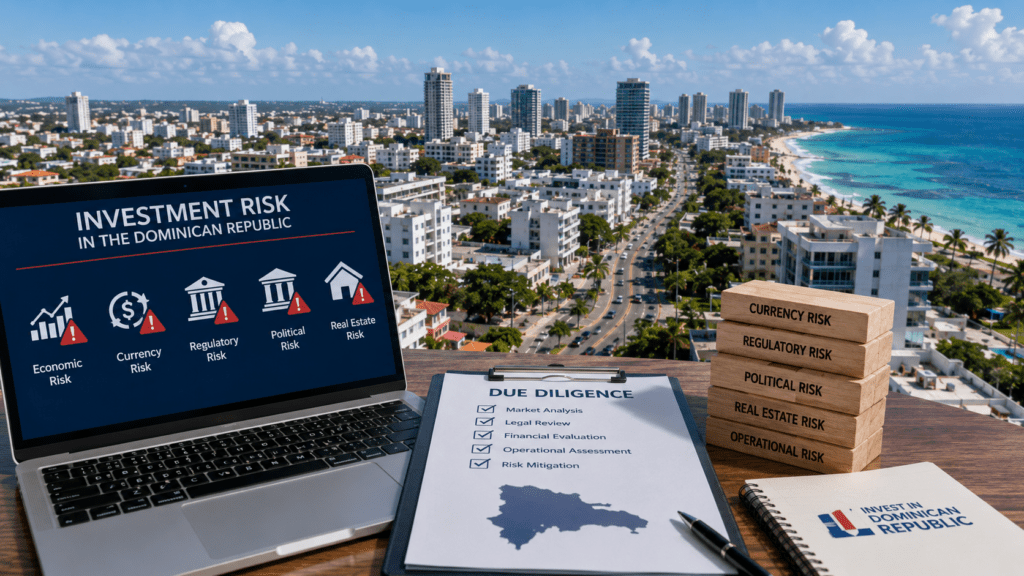
The Dominican Republic has maintained strong economic growth and attracted substantial foreign direct investment, but those strengths do not eliminate investment risk. The International Monetary Fund (IMF) describes the country’s fundamentals as strong while identifying global financial conditions, uncertainty, natural disasters and delays in structural reforms among the principal downside risks. Foreign investors have also reported regulatory, administrative and judicial challenges that can increase the time, cost and uncertainty associated with operating a business.
Economic and Macroeconomic Risk
The Dominican economy is relatively open and closely connected to international tourism, trade, remittances, foreign investment and external financing. This creates opportunities for growth but also exposes businesses to changes in global demand. A slowdown in the United States or other major markets, higher international interest rates, weaker tourism or disruptions to global trade can affect domestic activity and investment conditions.
The IMF identified high global uncertainty and tighter financial conditions as important downside risks in its 2025 assessment. Higher global interest rates can increase financing costs, reduce investment appetite and put pressure on businesses that depend heavily on external funding. Commodity-price volatility can also affect operating costs, particularly for businesses dependent on imported energy or other inputs.
These risks do not imply that the Dominican economy is structurally unstable. The IMF considers the country’s fundamentals relatively strong and notes that its banking system remains resilient and well capitalized. The relevant issue for an investor is therefore not whether a downturn is inevitable, but how a particular investment would perform under slower growth, higher financing costs or weaker external demand.
Currency and Foreign-Exchange Risk
Investors whose capital, debt or expected returns are denominated in U.S. dollars or another foreign currency face exposure to movements in the Dominican peso. A depreciation of the peso can increase the local-currency cost of foreign-currency debt and imported inputs, while a peso appreciation can have the opposite effect.
The exchange rate operates as an important shock absorber within the Dominican Republic’s inflation-targeting framework. The IMF has noted that the Central Bank has allowed greater exchange-rate flexibility and expects the peso to remain aligned with economic fundamentals, with intervention focused on smoothing major shocks. This reduces the case for treating currency movements as a fixed or predictable variable.
Currency risk can be particularly important when the revenues of a project are generated in pesos but its financing, equipment purchases or contractual obligations are denominated in dollars. The opposite situation can arise when a business earns foreign currency but carries substantial local-currency costs.
Regulatory and Administrative Risk
One of the most important practical risks for foreign investors is not necessarily the existence of regulation but the clarity, consistency and enforcement of rules. The U.S. Department of State has reported investor concerns involving bureaucratic hurdles, unclear or non-standardized procedures, uneven enforcement, delays in government payments and administrative processes that can sometimes be slow or locally inconsistent.
These issues can increase the time required to obtain permits, resolve administrative matters or interpret regulatory requirements. They can also create additional uncertainty for projects that depend on several government agencies or municipal authorities.
The appropriate response is not to assume that regulation is unpredictable in every case. Rather, investors should identify which approvals, licenses and agencies are relevant to the specific project and assess the practical implementation of those rules before committing significant capital.
Political and Institutional Risk
The Dominican Republic has experienced considerable political and economic stability over the past two decades, and the IMF attributes part of its strong economic performance to strengthened institutions, social and political stability and business-oriented reforms. This provides an important counterweight to concerns about political risk.
Political risk nevertheless remains relevant because changes in government policy can affect taxation, subsidies, infrastructure priorities, labor rules, environmental requirements or sector-specific incentives. The risk is generally more significant for long-duration projects that depend heavily on public policy or regulated prices.
Institutional risk can also arise from differences between formal rules and their practical application. Foreign investors have reported concerns about corruption, weak enforcement of intellectual-property rights and judicial or administrative processes that can be slow. These are not necessarily risks present in every transaction, but they justify careful institutional due diligence.
Real Estate and Property Risk
Real estate is one of the Dominican Republic’s major investment sectors, particularly in tourism-oriented destinations. Property investment can nevertheless involve risks that differ from those associated with operating businesses.
The most important is title and ownership due diligence. Investors need to establish that the seller has valid ownership rights and that the property is correctly registered, while also checking liens, encumbrances, boundaries, planning conditions and other matters that could affect the asset.
Development projects introduce additional risks. Construction delays, cost overruns, infrastructure availability, zoning or permitting issues and changes in local demand can alter the expected economics of a project. These risks become more significant when an investment depends on future development rather than an already operating property.
Location also matters. Tourism-oriented real estate can be highly sensitive to visitor flows, infrastructure development and local property-market conditions. A strong national tourism market does not guarantee that every individual location or property project will perform equally well.
Operational and Infrastructure Risk
Businesses operating in the Dominican Republic can face operational risks related to electricity, transport, logistics, telecommunications, labor availability and supply chains. The country’s infrastructure has improved significantly, but the reliability and cost of individual services can vary by location and industry.
The electricity sector deserves particular attention. The IMF has identified reforms to reduce electricity-sector losses and improve the financial sustainability of the system as important for medium-term economic resilience. Investment in transmission and distribution is also considered necessary.
For businesses that require continuous power or temperature-controlled operations, electricity reliability can therefore be a direct commercial consideration rather than simply a macroeconomic issue. Investors may need to assess backup generation, energy costs, grid capacity and the reliability of local infrastructure as part of the project’s operating model.
Natural Disaster and Climate Risk
The Dominican Republic is exposed to hurricanes, tropical storms, flooding, earthquakes and other natural hazards. The IMF specifically identifies the country’s vulnerability to natural disasters as a significant economic risk because major events can damage infrastructure, interrupt economic activity and affect specific sectors.
The impact varies considerably by location and business model. Tourism facilities, coastal property, agriculture, logistics infrastructure and industrial assets can have different levels of exposure to storms, flooding or other hazards.
For long-term projects, disaster resilience should therefore be treated as part of financial analysis. Investors should consider construction standards, drainage, elevation, insurance coverage, business-continuity plans, backup infrastructure and the geographic diversification of critical assets.
Sector-Specific Risks
Risk cannot be assessed solely at the national level. A tourism project, manufacturing plant, renewable-energy facility and technology company can face very different combinations of risk.
Tourism
Tourism is exposed to international travel demand, economic conditions in source markets, airline capacity, weather events and changes in consumer preferences. A project concentrated in one destination can also be vulnerable to local infrastructure problems or an oversupply of competing accommodation.
Real Estate
Property investment is exposed to construction costs, financing conditions, local demand, title and permitting issues and changes in property values. Projects dependent on future tourism or infrastructure development carry additional execution risk.
Manufacturing and Free Zones
Export manufacturers are exposed to international trade policy, logistics costs, supply-chain disruptions and demand in destination markets. The IMF has highlighted the Dominican Republic’s exposure to changes in global trade policies, particularly because the country is integrated into international supply chains and depends heavily on external demand.
This creates both risk and opportunity. Trade diversion and nearshoring could attract additional investment, but new tariffs, trade restrictions or disruptions affecting major export markets could have the opposite effect.
Energy
Energy projects can face regulatory, financing, construction, grid-connection and resource risks. The electricity sector also has broader institutional and financial challenges, making the quality of contractual, regulatory and infrastructure due diligence particularly important.
Agriculture and Agroindustry
Agricultural investment is exposed to weather, water availability, disease, commodity prices, labor conditions and logistics. Climate-related disruptions can be especially important for businesses dependent on a specific crop or geographic area.
Technology
Technology businesses face a different risk profile, including access to specialized talent, cybersecurity, intellectual-property protection, telecommunications reliability and the ability to scale services internationally. The country’s growing digital economy can create opportunities, but technology investors should not assume that a strong consumer market automatically translates into an adequate supply of specialized technical skills.
Legal and Dispute-Resolution Risk
Foreign investors should assess how contractual disputes, commercial disagreements and regulatory conflicts would be handled before entering a major project. The U.S. Department of State has reported concerns from investors about slow judicial and administrative processes and, in some cases, perceptions of local bias.
International investment treaties can provide additional protections in qualifying circumstances. The CAFTA-DR, for example, includes investment protections covering issues such as nondiscriminatory treatment, transfer of funds, expropriation and dispute-resolution mechanisms for covered investors. The exact protection available depends on the investor, investment and applicable treaty provisions.
For substantial investments, dispute-resolution provisions should therefore be considered during the structuring stage rather than only after a disagreement occurs.
How to Evaluate Investment Risk Before Committing Capital
A good risk assessment should begin with the investment itself rather than with a generic country-risk ranking. The objective is to identify which national, sectoral and project-specific factors could materially reduce expected returns or interrupt operations.
- Assess the economic model. Test the investment under different assumptions for growth, interest rates, inflation, tourism, exports and financing costs.
- Map regulatory dependencies. Identify every major permit, license, concession, environmental approval and government interaction required by the project.
- Analyze currency exposure. Compare the currency of revenues, costs, debt and expected distributions and model plausible exchange-rate movements.
- Conduct property and corporate due diligence. Verify ownership, contracts, liabilities, licenses, permits, financial statements and other material documentation before closing a transaction.
- Evaluate infrastructure. Confirm actual electricity, water, telecommunications, transport and logistics capacity at the specific project location.
- Stress-test the business. Model adverse scenarios such as lower demand, higher costs, currency depreciation, financing-rate increases, construction delays or temporary operational disruption.
- Review insurance and resilience. Match coverage and contingency plans to the project’s exposure to natural disasters, business interruption and physical damage.
- Check counterparties. Investigate developers, suppliers, distributors, partners, contractors and other parties whose failure could materially affect the investment.
How Foreign Investors Can Mitigate These Risks
Risk mitigation should focus on reducing the probability of adverse events and limiting their financial impact when they occur. The appropriate measures depend on the project, but several principles apply broadly.
Diversification can reduce concentration risk. A business dependent on one customer, one tourism market, one supplier or one geographic location may be more vulnerable than one with several sources of demand and supply.
Currency matching can reduce foreign-exchange exposure. Where commercially feasible, aligning the currency of financing with the currency of revenues can limit the effect of exchange-rate movements on debt service.
Contractual protection is particularly important for long-term projects. Contracts should clearly define responsibilities, payment mechanisms, performance standards, termination provisions and dispute-resolution arrangements.
Local professional due diligence can also be valuable. Foreign investors should independently verify legal, tax, accounting, property, environmental and regulatory matters rather than relying solely on information supplied by a seller, developer or prospective partner.
Finally, investors should distinguish between risks that can be controlled and risks that can only be priced. A hurricane cannot be eliminated as a risk, but a project can be designed for resilience, adequately insured and financially stress-tested. Likewise, global interest rates cannot be controlled by an individual investor, but the financing structure can be designed to reduce sensitivity to them.
A Balanced View of Investment Risk in the Dominican Republic
The Dominican Republic should not be characterized either as a high-risk investment destination or as a market without significant challenges. The evidence supports a more nuanced assessment. The IMF considers the country to have strong fundamentals and policy space to respond to shocks, while identifying external uncertainty, financial conditions, natural disasters and reform delays as meaningful downside risks.
At the operational level, investors face a different set of challenges, including administrative bureaucracy, inconsistent enforcement, judicial delays and infrastructure constraints in some areas. These risks are especially important for projects that depend on multiple permits, public-sector interaction or complex local supply chains.
The result is an investment environment in which due diligence and project design matter considerably. The same country can present very different risk profiles depending on the sector, location, financing currency, regulatory exposure, business model and quality of the local counterparties.
For a foreign investor, the most useful approach is therefore not to ask whether the Dominican Republic is “safe” or “risky” in absolute terms. The better question is whether the specific risks of a proposed investment have been identified, quantified, priced and mitigated sufficiently to justify the expected return.